The Franchise Disclosure Document isn't a legal hurdle; it's your most powerful diagnostic tool for identifying a high-ROI exit from corporate burnout. Decisive action. Measurable results. These are the hallmarks of elite leadership, yet they're often missing from the due diligence process. Understanding exactly what is in a franchise disclosure document allows you to strip away the marketing gloss and see the underlying systems of a business. You've likely spent years navigating complex corporate contracts, yet the prospect of hidden fees in legacy networking organizations still feels like a calculated risk you'd rather avoid. It's exhausting to trade one time-trap for another.
This executive review promises to demystify the 2026 FDD landscape, empowering you to secure a lifestyle-friendly model that prioritizes recurring revenue and professional autonomy. You'll learn to navigate the 23 essential items, spot the red flags common in traditional networking models, and build a streamlined due diligence roadmap. It's time to stop guessing and start analyzing the tech-forward systems that drive modern business growth. Master the data to claim your time freedom.
Key Takeaways
- Decode the 2026 shift toward enhanced transparency in technology and data privacy disclosures to ensure your investment is built on a modern foundation.
- Identify the critical "vibe check" within the 23 items to understand exactly what is in a franchise disclosure document before committing your executive capital.
- Master the nuances of Item 19 to differentiate between gross revenue and actual net profit potential in sophisticated referral marketing systems.
- Execute a high-level audit of Items 8 and 11 to expose the hidden operational costs that often plague legacy networking organizations.
- Discover how a monthly meeting cadence and proprietary technology create a scalable franchise model designed for lifestyle autonomy rather than a weekly time-trap.
Understanding the Franchise Disclosure Document (FDD) in 2026
The Franchise Disclosure Document (FDD) is far more than a regulatory requirement; it's the ultimate transparency tool for the modern investor. Every franchisor must provide this document to prospective owners to disclose critical operational, legal, and financial data. In 2026, the document has evolved to reflect a tech-heavy economy, with new mandates regarding data privacy and proprietary software systems. For an executive seeking a high-ROI opportunity, understanding exactly what is in a franchise disclosure document is the first step in separating scalable innovations from stagnant legacy models.
Federal law mandates a 14-day "cooling off" period after you receive the FDD. This window isn't just a waiting period. It's a high-stakes due diligence phase. Use this time to perform a deep-tissue audit of the franchisor's claims. If a brand hides behind vague legal jargon or fails to clearly outline its support infrastructure, it's a red flag. Modern entrepreneurs don't just sign contracts; they verify systems. This period allows you to consult with legal and financial advisors to ensure the model aligns with your long-term wealth goals.
The FDD as a Strategic Blueprint
Smart professionals use the FDD to evaluate the structural integrity of a business networking franchise before committing capital. Unlike a standard service contract, the FDD reveals the franchisor's historical performance and the health of the entire network. It's the key to identifying informed disruption. While legacy networking organizations often rely on outdated, manual processes, a modern FDD will highlight the technology-enabled platforms that drive efficiency and member ROI. It's the difference between buying a job and investing in a scalable asset.
Why 2026 Requirements Matter for Executives
The 2026 regulatory environment demands unprecedented clarity on proprietary AI and technology platforms. You need to know if the software you're paying for is a competitive advantage or a liability. Additionally, reviewing the franchisor's litigation history in Item 3 provides a clear "vibe check" on their corporate ethics. A volatile economy leaves no room for partners with a history of broken promises or legal disputes with franchisees. The FDD is the pre-investment audit for every serious entrepreneur.
The 23 Items: What is in a Franchise Disclosure Document?
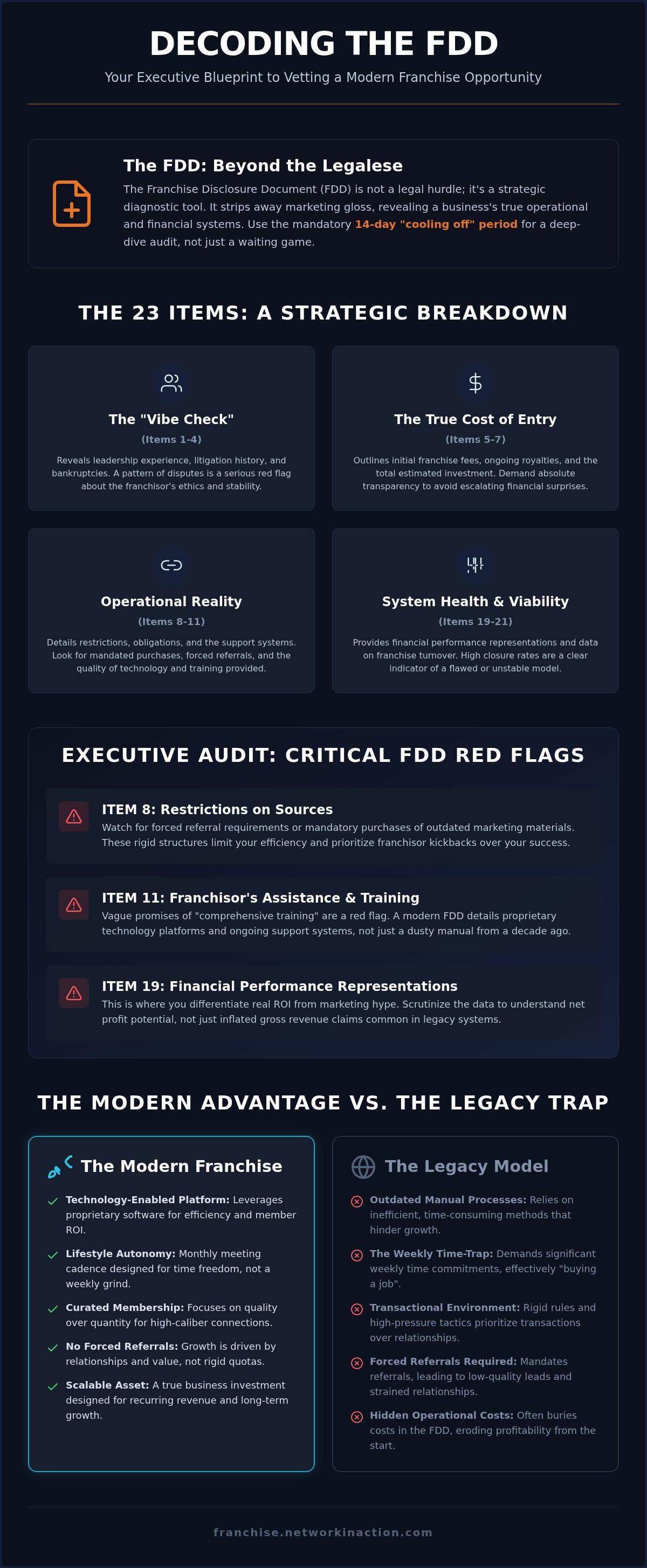
The 23 items required by the FTC provide a granular look at a brand's DNA. To effectively analyze what is in a franchise disclosure document, you must categorize these sections into four distinct buckets: background history, initial and recurring costs, operational obligations, and system performance. Items 1 through 3 serve as your primary "vibe check." These sections reveal the leadership's experience and any history of litigation or bankruptcy. A pattern of legal disputes isn't just a footnote; it's a warning of potential friction in your future partnership. Serious executives look for stability, not baggage.
Items 5 through 7 outline the true cost of entry. This includes the Initial Franchise License Fees and the estimated total investment required to launch. Transparency is non-negotiable here. You're looking for a clear, predictable path to revenue, not a series of escalating financial surprises that erode your capital before you've even opened your doors.
The 'Red Flag' Items for Executives
Item 8 and Item 9 often hide the constraints that turn a business opportunity into a "buying a job" trap. In traditional networking models, Item 8 might disclose restrictions on sources, such as forced referral requirements or mandatory purchases of outdated marketing materials. These rigid structures prioritize the franchisor's vendor kickbacks over your local market efficiency. Additionally, Item 20 tracks system growth and turnover. If you see high closure rates or a revolving door of territories, it's a sign of instability in legacy networking organizations. Before you commit, you should check available territories to see where modern growth is actually occurring.
Support and Technology Disclosures
Item 11 is where the promise of "comprehensive training" meets reality. In 2026, training shouldn't just be a dusty manual or a weekly conference call. You're looking for specific disclosures regarding proprietary technology and platform access fees that enable tech-forward connectivity. Modern brands leverage digital tools to automate manual legacy processes, freeing up your time for high-level community leadership. If the FDD focuses on manual reporting and rigid weekly meeting requirements, you're looking at a time-trap. A results-oriented model will clearly define how technology supports your ROI and lifestyle freedom, providing a final answer to what is in a franchise disclosure document that actually matters for long-term growth.
Analyzing Item 19: Financial Performance and ROI Potential
Item 19 is the ultimate litmus test for any investor. While other sections define the rules of the game, this section defines the rewards for winning it. If you're wondering exactly what is in a franchise disclosure document that shifts the needle on your net worth, Item 19 is the answer. For an executive implementing a referral marketing strategy, this data provides the hard evidence needed to validate a brand's claims. You must differentiate between gross revenue and net profit. Gross revenue is a vanity metric; net profit is what fuels your freedom.
Modern service-based models prioritize recurring revenue over the exhaustion of one-off sales. This creates a predictable financial floor that allows for strategic scaling. Use the disclosures in Item 19 to build a realistic pro-forma for your target territory. Analyze the performance tiers of existing owners to understand the delta between top performers and the system average. This level of scrutiny ensures you aren't just buying into a brand, but investing in a proven profit engine. Math doesn't lie.
The Power of Recurring Revenue
Elite franchise models emphasize consistent income streams that compound as your network grows. These systems leverage social capital and professional credibility to drive higher margins without the burden of heavy inventory. By linking the FDD data to the NIA Franchise Economics, you can perform a rigorous comparative analysis against outdated models. You're building a community asset that yields dividends month after month. High-level professionals value this stability because it translates directly into time freedom. It's about working smarter, not harder.
Spotting Inefficiencies in Legacy Financials
High overhead is the silent killer of lifestyle autonomy. Retail disclosures often reveal staggering costs for real estate, inventory, and massive staffing requirements that erode margins. Traditional "bricks and mortar" models often trap owners in a high-risk, high-maintenance cycle. In contrast, lean service models offer a more agile approach to business ownership. You can see the difference in the bottom line when you strip away the unnecessary fluff of legacy operations. Item 19 is where "informed disruption" is proven with data.
Due Diligence Steps: Using the FDD to Spot Legacy Flaws
Execution is everything. Understanding what is in a franchise disclosure document is only half the battle; the other half is using that data to expose legacy flaws that could jeopardize your ROI. High-level professionals don't just read the FDD. They weaponize it. Use this five-step roadmap to perform a surgical audit of any potential investment:
- Step 1: Cross-reference Item 20. Compare the List of Outlets with actual territory availability to gauge system health and stability.
- Step 2: Audit hidden costs. Scrutinize Item 8 and Item 11 for mandatory vendor fees or "suggested" marketing expenses that inflate overhead.
- Step 3: Conduct a Lifestyle Audit. Search Item 9 for rigid meeting requirements that are common in legacy models.
- Step 4: Interview existing owners. Focus your validation calls specifically on tech-platform efficiency and actual operational support.
- Step 5: Verify territory rights. Ensure Item 12 provides the ironclad exclusivity you need to build local authority.
The Lifestyle Audit: Avoiding the Time-Trap
Traditional networking models are notorious for demanding 60-hour work weeks disguised as "community building." You must scrutinize Item 9 to identify rigid meeting requirements that force you into a manual, administrative role. A management-heavy model is just another job. Modern systems position you in a "convening" role, where your influence is the primary asset, not your hours behind a desk. By the time you finish your audit, you'll know exactly what is in a franchise disclosure document that separates a scalable lifestyle business from a time-consuming trap. Consult the Available Territories map to see where this modernized growth is taking hold.
The Technology Vetting Process
A tech-forward franchisor will disclose a proprietary platform in Item 11, not just a list of third-party software suggestions. This distinction is critical for your daily operations. Tech-enabled connectivity reduces your operational burden by automating referral tracking and member engagement. Ask existing owners if the platform actually delivers on its promise of efficiency or if they're stuck using manual legacy processes. You're looking for a brand that leads the tech space, ensuring your investment remains relevant in a digital-first economy. Don't settle for a franchisor that is following the pack when you can lead with a modern solution.
To see if your market is ready for a modernized networking approach, check available territories today.
Network In Action: A Transparent Approach to Modern Franchising
Network In Action (NIA) represents the next evolution of the industry. It strikes a professional balance between corporate sophistication and entrepreneurial excitement. While legacy networking organizations often bury their inefficiencies in dense legal text, NIA prioritizes transparency and executive time. Understanding what is in a franchise disclosure document is the final step in confirming that NIA is the sophisticated alternative you've been searching for. The documentation reveals a model built for the modern leader. It's a system that values measurable results over performative attendance.
The NIA FDD highlights a revolutionary monthly meeting model. This stands in stark contrast to the rigid, weekly requirements found in traditional models. You aren't just buying a franchise; you're securing a lifestyle-friendly asset that respects your professional autonomy. The proprietary technology platform disclosed in Item 11 turns relationship-building into a scalable digital asset. It automates the manual, transactional tasks that plague outdated networking approaches. This allows you to focus on high-level community leadership and strategic growth.
Why NIA Disclosures Stand Out
Quality over quantity is the core philosophy. NIA eliminates the "forced referral" culture that makes legacy networking organizations feel transactional and inefficient. Instead, the focus is on curated, high-quality membership. The FDD outlines the "Z-Factor," a proprietary system designed to drive member ROI and ensure franchisee success. This metric-driven approach ensures that every relationship in your network has a clear financial value. It transforms social capital into a consistent income stream. You're building a professional community where credibility is the primary currency.
Your Next Executive Move
Transitioning from corporate leadership to community influence requires a proven roadmap. NIA provides the structure and technology needed to leverage your existing network without the burden of cold prospecting. It's a ready-to-use solution for those ready to lead. You've spent years managing complex systems for others. Now, it's time to own the system yourself. This is your path to time freedom and meaningful impact. Don't just observe the disruption; lead it. You have the skills to build something significant. Use the data to make your move.
Take the next step in your due diligence process. Download the NIA Franchise Kit to see the model in action and review the economics of modern ownership. For a deeper dive into the philosophy of relationship-driven growth, access the Free Book today. Move from learning to owning.
Strategic Ownership Starts with Data
Strategic clarity leads to decisive action. Mastering the complexities of the FDD is the final step in reclaiming professional autonomy and identifying high-ROI opportunities. You've learned how to spot the red flags of legacy networking organizations and analyze the net profit potential in Item 19. Now, you have a definitive answer to what is in a franchise disclosure document that actually drives results. It's about vetting the systems that allow for scalability without the time-trap of outdated models.
Network In Action has solved the inherent flaws of traditional networking. With over 150 successful locations globally and a proprietary tech-enabled platform, the path to community leadership is clear. You don't need to guess; you only need to execute. Exclusive professional territories are available for those ready to disrupt the status quo. It's time to align executive experience with a model built for the future. The data is clear, and the opportunity is yours to claim.
Download the Network In Action Franchise Kit to explore your next executive move.
Your background has prepared you for this strategic transition. Take the lead and build your legacy today.
Frequently Asked Questions
What is the most important item in a Franchise Disclosure Document?
Item 19 is widely considered the most critical section for high-level investors. It provides the financial performance representations needed to validate a sophisticated referral marketing strategy. While this section is optional, elite brands use it to demonstrate transparency and ROI potential. You should also scrutinize Item 20 to understand system stability and territory turnover. These sections collectively reveal what is in a franchise disclosure document that directly impacts your long-term wealth.
Can a franchisor change the FDD after I have received it?
Franchisors must update their FDD annually within 120 days of their fiscal year end. They also update it whenever a material change occurs in the business structure or leadership. If a franchisor issues a new version while you are in your 14-day review period, you must receive the updated document. This ensures you make decisions based on the most current data regarding litigation, fees, and operational obligations before signing any agreement.
How do legacy networking organizations differ in their FDD disclosures?
Legacy networking organizations typically disclose rigid, weekly meeting requirements and manual referral tracking processes in Item 9. These traditional models often lack the tech-forward disclosures found in modern alternatives. In contrast, a modern FDD will highlight a monthly meeting cadence and proprietary technology platforms. These differentiators are designed to protect your time freedom while maximizing member ROI through efficient, scalable systems rather than transactional, high-pressure environments that drain your energy.
Is the Item 19 financial disclosure a guarantee of my future earnings?
Item 19 is a historical representation of past performance, not a guarantee of future results. It provides a data-rich look at what current owners have achieved within the system over a specific period. Use this information as a benchmark to build your own pro-forma and territory projections. While it proves the scalability of the model, your individual success depends on your leadership and execution within your exclusive professional territory.
What are technology and platform access fees in a modern franchise?
These recurring fees cover the cost of exclusive digital tools that automate manual tasks. In a modern franchise, these fees grant you access to a proprietary platform that manages member connectivity and referral tracking. Unlike legacy systems that rely on paper slips or outdated spreadsheets, these tech-enabled systems drive efficiency. This ensures your role remains focused on high-level community leadership rather than administrative overhead or tedious manual reporting that wastes time.
How much time should I spend reviewing the FDD before signing?
Federal law mandates a minimum 14-calendar-day cooling-off period after receiving the document. This window is a mandatory safety net designed for thorough due diligence. Serious entrepreneurs use this time to interview existing owners and cross-reference territory availability. Don't rush the process; use the full window to ensure the model aligns with your lifestyle goals and financial expectations. High-stakes investments require a deep-tissue audit of every disclosure before you commit capital.
Do I need a lawyer to review the Franchise Disclosure Document?
Engaging a specialized franchise attorney is a strategic move for any executive investor. A lawyer helps decode the legal jargon in Items 1 through 4 and ensures the exclusivity clauses in Item 12 are ironclad. They provide an objective "vibe check" on the franchisor's litigation history and bankruptcy status. This professional oversight minimizes your risk and ensures that the final contract reflects the transparency promised during the initial discovery and alignment process.
What is the difference between an FDD and a Franchise Agreement?
The FDD is a comprehensive disclosure of 23 specific items required by the FTC; the Franchise Agreement is the actual legal contract. Think of the FDD as the pre-investment audit that explains what is in a franchise disclosure document regarding fees, history, and obligations. The Franchise Agreement is the document you sign to finalize the partnership. Both are essential, but the FDD provides the factual context needed to sign the agreement with total confidence.