Your professional network isn't just a list of contacts; it's the most valuable asset you aren't currently monetizing. Most high-level executives spend decades cultivating elite relationships only to find themselves isolated in corporate roles or wasting hours in legacy networking organizations. If you're searching for business ideas for people who thrive on interaction, you've likely realized that traditional models are too rigid and transactional for your caliber. You deserve a system that values quality over quantity.
It's time to stop treating your social capital as a side effect of your career and start treating it as the engine of your growth. Discover how to transform your natural ability to connect into a high-ROI business model that leverages sophisticated technology for long-term expansion. This path replaces the grind of cold prospecting with a structured, community-led approach. It's about working smarter, not harder.
This guide provides a strategic roadmap to achieving true time freedom and lifestyle autonomy by leading a community of influential peers. Analysis of the shift from manual outreach to modern, technology-enabled systems reveals how to secure consistent income streams. Prepare to move beyond outdated methods and embrace the next evolution of professional connectivity.
Key Takeaways
- Transform social capital from a passive asset into a high-growth business engine by shifting focus to community leadership.
- Evaluate various business ideas for people who thrive on interaction, moving beyond the "trading time for money" consulting trap.
- Identify the critical inefficiencies within legacy networking organizations that prioritize quantity over executive-level quality.
- Follow a clear roadmap to audit professional relationships and identify scalable, tech-forward franchise opportunities.
- Discover the modern evolution of networking that eliminates forced referrals and maximizes ROI through exclusive digital tools.
Beyond Sales: Why Social Interaction is the Ultimate Business Asset in 2026
Interaction isn't a soft skill; it's the primary revenue driver for the modern executive. In a market saturated with automated noise, the ability to foster genuine human connection has become a rare and valuable commodity. You aren't just searching for business ideas for people who thrive on interaction; you're looking for a way to monetize your existing social capital. The year 2026 marks a decisive shift toward high-trust, referral-based economies. Cold digital prospecting is losing its edge. Real relationships are the only currency that consistently delivers results.
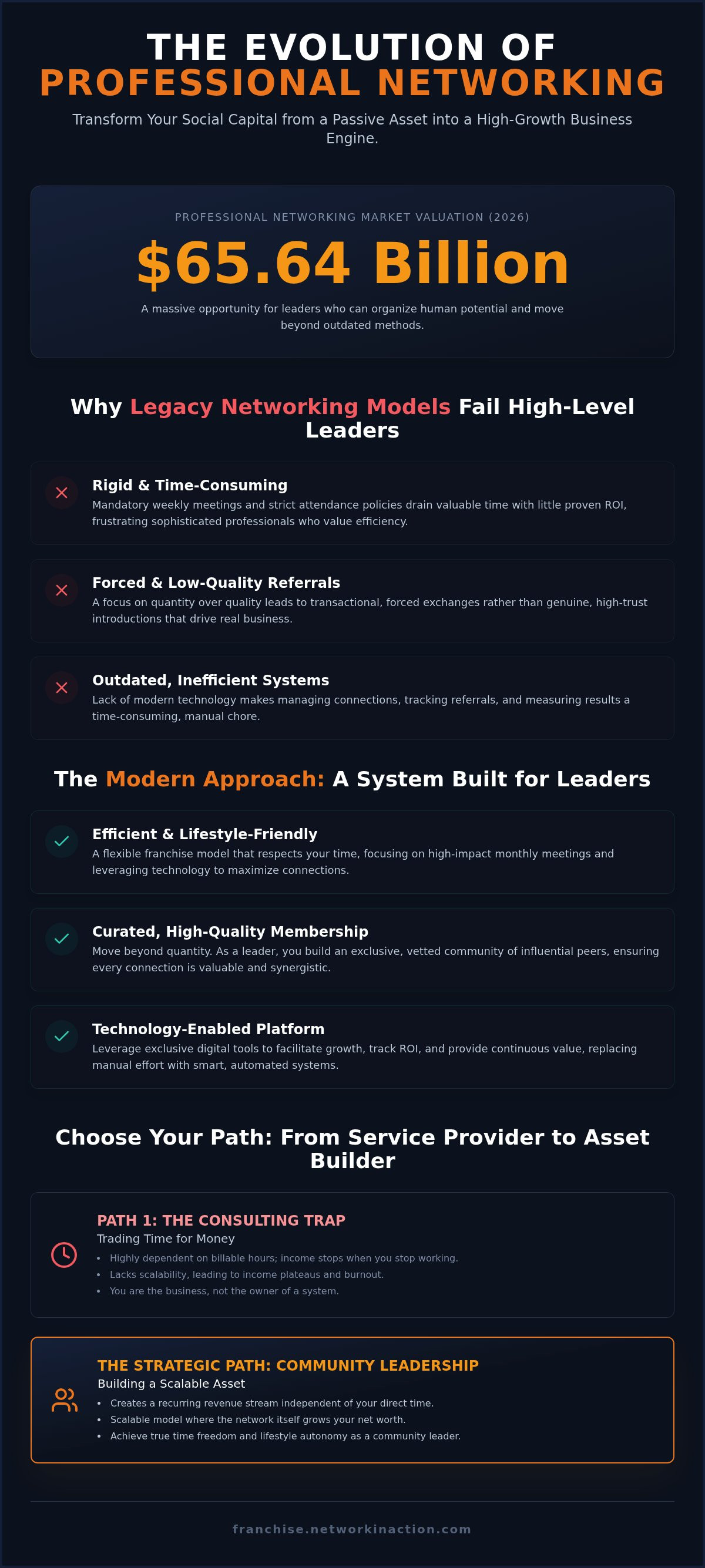
The professional networking market is valued at $65.64 billion in 2026, signaling a massive opportunity for those who can organize human potential. While AI can draft emails and manage schedules, it cannot replicate the emotional intelligence or nuanced trust required to lead a professional community. High-level executives are uniquely positioned to capitalize on this gap. You already possess the network; you simply need the system to turn those relationships into a scalable business model where community leadership is the core product.
The ROI of Social Capital in Modern Business
High-quality referrals are the lifeblood of small to mid-sized businesses because they reduce acquisition costs and shorten sales cycles. By focusing on interaction-heavy models, you build "trust equity" that remains resilient even during market volatility. Business networking in its most advanced form isn't a hobby. It's a strategic system for growth. Social capital is the strategic leverage of professional relationships for measurable financial gain. When you own the network, you own the flow of opportunities. This creates a consistent income stream that isn't dependent on the next cold call or advertising campaign.
From Socializing to Strategic Community Leadership
There's a massive gap between being a "people person" and being a strategic connector. Most professionals spend years attending events without seeing a tangible return on their time. Traditional networking often fails because it lacks structure and accountability. It's transactional, time-consuming, and often feels like a chore. To succeed, you must move from participation to ownership. This requires a psychological shift. You aren't just another member in a legacy networking organization. You are the visionary leader of an exclusive group.
Legacy networking organizations often rely on rigid, outdated models that demand weekly attendance and forced referrals. These systems frustrate sophisticated leaders who value efficiency. They prioritize quantity over quality. True leadership involves curated membership and technology-enabled platforms that respect your time. The best business ideas for people who thrive on interaction focus on building systems where you facilitate growth for others while securing your own recurring revenue. It's about leading a community of influential peers and achieving true lifestyle autonomy.
Evaluating High-Interaction Business Models: From Consulting to Community Leadership
Most search results for business ideas for people who thrive on interaction point toward retail management or real estate. These are linear paths with capped potential. For a high-level executive, the goal is a scalable model that rewards social capital without the burnout of traditional service roles. You need a business that utilizes your sophisticated background rather than just your time.
Consulting is the most common transition for corporate leaders. It offers high interaction and utilizes your expertise. However, it's a trap of trading time for money. If you aren't actively billing, your income stops. Event planning and hospitality offer similar social engagement, yet they are plagued by thin margins and massive overhead. You want a model where your network grows your net worth while you stay focused on high-level strategy. Professional networking ownership provides this balance, offering recurring revenue and the ability to scale without the logistical nightmares of traditional service industries.
The Scalability Problem in Service Businesses
Solo-entrepreneurship is a recipe for exhaustion. You end up managing spreadsheets instead of people. Modern community leadership models use technology to automate the administrative friction of networking. This allows you to scale without adding headcount or expensive leases. A home-based franchise model offers a lean, high-margin alternative to traditional brick-and-mortar investments. It lets you focus on the relationships that drive growth while the system handles the backend. Before you commit to a solo venture, it's worth checking available territories for established models that offer the structure you need.
Why Franchising Beats Starting from Scratch
Building a professional community from zero is a massive risk. You have to build the tech, the brand, and the methodology simultaneously. Franchising provides a shortcut to results. You gain access to a proven system and training that refines communication skills for business leadership. This foundation lets you attract top-tier local owners who are tired of the rigid, transactional nature of legacy networking organizations. It's about moving from a participant to an owner. Leveraging a national brand creates instant credibility, allowing you to bypass the "cold start" problem and begin generating ROI from day one.
The Evolution of Professional Networking: Why Legacy Models Fail High-Level Leaders
Legacy networking is a relic of the past. It was designed for a slower, local-only economy that prioritized volume over value. For executives seeking business ideas for people who thrive on interaction, the most dangerous move is adopting a model that relies on antiquated rules. Legacy networking organizations operate on a foundation of rigid structures and mandatory participation. This approach doesn't respect your time. It drains it. High-performers don't need more meetings. They need more results.
The "forced referral" trap is particularly damaging to professional credibility. In outdated networking models, members are often required to pass a certain number of leads each week regardless of quality. This leads to transactional, low-value interactions that frustrate sophisticated business owners. It devalues the very concept of a referral. You shouldn't be forced to recommend a service you don't trust just to satisfy a quota. This inefficiency is a primary reason why traditional groups fail to retain top-tier talent. They trade quality for a spreadsheet metric.
The Problem with Weekly, Transactional Meetings
High-level leaders avoid groups that feel like a high-pressure sales pitch. When a meeting is mandatory every seven days, the focus shifts from building relationships to simply filling a seat. This creates a culture of desperation rather than collaboration. Outdated networking models often rely on manual tracking and clumsy reporting systems that provide zero transparency. You end up wasting hours on administrative overhead instead of high-value connection. Monthly, curated meetings provide a significantly higher ROI than weekly, mandatory attendance because they prioritize deep strategic alignment over repetitive administrative updates.
Modern Networking: Quality, Tech, and Efficiency
The next evolution of the industry replaces manual labor with proprietary technology. Efficient systems use digital platforms to keep members connected 24/7 without the need for constant, physically draining meetings. This tech-first approach ensures that interaction remains high while time commitment remains low. It's a modern solution for a modern problem. Technology handles the tracking. You handle the relationships.
Curated membership is the cornerstone of this evolution. Legacy organizations often accept anybody with a checkbook, leading to a diluted room and low-quality referrals. In contrast, a modern model focuses on ROI and measurable results. You lead a group of influential peers who are there to grow, not just to show up. This shift from quantity to quality is what transforms a networking group into a powerful business asset. It allows you to leverage social capital effectively while maintaining the freedom to lead your life on your own terms. You aren't just running a group. You are building an elite professional ecosystem.
Building Your Empire Through Relationships: A Roadmap for Social Entrepreneurs
You aren't looking for a job. You're looking for a legacy. While many search for generic business ideas for people who thrive on interaction, the executive path requires a strategic blueprint to transform social capital into a scalable asset. Success in this space isn't accidental. It's the result of following a proven roadmap that prioritizes efficiency and ROI. Stop thinking like a participant and start thinking like an owner. This transition requires a structured approach to ensure your social skills yield a professional return.
- Step 1: Audit your network. Identify the high-value professional connections you've spent years cultivating.
- Step 2: Research opportunities. Evaluate executive business opportunities that align with your specific lifestyle and financial goals.
- Step 3: Evaluate the technology. Ensure your potential partner provides proprietary systems that automate administrative friction.
- Step 4: Secure your territory. Move from the exploration phase to the onboarding process to lock in your market.
- Step 5: Launch and scale. Begin building your referral-based business empire by facilitating high-level connections.
Transitioning from Employee to Entrepreneur
The shift from corporate executive to business owner requires a fundamental mindset change. You are no longer following a structure; you are creating one. Your social superpower is your greatest recruitment tool. Use it to attract your initial group of business owners who are tired of the rigid, time-consuming nature of legacy networking organizations. Implementing a sophisticated referral marketing strategy during your launch phase ensures you build momentum quickly. You aren't just selling a service. You are offering a modern, superior alternative to outdated networking models.
Maximizing Your Time Freedom
Owning a networking franchise shouldn't feel like another corporate grind. A monthly meeting model is the key to achieving true lifestyle autonomy. It respects your time and the time of your members. By using proprietary tech tools, you can manage communications and track referrals on the go. This is how you build a business that works for you. You remain the visionary leader, facilitating high-level connections while the system handles the backend. It's about efficiency. It's about results. If you are ready to lead your own professional community, take the first step and download your franchise kit today.
Network In Action: The Modern Franchise for Influential Leaders
Network In Action (NIA) isn't just another networking group. It's the next evolution of the industry. While you may have explored various business ideas for people who thrive on interaction, NIA is the only model that treats social capital as a high-yield investment. It replaces the inherent flaws of traditional networking with a streamlined, tech-forward system designed for the modern executive. This is where professional sophistication meets entrepreneurial excitement. You don't just join a group; you own the platform that drives local economic growth.
The NIA model solves the "forced referral" trap and the exhaustion of weekly meetings. By focusing on curated, high-quality membership and monthly sessions, the brand ensures that every interaction is meaningful. There are no quotas. There's no fluff. Instead, NIA utilizes a proprietary technology platform to maintain connectivity and drive member ROI between meetings. This technology-led approach shifts the burden of administration from the owner to the system, allowing you to focus on high-level relationship management and territory expansion. It's a professional solution for a legacy industry's most persistent problems.
The financial logic is undeniable. With low overhead and a home-based B2B model, NIA offers a path to recurring revenue without the risks of retail build-outs or heavy staffing. You leverage your existing professional credibility to build a scalable empire. With over 150 locations globally, the brand has proven that high-level professionals are hungry for a networking alternative that respects their time and delivers measurable results. You aren't just facilitating meetings; you're building a consistent income stream based on the value of your connections.
A Turnkey Opportunity for Professional Connectors
Becoming an NIA franchisee means stepping into a ready-to-use system of leadership. You receive comprehensive training, ongoing support, and access to a brand that carries immediate weight with local business owners. NIA empowers you to become the most influential connector in your community. You provide the leadership; the system provides the results. To understand the specific economics and growth potential of this model, you should download the franchise kit and see how social equity translates into financial returns.
Join the Next Evolution of Networking
The demand for high-trust, referral-based business environments is at an all-time high. Securing your territory now positions you at the forefront of a growing global movement. There's a profound satisfaction in helping small business owners scale while you simultaneously build your own professional legacy and achieve true lifestyle autonomy. This is your chance to lead. If you're ready to transition from the corporate grind to community ownership, check available territories to see where you can start your journey as an NIA franchise owner.
Lead the Next Evolution of Professional Connectivity
The corporate world often undervalues the very skill that makes you exceptional: your ability to connect people. You've seen how social capital drives growth in a high-trust economy. While exploring business ideas for people who thrive on interaction, it's clear that owning the network is the ultimate path to executive-level returns. You don't have to settle for the inefficiency of legacy networking organizations or the burnout of solo consulting. It's time to monetize your influence.
Network In Action provides a sophisticated framework with over 150 successful locations globally. It's built on a monthly meeting model designed for executive efficiency; it's powered by a proprietary tech-enabled referral platform. This system replaces forced referrals with curated relationships and professional structure. You can leverage your connections to build a scalable empire while enjoying true lifestyle autonomy. The transition from executive to owner is a strategic move toward measurable impact and recurring revenue.
Explore available NIA territories and start building your network today. Your expertise has already built great things for others. Now, it's time to build something for yourself. Step into a leadership role that rewards your natural talents and secures your financial future.
Frequently Asked Questions
What are the best business ideas for social people with professional backgrounds?
The most effective business ideas for people who thrive on interaction are those that transform social capital into a scalable asset through community leadership. While consulting or event planning offer high social engagement, they often lack recurring revenue and long-term scalability. A networking franchise allows you to lead a group of influential peers while using a proven system to drive results. This model rewards your ability to connect others without the overhead of traditional service-based businesses.
How much interaction is required to run a networking franchise?
Interaction is the primary activity, but the NIA model is designed for maximum efficiency. You lead monthly meetings rather than the exhausting weekly sessions required by traditional networking groups. This structure allows you to maintain high-level engagement with your members while preserving your own time freedom. Proprietary technology handles the daily connectivity, ensuring that your time is spent on strategic relationship building rather than repetitive administrative tasks.
Can a high-interaction business be truly scalable?
High-interaction businesses become truly scalable when they are backed by sophisticated technology and a franchise system. Unlike solo consulting, where your income is capped by your billable hours, owning a networking territory allows for multi-unit expansion. Data shows that 55% of existing NIA franchise owners have purchased additional units. This demonstrates that a relationship-driven model can grow into a significant business empire when supported by the right operational tools and systems.
What is the difference between traditional networking and modern referral models?
Traditional networking relies on rigid, weekly attendance and forced referrals that often prioritize quantity over quality. Modern referral models, such as NIA, utilize a monthly meeting structure and curated membership to ensure every interaction is high-value. There are no forced referrals. Instead, technology keeps members connected throughout the month, fostering genuine trust and higher ROI. This shift from transactional meetings to strategic community leadership is the next evolution of the industry.
Do I need a background in sales to own a networking group?
You don't need a background in sales to successfully lead a professional networking community. The most successful owners are servant leaders with calm confidence and strong communication skills. NIA provides comprehensive training and support to help you manage your groups effectively. Your primary role is to facilitate connections and build credibility within your local business ecosystem. If you can lead a sophisticated conversation, you can lead a professional group.
How does technology improve the ROI of professional networking?
Technology transforms networking from a manual, time-consuming chore into a high-efficiency business asset. Proprietary platforms automate lead tracking and member connectivity, providing a transparent measure of social capital. This reduces the administrative burden on the owner and increases the ROI for members by keeping them connected 24/7. It ensures that referrals are documented and followed up on, creating a measurable impact that outdated networking models simply cannot match.
What are the overhead costs for an interaction-based service franchise?
Overhead costs for an interaction-based service franchise like NIA are exceptionally low compared to retail or hospitality models. Since the business is home-based and B2B, you avoid expensive retail build-outs, inventory costs, and large staffing requirements. Your primary investments are the initial franchise license fee and ongoing royalty payments. This lean structure maximizes your profit margins and allows you to focus your resources on growing your local influence and network.
Is it possible to run a networking business part-time while transitioning from a job?
It's entirely possible to launch a networking franchise while transitioning from a corporate role due to the flexibility of the monthly meeting model. You aren't tied to a rigid 9-to-5 schedule or the daily grind of legacy networking organizations. This lifestyle-friendly business allows you to build your referral groups at a pace that suits your current commitments. Many owners use this flexibility to secure their financial future and achieve true time freedom.