Your capital is too valuable to be buried in a legacy model that prioritizes headcount over high-performance results. Results matter. Efficiency counts. In an era where the U.S. franchise sector is projected to reach $921.4 billion in economic output, the difference between a thriving investment and a stagnant one comes down to modern efficiency. You likely share the common anxiety of buying into a rigid, outdated system that hides operational inefficiencies behind corporate promises. Identifying the signs of a healthy franchise system requires looking beyond the brand name and into the underlying technology and support structures.
This executive evaluation provides the tools to master the metrics that separate high-performance franchise investments from legacy models that drain your resources. You'll gain a clear framework for vetting franchise health and the confidence to choose a scalable, tech-forward business model. The following analysis explores how to align your investment with your lifestyle goals; it ensures your next move is a strategic evolution rather than a step backward into traditional, manual methods.
Key Takeaways
- Identify the critical signs of a healthy franchise system by shifting focus from sheer unit growth to individual franchisee profitability and operational efficiency.
- Master the "Validation Score" to uncover the real operational experience of current owners and ensure corporate support aligns with your professional standards.
- Replace the rigid, time-consuming requirements of legacy networking organizations with a streamlined, monthly high-impact model designed for maximum ROI.
- Audit the proprietary technology stack to ensure it provides a scalable, 24/7 connection platform rather than just serving as a basic administrative tool.
- Secure long-term lifestyle autonomy by selecting a franchise opportunity that prioritizes recurring revenue and community leadership over manual, outdated prospecting.
Defining Franchise Health in a Tech-Driven Economy
Legacy metrics are dead. In the 2026 economy, counting open storefronts is a vanity exercise that masks deeper operational rot. When understanding the franchise model, you must look past the gloss of rapid expansion. True signs of a healthy franchise system reside in unit-level profitability and the elimination of the time-drain that plagues legacy networking organizations. Modern health is measured by the success of the individual, not the growth of the corporate office. It is about building a sustainable, scalable asset that respects your time and your capital.
The Shift from Unit Count to Unit Profitability
Rapid expansion often acts as a smokescreen. A franchisor might flood the market to collect initial fees while ignoring the struggle of existing owners. This creates a churn and burn cycle that destroys long-term value. A healthy system prioritizes franchisee profitability over sheer unit count. Analyze the ratio of corporate-owned versus franchisee-owned locations. If a brand doesn't invest in its own model, it signals a lack of confidence in the underlying systems. Consistent, high-margin revenue streams are the only metrics that matter for your lifestyle autonomy. You need a model that scales without requiring a proportional increase in your daily labor.
Technology as a Vital Sign
Modern business moves at the speed of data. A franchise relying on off-the-shelf software or manual spreadsheets is a liability. It is a relic of a slower era. The tech stack must be proprietary. It needs to automate the administrative burden, allowing you to focus on community leadership rather than paperwork. Real-time data access is essential. You need to track member engagement and ROI instantly to ensure your network remains elite. Traditional networking models often fail because they lack this digital backbone, leaving owners to guess at their impact. If you are ready to evaluate a model built for the modern professional, you can check available territories to see where this evolution is taking place.
Legacy organizations thrive on volunteer fatigue. They demand your time without offering the tools to manage it. A healthy system solves this problem through informed disruption. It replaces the weekly grind with streamlined, technology-led solutions that respect your schedule. Data-driven support is the new benchmark. If the franchisor can't show you real-time performance metrics across the entire network, they are flying blind. You deserve a partner that values precision over promises. This transition from manual guesswork to digital certainty is the hallmark of a high-performance investment.
Core Metrics of a High-Performance Franchise Network
Legal compliance is the baseline. Profitability is the prize. While many brands focus on rapid growth, the true signs of a healthy franchise system are found in the data that corporate brochures often omit. High-performance networks prioritize franchisee retention over new sales. They treat every owner as a strategic partner rather than a royalty stream. When you evaluate a system, you must look for corporate reinvestment into R&D and platform evolution. A brand that stops innovating is a brand that is dying. Results matter. Churn kills.
The Validation Process: Beyond the FDD
Executive-level due diligence requires going beyond the Franchise Disclosure Document. You need to speak with current owners to identify the gap between promised support and daily reality. Ask about system-wide technology adoption. If the network isn't using the proprietary tools provided, the system is broken. Franchisee validation is the ultimate litmus test for system health, revealing whether the operational reality aligns with the initial corporate promise. Listen for the "Validation Score": the unscripted feedback from owners when corporate isn't listening. If you want to dive deeper into the specifics of this model, you can download the franchise kit for a transparent look at the operations.
Financial Transparency and ROI Metrics
Speed matters. Your capital should work for you, not just for the franchisor. Evaluate the initial investment against the projected timeline for breaking even. Healthy systems offer clear financial transparency and prioritize recurring revenue models. This stability allows for lifestyle autonomy and long-term business growth. In contrast, legacy networking organizations often rely on transactional, high-churn models that demand constant manual effort. You can Calculate Your ROI: NIA Franchise Economics to understand how a modernized approach drives superior financial outcomes. High-level professionals choose models that leverage existing networks rather than requiring cold prospecting. This is the strategic evolution of the industry. Professionals who value their time should consider how modern networking models outperform outdated alternatives.
Legacy Limitations vs. Modern Efficiency
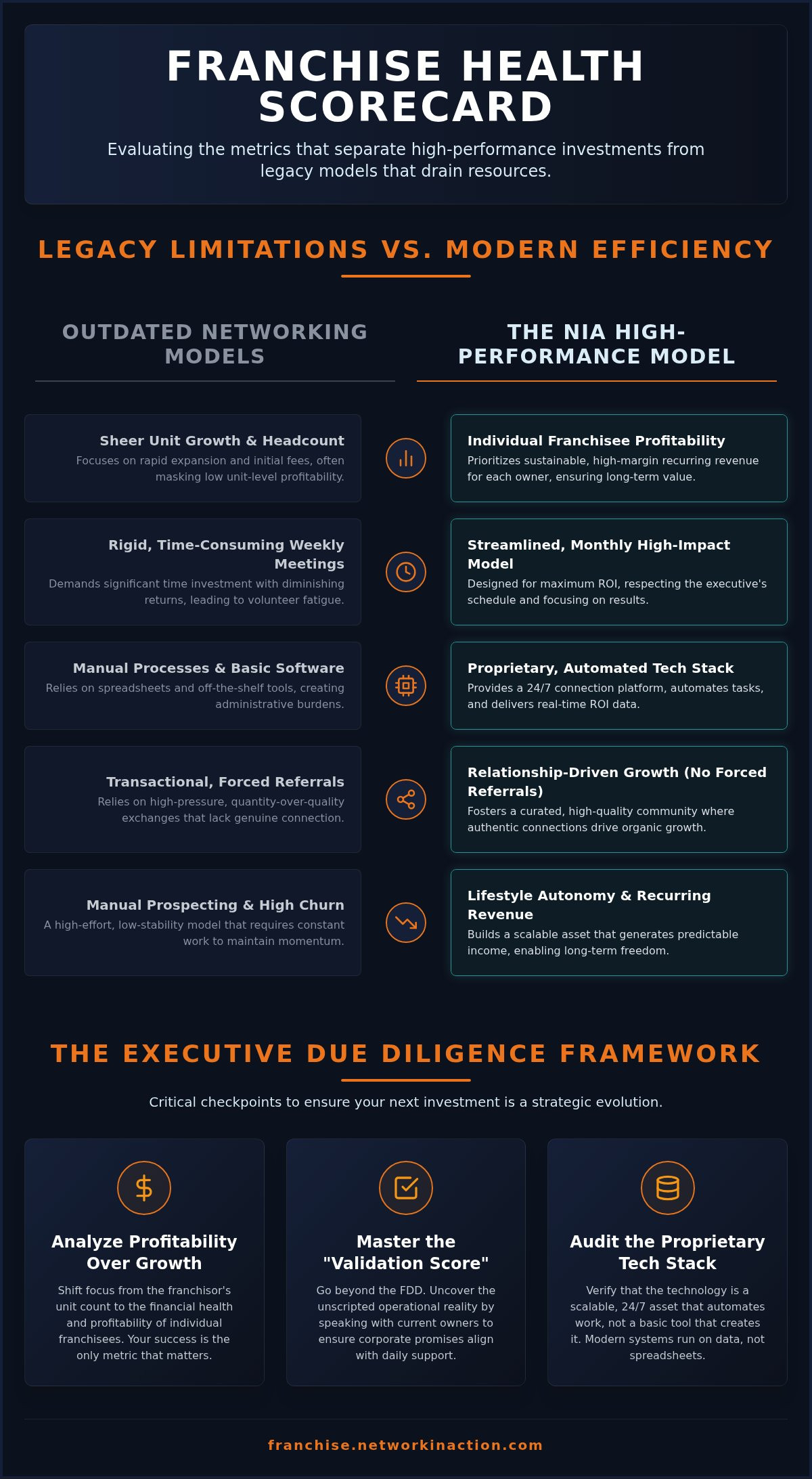
Legacy networking organizations are built on a foundation of manual labor and rigid attendance. They demand your presence every week, regardless of the actual business value generated. This is the antithesis of efficiency. One of the primary signs of a healthy franchise system in 2026 is the rejection of these outdated networking models in favor of streamlined, technology-led operations. Executives don't have time for busy work. They need results. Traditional networking often feels like a second job; it leads to chronic volunteer fatigue and high member turnover. The leading brand in the legacy space often requires a time commitment that seasoned executives find completely unsustainable. High-level professionals need a model that respects their schedule while delivering consistent income streams.
The Problem with Rigid, Transactional Models
Forced referrals destroy professional credibility. When a system mandates a specific number of leads per week, the quality inevitably plummets. It becomes a game of hitting quotas rather than building meaningful strategic partnerships. Legacy brands prioritize quantity. They fill rooms with anyone who can pay the entry fee, regardless of their professional standing. Modern alternatives focus on quality. They curate memberships to ensure every person in the room is a high-level peer. The hidden cost of "busy work" in traditional business groups is staggering. It drains your time and capital without providing a measurable ROI. You want a system that builds professional credibility, not one that compromises it through transactional pressure. Quality relationships are the primary measure of social capital in any high-performance network.
Informed Disruption: The Monthly Meeting Advantage
Informed disruption changes the game. By reducing meeting frequency to once a month, you immediately increase the caliber of participants. High-level professionals can commit to twelve high-impact sessions a year. They cannot commit to fifty weekly meetings. This is the modern evolution of the industry. Professional facilitators drive the conversation, ensuring every minute spent translates into strategic growth and community leadership. Between these sessions, a proprietary technology platform maintains connectivity 24/7. This digital link replaces the need for constant physical presence, offering the freedom and flexibility that modern leaders demand. It allows for relationship-driven growth without the manual grind of cold prospecting. If you're looking for a path to time freedom and meaningful impact, you can find more insights in the free book offered by the brand leading this shift. A healthy system leverages networks rather than draining them. It empowers you to lead your professional community with sophistication and ease.
The Executive Due Diligence Framework for 2026
Due diligence is not a checklist. It is a strategic interrogation. To secure your future, you must look beyond the surface level of brand recognition and investigate the infrastructure that drives long-term profitability. One of the most telling signs of a healthy franchise system is a technology stack built specifically to scale rather than just manage daily tasks. Legacy networking organizations often rely on manual reporting and rigid attendance logs that provide zero strategic value. You need a system that offers predictive analytics and seamless member connectivity. This is about owning a business that leverages your time, not a business that consumes it.
Analyze the territory protections with precision. A healthy brand ensures you aren't competing with your own colleagues for market share. If the franchisor is willing to cannibalize your territory for a quick sale, the system is fundamentally flawed. Similarly, assess the training provided. High-level professionals require leadership development and community-building strategies, not just basic operational checklists. The business should empower your lifestyle, offering the recurring revenue and flexibility that traditional networking models lack.
Vetting the Technology and Support Infrastructure
Request a demo of the proprietary member platform. If the software looks like a relic from the early 2000s, the brand is stagnant. Modern systems provide automated marketing and lead generation support, allowing you to focus on high-level relationship building. You can start by Finding Available Franchise Opportunities Near You to see how these territories are strategically mapped. Robust support infrastructure means corporate is invested in your growth, providing the digital tools necessary to maintain member engagement 24/7 without constant manual oversight.
Assessing Cultural Alignment
Determine if the brand attracts peers or subordinates. High-level professionals want to lead communities of equals, not manage rooms full of transactional vendors. Cultural health is the strategic alignment between franchisee values and corporate vision. Your role as a community leader should build your professional credibility, not diminish it through forced referrals or "busy work." If the brand culture prioritizes rigid attendance over actual business results, it is a legacy trap. You deserve a network that mirrors your own ambition and sophistication.
If you are ready to lead a high-performance community, you should explore a modern networking franchise that aligns with your executive goals.
Network In Action: The Blueprint for a Healthy System
Network In Action (NIA) represents the next evolution of professional networking. It is a calculated disruption of a stagnant industry. When evaluating the signs of a healthy franchise system, NIA stands as the definitive benchmark for 2026. It replaces the manual grind of legacy organizations with a sophisticated, technology-led platform. This model ensures members remain connected 24/7, driving ROI long after the meeting ends. It's built for those who value time. It's built for those who demand results. With over 150 locations globally, the system has proven its ability to scale while maintaining elite standards of membership and profitability. Efficiency matters. Results count.
Innovation Over Tradition
Outdated networking models rely on rigid, weekly attendance that drains executive energy. This creates volunteer fatigue. It leads to high turnover. NIA solved these inherent flaws by implementing a high-impact monthly meeting model. This shift attracts a higher caliber of professional who cannot commit to the weekly churn of traditional networking. It prioritizes quality over quantity. Instead of forced referrals, the focus remains on relationship-driven growth and curated membership. The proprietary technology platform acts as a digital glue, maintaining engagement without requiring your constant physical presence. You can Download the Franchise Kit to see how this innovation creates a superior alternative to legacy networking organizations.
Your Path to Community Leadership
Transitioning from the C-suite to business ownership requires a model that matches your professional sophistication. NIA offers a strategic path to community leadership. You aren't just running a group; you're leading an elite professional community. This role builds your personal credibility while generating consistent, recurring revenue. It offers the lifestyle autonomy that legacy networking organizations simply cannot provide. You leverage your existing network instead of cold prospecting. You focus on high-level referrals instead of transactional leads. This is about building a legacy through high-quality professional connections. You own the business; the business doesn't own you. Explore the Top Executive Business Opportunities in 2026 to understand why high-level professionals are choosing this modernized approach. A healthy franchise system aligns your investment with your lifestyle goals, ensuring that every strategic move you make leads toward greater freedom and impact.
Securing Your Strategic Evolution
The investment landscape has shifted. You now possess the framework to identify the signs of a healthy franchise system by prioritizing unit profitability and technological scalability over vanity metrics. Legacy networking organizations rely on rigid, manual processes that drain your time. Modern leadership demands efficiency. By leveraging an exclusive monthly meeting model and proprietary ROI-tracking technology, Network In Action has established over 150 successful global territories. This is the modern evolution of professional networking. It's a system designed for high-level leaders who refuse to settle for outdated, transactional models. Efficiency first. Results guaranteed.
Your path to lifestyle autonomy and community impact is clear. It's time to align your capital with a model built for the future. Take the next step in your executive journey and Download the NIA Franchise Discovery Kit to explore your potential. Your future as a community leader starts with a strategic decision today. Lead with confidence.
Frequently Asked Questions
What are the most critical signs of a healthy franchise system?
The most critical signs of a healthy franchise system include high franchisee retention rates and consistent unit-level profitability. You should look for systems that prioritize the success of individual owners over rapid corporate expansion. Healthy brands maintain transparent financial disclosures and demonstrate a clear commitment to ongoing research and development. This ensures that the business model remains relevant and competitive in a tech-driven economy where efficiency is the primary measure of value.
How does technology impact the health of a modern franchise?
Technology serves as the operational backbone of any high-performance network. A modern system utilizes proprietary platforms to automate administrative tasks, allowing you to focus on high-level community leadership. This digital infrastructure ensures 24/7 connectivity between members, which is a significant departure from the manual processes of legacy organizations. Real-time data access allows for precise ROI tracking, ensuring that the franchise remains a scalable and efficient investment for the executive owner.
Why do some legacy franchise systems fail to adapt to modern markets?
Many legacy franchise systems fail because they are built on rigid, transactional models that prioritize quantity over quality. These outdated networking models often suffer from volunteer fatigue and high turnover due to unsustainable weekly meeting requirements. They lack the digital agility needed to compete in 2026, relying instead on manual tracking and antiquated communication methods. Without a technology-led solution, these systems become time-consuming burdens that fail to resonate with high-level professional members.
What is the ideal franchisee-to-corporate support ratio?
The ideal support ratio ensures that every franchisee has direct access to executive-level guidance without being lost in a corporate bureaucracy. While specific numbers vary by industry, a healthy system uses technology as a force multiplier to enhance support efficiency. You should seek a franchisor that offers comprehensive initial training and ongoing operational resources. This structure allows the corporate team to provide high-impact, strategic support that drives individual profitability rather than just managing basic compliance.
How can I verify the ROI of a networking franchise?
You can verify the ROI of a networking franchise by analyzing recurring revenue streams and member retention data. High-performance systems use proprietary technology to track referrals and business generated within the network, providing concrete proof of value. During your due diligence, conduct executive-level interviews with current owners to identify the speed of reaching break-even. A healthy model leverages existing professional networks to drive relationship-driven growth, minimizing the need for expensive and time-consuming cold prospecting.
What happens if a franchise system stops innovating its technology?
If a franchise system stops innovating, it quickly becomes a legacy trap that drains your time and capital. Stagnant technology leads to operational inefficiencies and a loss of professional credibility among members who expect modern solutions. Innovation is a vital sign of health; without it, the system cannot scale or adapt to changing market dynamics. You need a partner that consistently reinvests in its platform to ensure the business remains a superior alternative to traditional models.
Can a franchise be healthy if it has a low number of total units?
A franchise can be exceptionally healthy with a low unit count if those units demonstrate high profitability and strong market penetration. Health is not a vanity metric based on headcount; it is defined by the financial success of the individual franchisees. Some of the most exclusive systems prioritize curated growth to maintain high-quality standards across the network. You should focus on the underlying business logic and the strength of the proprietary systems rather than just the total number of establishments.
How do monthly meeting models compare to traditional weekly networking?
Monthly meeting models offer a streamlined, results-oriented schedule that high-level executives find sustainable. In contrast, traditional weekly networking often demands an excessive time commitment that leads to burnout and transactional, low-quality referrals. The monthly approach attracts a higher caliber of participant, focusing on strategic partnerships rather than rigid attendance quotas. This modern evolution of networking leverages technology to maintain connections between sessions, providing the freedom and flexibility required for a successful lifestyle-friendly business.