Most high-level executives searching for the best franchises for first-time business owners are unknowingly looking for a second job instead of a scalable asset. You've spent decades mastering corporate strategy and high-stakes leadership. Trading that expertise for the manual grind of a retail or food franchise isn't just inefficient; it's a strategic error. It's a common fear that leaving the C-suite means swapping one high-stress environment for another where you're suddenly worried about inventory or hourly staffing. You deserve a transition that respects your time and leverages your professional network.
This 2026 executive guide promises a different path. You'll learn how to move beyond the limitations of legacy networking organizations and manual business models. The following sections explore a technology-backed, relationship-driven system designed for sophisticated owners who prioritize ROI and lifestyle autonomy. This is the modern evolution of business ownership. It's built for those ready to lead their professional communities without the rigid, time-consuming demands of outdated networking models. Prepare to discover a recession-proof strategy that turns your existing social capital into a consistent, recurring revenue stream.
Key Takeaways
- Identify why the transition from the C-suite to entrepreneurship requires a strategic pivot toward turnkey frameworks that leverage your existing leadership skills.
- Discover why the best franchises for first-time business owners in 2026 prioritize informed disruption and technology over manual labor or retail logistics.
- Learn to evaluate business opportunities based on their ability to provide lifestyle autonomy and high-ROI recurring revenue streams through professional B2B services.
- Uncover the critical flaws in legacy networking organizations, such as forced referrals and rigid weekly commitments, that drain executive time without delivering value.
- Explore how a modernized networking franchise model uses proprietary technology to build elite local business communities and drive consistent growth.
Defining the 'Best' Franchise for the Executive Mindset
Success in business ownership isn't about starting from scratch. It's about strategic acquisition. For a high-level leader, the transition from the C-suite to entrepreneurship isn't a career change; it's a strategic pivot toward asset ownership. Identifying the best franchises for first-time business owners requires a fundamental shift in how you evaluate success. You aren't looking for a new job. You're looking for a vehicle that monetizes your existing leadership, strategic oversight, and professional network. Equity over salary. Systems over sweat.
A foundational understanding the franchise model reveals that success isn't about the product; it's about the system. For executives, the ideal system is one that offers executive-grade prestige. While many industry lists focus on high-overhead retail or food service, these models often force you into the manual grind of inventory and hourly staffing. Professional service franchises outperform these legacy models by offering higher margins and lower physical overhead. The goal is a turnkey framework that allows you to lead from day one without sacrificing the professional credibility you've spent decades building.
The Employee to Entrepreneur Transition
Moving beyond the corporate hierarchy requires a new lens. In 2026, high-level leaders are increasingly seeking autonomy to escape the volatility of corporate restructuring. Your transferable skills; leadership, relationship management, and strategic oversight; are your greatest assets. The Shift from Employee to Business Owner involves applying these skills to a proven business framework rather than a corporate silo. The best franchises for first-time business owners in 2026 are those that offer a clear path to leadership without the burden of manual operations. It's about informed disruption of outdated industries.
Why Time Freedom is the Ultimate KPI
Revenue is only half of the equation. The other half is the time required to generate it. You must evaluate business models based on the ratio of hours worked to revenue generated. Avoid the trap of "buying a job" where you become the primary operator of a rigid system. Instead, prioritize lifestyle autonomy. A scalable business system should allow you to focus on professional impact and high-level strategy. In a world where legacy networking organizations demand excessive weekly time commitments, modern alternatives prioritize efficiency and measurable results. Your time is finite. Spend it on growth, not maintenance.
3 Essential Criteria for First-Time Franchise Success
For executives vetting the best franchises for first-time business owners, the evaluation process must go deeper than mere brand recognition. It's about infrastructure. You need a model that offers "Informed Disruption"—a system that identifies the systemic failures of a legacy industry and solves them through superior logic. Scalability is the primary goal. You want a business that grows without a proportional spike in headcount or overhead costs. This requires a shift away from manual operations toward streamlined, system-driven leadership.
Success isn't found in reinventing the wheel. It's found in identifying a wheel that is already turning with precision. The role of technology in 2026 is to automate the administrative burdens that plague traditional business models. By removing the friction of manual tracking and reporting, you can dedicate your energy to high-level strategy and community leadership. This is how you transition from an employee mindset to an owner mindset without sacrificing your professional prestige.
Comprehensive Training and Ongoing Support
Reviewing the Franchise Disclosure Document (FDD) is your first line of defense. Pay close attention to Item 11, which outlines the franchisor’s obligations regarding assistance and training. Following the FTC guidelines for new franchise owners ensures you understand the legal protections and training requirements necessary for a secure investment. A dedicated onboarding process is non-negotiable. You aren't just learning a trade; you're mastering a leadership system. Access the Franchise Kit to see how a professional support structure accelerates your path to profitability.
Proprietary Technology and Platforms
In 2026, a tech-forward mindset is a prerequisite for success. Manual tracking and paper-based reporting are relics of legacy networking organizations. A modern franchise uses proprietary digital tools to facilitate member engagement and ensure operational efficiency. These tools do more than just manage data; they provide automated ROI reporting that high-level professionals demand. When the system handles the heavy lifting of member connectivity, you're free to focus on building high-quality relationships. Efficiency is the ultimate competitive advantage in a crowded market.
Recurring Revenue and Financial Predictability
Predictable cash flow is the bedrock of executive-grade investments. Subscription-based business models offer a level of stability that retail or food service simply can't match. Service-based franchises allow you to predict growth through consistent monthly income streams. This financial clarity enables long-term strategic planning rather than daily firefighting. If you're ready to explore a model that values your time as much as your investment, you should evaluate available territories to see where your network can thrive. Focus on models that offer lifestyle autonomy and professional impact.
Top Franchise Categories for Professional Leaders in 2026
Professional leaders aren't looking to manage inventory or flip burgers. They're looking to monetize their social capital. In 2026, B2B service franchises are thriving because businesses are desperate for high-quality referrals. Cold prospecting has failed. The digital noise is deafening. Consequently, the best franchises for first-time business owners with executive backgrounds are those that center on relationship-driven growth. These models allow you to lead local business communities while building a scalable asset that doesn't require a massive headcount or complex logistics.
Relationship-driven business models are inherently recession-proof. When the economy tightens, businesses don't stop spending; they stop wasting. They shift their budgets away from unproven lead generation toward trusted referral networks. This creates a massive opportunity for professional networking organizations and high-level consulting franchises. These categories offer professional prestige and consistent, recurring income streams. They leverage decades of corporate experience to solve real-world problems for small to mid-sized business owners who need strategic oversight.
The Rise of the Networking Franchise
Modern businesses are abandoning cold prospecting for warm referrals. They want curated connections. As a franchise owner in this space, you act as a community connector and visionary leader. You aren't just running meetings. You're building an elite ecosystem where high-level professionals collaborate and grow. This is the modern evolution of the industry. For a deeper dive into this specific model, see the Business Networking Franchise: The Executive Guide. It's a strategic path to time freedom and meaningful local impact.
High-Level Consulting and Strategic Growth
Consulting franchises allow you to advise businesses without the overhead of a massive firm. You leverage your professional credibility to build a high-value client base quickly. While researching the steps to starting a franchise, many executives realize that service-oriented models provide the fastest route to ROI. These opportunities focus on strategic growth rather than manual operations. You provide the roadmap; the systems provide the execution. This balance ensures you maintain lifestyle autonomy while driving measurable results for your clients. It's about working smarter, not harder, to grow your influence and income.
The best franchises for first-time business owners in this category prioritize efficiency. They use digital tools to automate the administrative heavy lifting. This allows you to focus on what you do best: leading, advising, and connecting. By choosing a model that values your time, you ensure that your transition from the C-suite is a step toward freedom, not just another high-pressure job.
Avoiding the Pitfalls of Legacy Business Models
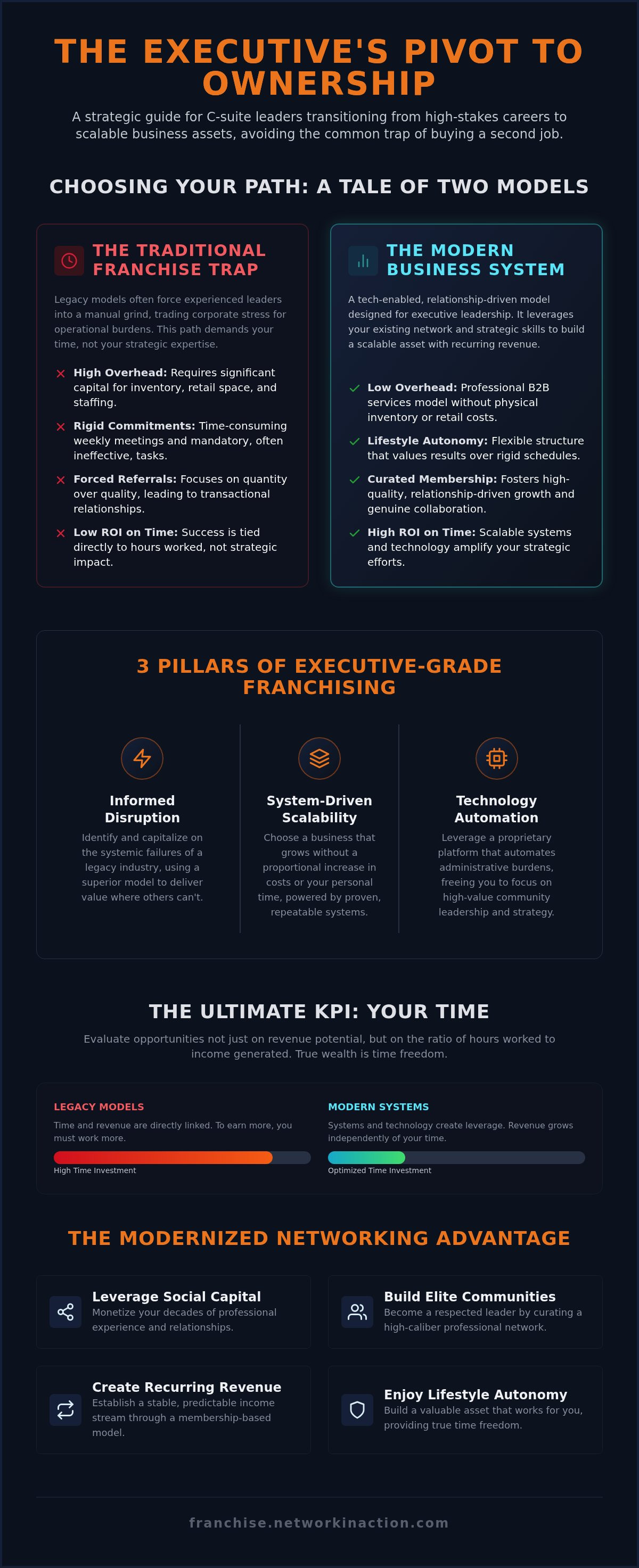
Executives often fail by choosing models that replicate the very corporate drudgery they tried to escape. Inefficiency is a silent killer. Traditional networking models are notorious for this. They demand rigid weekly commitments that drain your most valuable asset: time. When searching for the best franchises for first-time business owners, you must avoid systems that prioritize attendance over results. Legacy networking organizations often rely on transactional, "forced referral" structures that stifle genuine relationship-driven growth. These models feel outdated because they are. Legacy status is often a mask for obsolescence.
Longevity without innovation is a red flag in a 2026 market. Outdated networking models rely on the momentum of the past while ignoring the technological demands of the present. They offer rigidity where you need flexibility. Transactional relationships are the byproduct of these forced systems. When a franchise mandates a specific number of referrals per week, the quality of those connections plummets. It becomes a game of numbers rather than a strategy for growth. You need a system that facilitates organic, high-value introductions through curated membership rather than rigid quotas. Rigid systems stifle. Modern systems scale.
Efficiency vs. Inefficiency: The Meeting Model
Weekly meetings are a relic of a pre-digital era. They attract professionals who have more time than business. This frequency creates a high-friction environment that drives away the very executives you want to attract. In contrast, a streamlined monthly meeting model attracts high-caliber leaders who value efficiency. This frequency respects your lifestyle autonomy and significantly improves member retention. High-level professionals don't want more meetings; they want more results. Less time spent in meetings means more time spent on strategic community leadership and personal freedom.
Technology-Enabled vs. Manual Networking
Manual tracking is a liability for a modern owner. Outdated networking models still use "paper-based" referral systems that require constant owner intervention to manage. This is a massive time-drain that prevents scalability. A modern platform solves this by keeping members connected 24/7. It facilitates organic growth and connectivity without the need for manual oversight. If you want to master these modernized strategies, you should Claim your Free Book for a blueprint on high-efficiency networking. This technology allows you to own a business that works for you, rather than you working for the business.
Transitioning to ownership should be a strategic move toward freedom. You can explore available territories that offer a professional, tech-led alternative to the status quo. You deserve a model that respects your professional history while providing a clear path to future growth.
Why Network In Action is the Modern Evolution for New Owners
Network In Action (NIA) represents the next evolution of professional networking. It's a franchise model built specifically for the 2026 market, designed to solve the inherent flaws of a legacy industry. For high-level leaders vetting the best franchises for first-time business owners, NIA offers a streamlined path to recurring revenue without the operational headaches of traditional retail or food service. It doesn't merely invite participation. It challenges you to lead a community using a technology-led system that prioritizes ROI over activity for activity's sake. This is informed disruption at its finest.
Results matter. Systems scale. NIA replaces the manual, high-friction processes of outdated networking models with proprietary technology that automates the heavy lifting of group management. This tech-forward approach ensures you spend your time on high-value leadership rather than administrative minutiae. You aren't buying a job. You're owning a scalable business system that monetizes your existing social capital. It's an executive-grade opportunity designed for those who value efficiency, professional prestige, and consistent income streams.
The NIA Differentiators: Beyond the Status Quo
Authenticity drives growth. NIA eliminates the transactional nature of traditional networking by removing forced referrals. This ensures every introduction is based on genuine value, not a rigid quota. Trust is the primary measure of social capital. By hosting monthly meetings instead of weekly ones, the model respects your lifestyle autonomy and attracts higher-caliber professionals. Busy executives don't have time for the weekly time-drain of legacy networking organizations. They want curated connections and measurable results. NIA provides both through a lifestyle-friendly model that fits your schedule.
Building Your Legacy as a Community Leader
Ownership is about influence. As an NIA franchise owner, you become the primary resource for business growth in your territory. You aren't just a facilitator; you're a visionary leader. The NIA system empowers you to build an elite ecosystem where high-level professionals collaborate to solve real-world problems. This leadership position builds immense professional credibility and opens doors to further strategic opportunities. Your influence grows as your group thrives.
Scalability is built into the framework. You can expand your impact by owning multiple territories, creating a powerful network of groups that drive significant recurring revenue. This isn't a high-pressure sales pitch; it's a strategic move toward time freedom and meaningful impact. To begin your transition from the C-suite to community leadership, you should Explore Available Territories to see where your network can provide the most value. This is the modern path for first-time owners who demand more from their investment.
Strategic Ownership Starts Here
Strategizing your exit from the C-suite requires more than just a change of scenery. It demands a superior business model that values your time as much as your investment. You've discovered that the best franchises for first-time business owners in 2026 aren't found in the manual grind of retail. They're found in the high-margin world of professional networking. By prioritizing informed disruption over outdated networking models, you secure a path to recurring revenue and true lifestyle autonomy. Efficiency matters. Results follow.
Network In Action has solved the inherent flaws of the industry. With over 150 successful locations worldwide, the model leverages a proprietary technology platform to drive member ROI while maintaining a monthly meeting model for executive-level efficiency. This is your opportunity to lead your community without the rigid, transactional burdens of the past. It's time to trade corporate stress for professional influence and a scalable asset. Your expertise belongs at the center of your community leadership.
Discover the modern evolution of business networking; Download the NIA Franchise Kit today.
Your transition to business ownership should be a strategic move toward freedom and measurable impact. The future of your professional legacy is ready for its next evolution.
Frequently Asked Questions
What makes a franchise 'best' for a first-time business owner?
The best franchises for first-time business owners provide a turnkey operational framework that leverages your existing leadership skills while minimizing manual labor. You should look for systems that offer informed disruption of outdated industries. A superior model provides a clear path to leadership without the burden of retail logistics or complex inventory management. It's about owning a scalable asset that respects your professional history and provides a predictable, tech-led environment for growth.
How much time does a first-time franchise owner need to commit weekly?
Time commitment varies by model, but executive-grade franchises prioritize efficiency over raw hours. Unlike legacy networking organizations that demand rigid weekly meetings, modern models utilize monthly sessions to maximize impact. This streamlined approach allows you to manage your business in a fraction of the time required by traditional retail. By leveraging proprietary technology to automate administrative tasks, you can focus on high-level strategy and community leadership while maintaining your desired lifestyle autonomy.
Are service-based franchises better than retail for former executives?
Service-based models often outperform retail for former executives because they focus on professional prestige and social capital rather than inventory management. These franchises typically require lower physical overhead and fewer hourly employees. You spend your time advising and connecting high-level professionals instead of managing supply chains. This alignment with the executive mindset ensures that your transition into business ownership feels like a strategic advancement rather than a step back into manual operations.
What is the typical ROI for a professional networking franchise?
ROI in professional networking is driven by consistent, recurring revenue and the appreciation of your social capital. Because these models require minimal physical infrastructure, a higher percentage of revenue flows directly to the bottom line. You build a scalable asset that grows as your local influence expands. While specific returns depend on territory management, the combination of low overhead and membership-based income provides a level of financial predictability that traditional, transactional businesses struggle to match.
How does proprietary technology impact the success of a new franchise?
Proprietary technology is the engine of modern franchise success. It automates the heavy lifting of group management and member connectivity, allowing the owner to focus on strategic growth. Digital platforms keep your professional community engaged 24/7 without requiring constant manual intervention. This tech-forward approach eliminates the inefficiencies of paper-based referral systems found in outdated networking models. It provides the data-driven ROI reporting that sophisticated members expect in a competitive, modern business environment.
Can I run a networking franchise while maintaining my current lifestyle?
The modern networking model is specifically designed for lifestyle autonomy. By hosting monthly meetings instead of the weekly sessions required by traditional networking, you gain significant flexibility. You aren't tied to a physical storefront or a rigid corporate clock. The system allows you to build a professional legacy on your own terms. This flexibility is a key reason why these are among the best franchises for first-time business owners seeking freedom from the C-suite.
What support can I expect from a modern franchise organization?
Modern franchise organizations provide comprehensive training and a dedicated onboarding process to ensure your success from day one. You receive access to proprietary tools, marketing resources, and a global network of fellow owners. The support structure is outlined clearly in the Franchise Disclosure Document (FDD), ensuring transparency. You aren't just buying a license; you're gaining a strategic partner that provides the ongoing systems and expertise necessary to lead your professional community with confidence.
Why is recurring revenue critical for first-time business owners?
Recurring revenue is the bedrock of financial stability. It removes the stress of starting each month at zero, which is a common pitfall in transactional business models. For a first-time owner, this predictability allows for better long-term strategic planning and easier scaling. Membership-based models ensure a consistent income stream while you focus on building high-quality relationships. This stability creates a secure environment where you can grow your influence and income without the volatility of traditional sales cycles.