Most franchise opportunities are simply high-priced jobs in disguise. You didn't spend decades climbing the corporate ladder just to trade your 9-to-5 for a 24/7 grind that lacks sophistication. Finding a franchise that aligns with my values requires looking beyond the glossy brochures of legacy networking organizations that still rely on rigid, transactional models. You're seeking more than just a paycheck; you want a business that builds professional credibility while offering the time freedom you've actually earned.
It's understandable to feel frustrated by outdated systems that prioritize quantity over quality. This guide will show you how to identify a franchise opportunity that respects your time, matches your high professional standards, and delivers a modern ROI. You'll discover how to leverage a tech-forward, scalable model that focuses on recurring revenue and lifestyle autonomy. The following sections break down the essential criteria for selecting a business that functions as the next evolution of your career, ensuring your investment works for you rather than the other way around.
Key Takeaways
- Learn why value alignment is the ultimate filter for operational success and long-term owner satisfaction.
- Discover a repeatable framework for finding a franchise that aligns with my values by auditing your professional non-negotiables.
- Identify the inherent flaws in legacy networking organizations that rely on rigid, transactional quotas instead of high-quality relationships.
- Evaluate how proprietary technology and streamlined systems replace the manual, time-consuming processes found in outdated business models.
- Unlock a path to lifestyle autonomy and recurring revenue by choosing a model designed for executive-level efficiency.
Why Core Value Alignment is the Ultimate ROI Driver in Franchising
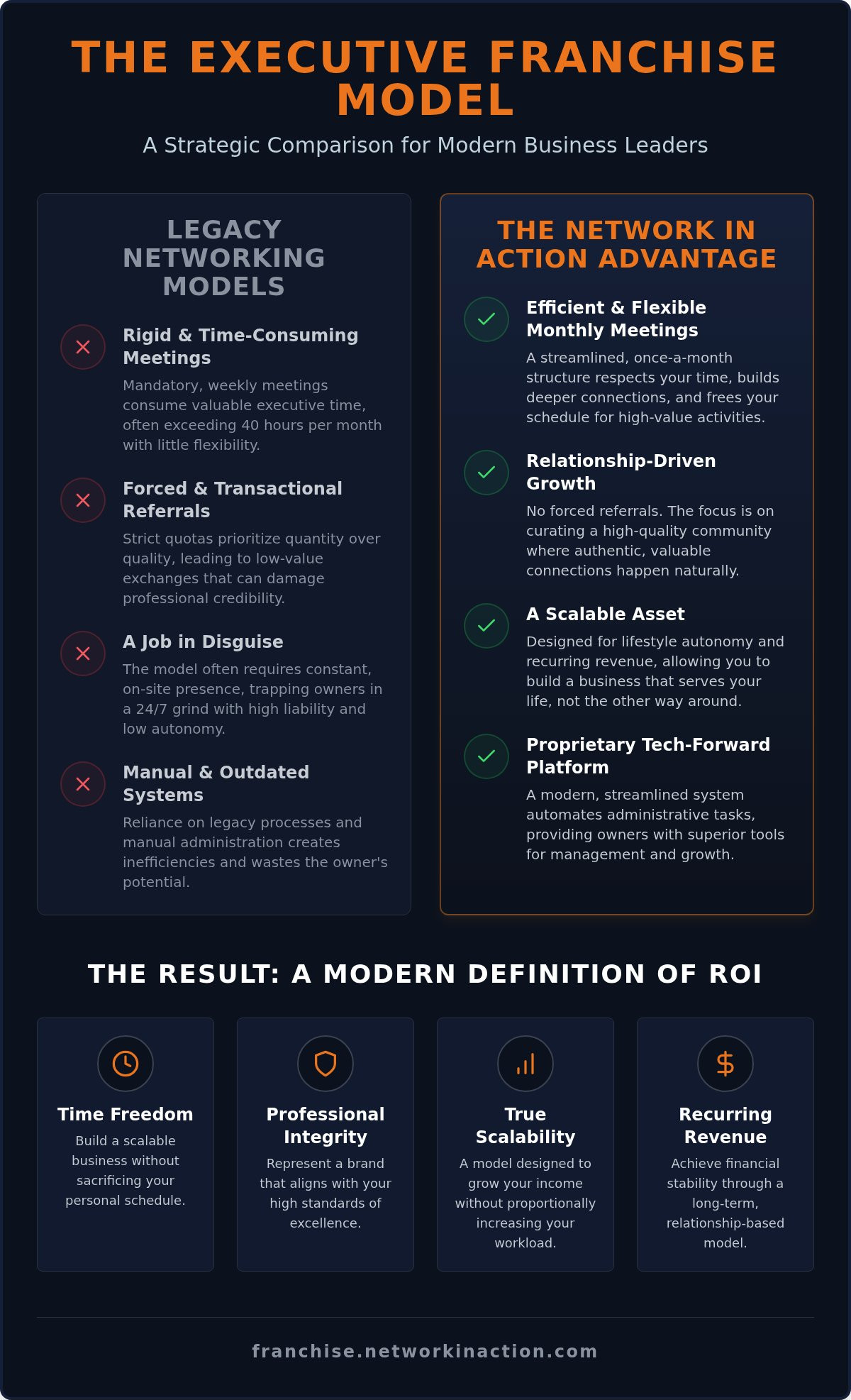
Core values are often dismissed as soft concepts in traditional business circles. This is a strategic error. For an executive, values are the operational filters that determine every outcome, from daily efficiency to long-term profitability. Finding a franchise that aligns with my values isn't just about feeling good about your work; it's about building a defense against owner burnout. Mismatched cultures create friction. Aligned cultures create momentum. Results matter. When your business model mirrors your internal standards, decision-making becomes streamlined and intuitive.
True ROI is measured in more than just a balance sheet. It includes time freedom, professional credibility, and lifestyle autonomy. A business that mirrors your standards naturally attracts higher-quality partners and clients. It eliminates the need for high-pressure sales tactics. Instead, it relies on shared principles to drive growth. Before signing any agreement, understanding the franchise model is critical to ensure the franchisor's culture doesn't conflict with your personal brand. A modern ROI includes:
- Time Freedom: Systems that respect your schedule.
- Professional Integrity: A brand you are proud to represent in your community.
- Scalability: A model that grows without demanding more of your personal time.
- Recurring Revenue: Financial stability built on long-term relationships.
The High Cost of Cultural Mismatch
Rigid, legacy systems drain executive energy. Traditional networking models often rely on forced participation and strict, weekly quotas. This creates a transactional environment that feels outdated and cumbersome to modern professionals. The psychological toll of representing a brand that prioritizes quantity over quality leads to rapid turnover and frustration. You didn't leave the corporate world to become a cog in an inefficient machine. Voluntary excellence beats forced compliance every time. Finding a franchise that aligns with my values means choosing a model that values your expertise over your attendance record.
Values as a Strategic Business Filter
Core principles act as a magnet. They draw in a community of like-minded leaders while repelling those who don't meet your standards. Executives must prioritize professionalism and efficiency as non-negotiable filters. A tech-forward approach isn't just a perk; it's a statement of value that signals you respect modern business dynamics. Value alignment is the intersection of personal conviction and business logic. By prioritizing these standards, you build a scalable asset that enhances your reputation rather than compromising it.
Defining Executive Values: Time, Efficiency, and Professional Integrity
Transitioning from a C-suite role to business ownership isn't just a career change. It's a fundamental shift in how you value your professional capital. Finding a franchise that aligns with my values means identifying a model that treats time as your most precious asset. You've spent years managing complex systems; you shouldn't settle for a business that relies on manual, legacy processes. Efficiency is a core executive value. If a system doesn't leverage modern tools, it's wasting your potential and your profit margins.
Professional integrity goes beyond simple honesty. It involves adhering to a high standard of excellence and refusing to participate in transactional referral swaps that compromise your reputation. While the franchise industry code of ethics provides a baseline for trust, true alignment requires a model that prioritizes quality over quantity. You want to build relationships that go deeper than a business card exchange. This is why a lifestyle-first strategy is vital for long-term sustainability. It ensures your business serves your life, rather than your life serving the business.
The Value of Time-Freedom
Many franchise models trap owners in a low-margin cycle requiring 40 or more hours of on-site presence every week. This is essentially a high-stress job with significant liability. Smart executives look for a business networking franchise that utilizes a monthly meeting structure. This replaces the rigid, weekly commitments of legacy networking organizations with a streamlined approach that respects your schedule. You can lead your community without sacrificing your personal autonomy or family time.
Technological Sophistication as a Core Requirement
In 2026, manual reporting and paper-based tracking are unacceptable for high-level entrepreneurs. Executives should demand proprietary tech platforms that automate connections and provide measurable data. Technology allows you to maintain deep connections across your network without constant manual intervention. It maximizes your return on social capital by ensuring every interaction is tracked and every referral is high-quality. This tech-forward mindset is a key differentiator for those exploring exclusive territory opportunities. Modern tools transform a traditional service into a scalable, high-growth asset that operates with surgical precision.
Legacy Models vs. Modern Innovation: Evaluating Cultural Fit
Many executives realize that finding a franchise that aligns with my values means rejecting the status quo. Traditional networking models were built for a different era. They rely on volume, not value. They prioritize physical presence over actual performance. For an executive, finding a franchise that aligns with my values requires a sharp departure from these legacy networking organizations. You've spent your career building a reputation based on excellence. You shouldn't have to compromise that reputation by participating in a model that feels transactional and forced. Results matter. Efficiency matters. If a business model doesn't reflect these standards, it isn't worth your investment.
The "forced referral" trap is a primary example of this cultural mismatch. In many outdated networking models, members are required to pass a specific number of leads every week. This creates a culture of desperation. It devalues the very concept of a referral. When a referral is mandatory, it ceases to be a mark of trust and becomes a checkbox. This contradicts the professional integrity that defines most C-suite veterans. Informed disruption is changing this. It's replacing the high-pressure sales pitch with a sophisticated, results-oriented framework that respects professional capital. You need a model that leverages your network, not one that exploits it.
The Pitfalls of Outdated Networking Models
Weekly meetings are a massive drain on executive resources. Rigid attendance policies penalize professionals for having a busy schedule. This "quantity over quality" approach devalues the network by filling the room with anyone willing to pay a fee rather than curated, high-level peers. Legacy models are often time-consuming and lack the sophistication required to attract top-tier talent. They focus on manual tracking and physical presence, ignoring the efficiency gains offered by modern technology. This creates an environment that feels more like a high-pressure sales club than a strategic business community. High-level leaders don't need another job; they need a scalable system that works in the background.
The Modern Alternative: Quality-Driven Growth
Modern innovation has introduced a superior alternative. The Network In Action philosophy centers on curated, high-level membership. It replaces the noise of traditional networking with a streamlined, monthly structure. This model shifts the focus from simple lead generation to a comprehensive Referral Marketing Strategy: Unlocking Growth through Trust and Connections. By leveraging proprietary technology, you can facilitate meaningful connections without the manual grind. This is about community leadership. It allows you to lead a professional community that respects your time and mirrors your standards. It's about building a scalable asset that rewards your expertise rather than demanding your constant physical presence. You're not just running a group; you're orchestrating a high-value ecosystem that delivers consistent, measurable ROI for every member involved.
A Strategic Framework for Finding a Franchise That Aligns With Your Values
High-level professionals don't just buy a business; they invest in a philosophy. Finding a franchise that aligns with my values requires a tactical approach that cuts through marketing fluff and focuses on operational reality. You need a rigorous process to ensure the model you choose respects your professional capital and your personal time. This isn't about reading a mission statement. It's about auditing the engine of the business to see if it's built for the future or stuck in the past.
Follow this five-step strategic framework to vet any potential opportunity:
- Step 1: Audit your Professional Non-Negotiables. Define your requirements for technology, time commitment, and professional standards. If you value efficiency, a model relying on manual processes is a non-starter.
- Step 2: Scrutinize the operational model for Efficiency Gaps. Look for signs of "legacy" friction like manual reporting, forced quotas, or rigid attendance rules. These gaps indicate a model that prioritizes control over results.
- Step 3: Interview current franchisees about Lifestyle Autonomy. Don't just ask about the bottom line. Ask if they have the freedom to attend their children's events or travel without the business collapsing.
- Step 4: Test the technology platform for real-world utility. A tech-forward brand must prove its tools actually drive member engagement and reduce owner workload.
- Step 5: Evaluate the franchisor’s response to Informed Disruption. Ensure the leadership is actively evolving the model to stay ahead of industry trends rather than clinging to outdated methods.
The "Beyond the FDD" Checklist
The Franchise Disclosure Document is a legal necessity, but it rarely reveals the soul of a company. To find a franchise that aligns with my values, you must ask questions that expose a franchisor’s true priorities. Ask how the model rewards quality over quantity. Inquire about the specific proprietary tools designed to automate your daily tasks. If the answers sound like they belong in a 1990s sales manual, walk away. You can Download the Franchise Kit to see how a modernized model should actually function.
Assessing the "Professional Peer" Factor
The quality of your fellow franchisees is the most accurate indicator of value alignment. A brand that attracts high-level executives signals a culture of sophistication and mutual respect. Conversely, a brand filled with low-level operators suggests a transactional, high-volume model that will likely devalue your professional standing. Curated membership begins with the people you will call your peers. Evaluate whether the brand’s community mirrors the elite network you've spent years building. Start your discovery process today by visiting Network In Action to see a model built for leaders.
The Network In Action Advantage: Where Professionalism Meets Purpose
Network In Action (NIA) represents the modern evolution of professional connection. It's the logical conclusion for any executive who's spent years perfecting systems and managing high-stakes relationships. Finding a franchise that aligns with my values requires a model that respects your history of leadership while providing a scalable path forward. NIA doesn't just participate in the industry; it disrupts it by solving the inherent flaws found in traditional networking. It's built for those who demand excellence and refuse to settle for the status quo.
The NIA model replaces the rigid, weekly grind of legacy networking organizations with a streamlined monthly structure. This is efficiency in action. It prioritizes recurring revenue and community leadership without the operational friction that plagues outdated models. You aren't buying a job; you're building a high-value asset that leverages your existing professional capital. Results are the only metric that matters. By focusing on quality over quantity, NIA ensures that every interaction is meaningful and every referral is high-caliber. This is the intersection of sophisticated business logic and personal conviction.
A Tech-Forward Approach to Relationship Building
Relationship management shouldn't be a manual task in 2026. NIA utilizes a proprietary technology platform that keeps your members connected 24/7 without requiring your constant physical presence. This tech-enabled approach allows for a significantly higher ROI on your time. It automates the tracking, reporting, and connection processes that make legacy systems so cumbersome. You can Check Available Territories to see where this sophisticated model is currently expanding. Technology shouldn't just be a feature; it must be the foundation of your business efficiency.
Leading Your Professional Community
The most profound shift in the NIA model is the transition from being a member to being the owner of the network. You're the architect of your professional community. You curate the membership, ensuring only high-level peers are in the room. This builds your personal brand and professional capital in a way that traditional employment never could. Owning an NIA franchise positions you as a visionary leader in your local market. It's a strategic move for your next career chapter, offering a ready-to-use solution for those ready to lead. Explore the NIA model as the final step in your search for professional alignment and financial freedom.
Leading the Evolution of Professional Networking
Finding a franchise that aligns with my values is the difference between buying a job and building a lasting legacy. You've seen why legacy networking organizations fail to meet the standards of modern professionals through rigid quotas and manual processes. True success requires a model that respects your time, leverages proprietary technology, and prioritizes high-quality relationships over transactional noise. By focusing on efficiency and quality, you ensure your business works for you rather than the other way around.
Network In Action offers a proven model with over 150 global locations designed specifically by executives for executives. It's the modern evolution of professional connection, providing the lifestyle autonomy you've earned without sacrificing professional credibility. You've already done the hard work of building your expertise; now it's time to leverage that social capital into a scalable, tech-forward asset that delivers consistent results. This is your opportunity to lead a community of peers while securing a recurring revenue stream.
Explore the Network In Action model and find your alignment. Take the lead in your professional community and secure the entrepreneurial freedom you deserve.
Frequently Asked Questions
What are core values in a franchise and why do they matter?
Core values are the operational filters that dictate how a business functions daily. They matter because they determine owner satisfaction and long-term success. Finding a franchise that aligns with my values ensures your professional standards aren't in conflict with the franchisor's systems. When values align, decision-making becomes faster and friction is reduced. This alignment acts as a safeguard against the burnout often caused by cultural mismatch. Results are more consistent.
How can I tell if a franchise culture really matches my professional standards?
Look beyond marketing brochures and scrutinize actual operational requirements. High professional standards involve a focus on quality, efficiency, and sophisticated communication. If the model relies on high-pressure sales or manual, outdated reporting, it won't match an executive mindset. Interview existing owners about their daily tasks. If those tasks feel transactional rather than strategic, the culture prioritizes volume over professional excellence. You need a model that respects your expertise.
Is it possible to find a franchise that offers both high ROI and time freedom?
Yes, but it requires a model built on recurring revenue and efficient systems. Modern franchises achieve this by replacing manual labor with proprietary technology and streamlined meeting structures. Moving from a weekly to a monthly meeting model preserves your time while maintaining high-value connections. This structure allows for lifestyle autonomy without sacrificing the financial returns expected by seasoned professionals. Efficiency drives both your schedule and your bottom line.
What are the red flags of a misaligned franchise culture?
Red flags include rigid attendance policies, forced referral quotas, and a lack of technological investment. These indicate a culture of control rather than a culture of results. If a franchisor emphasizes physical presence over the actual quality of business transacted, their values are misaligned with an executive's need for efficiency. Another warning sign is a high turnover rate among franchisees. This suggests the model is unsustainable for long-term professional owners.
How does a technology-enabled franchise improve value alignment?
Technology acts as a bridge between professional standards and operational reality. A technology-enabled platform automates mundane aspects of business, such as member connection and data tracking. This allows the owner to focus on high-value leadership and relationship building. Finding a franchise that aligns with my values often means choosing a brand that invests in proprietary tools. These tools ensure the business remains modern, scalable, and efficient for the owner and the community.
Why do legacy networking organizations often fail to align with executive values?
Legacy networking organizations rely on outdated, high-frequency models that disrespect an executive's time. Their focus on quantity leads to a lead swap culture that feels transactional and unprofessional. Executives value curated, high-quality interactions and strategic growth. Traditional models that mandate weekly, rigid meetings create an environment of forced participation. This contradicts the autonomy and professional integrity that high-level leaders expect from a business investment. Efficiency is sacrificed for the sake of tradition.
Can I maintain my professional credibility while owning a franchise?
Credibility is maintained when the franchise brand enhances your local reputation. Choosing a model that focuses on community leadership and high-quality referrals builds your professional capital. You become a connector and a visionary leader rather than a salesperson. When you own a business that utilizes sophisticated systems and attracts high-level peers, your credibility grows. It positions you as a sophisticated authority who has solved the inherent flaws of a legacy industry. Reputation is protected.
What steps should I take if a franchisor’s values seem transactional?
Challenge the franchisor on their long-term vision and member retention strategies. Ask for specific examples of how they prioritize quality over volume. If their primary metrics are purely transactional, it is a clear sign to look elsewhere. Seek out organizations that emphasize relationship-driven growth and tech-led solutions. Your goal is to find a partner that views business as an evolution of professional service. Avoid models that feel like a high-pressure sales pitch.