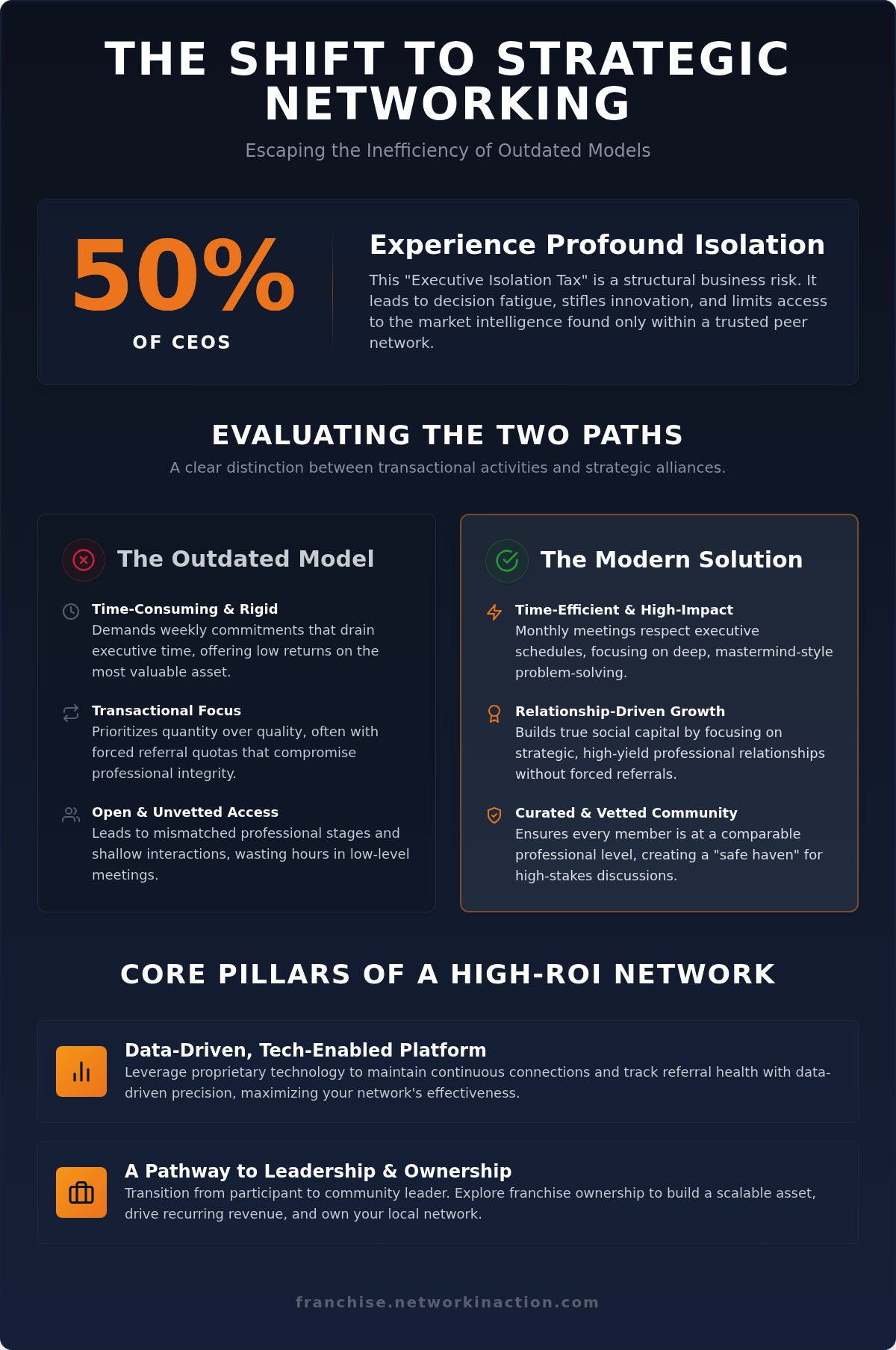
Fifty percent of CEOs report experiencing profound loneliness in their roles; a staggering figure that highlights a systemic flaw in modern leadership. You've likely felt this friction. You're scaling a company and leveraging AI to maximize efficiency, yet the high-level feedback loop is shrinking. You're looking for how to avoid entrepreneurial isolation without wasting hours in the transactional, low-level meetings common in traditional networking models. It's an exhausting trap where precious time is traded for noise rather than signal.
This guide reveals how to transform professional solitude into a high-ROI engine of influence and connection through modern networking structures. Discover a sophisticated alternative to legacy organizations that prioritizes intellectual stimulation and measurable business growth. This analysis explores the shift from manual, time-consuming outreach to tech-enabled, curated communities that position you as a visionary leader. It's time to replace the isolation of the solopreneur economy with a strategic circle of influence that drives your bottom line and your legacy.
Key Takeaways
- Understand why professional solitude is a structural business risk that leads to decision fatigue and limits your market intelligence.
- Master how to avoid entrepreneurial isolation by shifting from open-access community clubs to curated peer groups that utilize a high-impact mastermind approach.
- Evaluate the critical differences between legacy networking organizations and modern, relationship-driven models designed for time efficiency and maximum ROI.
- Leverage proprietary technology platforms to maintain continuous professional connections and track referral health with data-driven precision.
- Transition from participant to leader by exploring franchise ownership as a scalable method to own your local network and drive recurring revenue.
The Executive Tax: The Real Cost of Entrepreneurial Isolation
Entrepreneurial isolation is more than a feeling of loneliness; it is a structural barrier that blocks innovation and market intelligence. While Entrepreneurship is often romanticized as a solo journey, the reality is that 50% of CEOs report experiencing profound isolation according to the 2026 Entrepreneur Loneliness Report. This "loneliness at the top" triggers decision fatigue and cognitive bias, forcing leaders to make high-stakes choices without the benefit of external vetting. Strategic silence. Expensive errors.
The "Isolation Tax" is the hidden cost of missed high-level referrals and strategic alliances. It represents the measurable gap between your current growth and your potential when backed by a curated circle of influence. Traditional networking models often exacerbate this by focusing on transactional volume rather than executive-level synergy. These legacy organizations trap you in rigid, weekly cycles that offer little more than coffee and small talk. When you understand how to avoid entrepreneurial isolation, you stop paying this tax and start investing in high-yield professional capital.
Innovation Stagnation in a Vacuum
Peer feedback is the primary driver of pivot-readiness. In a vacuum, leadership becomes an echo chamber. You lose the ability to vet new strategies against external professional standards. Isolation restricts access to emerging technology trends and market shifts that your peers are already navigating. High-level vetting ensures your business remains agile. It turns potential blind spots into competitive advantages and keeps your innovation pipeline full. Without this external pressure, innovation doesn't just slow down; it stops.
The Erosion of Social Capital
Social capital is a measurable financial metric for business owners. Network depth correlates directly with crisis resilience. While 30.7% of entrepreneurs under the age of 34 report isolation as a significant struggle according to Founder Reports 2026, those with structured support systems report faster recovery from market downturns. Passive social media connections fail here. They are digital noise. They offer no real-world support when you need a high-stakes solution or a strategic pivot. True social capital requires an exclusive system where relationships are engineered for depth and mutual ROI.
To maximize your leadership impact, consider these structural differences:
- Legacy Models: Transactional, rigid, and time-consuming weekly commitments that drain resources.
- Modern Systems: Curated, high-level, and focused on strategic relationship depth and technology-led efficiency.
Shifting from isolation to influence requires a deliberate move away from outdated networking. It demands a system designed for the modern executive who values time as much as capital.
Beyond the Water Cooler: Strategic Solutions for 2026
Solving the executive tax requires more than just "getting out more." It requires a shift from social integration to strategic alignment. If you want to know how to avoid entrepreneurial isolation, you must look beyond the water cooler and toward curated peer groups. High-level leaders don't need more contacts; they need a specific caliber of connection that understands the complexities of 2026 market dynamics. Curated connection. Strategic growth.
Curated Peer Groups vs. Open Networking
Traditional networking models often fail because they prioritize quantity over quality. They operate on open-access rules that invite mismatched professional stages, leading to wasted time and shallow interactions. High-level leaders avoid groups with forced referral quotas because they prioritize professional integrity over transactional volume. Research on how entrepreneurs manage isolation indicates that peer vetting is crucial for professional alignment. You need a "safe haven" where high-stakes challenges can be discussed without fear of judgment or breach of confidentiality. Vetting members for revenue stage and professional alignment ensures that every conversation is relevant to your scale. This curated approach filters out the noise, allowing you to focus on high-yield relationships that drive real business growth.
The Monthly Meeting Advantage
Weekly meetings are a legacy of an outdated, manual business era. They are a drain on the most valuable resource: your time. For a modern executive, a weekly commitment is often a barrier to participation rather than a benefit. A monthly cadence respects executive schedules while maintaining deep, high-impact connection. This model maximizes your Return on Time (ROT). It allows you to focus on execution for three weeks and then pivot to high-level strategy and connection in the fourth. Professional facilitators ensure these meetings deliver measurable ROI rather than drifting into aimless socializing. They keep the agenda tight, the energy high, and the focus on actionable results. By implementing a "Mastermind" approach to problem-solving, these sessions become an essential part of your strategic toolkit rather than just another calendar invite.
The shift to monthly interactions doesn't mean less connection; it means more meaningful connection. When you leverage a system designed for the 2026 economy, you replace the friction of legacy organizations with a streamlined, technology-led solution. Leading such a group as a franchise owner allows you to curate this environment yourself, turning your professional network into a scalable, high-yield asset that benefits everyone involved.
Legacy vs. Modern: Evaluating Professional Communities
The choice between legacy and modern communities is the difference between a chore and a catalyst. Traditional networking models rely on rigid, time-consuming rules that prioritize attendance over achievement. If you're researching how to avoid entrepreneurial isolation, you've likely encountered these groups. They demand weekly presence. They enforce quotas. They value volume over value. This structure is a relic of an era before digital efficiency. Legacy systems fail because they ignore the reality of the executive schedule. High-level commitment. Low-level return.
The Flaws of Traditional Networking Models
Outdated networking models often implement a forced referral system. This is a direct threat to genuine relationship quality. When members are required to produce a specific number of leads each week, the result is low-caliber, transactional noise. It devalues your professional reputation. High turnover rates plague legacy organizations because high-level leaders eventually realize the return doesn't justify the investment. Executives are abandoning transactional groups in favor of environments that respect their expertise and their time. Rigid participation requirements are a barrier to entry for the very people you want in your circle. Quality suffers. Trust erodes.
Differentiators of Modern Networking
Modern networking is built on informed disruption. It challenges the status quo by positioning itself as a superior, technology-led alternative. These groups focus on ROI and financial metrics as a primary measure of success. They don't just track handshakes; they track growth. Community leadership within these organizations builds immediate professional credibility. By leading a curated group, you shift from a passive participant to a visionary authority. This is a core component of a modern Referral Marketing Strategy: Unlocking Growth through Trust and Connections.
Relationship-driven growth replaces cold, transactional prospecting. A tech-forward networking organization uses proprietary tools to bridge the connection gap between monthly sessions. These platforms allow for 24/7 interaction without the need for constant physical presence. They provide real-time data on referral health and network strength. This shift toward quality over quantity is the hallmark of a system designed for the 2026 economy. It's not about how many people you know. It's about who is in your corner and how efficiently you can leverage those connections. Professional synergy. Measurable impact.
Leveraging Technology to Bridge the Connection Gap
Technology should never replace the human element; it should accelerate it. While legacy networking organizations rely on manual tracking and gut feelings to measure success, modern leaders demand precision. Understanding how to avoid entrepreneurial isolation in 2026 involves more than just attending a monthly session. It requires a 24/7 digital infrastructure that maintains momentum when you're not in the room. This hybrid approach uses a proprietary technology platform as a networking assistant that never sleeps. Continuous connection. Seamless integration.
The gap in traditional models is the "dark period" between meetings. Without a centralized system, referrals get lost, follow-ups are forgotten, and the initial energy of a face-to-face interaction dissipates. A tech-forward platform solves this by integrating CRM-style relationship management directly into the professional community. It transforms a group of individuals into a synchronized network capable of high-speed collaboration across different territories. Data-driven growth is the only way to ensure your time investment translates into financial returns.
Real-Time ROI Tracking
Stop relying on hope-based networking. Data-driven referral management ensures every member of the network is held to a high standard of professional accountability. Digital tools now allow you to track ROI and referral health in real-time, providing transparent financial metrics for the entire group. This system removes the ambiguity of "social capital" and turns it into a measurable business asset. When you can see the direct correlation between your network interactions and your income stream, the value of the community becomes undeniable. Accountability matters. Results matter more.
Maintaining Momentum Digitally
Exclusive digital tools reduce the manual labor of networking by automating the administrative friction of legacy systems. Mobile-first connectivity ensures that the modern, on-the-go entrepreneur can foster collaboration without being tethered to a desktop or a rigid weekly schedule. This tech-led approach allows for:
- Instant Referrals: Pass and track high-level leads the moment they arise.
- Territorial Collaboration: Connect with peers beyond your local group to solve national or global challenges.
- Continuous Feedback: Access the mastermind collective for urgent vetting of new technology or market shifts.
By leveraging these systems, you ensure that your professional circle is always active and always working for your growth. If you're ready to lead a tech-enabled community that delivers these results, you should download the franchise kit to explore the next evolution of networking.
From Isolation to Influence: The Power of Owning the Network
Passive participation is a temporary fix. Ownership is the permanent solution. While joining a group provides a necessary feedback loop, taking the lead as a franchise owner transforms your professional standing from a participant to a visionary. This is the ultimate strategy for how to avoid entrepreneurial isolation. It places you at the epicenter of your local economy, ensuring that you're never on the outside looking in. You don't just join a community; you build the engine that powers it. High-level prestige. Absolute authority.
Leading a curated group of high-level business owners solves the "peer-level gap" that plagues traditional networking. It allows you to hand-pick your inner circle, ensuring that every interaction delivers the intellectual stimulation and strategic depth required for 2026 market leadership. You shift from being a seeker of opportunities to the primary connector in your territory. This transition provides a psychological shift that eliminates isolation by design. When you own the network, you own the influence.
Leading the Local Business Ecosystem
Owning a networking franchise builds instant authority. It positions you as a community leader who has solved the inherent flaws of legacy industry practices. This prestige isn't just about social capital; it's a measurable business asset that opens doors to strategic alliances and high-yield referrals. The psychological benefit of being the connector cannot be overstated. You are no longer navigating the market alone. You are the architect of a professional safe haven where high-stakes challenges are solved through a collective mastermind. For those ready to transition from executive roles to community leadership, this is the Business Networking Franchise: The Executive Guide to Modern Ownership.
Scalability and Lifestyle Autonomy
The NIA model is designed for the modern entrepreneur who values time as much as capital. Unlike legacy networking organizations that demand weekly manual labor, this monthly meeting model provides true lifestyle autonomy. You build a referral-based business empire with consistent, recurring revenue streams without the overhead of a traditional 9-to-5. It is a scalable solution that offers freedom and flexibility. You lead the sessions, leverage the proprietary technology platform, and focus on high-level growth. The financial logic is simple: own the asset, control the network, and secure your future. If you're ready to lead, you can explore available territories to lead your own network and start your journey from isolation to influence.
Secure Your Seat at the Center of Influence
Isolation is a structural risk that degrades decision-making and erodes social capital. You've seen the data. You've felt the friction of legacy networking organizations that demand weekly manual labor for minimal return. Transitioning to a modern, tech-led model isn't just a lifestyle choice; it's a calculated move to protect your innovation and scale your influence. This guide has defined exactly how to avoid entrepreneurial isolation by leveraging exclusive systems designed for the 2026 executive.
The next evolution of networking is here. With 150+ locations worldwide and a proprietary tech-led networking platform, the NIA model replaces noise with signal. It's time to stop seeking a seat at the table and start owning the room. By leading an exclusive monthly meeting model, you create a high-ROI engine of connection that works on your terms. Don't settle for the status quo of an outdated industry. Download the NIA Franchise Kit to start building your own network and transform your professional landscape. Your community is waiting for a visionary leader. Be the one who builds it.
Frequently Asked Questions
What is the most effective way to avoid entrepreneurial isolation in 2026?
The most effective strategy is to transition from a passive participant to a community leader within a structured, high-level peer group. Understanding how to avoid entrepreneurial isolation requires moving beyond the transactional noise of legacy organizations. By positioning yourself at the center of a curated local business ecosystem, you ensure a continuous feedback loop. This leadership role replaces the solitude of the solopreneur economy with a high-ROI engine of influence and connection.
How do modern networking groups differ from traditional networking organizations?
Modern networking groups differ from legacy networking organizations by prioritizing efficiency and relationship depth over rigid, time-consuming rules. While outdated models rely on forced referrals and weekly commitments, modern systems utilize a monthly meeting cadence and proprietary technology. This shift ensures that every interaction delivers measurable results. It replaces the manual labor of traditional networking with a streamlined, results-oriented approach that respects the executive schedule and focuses on high-quality membership.
Can technology actually help reduce the feeling of isolation for business owners?
Technology acts as a force multiplier that maintains professional momentum between face-to-face sessions. A proprietary technology platform serves as a 24/7 networking assistant, allowing you to track ROI and referral health in real-time. This digital infrastructure ensures that connection is constant rather than sporadic. It bridges the gap between monthly meetings, providing a secure environment to vet new strategies and access emerging market shifts without the need for constant physical presence.
Why are monthly meetings more effective than weekly ones for high-level executives?
Monthly meetings are superior because they maximize your Return on Time (ROT) while preserving space for business execution. Weekly sessions are a legacy of a manual era and often lead to burnout and high turnover. A monthly cadence allows for high-impact mastermind sessions that deliver strategic depth. This structure attracts high-level professionals who value efficiency, ensuring that the group remains a safe haven for discussing high-stakes challenges rather than a transactional chore.
Is owning a networking franchise a viable way to build a professional network?
Owning a networking franchise is the most strategic path to building a dominant professional network and a scalable business empire. This model allows you to curate your local business ecosystem, positioning you as an authoritative visionary rather than a seeker of connections. It provides a lifestyle-friendly business model with recurring revenue potential. Leading a group of high-level business owners creates instant professional prestige and ensures you are always at the epicenter of market intelligence.
How does curated membership improve the ROI of a networking group?
Curated membership improves ROI by ensuring every member is professionally aligned and operating at a similar revenue stage. Traditional networking often fails because it lacks a vetting process, leading to mismatched expectations and low-value interactions. By focusing on quality over quantity, a curated community ensures that referrals are high-caliber and strategic alliances are impactful. This elite environment fosters the intellectual stimulation required for innovation and long-term business growth in a competitive market.
What should a business owner look for when choosing a professional community?
You should look for a community that offers a technology-enabled platform, a monthly meeting model, and a strictly vetted membership. Avoid legacy organizations that enforce rigid participation rules or forced referral quotas. A modern community should focus on relationship-driven growth and provide measurable financial metrics as a measure of social capital. Seek an environment that values your time and offers a sophisticated alternative to the transactional nature of outdated networking models.
Does professional networking help with mental health and burnout?
Strategic networking directly combats the decision fatigue and cognitive bias that lead to executive burnout. By creating a feedback loop with high-level peers, you reduce the psychological burden of loneliness at the top. This structured support system provides the crisis resilience necessary to navigate market downturns. Effective networking isn't just about business growth; it's a structural solution to the mental tax of entrepreneurship, offering a safe haven for professional vetting and support.