Most professional networking is a monumental waste of time. You've likely endured the rigid, weekly meetings where forced referrals are traded like low-value currency. It's a manual, outdated grind that yields zero ROI for high-level executives. If you're searching for a networking group franchise opportunity that actually scales, you need a model built for 2026, not 1985. Real leadership. Proven systems. Maximum efficiency.
You understand that relationships are the ultimate business asset. Yet, legacy networking organizations have turned connection into a chore, burdened by manual administration and a lack of member accountability. This guide provides the strategic blueprint to launching a high-ROI networking group that prioritizes quality, technology, and professional autonomy. You'll learn how to replace the transactional noise of traditional networking with a curated referral engine. The following sections explore the path to community leadership status and the systems required to build a scalable, recurring revenue stream that fits your lifestyle.
Key Takeaways
- Establish immediate community authority by shifting from a passive participant to a strategic network owner.
- Implement a "No Forced Referrals" policy to ensure every connection is genuine, high-value, and results-driven.
- Evaluate the networking group franchise opportunity as a tech-forward alternative to legacy networking organizations that demand excessive weekly time commitments.
- Utilize a proprietary technology platform to automate administrative tasks and provide members with transparent ROI tracking.
- Scale your professional footprint by moving beyond standalone groups toward a multi-territory model that generates consistent, recurring revenue.
The Strategic Case for Leading a Business Networking Group
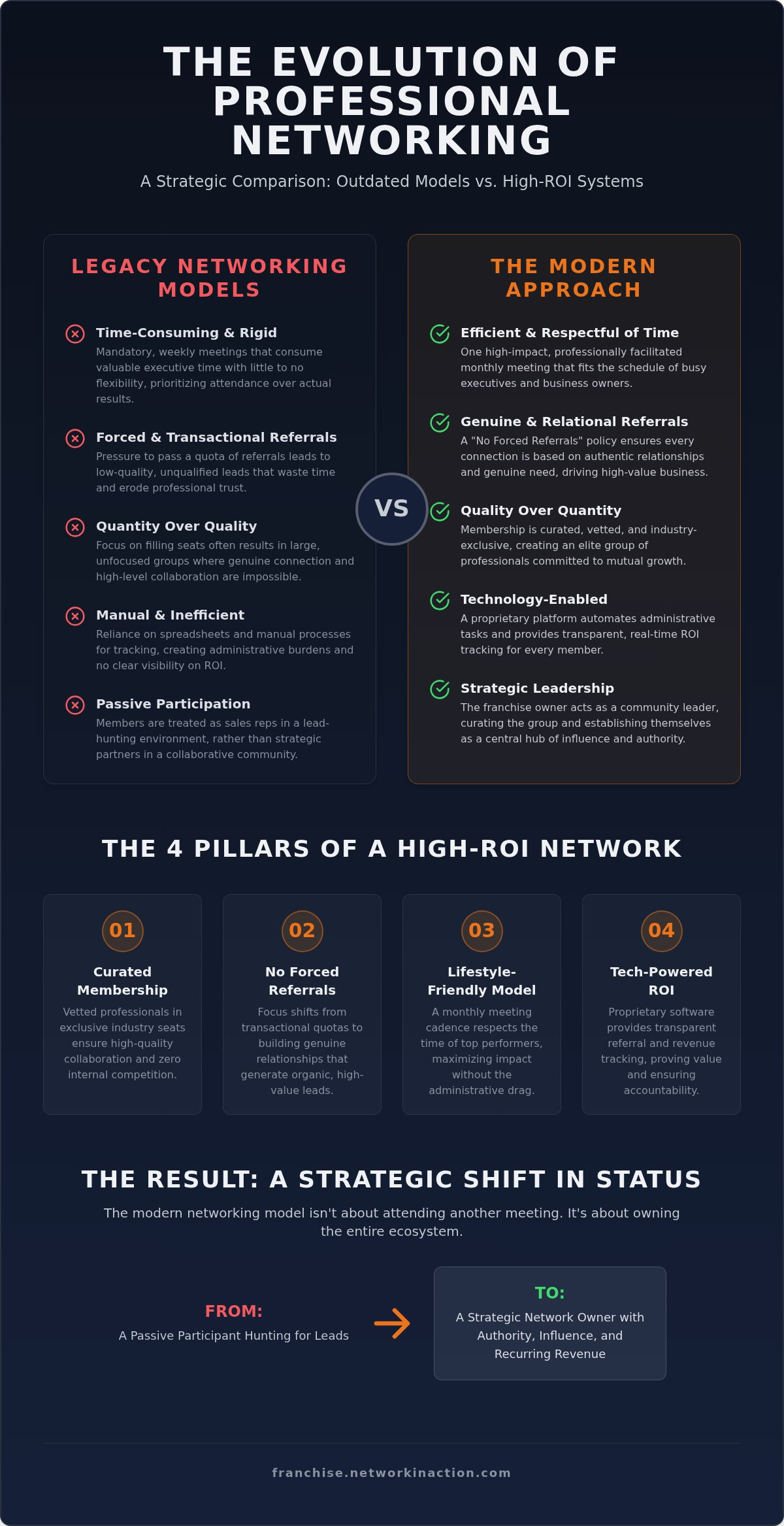
Stop participating. Start leading. A business networking group is not a social club; it's a precision-engineered professional community designed for referral generation and mutual growth. While most professionals join groups to hunt for leads, leaders create them to gain leverage. Owning the network establishes immediate authority and elite professional credibility. You're no longer just another service provider in the room. You're the gatekeeper. You're the hub. You're the authority.
The 2026 business environment has no patience for cold prospecting or generic mixers. It demands curated, high-trust environments. High-level executives are abandoning legacy networking organizations because those models don't respect their time. They're seeking a business networking framework that prioritizes quality over quantity. This shift from transactional interactions to relational capital is driving a massive market demand for sophisticated leadership.
Identifying the Gaps in Traditional Networking
Traditional networking is a liability. The "Legacy Trap" forces high-level professionals into rigid, weekly meetings that prioritize attendance over outcomes. It's inefficiency by design. When you analyze the time-to-value ratio of these outdated networking models, the math fails every busy executive. Forced referrals lead to low-quality leads, wasting everyone's time and eroding trust. Modern systems favor monthly engagement. Less frequency. Higher quality. Better results. Moving to a monthly model respects the schedules of top-tier earners while ensuring that every interaction is high-impact. It replaces the administrative drag of constant meetings with a streamlined, results-oriented cadence.
The ROI of Community Leadership
Leading a group turns you into the central hub of your local economy. You aren't just building a list; you're leveraging social capital to create a self-sustaining referral engine for your primary business. This isn't just about influence. It's about income. A networking group franchise opportunity transforms networking from a line-item expense into a profitable business asset. You're building recurring revenue streams while establishing professional autonomy. This model allows you to curate an elite membership base, ensuring that you're always the most connected person in the room. By securing available territories, you can scale this influence across entire regions, turning community leadership into a scalable professional footprint. Results matter. Influence pays. Autonomy wins.
Establishing the Structural Pillars of a High-ROI Network
High-ROI networking doesn't happen by accident. It's built on four non-negotiable pillars. First, prioritize quality over quantity. A curated group of 30 high-performing professionals will always outproduce a generic room of 100. Small, elite groups foster deeper trust and more substantial financial outcomes. Second, eliminate forced referrals. Legacy networking organizations often mandate quotas, leading to low-value leads that waste everyone's time. By implementing a "No Forced Referrals" rule, you ensure every lead is genuine and qualified.
Third, respect the clock. Busy business owners don't have time for weekly breakfast meetings. A monthly meeting model maximizes impact while maintaining a lifestyle-friendly schedule. Fourth, leverage technology. Spreadsheets are the enemy of scale. A modern networking group franchise opportunity provides the digital infrastructure needed to scale without administrative overhead. Understanding the importance of business networking is only the first step. You must have the systems to capture and measure that value.
Curation and Membership Selection
Vetting is your first line of defense. You must select members based on professional alignment and a visible commitment to growth. Maintaining a strict one-person-per-industry rule is essential. This exclusivity removes internal competition and increases the value of each seat. When members know they're the sole representative of their field, they engage more deeply. The goal is a Culture of Contribution. Members should focus on serving the group rather than selling to it. This shift in mindset transforms a room of vendors into a board of advisors. If you're ready to see how these systems work in practice, you can download a franchise kit to explore the full operational blueprint.
Technology-Enabled Referral Tracking
Manual tracking is a relic of the past. A proprietary business referral platform allows for real-time tracking of closed business and lead quality. This transparency creates immediate accountability. Mobile connectivity ensures members remain engaged between monthly sessions. They can pass leads, schedule one-on-ones, and track their ROI directly from their phones. Data-driven leadership allows you to use analytics to identify high-performers and address friction points before they become problems. You aren't just running a meeting; you're managing a high-performance engine. Use the data to refine the membership and optimize the referral flow.
Legacy Models vs. Modern Networking Systems
Legacy networking organizations operate on an obsolete script. They demand weekly presence, regardless of the actual value exchanged. This rigid structure is a relic of a pre-digital era. Modern systems prioritize results over attendance. You don't need a weekly breakfast meeting to drive growth; you need a networking group franchise opportunity that leverages technology to verify organic referrals. Moving from forced quotas to tech-verified connections changes the entire dynamic of the room. It shifts the focus from "who do I have to refer today" to "who is the best fit for this opportunity." Maximum efficiency. Zero fluff.
The High Cost of DIY Management
Administrative friction is a silent profit killer. The hidden hours spent on scheduling, manual billing, and chasing member communications add up quickly. Most DIY groups plateau at 10 to 15 members because the organizer runs out of bandwidth. This is the scalability ceiling. Beyond the time drain, there is a significant professionalism gap. High-level executives expect sophisticated tools. If your group relies on messy spreadsheets and fragmented email chains, member perception drops. Retention suffers when the experience feels amateur. Legacy tools project a legacy image.
The Advantage of an Established Framework
Proven processes eliminate the risk of group failure. Starting with a validated business model means you aren't guessing at what works. You're implementing a system already refined across over 150 locations worldwide. A networking group franchise opportunity provides immediate brand authority. You aren't just building a local meetup; you're connecting your members to a global reach of professionals. This Business Networking Franchise: The Executive Guide to Modern Ownership details how an established framework offers influence that extends beyond your local zip code. Global reach. Proven systems. Elite results.
A Strategic 5-Step Framework for a Successful Launch
Success in business networking isn't accidental. It's engineered. To move from a participant to a leader, you must follow a structured blueprint that prioritizes high-value connections and operational efficiency. Selecting the right networking group franchise opportunity provides the turnkey system needed to bypass the trial-and-error phase of group building. This isn't about gathering a crowd. It's about building a fortress of professional influence. If you're exploring a networking group franchise opportunity, these five steps ensure your launch is both impactful and sustainable.
- Step 1: Map your territory. Identify the high-value demographics and industries that form the backbone of your local economy.
- Step 2: Deploy the infrastructure. Select a technology platform that automates referrals, tracks ROI, and handles communication without manual intervention.
- Step 3: Anchor with founders. Recruit influential leaders who command respect and set a sophisticated professional tone for the entire group.
- Step 4: Execute the showcase. Host a launch event that demonstrates modern networking philosophy in action, focusing on results rather than fluff.
- Step 5: Normalize monthly operations. Transition into a consistent cadence that balances deep professional engagement with member accountability.
Sourcing High-Level Founding Members
Your founding members are your brand. Use a Power Partner strategy to identify professionals who naturally trade high-value referrals, such as CPAs, attorneys, and business consultants. When you reach out, pitch the disruption. Highlight the inherent flaws in outdated networking models, specifically the time drain of weekly meetings and the low quality of forced referrals. Position your group as the elite alternative. Implement a rigorous application process from the start. Exclusivity creates value. When you make the "seat" a prize to be won, you attract the caliber of professional who values their time and their network. To get started, you can check available territories to see where you can lead.
Facilitating the First Meeting
The first meeting is a demonstration of ROI. Ditch the 30-second commercials. They're transactional and inefficient. Instead, use the time for deep professional dives and collaborative problem-solving. This shows members that the group is a strategic asset, not just a lead-gen tool. Demonstrate the technology early. Show them exactly how the platform simplifies the referral process and tracks every dollar of closed business. Close the room with logic. High-level professionals stay because the math works. If the efficiency and the potential for relationship-driven growth are clear, the commitment follows naturally. Professional autonomy starts here.
Scaling Your Influence: From Organizer to Network Owner
Owning a single group is a start. Owning a territory is a strategy. Standalone groups often fail because the organizer is the only engine. If you stop, the group stops. A networking group franchise opportunity provides the fuel and the framework to move beyond manual management. You aren't just running meetings; you're building a massive professional footprint across a region. This is the definitive shift from being a local organizer to becoming a network owner.
Scalability is the differentiator. You can launch multiple groups across a region, creating a web of influence that most independent organizers can't touch. Each group acts as a strategic node in your network, increasing both your recurring revenue and your social capital. This model offers true lifestyle autonomy. Low overhead. No inventory. High-level engagement. You're positioning yourself as the premier business facilitator in your market. You aren't just a member; you're the architect of the local economy. The person everyone needs to know. The authority who makes things happen.
The Turnkey Path to Ownership
Don't learn as you go. Professional onboarding beats DIY trial-and-error every time. You gain immediate access to systems refined across more than 150 locations worldwide. This turnkey approach eliminates the guesswork that plagues independent groups. Territory rights are your most valuable asset. They secure your market and prevent competition within your own professional network. You own the space. You set the rules. You reap the rewards. It's a sophisticated way to build a business that values your time as much as your talent. It's time to Explore Available Territories to see where you can lead.
Finalizing the Executive Move
Transitioning from the corporate grind requires a bridge. Networking ownership provides that path to full-time entrepreneurship without the risks of an unproven startup. You're building a long-term asset that has value beyond your personal participation. Unlike a corporate role, this is a business you can eventually sell or pass on. It's a strategic move for the smart professional who wants to leverage their existing network into a self-sustaining income stream. The discovery process is the first step toward time freedom and professional autonomy. You've seen the blueprint. You understand the math. Now, Download the Franchise Kit to begin the discovery process and secure your professional future.
Securing Your Place in the Next Evolution of Business Networking
The era of wasting hours in rigid, weekly meetings is over. You've seen the blueprint for a model that respects your time and maximizes your influence. By choosing a networking group franchise opportunity that prioritizes quality over quantity, you move from a mere participant to a strategic hub of your local economy. You gain the freedom of a lifestyle-friendly business while building a high-value asset that delivers consistent, recurring revenue.
Success in 2026 requires more than just handshakes. It requires a proprietary technology platform and a proven monthly meeting model already validated across over 150 global locations. This is the modern evolution of networking leadership. You have the skills and the network; now you need the system to scale them. The next step is alignment.
If you're ready to lead a curated community of elite professionals, it's time to explore the operational details. Start your journey toward network ownership; Download the NIA Franchise Kit. Professional autonomy and community impact are within reach.
Frequently Asked Questions
How do you structure a business networking meeting for maximum ROI?
Maximum ROI is achieved by replacing 30-second commercials with collaborative problem-solving and deep professional dives. Modern meetings occur monthly rather than weekly, respecting the schedules of top-tier earners. This structure ensures that every minute spent in the room focuses on high-level strategic alignment rather than transactional small talk. By utilizing a technology-enabled platform, you can track closed business in real-time, ensuring the group's financial impact is transparent and measurable from day one.
What are the common pitfalls when starting a networking group from scratch?
The most common pitfall is falling into the trap of manual administration without a scalable system. Organizers often struggle with referral fatigue in traditional networking models where members feel pressured to pass low-quality leads. Without a proprietary technology platform, tracking ROI becomes impossible, leading to member attrition. Starting from scratch also lacks the brand authority needed to attract elite professionals who are skeptical of unproven, informal meetups that lack clear structure.
How do you recruit high-level executives who are usually too busy for networking?
Recruiting busy executives requires a pitch focused on efficiency and exclusivity. You must highlight that this isn't a traditional networking model burdened by weekly commitments. Executives respond to the monthly meeting model and the promise of a curated, high-quality membership base. Position the networking group franchise opportunity as a strategic board of advisors rather than a sales club. When they see that their time is respected and the ROI is tracked, the commitment follows.
What is the ideal member size for a professional networking group?
The ideal size for a high-performance group is approximately 30 to 40 professionals. While legacy networking organizations often push for massive numbers, modern excellence requires curation over quantity. A group of this size allows for one representative per industry while maintaining deep, personal relationships. This scale ensures that the referral engine remains manageable and that every member is a high-contributor, preventing the dilution of lead quality found in larger, generic groups.
How do you handle members who do not contribute or pass high-quality referrals?
Handling non-contributing members requires a data-driven approach rather than personal confrontation. Use a proprietary technology platform to monitor referral quality and engagement metrics transparently. Because there are no forced referrals, the focus shifts to a culture of contribution where members are expected to add value through their expertise and connections. If a member consistently fails to engage, the data provides a clear, objective basis for removal to protect the group's overall ROI.
Is it better to start a DIY group or invest in a networking franchise?
Investing in a networking group franchise opportunity is superior to the DIY route due to the turnkey systems and immediate brand authority. Independent groups often hit a scalability ceiling because the organizer is bogged down by scheduling, billing, and member vetting. A franchise provides the technology, training, and 150-plus location track record needed to build a professional organization. It transforms a time-consuming hobby into a scalable, recurring revenue asset with a clear path to profitability.
What technology is required to manage a modern networking group efficiently?
Modern management requires more than just a spreadsheet or a basic email list. You need a proprietary referral platform that automates lead tracking, ROI reporting, and member communication. Mobile connectivity is essential for keeping members engaged between monthly sessions without requiring manual follow-up from the leader. This digital infrastructure handles the administrative overhead, allowing you to focus on high-level community leadership and strategic growth rather than tedious clerical tasks.
How long does it take to see a return on investment when starting a group?
ROI timing depends on your ability to recruit influential founding members who set the professional tone. Because the model relies on recurring membership revenue and low overhead, the path to profitability is typically faster than traditional brick-and-mortar businesses. Using a proven franchise framework allows you to bypass the trial-and-error phase that often delays returns in independent startups. By leveraging existing systems and brand equity, you can establish a self-sustaining referral engine within the first few months.