Most executive investments fail not because of a lack of capital, but because of a lack of modern vision. You've spent years building a professional reputation and refuse to settle for a rigid, legacy system that feels like a step backward. Learning how to perform due diligence on a franchise opportunity is the only way to separate high-growth, tech-forward models from the inefficient fossils of the past. It's a critical skill for any leader who values time as much as ROI.
You likely agree that the fear of buying into a "job" rather than a scalable asset is real. Outdated networking models often trap owners in a cycle of transactional busywork and hidden costs. This guide changes that narrative. You will master a strategic framework designed to evaluate the 2026 market landscape with surgical precision. It's time to build a business that serves your lifestyle, not one that consumes it.
This roadmap provides the clarity you need to validate financial projections and ensure your investment aligns with your long-term goals. You'll explore the essential steps to identify modern, technology-led systems that offer consistent income streams and genuine community impact. Prepare to replace uncertainty with an actionable plan for professional freedom and measurable results.
Key Takeaways
- Shift from emotional excitement to cold business logic by treating your investigation as a strategic intelligence mission rather than a simple hurdle.
- Decode the true cost of entry and potential earnings by conducting a deep-dive analysis of Item 19 and total investment metrics within the FDD.
- Master how to perform due diligence on a franchise opportunity by using validation calls to verify proprietary technology and real-world scalability.
- Audit your future lifestyle by comparing the time ROI of modern monthly meeting structures against the rigid demands of legacy networking organizations.
- Finalize your investment with confidence by assembling a professional cabinet of advisors and preparing for a high-impact Discovery Day experience.
The Executive Framework for Franchise Due Diligence
Due diligence isn't a bureaucratic hurdle. It's a strategic intelligence gathering mission. Successful executives don't just "look into" a business; they dissect it. You must shift from emotional excitement to cold, practical business logic. By learning how to perform due diligence on a franchise opportunity, you stop being a prospect and start being an investor. Emotional decisions lead to regret. Logical ones lead to ROI. You aren't just buying a brand; you're acquiring a system that must perform under pressure.
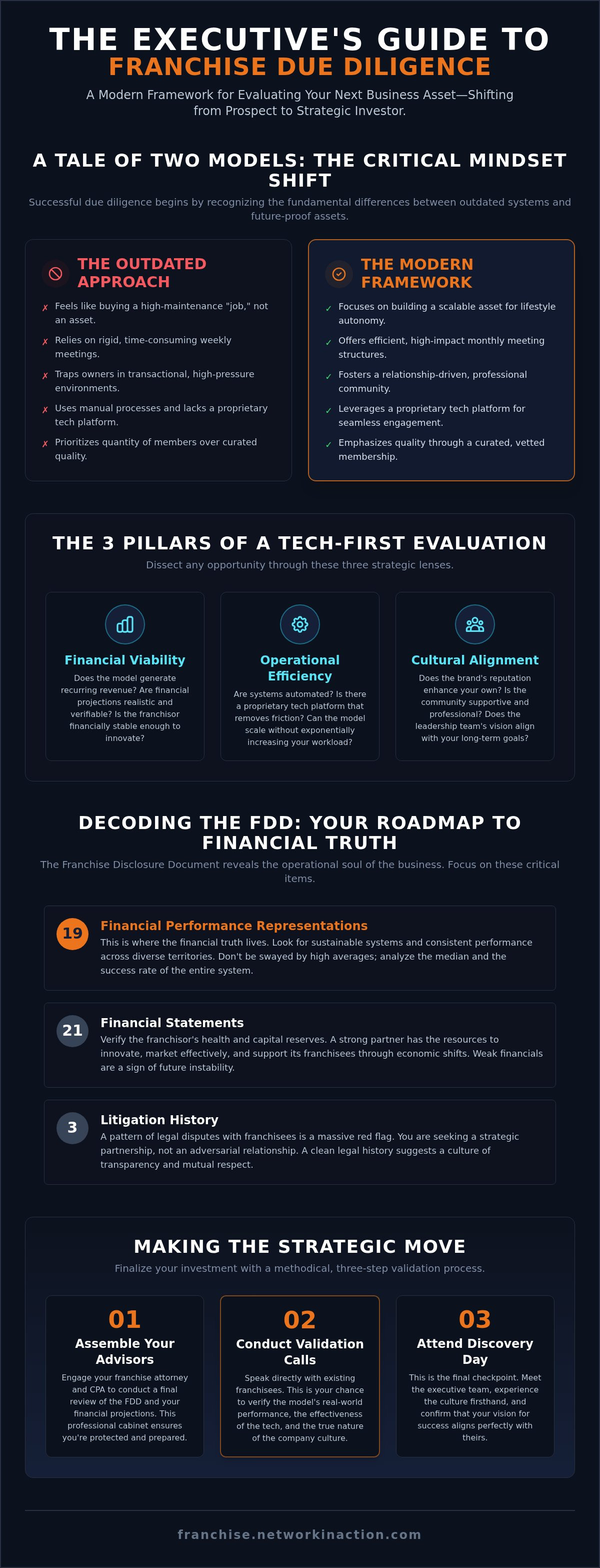
The framework for 2026 requires a tech-first approach. Outdated networking models rely on manual processes and legacy thinking. You need a system built for the digital age. This involves evaluating three core pillars: Financial, Operational, and Cultural. Does the model generate recurring revenue? Are the systems automated and efficient? Does the brand's reputation enhance your own? If the answer to any of these is "no," the investment is a liability. In 2026, connectivity is the new currency. A franchise without a proprietary tech platform for member engagement is already obsolete. You want a model that uses technology to remove friction, not add to it.
Defining Your Investment Thesis
Clarity precedes success. You must identify if your primary goal is lifestyle autonomy or aggressive market expansion. Not all models are created equal. Determine the required ROI for both your capital and your time. If a business demands 50 hours of manual oversight each week, it's a job, not an asset. Assess how the franchise model aligns with your existing professional network. You want a system that leverages your current social capital to scale quickly. Professional credibility is your most valuable asset. The right franchise acts as a force multiplier for your influence within the local business community.
Market Viability and Informed Disruption
Analyze the local competitive landscape with a critical eye. Many markets are cluttered with legacy networking organizations that prioritize quantity over quality. These traditional networking models are ripe for disruption. You're looking for "white space" in available territories where business owners are tired of transactional, time-consuming meetings. By understanding how to perform due diligence on a franchise opportunity, you can identify regions where a modern, monthly meeting model will thrive as a superior alternative to the status quo. Seek territories that fit your demographic profile and offer the highest potential for long-term growth. Strategic territories are disappearing fast; your due diligence must be both thorough and timely.
Decoding the Franchise Disclosure Document (FDD) and Financial Metrics
The FDD is the most powerful tool in your arsenal. It's a 23-item roadmap that reveals the franchisor's operational soul. Understanding how to perform due diligence on a franchise opportunity requires a surgical focus on Item 19. This is where the financial truth lives. You aren't just looking for high numbers; you're looking for sustainable systems. Referencing the Consumer's Guide to Buying a Franchise from the FTC is a smart first step to understanding these legal protections. Data doesn't lie. It reveals the gap between marketing promises and actual performance.
Review the franchisor's financial health in Item 21. You want a partner with the capital to innovate. Check Item 3 for litigation history. A pattern of legal disputes with franchisees is a massive red flag. You're looking for a partnership, not a battleground. Modern business requires a transparent relationship where both parties are aligned toward growth. If the financials are shaky or the legal history is cluttered, walk away. Efficiency starts with a clean foundation.
Analyzing Item 19 Performance Data
Don't settle for averages. Top-tier performers show what's possible when the system is executed perfectly. You need to see consistency across diverse geographic territories. If only one region is thriving, the model might not be scalable. Cross-reference this data with a franchise ROI calculator to build realistic projections for your own market. This isn't about hope. It's about data-driven confidence. High-performing locations validate the system's strength and your potential for market leadership.
Understanding Recurring Revenue and Fees
Evaluate the cost of entry vs. the total investment. Item 5 lists initial license fees, but Item 7 reveals the real capital required to reach profitability. In professional networking, the magic is in the recurring revenue. Sustainability depends on monthly membership fees, not one-off transactions. Audit the ongoing royalty structures. Traditional networking models often hide costs in rigid, legacy structures. Modern alternatives use flat fees or specific tech access charges that provide a clear value-added ROI. In 2026, the FTC's stricter fee transparency mandate requires all software and technology charges to be explicitly listed in Item 5. No more hidden markups. You deserve total clarity on where every dollar goes. To see how a modernized model structures these metrics for executive success, you can download the franchise kit for a transparent look at the numbers.
Validating the Model: Beyond the FDD
Validation calls are the most powerful tool in your due diligence arsenal. They move you past paper projections into lived reality. While the FTC's guide to buying a franchise provides the essential legal framework, talking to current owners provides the ground truth. You need to know if the system works when the corporate trainers leave the room. It's about verifying the efficacy of proprietary technology and the actual quality of ongoing corporate support. This is where you confirm if the brand delivers on its promises.
You aren't just looking for testimonials. You're looking for operational evidence. High-level executives don't settle for surface-level conversations. You need to understand the difference between "forced referrals" and "organic relationship growth." Legacy networking organizations often rely on rigid, transactional quotas that feel desperate and inefficient. A modern model focuses on high-quality membership and technology-enabled connectivity. This distinction is the key to maintaining your professional credibility while scaling your investment.
The Franchisee Validation Interview
Don't ask owners if they're "happy." Ask them about their path to profitability. Inquire about their specific break-even points and the actual time they spend on group management versus business development. This reveals the true nature of the daily grind. Gauge their level of satisfaction with the referral marketing strategy provided by the franchisor. If they're still cold prospecting, the system is flawed. You want a model where the network does the heavy lifting for you.
Auditing the Technology Stack
Most guides ignore the technology stack. In 2026, that's a fatal oversight. Request a comprehensive demo of the proprietary technology platform. Evaluate how it reduces the administrative burden that defines traditional networking. If the system doesn't offer mobile accessibility and advanced member engagement tools, it isn't built for the future. Tech should remove friction, not create it. Look for tools that automate tracking and connectivity, allowing you to focus on leadership rather than logistics. Learning how to perform due diligence on a franchise opportunity means auditing the digital infrastructure as strictly as the financial ledger.
The Lifestyle Audit: Assessing Time ROI and Scalability
True wealth is the ability to own your time while generating executive-level income. Many franchise opportunities are just high-intensity jobs in disguise. When learning how to perform due diligence on a franchise opportunity, you must distinguish between a business that serves you and one that consumes you. Legacy networking organizations often trap owners in a rigid weekly meeting model. This creates a relentless cycle of preparation and attendance that leaves little room for strategic growth or personal freedom. It's a transactional grind that lacks professional sophistication.
A modern monthly meeting structure respects the executive schedule. It allows you to build a high-impact professional community without the burnout associated with outdated networking models. You aren't just looking for cash flow; you're looking for time-freedom. A scalable business should function with high efficiency and low manual overhead. If the model requires your physical presence for every transaction, it isn't a scalable asset. In 2026, the most successful owners are those who leverage technology to replace manual labor. Efficiency is the ultimate measure of success.
Time-Freedom as a Business Metric
Calculate the hourly ROI of managing a professional networking business. Executives often overlook the "burnout factor" inherent in legacy networking organizations that demand constant, low-value administrative work. Verify if you can manage the business alongside other professional interests or if it will become a full-time operational anchor. The goal is to leverage your network, not become a slave to a spreadsheet. Efficient systems and proprietary technology should handle the logistics so you can focus on leadership and high-level relationship building. Your time is too valuable to spend on manual tracking and forced referral quotas.
Scalability and Expansion Potential
Analyze how the business scales without adding significant overhead. Look for models that allow for multiple territory ownership from the start. A deep understanding of how to perform due diligence on a franchise opportunity includes evaluating the flexibility of territory rights for future expansion. A truly executive-level opportunity allows you to hire group leaders as the business grows, shifting your role from operator to visionary leader. Audit the renewal and transfer terms in the franchise agreement to ensure your long-term exit strategy is protected.
- Identify models that support multi-unit growth through streamlined, digital systems.
- Evaluate the ease of replicating the model across diverse geographic demographics.
- Assess the potential for recurring revenue streams that grow without additional manual effort.
Scalability is the difference between a local group and a regional empire. If you are ready to lead a sophisticated professional community and secure your lifestyle autonomy, explore available territories to see where your network can thrive.
Making the Strategic Move: Finalizing Your Investment
Finalizing your investment is the culmination of your strategic intelligence mission. It's the moment where data-driven insights transform into executive action. Assemble your cabinet. You need a franchise attorney, a specialized accountant, and a strategic mentor to vet the final details. This professional support system ensures that your understanding of how to perform due diligence on a franchise opportunity is backed by expert verification. Precision at this stage prevents friction later. It builds the necessary foundation for long-term ROI and professional credibility.
Confirm the final territory boundaries and exclusive rights with surgical detail. In 2026, market boundaries represent your exclusive reach in a tech-enabled landscape. Ensure your rights are protected against encroachment from legacy networking organizations that might try to pivot into your space. A clear, undisputed territory is the bedrock of your future scalability. It's your professional kingdom. Secure it with a contract that reflects your long-term vision for market dominance. Don't leave any room for ambiguity when it comes to your exclusive footprint.
Discovery Day and Leadership Alignment
Discovery Day is your final audit. It's a high-energy environment where you meet the visionary leaders behind the brand. Evaluate their commitment to the informed disruption of the industry. You aren't just looking for a franchisor. You're looking for a technology partner. Ask critical questions about the future tech roadmap and brand growth strategies. If the leadership team still relies on the manual methods of outdated networking models, the partnership won't survive the digital shifts ahead. Seek a shared obsession with efficiency and member ROI. Ensure your values align with the next evolution of the industry.
Execution and Launch Readiness
Success requires meticulous preparation. Confirm the training schedule and ensure you have access to comprehensive launch support systems. Review the franchise kit for the marketing and operational blueprints that will drive your early growth. These aren't just suggestions. They're the battle-tested systems of a modern business model. Set clear 90-day goals for member recruitment and your initial group launch. This driving pulse of activity ensures that your transition from executive to franchise owner is seamless and immediately impactful. Execution is the primary measure of success. Lead with confidence and purpose.
Secure Your Professional Freedom Through Strategic Precision
Success in the franchise world isn't about luck. It's about the rigorous application of executive logic. You've learned to decode the FDD, conduct high-impact validation calls, and audit your future lifestyle. These steps separate those who buy a job from those who build a scalable asset. By prioritizing technology-led efficiency and a monthly meeting model, you can disrupt the status quo of legacy networking organizations while protecting your most valuable resource: time.
Mastering how to perform due diligence on a franchise opportunity is the final step before taking command of your market. With over 150 locations globally and a proprietary technology platform, the path to an executive-level ROI is clear. It's time to align your professional reputation with a system built for the digital age. Download the NIA Franchise Kit to Start Your Due Diligence today. Your evolution into community leadership starts with a single, informed decision. Build the legacy you deserve.
Frequently Asked Questions
What is the most important item to look for in a Franchise Disclosure Document?
Item 19 is the engine of your financial analysis because it reveals the actual earnings of existing owners. You must also scrutinize Item 21 to verify the franchisor's corporate stability and capital reserves. Learning how to perform due diligence on a franchise opportunity requires looking past top-line revenue to find the net profit. Focus on the consistency of performance across different territories to ensure the model is truly scalable and not dependent on a specific market.
How much time does a franchise owner typically spend on daily operations?
Operational time varies significantly based on the business structure. Traditional networking models often demand 40 plus hours of manual coordination and weekly meeting attendance. In contrast, modern monthly meeting structures utilize proprietary technology to automate administrative tasks. This shift allows executives to focus on high-level relationship building and community leadership rather than logistics. You should expect to spend time on business development while the digital platform manages the tracking and member connectivity.
Can I perform due diligence without hiring a franchise lawyer?
You can physically read the documents alone, but smart investors never skip professional counsel. A franchise attorney identifies predatory clauses and rigid corporate structures that might limit your future scalability. While you focus on the business logic and market viability, your attorney ensures your exclusive territory rights are ironclad. This dual approach is essential for any executive looking to protect their professional reputation and capital while securing long-term lifestyle autonomy.
What are the red flags to watch for when researching a franchisor?
Watch for high litigation rates in Item 3 or a large number of closed locations in Item 20. These metrics signal systemic failure or poor leadership alignment. Another major red flag is a reliance on outdated networking models that prioritize forced referrals over organic growth. If the franchisor lacks a clear technology roadmap or hides costs in vague operational manuals, the model is likely an inefficient legacy system that will consume your time without delivering ROI.
How do I verify the financial claims made in Item 19?
Direct validation calls with existing owners are the only way to confirm Item 19 claims. Ask them to share their break-even timelines and actual monthly expenses. Compare their results with the data in the FDD to find any discrepancies. Successful investors also use a specialized ROI calculator to run worst-case scenarios. Verifying these claims is a core part of how to perform due diligence on a franchise opportunity and ensures your financial projections are grounded in reality.
What is the difference between a royalty fee and a technology fee?
Royalty fees are recurring payments for the right to use the brand name and access ongoing corporate support. Technology fees specifically cover the maintenance and innovation of the proprietary platform. In a modern franchise, the technology fee is a value-add that reduces your manual workload and enhances member connectivity. Traditional networking models often lack these digital tools, forcing owners to handle tracking manually, which decreases your overall efficiency and time ROI.
How long does the franchise due diligence process usually take?
The process typically spans 30 to 90 days, depending on your pace and the franchisor's responsiveness. Federal law mandates a 14-day waiting period after receiving the FDD before you can sign any contracts. This timeline includes deep-dive financial analysis, multiple validation calls, and the final Discovery Day experience. Rushing this window is a mistake. A methodical approach ensures you've vetted every operational detail and confirmed the model's alignment with your professional goals.
Why is validation from current franchisees so critical?
Validation calls provide the ground truth that marketing materials often gloss over. Current owners will tell you if the corporate support is actually supportive or if the technology platform truly removes administrative friction. This is your chance to hear about the daily reality of running the business. If owners are thriving without cold prospecting, the system works. Their feedback confirms if the opportunity is a strategic asset or just a high-pressure job in disguise.