The most lucrative franchise opportunities in 2026 aren't bought with cash; they're engineered with strategic leverage. You recognize that traditional investment paths often lead to stagnant returns and high-pressure environments. Succeeding in this market requires more than just capital. It demands a sophisticated understanding of how to use SBA loans for franchise businesses to bypass legacy industry flaws. The June 30, 2026, certification deadline has already redefined the market, purging brands that failed to modernize their compliance. Strategic leverage. Elite growth.
Securing low-interest, long-term financing is the foundation of a scalable business built on recurring revenue. You deserve a model that offers lifestyle autonomy and community leadership without the rigid, transactional nature of legacy networking organizations. This executive guide provides the clarity needed to master SBA financing complexities. You'll discover how to leverage the new $10 million combined program limits to fuel rapid expansion. Move beyond outdated models. Embrace a tech-forward approach to professional ownership. Efficiency wins. Results matter. This is the modern evolution of business funding.
Key Takeaways
- Identify the critical August 2026 SBA Franchise Directory updates that determine your brand's eligibility for government-backed funding.
- Master the 5-step roadmap to secure SBA loans for franchise businesses by aligning your financial profile with modern underwriting standards.
- Analyze the superior ROI of tech-enabled networking models compared to the rigid, time-consuming requirements of legacy networking organizations.
- Leverage the newly clarified $10 million combined loan limits to scale your franchise operations and secure long-term capital efficiency.
- Discover how monthly meeting structures and proprietary technology platforms translate SBA funding into sustainable lifestyle autonomy.
Navigating SBA Loans for Franchise Businesses in 2026
Smart money moves with strategy, not desperation. Many executives mistakenly view government-backed financing as a fallback for those who can't secure traditional bank debt. In reality, SBA loans for franchise businesses serve as a high-octane fuel for sophisticated investors who value capital preservation and long-term liquidity. By utilizing the SBA 7(a) Loan program, you tap into a system designed to reduce lender risk through federal guarantees. This translates into lower down payments, extended repayment terms, and the ability to keep your personal capital working in other high-yield investments. It's a calculated play for the modern entrepreneur.
The 2026 Lending Landscape for Executives
August 2026 presents a unique window for acquisition. With the Wall Street Journal Prime Rate holding at 6.75%, the cost of capital remains manageable for those targeting high-margin service sectors. This environment has triggered a massive shift. Seasoned leaders are exiting the C-suite to pursue top executive business opportunities in 2026 that offer recurring revenue and professional autonomy. Unlike independent startups, which face a brutal failure rate, franchise systems provide a structured path that lenders actually trust. The modern executive doesn't just want a job; they want an asset. Service-based franchises have become the gold standard for this transition because they minimize physical overhead while maximizing professional impact. SBA funding facilitates this by providing up to $5 million in capital, allowing you to scale multiple territories simultaneously.
Why Lenders Prefer Franchise Models
Lenders prioritize predictability. They aren't just betting on your resume; they're betting on the franchisor’s operational blueprint. When you apply for SBA loans for franchise businesses, the bank reviews a proven track record documented in the Franchise Disclosure Document (FDD). This brand equity functions as a secondary form of security. Corporate support ensures you aren't building in a vacuum, which simplifies the underwriting process and accelerates your time to market. Banks recognize that franchise systems come with built-in training, marketing engines, and supply chains. This infrastructure significantly lowers the risk of default, making your application far more attractive than a solo venture. It's a modernized approach to debt that favors the prepared leader. Efficiency wins. Structure scales.
The SBA Franchise Directory: Ensuring Brand Eligibility
The SBA Franchise Directory is the ultimate gatekeeper for your capital strategy. In 2026, the stakes are higher than ever. The June 30, 2026, deadline for the new Franchisor Certification has already separated the elite brands from the laggards. If your chosen brand isn't on the list by August 2026, your path to SBA loans for franchise businesses is effectively blocked. This directory isn't just a list; it's a verification of a brand's health and compliance with federal lending standards.
The SBA uses this directory to ensure the franchisor doesn't exert excessive control over your business. They want to see that you are the true owner. While the SBA has streamlined the process by shifting from the required SBA Form 2462 (Addendum to Franchise Agreement) to a one-time Franchisor Certification, the core requirement remains. The franchisor cannot unilaterally access your bank accounts or dictate daily operations beyond brand standards. This protection ensures your autonomy as a community leader.
Eligibility Standards for Modern Franchises
To qualify, your franchise must meet the SBA’s Small Business size standards, typically based on annual receipts or employee counts. Tech-forward models often have a significant advantage here. Traditional networking organizations often struggle with outdated, manual reporting that complicates the underwriting process. Modern, tech-enabled platforms provide the data transparency lenders crave. Even if a brand has international operations, the U.S. entity must independently meet these eligibility benchmarks to secure domestic funding. Efficiency wins. Data speaks.
Vetting Your Chosen Brand
Verification is your first move. You can search the official directory to confirm a brand's status. Choosing a brand that isn't listed triggers a negotiation phase between the franchisor and the SBA. This is a high-risk delay you don't need. Smart professionals prioritize brands with pre-approved financing pathways. It signals that the franchisor has already cleared the bureaucratic hurdles, allowing you to focus on growth rather than paperwork.
- Verify Status: Check the directory before signing any disclosure documents.
- Analyze Compliance: Ensure the brand met the June 2026 certification deadline.
- Prioritize Speed: Pre-approved brands offer faster closing times.
Before committing capital, check territory availability to see where these pre-approved systems are expanding. Efficiency is the hallmark of an executive mindset. Don't waste time on brands that haven't secured their place in the 2026 directory. Focus on systems that respect your time and your investment. Results matter. Momentum is everything.
Legacy Networking vs. Modern Tech-Enabled Models
Legacy networking organizations operate on a manual, time-intensive model that hasn't evolved in decades. For an executive, time is the most valuable asset. Spending every Tuesday morning at a rigid, weekly meeting is an inefficient use of professional capital. Modern models disrupt this by utilizing monthly meetings and proprietary technology platforms. This shift isn't just about convenience; it's about ROI. A business networking franchise built on tech-enabled systems requires less manual labor and generates more consistent results. It's a calculated move for those who prioritize efficiency over tradition.
Efficiency as a Financial Differentiator
Outdated networking models rely on forced referrals, a metric that often prioritizes quantity over quality. This creates a transactional environment where members feel pressured rather than empowered. In contrast, tech-forward models focus on curated, high-quality membership. Proprietary technology platforms facilitate connectivity without requiring physical presence 52 times a year. This efficiency leads to higher member retention and more stable recurring revenue. Professionals choose these models because they value lifestyle autonomy. They want the professional credibility of community leadership without the shackles of rigid traditions. Quality wins. Structure scales.
Maximizing ROI with Low-Overhead Franchises
When applying for SBA loans for franchise businesses, your debt-to-income ratio is a critical factor. Service-based, low-overhead franchises are highly attractive to lenders because they don't require massive investments in real estate or heavy equipment. You can direct your SBA capital toward growth, marketing, and relationship-building rather than paying rent on a physical office that you don't actually need. This lean structure maximizes your ROI from day one. It's a smarter use of debt.
Lenders recognize that mobile, technology-enabled businesses are more resilient. They're easier to scale and adapt to shifting market conditions. By choosing a sophisticated service model over a manual-labor-intensive legacy business, you position yourself as a modern owner. You aren't buying a job; you're building a scalable asset. The proprietary tools provided by advanced systems reduce the need for high-interest working capital loans later on. Everything you need is built into the system. Results are measurable. Success is structured. This is the modern evolution of professional ownership.
The SBA Loan Roadmap: From Application to Approval
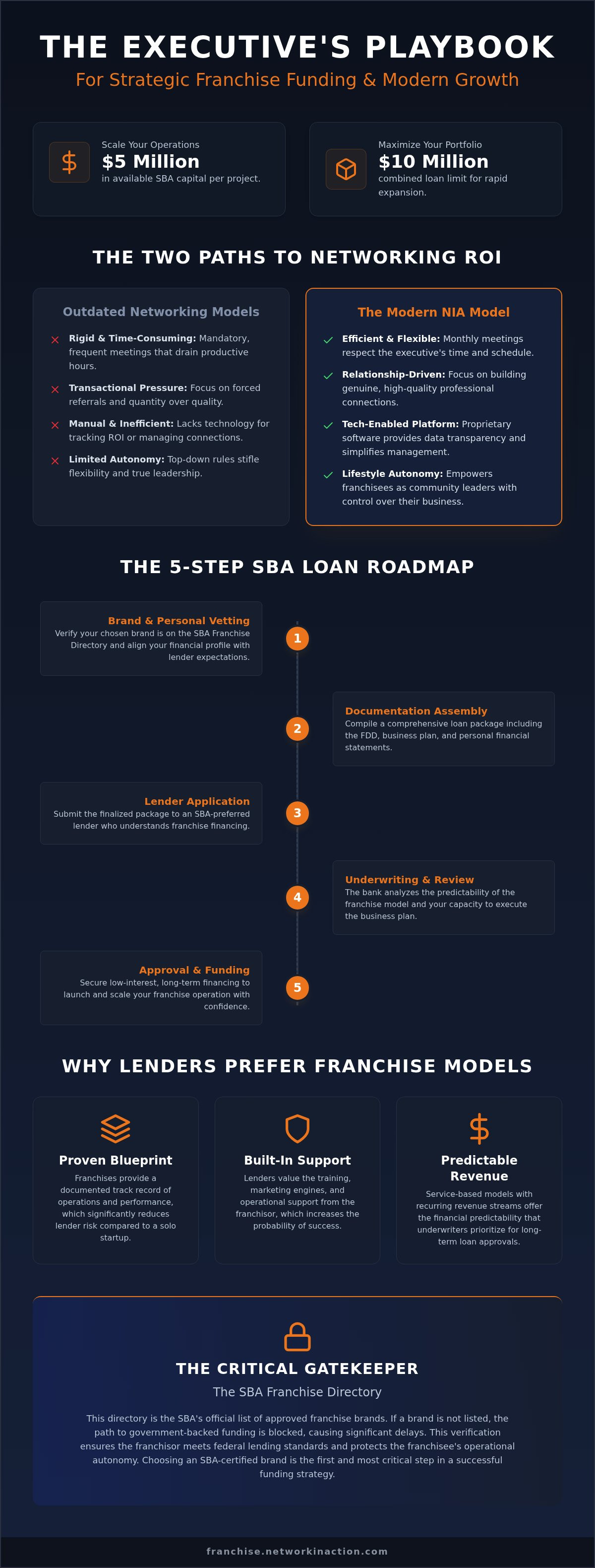
Strategic funding requires a precise roadmap. Securing SBA loans for franchise businesses is a structured 5-step process that begins with pre-qualification and ends with capital disbursement. First, you must verify your liquidity and credit profile. Second, compile a comprehensive documentation package. Third, enter the underwriting phase where lenders scrutinize the business model. Fourth, receive a commitment letter. Finally, move to closing and funding. Capital flows toward clarity. Preparation prevents delays.
Lenders prioritize high-level documentation. You'll need personal financial statements, the Franchise Disclosure Document (FDD), and a sophisticated business plan. Utilize the SBA's Lender Match tool to find institutions that specialize in service-based models. It's equally critical to select a lender with experience in the available territories you target. Regional expertise simplifies the appraisal and risk assessment phases. Lenders back leaders who understand their local market dynamics.
Preparing Your Executive Business Plan
Underwriters for referral-based businesses focus on the strength of the system. Your plan must project revenue based on member retention and high-quality connectivity rather than cold prospecting. Emphasize your community leadership and professional credibility as intangible assets that drive growth. These factors prove you can lead a sophisticated group of professionals. Working Capital is the lifeblood of a service franchise's first year. By including a clear strategy for these funds, you satisfy conservative underwriting requirements. Efficiency wins. Logic scales.
Closing the Deal: Timelines and Expectations
The 2026 lending environment requires patience and precision. Since the March 2026 shift back to manual underwriting for smaller 7(a) loans, realistic timelines now range from 60 to 90 days. Incomplete documentation is the primary pitfall that stalls applications. Ensure every tax return and financial statement is current to maintain momentum. Once funding is secured, the onboarding phase begins. This is where you transition from a candidate to a community leader. You can download a franchise kit to see how a tech-enabled system accelerates this transition. Speed to market is your competitive advantage. Results matter. Execute now.
Success in this phase depends on your ability to present a professional, executive-level case to the bank. Don't leave your funding to chance. Align with a brand that has already paved the way for SBA approval. This isn't just about getting a loan. It's about securing the foundation for your lifestyle autonomy. Move forward with confidence.
Leveraging SBA Funding for a Network In Action Franchise
Capital is a strategic weapon for the informed executive. Utilizing SBA loans for franchise businesses to launch a Network In Action territory aligns your financial resources with a model engineered for the 2026 economy. Lenders prioritize stability. NIA provides this through a recurring revenue stream anchored by high-level professional relationships. Unlike legacy networking organizations that demand weekly manual labor, NIA leverages a proprietary technology platform to maximize efficiency. This tech-forward approach reduces operational friction. Lenders see the data. They recognize the scalability. You secure the capital. It's the most efficient way to use SBA loans for franchise businesses to build a high-margin service asset.
Building Social Capital into Financial Returns
Social capital translates directly into financial returns when backed by a sophisticated referral marketing strategy. As an NIA franchise owner, you aren't just a facilitator; you're a community visionary. You curate elite groups of business leaders who value their time. By replacing outdated networking models with monthly, tech-enabled sessions, you offer a superior alternative that high-level members are eager to join. This is the modern evolution of professional networking. It's a system where technology handles the logistics, allowing you to focus on high-impact leadership. Influence grows. Income follows. Results matter.
Next Steps for the Aspiring Franchisee
Decision-making is the hallmark of leadership. If the goal is lifestyle autonomy and professional impact, the path forward is clear. Start your investigation by reading the free book, which details the philosophy behind modern networking. Once you understand the mindset, download the franchise kit to review the operational systems and financial metrics. These resources provide the transparency required for executive due diligence.
The final phase involves a discovery call to align your professional goals with a specific, strategic territory. This isn't a high-pressure sales pitch. It's a strategic alignment. You're a smart professional making a decisive move toward time freedom. Secure low-interest SBA funding. Build a scalable asset. Achieve the autonomy you've earned. The 2026 market rewards the bold. Efficiency wins. Momentum starts now.
Own the Evolution of Professional Networking
Success in the 2026 franchise market requires a total departure from the status quo. You've seen how SBA loans for franchise businesses provide the strategic leverage needed to acquire a scalable, tech-forward asset. By prioritizing brands that cleared the latest SBA Franchise Directory certification hurdles, you ensure your capital is backed by a compliant and verified system. Move beyond the rigid, time-consuming requirements of traditional networking. It's time to embrace a model that values your professional time and delivers measurable results through exclusive digital tools.
The path to lifestyle autonomy is paved with strategic decisions. Network In Action offers a solution specifically designed for high-level executive leadership, featuring proprietary ROI-tracking technology and a structure that eliminates the inherent flaws of legacy networking organizations. With exclusive territories available globally, the opportunity to lead your own professional community is ready for execution. Align your expertise with a system built for growth and influence. Secure Your Future: Download the NIA Franchise Kit Today. Your transition from executive to visionary owner starts with a single, calculated move.
Frequently Asked Questions
Can I use an SBA loan to pay for the initial franchise license fee?
You can use proceeds from SBA loans for franchise businesses to cover initial franchise license fees. This capital is designed to facilitate the full startup cost, including onboarding and territory reservation. Lenders view these fees as a necessary investment to access a proven system. Including these costs in your loan application ensures you maintain personal liquidity for other high-ROI opportunities during your first year of operation. Efficiency starts with smart capital allocation.
What credit score is required for an SBA franchise loan in 2026?
Most lenders target a personal credit score of 680 or higher to approve a franchise loan in 2026. While the SBA doesn't mandate a specific minimum, banks use your score as a primary indicator of financial discipline. Since the retirement of the FICO SBSS prescreen for smaller loans in March 2026, underwriters now rely more heavily on manual reviews of your full credit history. Strong scores accelerate the approval process. Results matter.
Are service-based franchises like networking groups eligible for SBA 7(a) loans?
Service-based models are fully eligible for the SBA 7(a) program provided the brand is listed on the SBA Franchise Directory. Lenders often prefer these models because they lack the high overhead and real estate risks associated with brick-and-mortar locations. A technology-enabled networking franchise provides the structured recurring revenue that underwriters look for when assessing repayment ability. It is a modern, capital-efficient way to leverage government-backed funding. Strategy wins.
How much of a down payment is typically required for an SBA-backed franchise?
You should expect to provide a down payment of approximately 10% for a new franchise startup. This equity injection demonstrates your commitment to the project and reduces the lender's exposure. Some lenders may require more based on your specific financial profile or the total loan amount. Using SBA loans for franchise businesses allows you to preserve the other 90% of your capital for scaling operations and driving growth. Capital preservation is key.
What is the difference between SBA 7(a) and 504 loans for a franchise?
The SBA 7(a) loan is the primary tool for working capital, franchise fees, and initial marketing. It offers flexibility for general business needs. In contrast, the 504 loan program is specifically designed for fixed assets like real estate or heavy equipment. For service-based franchises with low physical overhead, the 7(a) program is almost always the superior choice because it fuels the operational side of the business. Choose the tool that fits the model.
How long does it take to get approved for an SBA loan for a new territory?
Approval timelines currently range from 60 to 90 days following the shift to manual underwriting in early 2026. This period includes the initial application, lender review, and federal guarantee approval. You can shorten this window by providing a complete documentation package, including personal financial statements and the Franchise Disclosure Document. Speed depends on your preparation. Sophisticated executives treat the application process as a high-priority project to ensure momentum. Execute now.
Do I need collateral to secure an SBA loan for a low-overhead franchise?
Lenders generally require collateral for SBA loans exceeding $50,000 to mitigate their risk. For low-overhead franchises that lack significant physical assets, this collateral often takes the form of a lien on personal real estate. The SBA does not permit a lender to deny a loan solely based on a lack of collateral, but they must take what is available. Strong cash flow projections often help offset collateral shortfalls during underwriting. Logic overrides risk.
What happens if the franchise brand is not on the SBA Franchise Directory?
If a brand is not listed on the SBA Franchise Directory, it is ineligible for SBA-backed financing. Following the June 30, 2026, certification deadline, brands that failed to comply were removed from the directory. Choosing an unlisted brand forces you into a lengthy negotiation phase between the franchisor and the SBA. Smart professionals avoid this delay by prioritizing brands that have already secured their place on the official list. Momentum is everything.