A senior-level layoff isn't a career ending; it's a forced liberation from a legacy system that no longer values your expertise. You've spent decades building social capital and industry authority, only to find the traditional job market suddenly feels cold and riddled with ageism. It's frustrating to realize the ROI on time and effort has hit a ceiling in the corporate world. If you're wondering what to do after being laid off from a senior management role, the answer isn't a refreshed resume. It's a strategic pivot. Strategic growth. Maximum leverage.
This article provides a roadmap to transform a corporate exit into a launchpad for professional autonomy and high-yield ownership. You'll learn how to stop trading hours for a paycheck and start building a scalable asset. The following insights explain how to leverage an existing professional network into a recurring revenue stream using a modernized, technology-led networking model. It's time to stop participating in the industry and start owning it. Real results. Total freedom.
Key Takeaways
- Audit separation agreements and equity triggers within the first 72 hours to protect deferred compensation and stock options.
- Determine what to do after being laid off from a senior management role by comparing the true hourly ROI of a corporate salary against the scalability of business ownership.
- Map professional social capital to identify high-value referral power within existing networks, bypassing the need for cold prospecting.
- Evaluate high-yield business models like executive franchising to achieve faster speed-to-revenue and total lifestyle autonomy compared to independent startups.
- Transition from a corporate participant to a community leader by owning a technology-enabled networking group that generates consistent, recurring revenue.
The Executive Stabilization Plan: Navigating the First 72 Hours
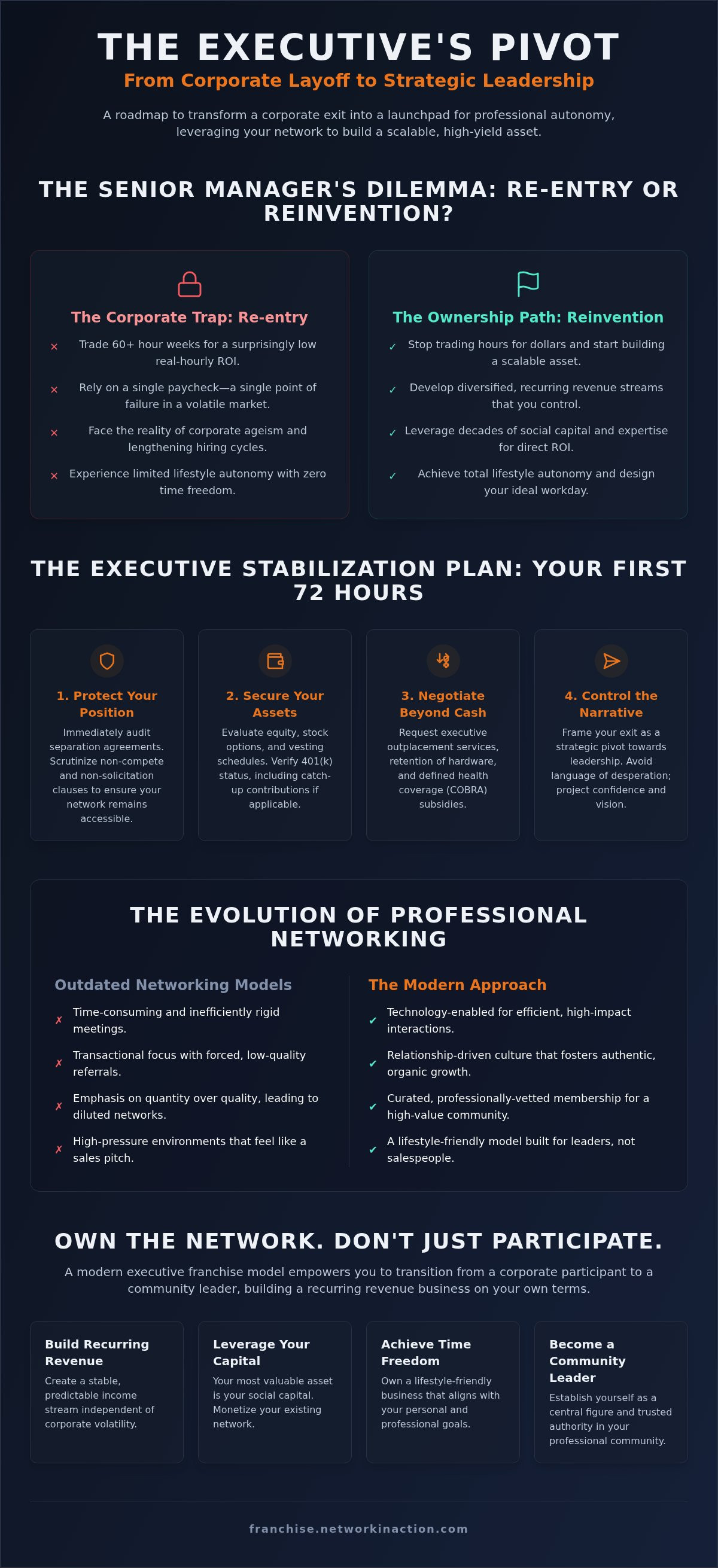
The moment the exit interview concludes, the clock starts. This isn't a time for reflection; it's a window for tactical defense. Your primary objective is asset protection. Audit every line of the separation agreement with a focus on restrictive covenants. Non-compete and non-solicitation clauses can derail your next move before it begins. If you're wondering what to do after being laid off from a senior management role, start with a legal review of these barriers. Ensure your ability to leverage your existing network remains intact. Protect your future leverage. Secure your professional autonomy.
Next, evaluate your equity and deferred compensation. Triggers for stock options and vesting schedules often change during a termination event. Check your 401(k) status; for 2026, the annual employee contribution limit is $24,500. If you're over 50, ensure your $8,000 catch-up contributions are accounted for in the final payout. Secure professional references immediately. Once internal communication channels close, your access to key advocates vanishes. Move fast. Secure the data. Initiate strategic silence. Avoid reactive social media posts that signal desperation rather than transition.
Negotiating the Severance Package Beyond Cash
Cash is only the baseline. High-level professionals must negotiate for specialized executive outplacement services that understand the nuances of understanding career shocks. Don't settle for generic resume builders. Request the retention of company-issued hardware and specific software licenses that support your transition. These are low-cost for the employer but high-value for your independent launch. Finally, verify that health coverage extensions and COBRA subsidies are explicitly defined. With healthcare costs projected to rise 9% in 2026, this protection is critical for your bottom line.
The Strategic Communication Rollout
Control the narrative. Your inner circle needs a concise "career pivot" story that emphasizes choice and leadership. Avoid the "looking for new opportunities" cliché on LinkedIn; it broadcasts a lack of leverage. Instead, update your profile to reflect a planned transition toward independent leadership or community advisory roles. Position the exit as a strategic move to maximize your professional social capital. This shifts the power dynamic. You aren't a displaced manager. You're a visionary executive entering a high-yield phase. Results matter. Narrative builds value.
The Senior Manager’s Dilemma: Re-entry or Reinvention?
Most leaders view a layoff as a problem to be solved by another job. This is a strategic error. When deciding what to do after being laid off from a senior management role, you must analyze the "Corporate Trap." You've likely traded 60 hours a week for a high salary, but your real hourly ROI is surprisingly low when factoring in constant stress and zero time freedom. One paycheck. One point of failure. High risk. Business ownership offers diversified, recurring revenue that no board of directors can take away. Real wealth. Total control.
Then there's the reality of "corporate ageism." Recruitment cycles for C-suite roles are lengthening while competition intensifies. While you wait for a headhunter to call, you could be building an asset you own. While unemployment insurance benefits provide a temporary safety net, they won't replace executive-level income or protect your long-term wealth. True stability comes from owning the system, not just operating within it. Build the network. Own the results.
Evaluating the 2026 Executive Job Market
The 2026 landscape has shifted. Fractional leadership and high-level consulting are the new standard. Traditional roles are volatile. Lean structures are the priority. Ask yourself: is your skill set better suited for managing someone else's legacy or building your own? A corporate title is temporary. Professional social capital is permanent. If your expertise can solve market problems, it can fuel a business. Don't just find a new boss. Become the leader of your own professional community.
The Freedom Factor: Lifestyle Autonomy as a Metric
Define your ideal day. Does it involve back-to-back Zoom calls and quarterly earnings pressure? Or does it involve high-impact community leadership on your own terms? Lifestyle autonomy is the ultimate metric of success. Many leaders are now exploring executive business opportunities that prioritize time efficiency over manual labor. You can lead high-level professional groups without the 60-hour corporate grind. This is the next evolution of your career. It's time to stop participating and start leading. You can check for leadership opportunities in your local market to see if you're ready for the pivot.
Auditing Your Social Capital: The Power of Your Professional Network
Your network is your most valuable asset, yet most executives leave it dormant until a crisis occurs. When considering what to do after being laid off from a senior management role, your first instinct might be to broadcast a plea for help on social media. Resist this impulse. Desperation devalues your professional brand and signals a lack of leverage. Instead, shift your mindset toward offering a platform for growth. You aren't a job seeker; you're a high-value connector who can deploy a sophisticated referral marketing strategy to solve problems for others. Influence is social capital. Capital must be audited. Results must be measured.
Start by mapping your high-value connections across diverse industries and geographic regions. Identify the specific "Referral Power" of each relationship. This isn't just about who you know; it's about who they trust and what resources they control. While managing the emotional impact of your transition is a necessary step in stabilization, focusing on the tangible value of your connections provides a grounded, results-oriented path forward. Build a strategic grid of advocates, peers, and potential business partners. Quality relationships drive high-yield results. Connection volume is just noise.
The Difference Between a Contact List and a Network
A contact list is a static database of names and emails. A network is a living ecosystem of reciprocal value. Legacy networking organizations often confuse the two, prioritizing transactional volume and forced referrals over deep-seated professional trust. You must segment your connections into three tiers: advocates who will vouch for your leadership, peers who share your market level, and potential clients who need your expertise. Your network generates a massive ROI for others when you facilitate high-level introductions that solve complex business problems. High trust. High impact. Zero fluff.
Monetizing Influence Without Cold Prospecting
Cold prospecting is a low-leverage activity suited for entry-level sales, not senior executives. Your goal is to position yourself as a community leader who utilizes proprietary technology to keep your network engaged and productive. Modern networking models allow you to transition from being a mere member of a group to owning the platform itself. This is a critical component of what to do after being laid off from a senior management role to maintain your income level and professional standing. By leading a curated community, you monetize your existing influence without the friction of outdated, manual methods. Lead the group. Own the network. Secure recurring revenue.
Beyond the Resume: High-Yield Business Models for Displaced Leaders
Updating a resume is an employee tactic. Executives build businesses. When deciding what to do after being laid off from a senior management role, you must evaluate the speed to revenue and long-term scalability of your next move. Consulting is the most common path, yet it remains a high-end version of trading time for money. Independent startups offer total control but carry a high failure rate and often require 18 to 24 months to reach profitability. In a 2026 economy characterized by persistent inflation and high labor costs, the "startup struggle" is an unnecessary risk for a seasoned leader. You need a model that leverages your existing authority immediately. Results-driven ownership. Scalable assets.
An executive-level business networking franchise provides a superior alternative by offering a turnkey system designed for high-impact leadership. Unlike traditional consulting, where income stops when you stop working, owning a network creates recurring revenue through a technology-enabled platform. It allows you to monetize your professional social capital without the overhead of a large staff or expensive commercial real estate. You aren't just finding a new role; you're acquiring a proven system that delivers immediate market presence. Efficient growth. Maximum leverage.
The Franchise Advantage for Corporate Refugees
Franchising allows you to bypass the trial-and-error phase of business ownership. By utilizing a proven framework, you focus your energy on community leadership rather than building administrative infrastructure from scratch. This is particularly effective for those seeking low-overhead models with high margins. You can identify available territories that align with your professional influence, ensuring you launch in a market where your name already carries weight. This strategic alignment accelerates your transition from a displaced executive to a profitable business owner.
Avoiding the Pitfalls of Traditional Networking Models
Not all networking models are created equal. Legacy networking organizations often fail the modern executive because they rely on rigid, time-consuming structures and forced referrals. These outdated systems prioritize transactional volume over relationship quality, which devalues your brand. Modern alternatives replace weekly manual meetings with monthly, technology-led sessions that respect your time. They focus on curated professional circles where high-level referrals happen naturally through trust rather than obligation. If you are ready to lead a sophisticated community, you should download the franchise kit to explore how a modernized system can secure your professional future. Elite circles. Real ROI.
Owning the Network: The NIA Path to Community Leadership
The corporate title is gone. Your authority is not. Transitioning from senior management to business ownership requires a model that matches your professional sophistication. Network In Action (NIA) offers a strategic path to community leadership that replaces the 60-hour corporate grind with a high-impact, monthly engagement. When you're determining what to do after being laid off from a senior management role, don't revert to the status quo of job hunting. Lead the next evolution of professional networking instead. You aren't just joining a group; you're owning the asset. Real leverage. Total control.
The legacy industry is broken. Traditional networking models rely on weekly manual meetings and forced referrals that drain time without delivering measurable ROI. NIA disrupts this outdated approach. By utilizing a proprietary technology platform, you manage high-level referrals with surgical precision. This tech-forward system ensures that every interaction is productive and every connection is high-quality. You're building a recurring revenue stream while serving as the primary business authority in your territory. Scalable growth. Professional autonomy.
The Technology-Enabled Executive Pivot
Modern tools are the differentiator between a hobby and a high-yield business. NIA franchisees use an exclusive digital platform to track member ROI and facilitate introductions, moving beyond the manual spreadsheets used by legacy organizations. This allows you to focus on relationship-driven growth rather than administrative noise. High-quality membership is the priority; attendance metrics are secondary. If you're ready to evaluate a modernized business model, you should download the franchise kit to see how the system functions. Real tools. Real results.
Leading Your Local Business Community
Positioning yourself as the premier connector in your territory scales your influence faster than any consulting gig. By bringing high-level professionals together once a month, you create a hub of industry innovation. You control the room. You curate the membership. Most importantly, you control your schedule. This model provides the lifestyle flexibility that corporate roles promise but rarely deliver. Secure a future where your income is tied to your influence, not a corporate budget. Lead the community. Own the results.
Secure Your Professional Autonomy
A corporate exit is not a setback; it's a strategic opening. You've spent decades building the expertise and social capital required to lead at the highest levels. Now, it's time to monetize those assets on your own terms. Instead of scouring job boards, focus on what to do after being laid off from a senior management role by securing a business model that offers recurring revenue and total lifestyle autonomy. Transition from a corporate operator to an elite community leader. Own the network. Control the results.
With over 150 global locations and a Red Dot-level technology platform, NIA provides a proven model for high-level professional referral generation. It replaces the rigid, time-consuming structures of traditional networking with an efficient, results-driven system. You can scale your influence while maintaining a schedule that prioritizes your time. Your next chapter isn't about finding another boss; it's about building a legacy that you own. The transition starts with a single strategic choice. Download the NIA Franchise Kit and Discover Your Next Executive Move. Your professional future is waiting. Take the lead.
Frequently Asked Questions
What is the most effective way to handle a senior management layoff financially?
Auditing separation agreements is the primary financial priority for any displaced executive. Secure your 401(k) contributions within the 2026 employee limit of $24,500 and utilize catch-up limits of $8,000 if you're over the age of 50. Evaluate stock options and deferred compensation triggers immediately to protect your net worth. This stabilization phase ensures you have the capital necessary to fund a strategic transition rather than just covering immediate expenses. Practical defense leads to profitable offense.
How do I pivot from a corporate role to business ownership without starting over?
Pivoting without starting over requires leveraging your existing professional social capital. Instead of building a startup from scratch, you can acquire a proven system that utilizes your current industry authority. This approach allows you to step into a leadership role as a business owner while bypassing the startup struggle phase. You aren't starting over; you're simply changing the platform where you deploy your expertise for higher ROI. Leverage your past to fund your future.
Should I consider franchising after being laid off from a VP role?
Franchising is a strategic move for former VPs because it provides a turnkey infrastructure for immediate impact. It solves the speed-to-revenue problem that plagues independent consulting. By choosing a model with low overhead and high margins, you can maintain an executive-level income while gaining total lifestyle autonomy. It's the most efficient way to determine what to do after being laid off from a senior management role while protecting your professional brand. Proven systems beat trial and error.
What are the best executive business opportunities for 2026?
The best opportunities for 2026 prioritize time efficiency and recurring revenue over manual labor. Tech-forward professional networking franchises are leading the market because they capitalize on the scarce resource of high-quality connections. These models allow displaced leaders to scale their influence across a specific territory without the need for large staff or inventory. Focus on businesses that deliver measurable results through exclusive systems rather than outdated legacy practices. Efficiency is the new currency of success.
How can I monetize my professional network after leaving a corporate job?
Monetizing your network involves transitioning from a participant to a community leader. By owning a professional referral group, you create a hub where high-level connections generate value for each other under your guidance. This model turns your contact list into a scalable asset. You stop asking for favors and start providing a platform that drives growth for others, allowing you to collect revenue from the influence you've already built. Social capital is your most valuable currency.
Why do traditional networking models fail high-level executives?
Traditional networking models fail senior leaders because they rely on rigid, time-consuming weekly meetings. These legacy organizations often prioritize transactional volume and forced referrals, which devalues the executive brand. High-level professionals require curated environments where trust and quality are the primary metrics. Outdated systems lack the sophisticated technology and streamlined structure necessary to respect an executive's time while delivering a consistent return on investment. Quality relationships require a modern framework.
What is the difference between NIA and legacy networking organizations?
NIA modernizes the industry by replacing weekly manual meetings with high-impact monthly sessions. While legacy networking organizations use outdated manual tracking, NIA utilizes a proprietary technology platform to manage referrals and track member ROI. This tech-forward approach ensures a more efficient use of your time. There are no forced referrals; instead, the focus is on curated, high-trust relationships within a global network of over 150 locations. It's the next evolution of professional connection.
How quickly can an executive launch a networking franchise?
Launching a networking franchise is a streamlined process supported by comprehensive corporate training and onboarding. Once a territory is secured, the system guides you through the setup of your first professional groups. The speed to launch is significantly faster than building an independent consulting practice or a traditional retail business. You can begin leveraging your network and generating revenue as soon as your initial training is complete, typically within a few months. Rapid launch. Immediate impact.