The corner office is no longer the pinnacle of professional influence. In 2026, the most successful leaders are trading the corporate grind for scalable systems that offer true lifestyle autonomy. You've spent years building someone else's empire, yet the idea of starting from scratch feels like a step backward into a risky unknown. Understanding the modern franchise owner requirements is the first step toward reclaiming your schedule without sacrificing your professional stature. It's about moving beyond the 9-to-5 and into a model that rewards your existing expertise. Proven systems. Measurable growth.
It's natural to feel skeptical of "get rich quick" schemes or traditional networking models that waste your time with rigid, transactional meetings. You want a business that mirrors your corporate sophistication while providing the autonomy you've earned. This blueprint outlines the financial, professional, and operational benchmarks required to transition from executive leader to high-growth owner. You'll learn how to leverage your professional network into a recurring revenue stream using a tech-forward, service-based approach. The focus is on efficiency, territory exclusivity, and the strategic shift toward multi-unit ownership in a rapidly evolving market.
Key Takeaways
- Identify the core financial benchmarks, including liquid capital and net worth, to ensure your portfolio aligns with executive-level opportunities.
- Evaluate your leadership skills against the 2026 franchise owner requirements to transition successfully from corporate management to community influence.
- Navigate the legal landscape of the Franchise Disclosure Document to secure exclusive territory rights and protect your long-term investment.
- Discover how a technology-led monthly meeting model eliminates the inefficiencies of traditional networking organizations to provide true time freedom.
- Build a scalable recurring revenue stream by leveraging existing professional relationships rather than relying on outdated cold prospecting methods.
Decoding Modern Franchise Owner Requirements in 2026
Business ownership has entered a new era. In 2026, the traditional franchising business model has evolved far beyond the retail storefronts of the past. Modern franchise owner requirements now prioritize strategic leadership over operational minutiae. You aren't just buying a job; you're building a scalable asset. Legacy networking organizations often rely on rigid, time-consuming structures that drain executive energy. Today's sophisticated owners demand efficiency. They seek models that leverage technology to drive results. Modern systems. Elite results.
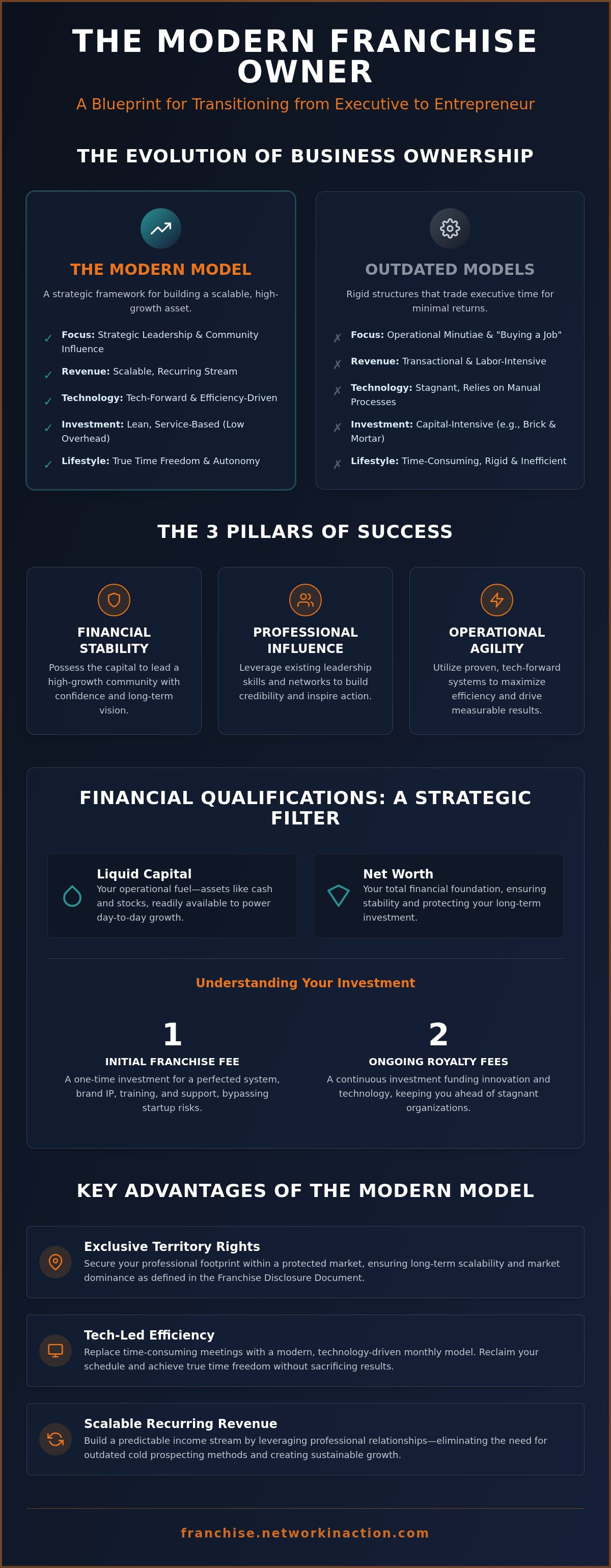
Success in this environment requires a balance of three core pillars: financial stability, professional influence, and operational agility. You must move from a mindset of managing tasks to one of leading communities. This transition is about high-leverage systems and measurable impact. The goal is to build a recurring revenue stream that doesn't require 60 hours of manual labor every week. It's about working smarter, not harder.
The Evolution of the Franchisee Profile
Corporate environments are seeing a massive exodus of top-tier talent. High-level executives are increasingly looking for ways to transition from employee to entrepreneur without the chaos of a startup. This new wave of owners brings a sophisticated skillset to the table. They don't need industry-specific technical knowledge. They possess the leadership experience required to manage professional groups and drive business growth. Modern franchise owner requirements focus on your ability to inspire, connect, and lead. You aren't looking for a "get rich quick" scheme. You're looking for a professional platform that honors your experience and rewards your influence.
Service-Based vs. Brick-and-Mortar Requirements
Capital intensity is a major differentiator in 2026. Traditional brick-and-mortar models require heavy upfront investment in real estate, inventory, and staffing. These legacy models often feel like a trap for the modern executive. Service-based, tech-enabled models offer a leaner, more agile alternative. These systems prioritize efficiency and recurring revenue over physical overhead. For the modern executive, the choice is clear. You want a model that respects your time and maximizes your ROI. Territory exclusivity plays a vital role here. By securing your professional footprint in available territories, you protect your market and ensure long-term scalability. This isn't just business; it's a strategic move for those who value impact, autonomy, and professional credibility.
Financial Qualifications: Beyond the Initial Investment
Capital is more than a requirement. It's a strategic filter. High-level franchise owner requirements ensure that every partner in the network possesses the stability to lead a high-growth community. Your initial franchise fee is a one-time investment in a perfected system. It buys you the right to bypass the trial-and-error phase of a startup. You're paying for a refined engine that already works. This fee grants you access to the brand's intellectual property, training, and support structures, as detailed in the Franchise Disclosure Document.
Beyond the entry fee, you must account for ongoing monthly royalty fees. These aren't just administrative costs; they fund the continuous innovation that keeps the brand ahead of legacy networking organizations. While traditional models stagnate, modern systems reinvest in technology to maintain a competitive edge. This ensures your asset grows in value while you focus on high-leverage leadership tasks. For those ready to analyze the numbers, it's wise to download the franchise kit to see how these metrics translate into a scalable model.
Calculating Liquid Capital and Net Worth
Franchisors distinguish between liquid capital and total net worth. Liquid capital includes cash, stocks, and other assets that can be converted to currency within days. This is your operational fuel. Net worth represents your total financial foundation. A high net worth threshold protects the brand's reputation by ensuring owners aren't over-leveraged. Common funding strategies include SBA 7(a) loans, which currently see maximum variable rates between 9.75% and 14.75% as of August 2026. You need a solid runway of working capital for the first 6 to 12 months to ensure growth isn't stifled by short-term cash flow needs.
Understanding the ROI of Technology Fees
Platform access fees are often a point of skepticism for corporate executives. However, the ROI is clear. Building a custom member connectivity platform would cost hundreds of thousands in development and maintenance. Leveraging a turnkey technology suite is a strategic shortcut to efficiency. These proprietary tools drive member retention by providing measurable results that outdated networking models can't match. You're investing in a system that automates the manual work of professional networking. This technology allows you to build a recurring revenue stream with minimal overhead. It's the difference between buying a job and owning a tech-enabled asset.
The Executive Skillset: Professional Requirements for Leadership
Corporate success is built on leadership. Transitioning to business ownership doesn't change that fact; it amplifies it. In 2026, the most critical franchise owner requirements center on your ability to command a room and curate elite professional circles. You aren't being recruited for your ability to follow a manual. You're being recruited for your ability to lead a local business ecosystem. This requires a high level of professional credibility. You must be viewed as a peer by other high-level executives to build a community that lasts. Credibility matters. Influence scales.
The modern owner embraces a mindset of informed disruption. You recognize that traditional networking models are fundamentally broken. They rely on quantity over quality. They demand time you don't have. By challenging these legacy networking organizations, you position yourself as a forward-thinking solution for busy professionals. You move away from the noise of cold prospecting toward a sophisticated, relationship-driven growth model. This shift is essential for anyone looking to build a business that values results over activity.
Community Leadership and Influence
Building a professional community requires more than a contact list. It requires social capital. There are several key factors to consider when evaluating how your background fits modern franchise owner requirements, specifically your ability to act as the primary connector in your territory. Executives excel here because they understand how to manage high-quality memberships. You aren't looking for every business owner. You're looking for the right ones. This selective approach is the foundation of a successful referral marketing strategy. High-value connections. Measurable ROI.
Operational Efficiency and Time Management
Legacy networking organizations demand weekly commitments that stifle productivity. They focus on the process rather than the result. As an executive owner, your advantage lies in efficiency. You manage groups with only a few hours of monthly commitment. This lifestyle-friendly model is a core differentiator for those who value their time. You use proprietary systems to automate the administrative fluff that wastes time in outdated networking models. This focus on high-impact results allows you to scale your business across available territories without sacrificing your personal freedom. Efficiency isn't just a goal. It's a requirement for the modern leader.
Legal and Operational Obligations: The Franchise Agreement
The Franchise Disclosure Document (FDD) is the cornerstone of your due diligence. For the executive reader, this isn't just a legal hurdle; it's a comprehensive audit of the business engine. In 2026, the FTC has intensified its focus on transparent fee disclosures. This was underscored by a record-breaking $17 million settlement in March 2026 regarding disclosure failures in the industry. These heightened standards ensure that every cost associated with franchise owner requirements is explicitly detailed in Item 5. This regulatory shift benefits the sophisticated investor. It eliminates the hidden fees often found in legacy networking organizations. You're entering a partnership built on clarity. Transparency drives trust.
Long-term equity building depends on the term of your agreement. Most modern contracts provide a clear path for renewal, allowing you to scale your influence over decades. This isn't a temporary gig; it's a strategic move to build a saleable asset. Understanding these obligations ensures you're prepared for the operational guardrails that maintain brand consistency across the network. You're investing in a system that protects your reputation while providing a blueprint for recurring revenue. Proven systems. Secure futures.
Navigating Territory Exclusivity
Exclusive territories are the lifeblood of a business networking franchise. Without them, you risk internal competition that dilutes your professional social capital. You must evaluate available territories based on group density and market demographics. A well-defined territory ensures you have the room to grow without stepping on the toes of fellow owners. Size matters. Density scales. By securing a specific professional footprint, you ensure that your efforts to curate elite memberships aren't undermined by market saturation or brand dilution.
Compliance vs. Autonomy
Modern franchising offers a unique balance. You follow a proven system for monthly meetings and member connectivity, yet you maintain the freedom to inject your own leadership style. Outdated networking models often rely on rigid, transactional scripts that feel forced and unprofessional. Modern systems provide the operational guardrails necessary to protect the brand's reputation while allowing you to lead with authenticity. Ongoing training ensures you stay at the forefront of industry innovation. You're supported, not stifled. This balance is what allows high-level executives to thrive without the burden of micromanagement. To see how these legal protections support your growth, download the full franchise kit today.
Why Network In Action Redefines the Ownership Model
Traditional networking models are failing the modern executive. They rely on rigid, weekly meeting schedules that prioritize attendance over actual business growth. Network In Action (NIA) represents the next evolution of the industry by replacing that manual grind with a streamlined, technology-led system. You don't need a business that demands 40 hours of administrative labor. You need an asset that leverages your influence. By shifting to a monthly meeting model, NIA honors the time of high-level professionals while delivering superior results. Efficiency is the new gold standard.
Quality remains the most significant of all franchise owner requirements. Legacy networking organizations often force members to pass referrals, regardless of quality, just to meet a quota. This transactional approach dilutes professional credibility. NIA disrupts this cycle with a "no forced referrals" policy. This ensures that every connection made within your groups is based on genuine trust and mutual benefit. You're building a curated community of elite leaders, not a directory of business cards. High standards. High impact.
The Power of Proprietary Technology
Technology is the central nervous system of the NIA model. While outdated networking models struggle with manual tracking and fragmented communication, NIA owners utilize a proprietary platform to keep members connected 24/7. This system handles the heavy lifting of automated tracking and reporting, significantly reducing your administrative burden. Members receive a measurable ROI through tech-enabled referral tracking that proves the value of their membership in real-time. You aren't just a facilitator; you're the provider of a sophisticated business tool that drives recurring revenue for your members and consistent growth for your franchise.
Taking the Next Step Toward Ownership
Transitioning from a corporate leader to a high-growth business owner requires a strategic approach to due diligence. It starts with evaluating how your professional goals align with a model built for lifestyle autonomy and social impact. If you value efficiency, professional credibility, and scalable systems, the first step is downloading the franchise kit. This document provides the deep-dive data you need to analyze the opportunity against your specific franchise owner requirements. Don't settle for a legacy model that wastes your most valuable resource. Claim your territory and lead the next evolution of professional networking in your community. Your journey toward a results-oriented business begins with a single, strategic move. Explore the possibilities today.
Secure Your Professional Legacy
The transition from corporate leader to high-growth business owner is a strategic pivot that demands a modern approach. You've seen how the 2026 franchise owner requirements prioritize community influence and technological leverage over the rigid, time-consuming methods of legacy networking organizations. By focusing on high-quality membership and monthly efficiency, you can build a scalable asset that offers true lifestyle autonomy. It's time to trade the 9-to-5 grind for a model that rewards your existing professional credibility. High standards. Elite results.
With over 150 successful locations worldwide, NIA provides a proven blueprint for executive success. You gain access to a proprietary technology platform and a monthly meeting model designed specifically for executive-level efficiency. This isn't just about starting a business; it's about leading your local professional ecosystem. Take the first step toward a results-oriented future by reviewing the details of this opportunity. Download the Franchise Kit and Lead Your Local Business Community. Your expertise has earned you this level of freedom. Start building your recurring revenue stream today.
Frequently Asked Questions
What are the minimum financial requirements to own a franchise in 2026?
The franchise owner requirements for financial stability typically focus on two metrics: liquid capital and total net worth. Liquid capital ensures you have the cash flow to cover the initial fee and working capital for the first six months. In 2026, many owners leverage SBA 7(a) loans, which have maximum variable rates between 9.75% and 14.75% as of August 2026. These thresholds protect the brand and ensure you have a solid runway for growth.
Do I need previous industry experience to qualify as a franchise owner?
No, industry-specific technical skills are rarely a prerequisite for high-level executive franchises. Franchisors prioritize leadership experience, professional credibility, and the ability to manage high-quality relationships. Your background in driving ROI and managing corporate teams is more valuable than technical expertise. The system provides the operational blueprint while you provide the community leadership and influence required to scale the business effectively within your exclusive territory.
What is the difference between an initial franchise fee and total investment?
The initial franchise fee is a one-time payment for the right to access the brand's intellectual property and proven systems. The total investment is a comprehensive figure that includes the initial fee plus working capital, technology setup, and marketing costs for the launch phase. It represents the total capital needed to reach operational sustainability. Understanding this distinction allows you to plan your portfolio allocation accurately without facing unexpected startup costs.
Why is territory exclusivity important in a professional services franchise?
Territory exclusivity protects your professional social capital by ensuring no other owner from the same brand can compete in your market. Without these rights, you risk internal competition that dilutes the quality of your memberships and confuses your professional network. In a service-based model, this protection is vital for building a dense, high-value community. It secures your professional footprint and allows you to focus on long-term, relationship-driven growth without brand saturation.
How much time does a franchise owner typically spend on operations?
Time commitment depends on the business model's efficiency. Legacy networking organizations often require weekly oversight that drains executive energy with transactional busywork. Modern models utilize a monthly meeting structure and proprietary technology to streamline operations significantly. This allows sophisticated owners to manage their professional communities with only a few hours of focused commitment each month. It is a lifestyle-friendly approach designed for those who value time freedom and measurable results over manual labor.
What are the ongoing costs associated with franchise ownership?
Ongoing costs generally include monthly royalty fees and technology platform fees. Royalties fund continuous brand innovation and marketing support, with national averages around 5.4% of gross revenue in 2026. Technology fees cover the maintenance of proprietary tools that automate administrative tasks. These recurring investments ensure your business remains competitive against outdated networking models that lack modern infrastructure. Reviewing these costs helps you understand the long-term ROI and scalability of the asset.
How does proprietary technology impact the daily requirements of an owner?
Proprietary technology acts as the central nervous system of the business, drastically reducing the franchise owner requirements for manual administrative work. These tools automate member connectivity, referral tracking, and reporting, which are often handled manually in legacy networking organizations. By leveraging tech-enabled platforms, you can provide members with a measurable ROI while spending less time on operational minutiae. This efficiency allows you to focus on high-impact leadership and strategic network expansion.
What legal documents should I review before becoming a franchisee?
You must conduct a thorough audit of the Franchise Disclosure Document (FDD) and the Franchise Agreement. The FDD contains 23 items detailing the franchisor’s history, litigation, and fee structures. Pay close attention to territory rights, renewal options, and the total investment breakdown. In 2026, the FTC has increased enforcement regarding transparent fee disclosures, making it easier for sophisticated investors to identify the true cost of ownership and the operational guardrails in place.