Why are you still sacrificing your most valuable asset for a handful of forced referrals and lukewarm coffee? Most legacy networking organizations operate on a model that hasn't changed since the 1980s. They demand weekly attendance and prioritize transactional volume over strategic relationship building. Unproductive meetings. Forced quotas. Outdated systems. If you're currently evaluating networking franchise opportunities, you've likely noticed the glaring gap between these manual methods and the tech-forward efficiency required by modern executives. You deserve a professional community that respects your schedule and delivers measurable ROI.
It's frustrating to sit through rigid meetings where the only goal is to hit a number. You're likely tired of the performance. This guide breaks down the structural flaws inherent in legacy networking models and reveals how to identify a results-driven alternative. You'll discover how to leverage exclusive digital tools, cultivate high-quality connections without pressure, and build a scalable business model that offers true lifestyle autonomy and recurring revenue. It's time to move past the sales theater and embrace the modern evolution of professional connectivity.
Key Takeaways
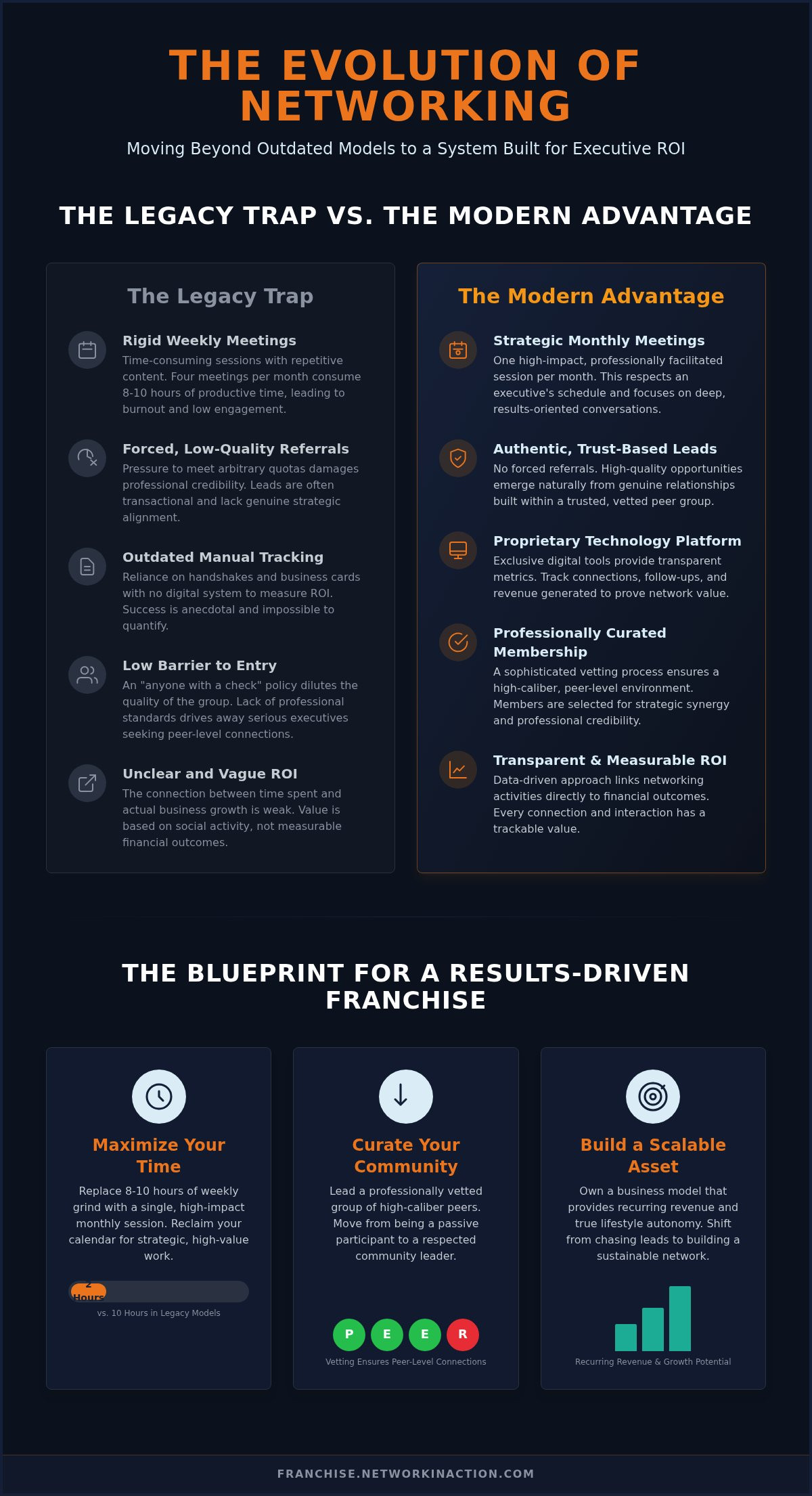
- Identify why frequent meetings often fail to deliver ROI. Focus on monthly, high-impact sessions that respect an executive's schedule rather than the rigid weekly grind of legacy models.
- Avoid the trap of forced referrals that damage professional credibility. Authentic relationships and curated memberships generate high-quality leads without the pressure of arbitrary quotas.
- Replace outdated manual tracking with proprietary technology. Efficient platforms maintain connectivity and provide transparent metrics that prove the value of your professional network.
- Shift from a passive participant to a community leader when evaluating networking franchise opportunities. Owning a results-driven model offers a strategic path to recurring revenue and lifestyle autonomy.
Why Networking Groups Fail: Identifying the Core Dysfunction
Traditional networking is dying because it ignores the value of an executive's time. Legacy networking organizations often mistake social activity for measurable business growth. You've likely felt the frustration of a room full of people trying to sell to you rather than connect with you. This "networking fatigue" isn't a lack of interest in growth; it's a rejection of structural dysfunction. When the focus shifts from strategic partnership to mere attendance, the model breaks. Aimless meetings and high member attrition are the inevitable results of a system that lacks clear, professional leadership. Most groups rely on volunteers who lack the skin in the game to drive real results. This creates a vacuum where professional standards vanish and the disconnect between time spent and ROI grows wider every week.
The Dilution of Professional Standards
The most common failure point in outdated networking models is the low barrier to entry. Many groups operate on an "anyone with a check" policy. This approach destroys group credibility for serious executives who require a peer-level environment. When you're evaluating networking franchise opportunities, the vetting process is a non-negotiable differentiator. Mismatched experience levels lead to low-quality referrals and a lack of strategic synergy. Executives avoid groups that feel like desperate sales clubs. They seek peer boards where professional standards are curated and maintained with precision. Without a sophisticated vetting system, the quality of the room inevitably settles at the lowest common denominator, driving away the very people you need to attract.
Lack of Accountability and ROI Tracking
Handshake promises are no longer sufficient in a data-driven business landscape. Traditional groups struggle because they rely on manual tracking and vague anecdotes of success. They fail to bridge the gap between social capital and actual financial metrics. Foundational business networking principles emphasize the development of professional relationships, but modern networks must go further by providing digital tracking and data-backed follow-ups. Groups that refuse to measure ROI eventually lose their most successful members. High-performers don't stay where they can't see the numbers. A professional community must utilize exclusive digital tools to ensure every connection translates into potential revenue. This transition from manual chaos to technological clarity is what defines the next evolution of the industry. It's about moving beyond the business card and into a system that guarantees transparency and growth for every participant.
The Weekly Meeting Trap: Why Frequency Does Not Equal ROI
Time is your most limited resource. Legacy networking organizations ignore this reality. They demand weekly attendance, regardless of your schedule or workload. In the 2026 business landscape, this rigidity is a liability. High-level executives are opting out. They're tired of the "Fluff Factor." When you meet every week, content becomes repetitive. Discussions turn into filler. Attendance drops because the value proposition doesn't justify the calendar commitment. If you're currently evaluating networking franchise opportunities, you must look for a model that respects the modern executive's schedule. Efficiency is the new gold standard. You don't need more meetings; you need better ones.
The Hidden Cost of Legacy Networking Models
Think about the math. Four meetings a month, plus travel time, equals roughly eight to ten hours of lost productivity. For a high-earning professional, the annual billable hours lost to these outdated networking models are staggering. It's an invisible tax on your success. These rigid requirements punish entrepreneurs who travel or manage large teams. It's a recipe for psychological burnout. You shouldn't have to choose between growing your business and attending a mandatory session that lacks substance. Real growth doesn't happen in a state of exhaustion. It happens when you have the freedom to focus on high-level strategy without being tethered to a legacy calendar that prioritizes presence over performance.
Quality Over Quantity in Professional Interaction
Efficiency wins. One high-impact meeting per month consistently outperforms four mediocre weekly sessions. It allows for deeper, strategic conversations. You move beyond the rushed 30-second pitch. Monthly cadences create space for genuine relationship architecture. This shift attracts a higher caliber of business leader. These are people who value time. They aren't looking for a social club; they're looking for an efficient engine for growth. By focusing on quality over quantity, you build a community of peers rather than a room of desperate prospectors. Professional preparation increases when meetings are less frequent. Every session becomes an event, not a chore. Before committing to a legacy model, consider exploring modern territories that prioritize executive efficiency and deliver a superior return on your time investment.
Transitioning to a monthly model isn't just about saving time. It's about sustaining engagement. Weekly groups often suffer from meeting fatigue. Members start checking their phones. The energy dies. A monthly cadence keeps the momentum high. It ensures that when you do meet, the room is packed with prepared, motivated professionals. This is the modern evolution of the industry. It's a system designed for the way business is done today, not how it was done forty years ago. It's about results, not rituals.
Forced Referrals vs. Authentic Trust: The Transactional Downfall
Traditional networking models often suffer from a fundamental flaw: the forced referral. In these legacy networking organizations, members are pressured to provide a specific number of leads every week. This quota-based system is a disaster for high-level professionals. It incentivizes the exchange of "junk" leads simply to satisfy a metric. When you're forced to give, you stop giving from a place of value and start giving from a place of obligation. This transactional downfall is a primary reason why serious executives are currently evaluating networking franchise opportunities that prioritize quality over arbitrary numbers. You don't need more leads. You need better ones.
The Psychology of the Transactional Trap
Pressure to perform leads to insincere recommendations. When a group requires a referral every week, members inevitably resort to "lead swapping" or passing irrelevant contact information. This behavior creates a culture of noise rather than opportunity. The long-term damage to your personal brand is significant. If you recommend a low-quality vendor to a valued client just to hit a quota, you've compromised your professional credibility. High-level leaders refuse to participate in these games. They understand that their network is their net worth. They won't risk it for a checkbox in an outdated system. Transactional environments lack the trust required for high-stakes business deals.
Architecting a Culture of Genuine Advocacy
Real growth requires a sophisticated referral marketing strategy built on organic trust. Instead of "forced" introductions, modern networks focus on "facilitated" advocacy. This is achieved through professional group management and rigorous vetting. When every member in the room is a high-caliber peer, referral synergies happen naturally. You don't need a quota when the people around you are genuinely capable of solving your clients' problems. Authenticity is the most valuable currency in business today. By removing the pressure of forced referrals, you create a space where introductions are meaningful, vetted, and high-ROI. This modern evolution of the industry replaces transactional desperation with strategic alignment. It's about building a community where members want to help each other because it makes business sense, not because they're being tracked on a spreadsheet.
When evaluating networking franchise opportunities, look for models that treat referrals as a natural byproduct of high-quality relationships. Authentic trust can't be manufactured through a weekly quota. It must be cultivated through consistent, high-value interaction between vetted professionals. This approach ensures that every introduction carries the weight of a true recommendation, protecting your reputation while accelerating your growth. Efficiency and trust are the twin engines of modern networking. Don't settle for a model that compromises either.
Beyond the Business Card: The Role of Technology and Curation
Manual tracking is a relic of a bygone era. Legacy networking organizations often rely on antiquated paper-based systems or clunky spreadsheets to record member activity. These methods are inefficient. They're unreliable. In a high-speed business environment, waiting for a weekly meeting to report a referral is a bottleneck your business can't afford. Modern executives demand transparency and real-time data. If you're currently evaluating networking franchise opportunities, you must prioritize platforms that offer a tech-forward approach to relationship management. Data wins. Manual systems fail.
The Tech-Forward Networking Model
Proprietary technology is the bridge that keeps a professional community connected between monthly sessions. A sophisticated business referral platform serves as more than just a directory. It's a 24/7 digital hub for communication, introduction management, and growth tracking. This digital access is mandatory for the 2026 executive. It reduces the friction of networking by allowing you to pass vetted leads and track their progress instantly. Technology proves ROI. It provides concrete financial metrics that justify your investment of time and capital. When connectivity is streamlined through exclusive digital tools, the network becomes a scalable asset rather than a logistical chore.
The Professionally Managed Group
The difference between a volunteer-led club and a professionally managed network is the difference between an amateur hobby and an elite business strategy. Legacy networking organizations often suffer from high member churn because they lack authoritative leadership. Volunteer leaders have no skin in the game. They struggle to resolve conflicts or maintain high membership standards. In contrast, a professionally managed group is led by an executive who is compensated to ensure the group's success. Curation is a service. This leader vets every applicant to ensure they meet the group's professional caliber. They act as a community architect, facilitating natural synergies and protecting the room's integrity. Managed groups solve the churn problem by delivering consistent, high-value experiences that respect your status and your schedule.
Professional management ensures that the group never devolves into a desperate sales club. It maintains the peer-to-peer environment that high-level professionals crave. To understand how a technology-enabled, professionally managed model can transform your local business landscape, download the franchise kit to see the platform in action. Efficiency and curation aren't just features. They're the foundation of the next evolution of the industry.
The Modern Solution: Owning a Results-Driven Networking Model
Stop being a passenger in failing organizations. You've seen the structural dysfunction of traditional networking firsthand. You've experienced the time-wasting rituals, the forced quotas, and the junk referrals that lead nowhere. The most effective way to solve these problems is to own the solution. Shifting from a participant to a community leader allows you to curate the room and set the professional standard. Owning a business networking franchise isn't just about making connections; it's about building a scalable asset that generates consistent, recurring revenue. You leverage established, tech-forward systems to bypass the pitfalls of legacy networking organizations and build a community that actually delivers ROI.
The Entrepreneurial Path to Community Influence
Leading a curated group of high-level experts builds immediate professional credibility. You become the central authority in your local business ecosystem. This isn't a social club; it's a strategic platform for growth. When evaluating networking franchise opportunities, consider the power of being the architect of your own network. You decide who enters the room. You maintain the standards. Transitioning from an executive professional to a franchise owner provides the lifestyle autonomy you've been seeking. It's about working smarter, not harder. You can start by identifying available territories for strategic growth in your region and securing your place as a local leader.
Taking the Next Step in Your Career Evolution
This path represents one of the top executive business opportunities in 2026. It bridges the gap between traditional corporate roles and entrepreneurial freedom. You don't have to reinvent the wheel. You use a proven, technology-led model to deliver results for your members and financial returns for yourself. Evaluate the metrics. Look at the recurring income streams. This model respects your time while maximizing your influence. If you're ready to lead the next evolution of the industry, the path is clear. You can download the franchise kit today to explore the model and see how it aligns with your professional goals. Don't just join a network. Own one.
The transition to ownership is a strategic move for those who value efficiency and results. You move away from the noise of outdated networking models and into a position of strength. By choosing a results-driven model, you ensure that every minute spent in your network translates into value. This is the modern standard for professional connectivity. It's time to take control of your community and your income.
Lead the Next Evolution of Professional Connectivity
The era of manual, time-consuming networking is over. You've identified the structural flaws that keep legacy networking organizations from delivering real value. Rigid weekly schedules, forced referral quotas, and a lack of professional management are relics of a slower age. By shifting your focus toward a results-driven model that utilizes a proprietary technology platform and a lifestyle-friendly monthly meeting structure, you reclaim your most valuable asset: your time.
When you're evaluating networking franchise opportunities, look for a system that has already solved the industry's legacy failures. With over 150 successful locations worldwide, this model offers a scalable path to recurring revenue and community leadership without the friction of outdated methods. It's time to stop participating in dysfunctional systems and start building a high-efficiency network that respects professional standards.
Discover the modern evolution of networking; Download your Franchise Kit today.
Take control of your local business landscape and build the elite community you deserve.
Frequently Asked Questions
Why do traditional networking groups require weekly meetings?
Traditional groups use frequency to compensate for a lack of technology and professional management. They rely on constant face time to keep members engaged because they lack the digital infrastructure to maintain connections between sessions. This rigid schedule often leads to high-level executive burnout and repetitive, low-value content. Modern models prove that monthly, high-impact meetings sustained by technology deliver far superior results without the unnecessary time tax.
What are forced referrals and why are they detrimental to my brand?
Forced referrals are mandatory quotas that require members to provide a set number of leads per week. This system is detrimental because it incentivizes the passing of junk leads to avoid penalties. Recommending a low-quality vendor just to satisfy a quota damages your professional credibility and erodes the trust you've built with your clients. High-level professionals prioritize authentic introductions over arbitrary metrics to protect their personal brand.
How do legacy networking organizations differ from modern technology-led models?
Legacy networking organizations rely on manual tracking, volunteer leadership, and rigid weekly calendars. Modern models disrupt this by utilizing proprietary technology platforms and professional management. These tech-forward systems allow for real-time referral tracking and 24/7 connectivity, replacing the sales theater of traditional groups with data-driven ROI. When you are evaluating networking franchise opportunities, look for these digital differentiators that solve the inherent flaws of the old industry standards.
Is it possible to run a networking group as a side business or a full-time career?
The networking franchise model is designed for scalability and flexibility. You can lead a single group as a high-margin side business or develop multiple territories to create a substantial full-time income stream. Because meetings occur monthly rather than weekly, the administrative burden is significantly reduced. This allows for lifestyle autonomy while building a recurring revenue asset that leverages your existing professional network and leadership skills.
What should I look for when evaluating the ROI of a networking membership?
Look for concrete financial metrics and the quality of the membership base rather than just the number of attendees. True ROI is measured by the actual revenue generated from referrals and the strategic value of the connections made. A professional community should provide transparent, data-backed tracking through a digital platform. This ensures you aren't just spending time on social activity but are actively building social capital that translates into growth.
Why is professional curation more effective than an open-door membership policy?
Open-door policies dilute the professional caliber of the room by allowing anyone with a check to join. Curation ensures that every member is a vetted, high-level expert capable of providing peer-level advice and high-quality referrals. This selective approach creates natural synergies and prevents the group from devolving into a room of desperate prospectors. Professional management is essential for maintaining these high standards and resolving conflicts that volunteer leaders often ignore.
How does proprietary technology improve the referral process between meetings?
Proprietary technology acts as a 24/7 digital hub that facilitates introductions the moment an opportunity arises. You don't have to wait for a weekly meeting to pass a lead or track its progress. This reduces friction and ensures that referral data is captured accurately and instantly. Digital platforms provide the transparency needed to prove the network's value, allowing modern business owners to manage their professional relationships with the same precision as their other operations.
What are the benefits of owning a networking franchise versus just joining a group?
Owning the franchise shifts you from a participant to a community architect. You gain a recurring revenue stream and the authority to curate an elite room of professionals in your market. This position of leadership builds massive credibility and influence within your local business ecosystem. For those evaluating networking franchise opportunities, the primary benefit is the ability to leverage a proven, tech-enabled system to build a scalable business that offers true freedom.