Your signature on a franchise agreement isn't just a legal formality. It's a high-stakes declaration of your professional future. For the modern executive, the transition from the corporate suite to business ownership requires more than just capital; it demands strategic disruption. You likely recognize that legacy networking organizations often trap partners in rigid, transactional models defined by hidden fees and manual, outdated processes. To avoid these pitfalls, you need a comprehensive franchise agreement checklist that prioritizes transparency, scalability, and long-term financial health.
Mastering the nuances of your contract ensures your transition is built on a high-ROI, modern framework rather than a restrictive, legacy-style trap. This guide provides the clarity you need to sign with total confidence. You'll gain a clear understanding of territory rights, verify the strength of technology assets, and confirm the financial commitments required for sustainable growth. Strategic clarity. Financial autonomy. It's time to move beyond traditional networking and secure a business model that values your time and rewards your expertise.
Key Takeaways
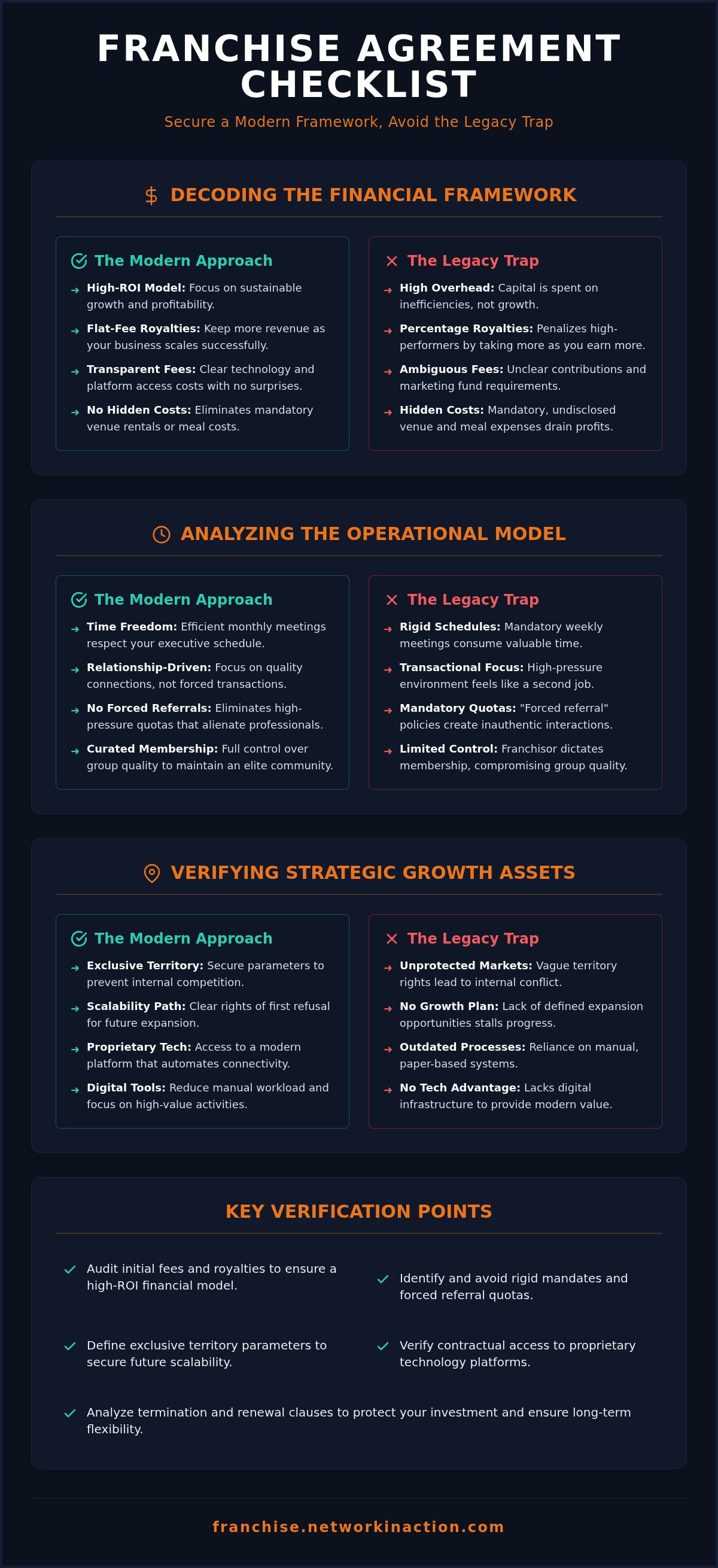
- Audit your initial license fees and ongoing royalties to ensure the financial framework supports a high-ROI, modern business model.
- Utilize a strategic franchise agreement checklist to identify and avoid the rigid mandates and forced referral quotas typical of legacy networking organizations.
- Define your exclusive territory parameters and rights of first refusal to prevent internal competition and secure your path to future scalability.
- Verify your contractual access to proprietary technology platforms, ensuring you have the digital tools necessary to lead a high-growth professional community.
- Analyze the termination and renewal clauses to build a clear exit strategy, protecting your investment and ensuring long-term flexibility.
Decoding the Financial Framework: Fees and ROI Projections
Financial clarity is the cornerstone of a successful transition into business ownership. When you begin your audit, your franchise agreement checklist must prioritize a deep dive into the fee structure to ensure every dollar drives ROI. You aren't just buying a brand; you're investing in a proven system. Understanding What is a Franchise Agreement? starts with recognizing that these documents are financial blueprints, not just legal hurdles.
Start by auditing the Initial Franchise License Fees. These fees should cover comprehensive onboarding and the reservation of your available territories. Next, examine the Ongoing Monthly Royalty Fees. You need to know how these scale with your gross revenue. A modern framework should reward your growth, not penalize it with escalating costs. Identify any specific Technology and Platform Access Fees. In a tech-forward model, these fees fund the proprietary tools that automate member connectivity and reduce your manual workload. Finally, differentiate between mandatory advertising fund contributions and local marketing requirements. You want to ensure your marketing spend stays close to home, driving results in your specific community.
Initial Investment vs. Working Capital
Successful executives look beyond the sticker price. You must verify the total liquidity required to sustain operations until you reach profitability. Service-sector models often offer a streamlined path to positive cash flow, but you need a realistic "time-to-profitability" projection. Watch out for the hidden costs common in legacy networking organizations. These often include mandatory venue rentals or meal costs that aren't clearly disclosed in the initial fee. A modern approach eliminates these inefficiencies, focusing your capital on growth rather than overhead.
Recurring Revenue and Royalty Clarity
Compare different royalty models to maximize your executive ROI. Flat-fee royalties are often superior for high-performers, as they allow you to keep more of your revenue as the business scales. Percentage-based models can act as a drag on your profit margins as you succeed. Leveraging proprietary technology is essential here. Efficient systems reduce administrative overhead, ensuring your focus remains on relationship-driven growth rather than paperwork. Financial transparency is the absolute baseline for any modern franchise agreement.
The Operational Checklist: Flexibility vs. Rigid Mandates
Operational efficiency is the engine of your ROI. When reviewing your franchise agreement checklist, look beyond the legal jargon. You must scrutinize how the franchisor expects you to spend your time. Many legacy networking organizations rely on rigid, weekly schedules that drain your most valuable asset: time. A modern framework should empower you to lead effectively without being tethered to an inefficient, manual process. Understanding the legal definition of a franchise agreement helps you identify where a franchisor’s control ends and your entrepreneurial freedom begins.
Start by reviewing the "Meeting Frequency" clause. Verify if the contract mandates weekly attendance or supports a more efficient monthly model. You should also check for "forced referral" quotas. These quotas characterize outdated networking models and create a high-pressure, transactional environment that alienates high-level professionals. Instead, look for clauses that prioritize curated membership rights. You must maintain control over group quality to ensure your community remains elite and relevant. Finally, audit the training and support timeline. A professional transition requires a structured onboarding process that respects your existing expertise. Verify that the franchisor provides a clear roadmap from signing to your first group launch. If you are ready to evaluate a model that respects your schedule, you can download a franchise kit to see the operational difference.
Monthly Meetings and Time Freedom
Time freedom is non-negotiable for modern executives. Traditional networking models often feel like a second job, demanding constant physical presence for low-impact activities. Your agreement should support a lifestyle-friendly schedule that emphasizes quality over quantity. When connectivity is automated through a proprietary technology platform, you provide consistent value to your members without the need for weekly meetings. This shift allows you to focus on high-level strategy and relationship-driven growth rather than administrative chores.
Quality Control and Member Selection
Your professional credibility is your primary currency. The agreement must explicitly grant you the right to vet and select high-level professionals for your groups. This is the essence of informed disruption. You are building a curated community of leaders, not just filling seats in a room. For those seeking top executive business opportunities, the ability to maintain high standards and exclude low-value participants is a primary differentiator. Ensure your contract protects your role as the ultimate gatekeeper of your professional network.
Territory Rights and Scalability Strategy
Market dominance begins with geographic clarity. While retail franchises obsess over physical storefronts and foot traffic, your focus as a modern executive is on professional density and network influence. Your franchise agreement checklist must include a rigorous evaluation of territory rights to ensure you aren't competing with your own brand. Exclusive territories provide the security needed to build deep, high-value relationships without the threat of internal saturation. Traditional networking models often fail here, allowing over-saturation that dilutes the value for every partner involved.
Analyze the "Rights of First Refusal" for adjacent areas. This clause is a strategic lever for future growth. If you plan to scale, you need the contractual right to expand into neighboring markets before they are offered to outside investors. Verify whether the agreement supports multi-unit ownership or the expansion of multiple groups within a single territory. In the modern networking landscape, boundaries are often a hybrid of physical geography and digital reach. Ensure your contract reflects this reality, protecting your professional footprint in both the physical and digital realms.
Securing Your Professional Footprint
Begin your due diligence by cross-referencing the available territories map with the specific language in your agreement. You must understand the exact duration of your territory rights and the conditions required for renewal. Market exclusivity is rarely permanent without performance; identify any "minimum performance" triggers that could jeopardize your status. These are often based on group size or revenue milestones. Strategic protection ensures that your hard-earned social capital remains yours alone.
Scalability and Expansion Clauses
Building a referral-based business empire requires a contract that facilitates growth. Your transition plan should include clearly defined growth milestones that align with your long-term vision. Negotiate these points early. If your goal is lifestyle autonomy, your agreement should allow for the eventual delegation of group leadership while you retain ownership. Finally, evaluate the transferability of the franchise. A sophisticated exit strategy is just as important as your entry. Ensure the agreement allows you to sell your established network as a high-value asset when you are ready to move on to your next venture.
Technology Assets and Intellectual Property Audit
Modern business is driven by data. Your franchise agreement checklist must treat technology as a foundational asset rather than a supplementary tool. In a traditionally manual industry, proprietary software is the ultimate differentiator. It's the mechanism that converts raw networking into measurable social capital. Verify that your access to the proprietary technology platform is a core contractual right. This ensures you aren't left behind as the digital landscape shifts. Audit the "Software Updates" clause specifically. You need a guarantee that the franchisor will invest in continuous innovation to keep the platform modern. Examine the training materials and "Franchise Kit" assets provided to ensure they align with your professional standards. A robust franchise agreement checklist serves as your shield against technological stagnation.
The Tech-Enabled Advantage
Efficiency creates time freedom. The platform must manage member data and referral tracking with surgical precision. This automation is what replaces the cumbersome, manual processes of legacy networking organizations. Ensure the agreement provides ongoing tech support for your daily operations. You're building an empire, not troubleshooting code. Before signing, download the franchise kit to compare the actual assets against the agreement’s specifications. This step prevents any mismatch between the marketing promises and the tools you'll use to lead your groups.
Brand Credibility and Social Capital
Brand equity is a force multiplier. Your contract should grant you the right to use brand intellectual property for local marketing, leveraging a global footprint of over 150 locations. This scale provides immediate credibility in your local market. Pay close attention to the IP guidelines regarding brand positioning. A modern brand should explicitly distance itself from outdated networking models through its messaging. Identify clauses that protect the brand reputation from low-quality operators. You want a contract that demands excellence from every partner in the system. This collective commitment to quality protects your individual investment and long-term ROI. If you're ready to lead a tech-forward community, download the franchise kit today to start your transition.
Termination, Renewal, and the Exit Strategy
Strategic foresight is the hallmark of a seasoned executive. While your focus is on growth, your franchise agreement checklist must include a comprehensive exit strategy. Entering a business without a clear path to liquidation or renewal is a mistake that many legacy networking organizations exploit through vague termination clauses. You need a contract that respects the equity you build. Analyze the "Cure Period" for any perceived breaches. This clause provides a defined window to rectify issues before a franchisor can move toward termination. It is your primary defense against arbitrary contractual disputes.
Understand the renewal process and its associated fees. Some outdated networking models use renewal as an opportunity to extract additional capital without providing new value. A modern, results-oriented agreement should offer a clear, affordable path to extending your partnership. Audit the "Non-Compete" clauses to ensure they meet executive standards. These should protect the brand’s integrity without unfairly restricting your professional future. Finally, evaluate the resale rights. You are building an asset. The agreement must outline how the franchisor assists in a transition, ensuring you can capitalize on the network you’ve cultivated. A robust franchise agreement checklist ensures that your hard work translates into a tangible, transferable asset.
Step-by-Step Agreement Exit Audit
- Step 1: Identify the length of the initial term. Most professional service franchises utilize 5 or 10-year terms. Knowing your timeline allows for better long-term financial planning and ROI projections.
- Step 2: Review the conditions for "termination without cause." You must know if the franchisor can end the relationship unilaterally and what protections you have in place. Professional agreements should require mutual alignment.
- Step 3: Verify the "buy-back" or "transfer" protocols. This ensures your equity is liquid. A transparent transfer process is essential for a clean exit when you are ready for your next venture.
Protecting Your Equity and Future
Your network is your net worth. The agreement must recognize the inherent value of the professional community you build. Unlike traditional networking models that treat partners as temporary placeholders, a modern framework views you as a long-term asset builder. For deeper insights into sustainable growth, consult the business networking franchise guide. This resource outlines the path to modern ownership and long-term profitability. Secure your financial future by making informed decisions today. To master the economics of your new professional community, get the free book and start building with confidence.
Secure Your Strategic Future in Professional Networking
Transitioning from a corporate executive role to business ownership requires a robust franchise agreement checklist to ensure your contract supports a high-ROI, tech-enabled future. You've learned to prioritize financial transparency over hidden fees, monthly flexibility over rigid weekly mandates, and scalable territory rights over geographic limitations. These pillars form the foundation of a modern business that rewards your expertise rather than draining your time through inefficient, manual processes.
With over 150 successful global locations, the Network In Action model proves that a lifestyle-friendly monthly meeting structure generates more value than the transactional grind found in legacy networking organizations. Leveraging proprietary technology for high-level connectivity isn't just a convenience; it's a requirement for sustainable growth in a digital-first economy. Your leadership deserves a platform built for the next evolution of the industry.
Ready to disrupt the status quo and build a legacy on your terms? Explore Strategic Franchise Opportunities with Network In Action and align your professional network with your personal goals. The transition to strategic ownership starts with a single, informed decision.
Frequently Asked Questions
What is the most common red flag in a franchise agreement?
The most common red flag is a lack of operational transparency, often manifested as "forced referral" quotas or hidden administrative costs. These mandates characterize outdated networking models and create a high-pressure, transactional environment that alienates high-level professionals. You should also watch for vague "marketing fees" that don't specify how capital is deployed. A modern agreement prioritizes your autonomy and focuses on quality over quantity, ensuring your investment remains a strategic asset rather than a burden.
How much time should an attorney spend reviewing my franchise agreement?
An experienced franchise attorney should typically spend three to five hours conducting a comprehensive review of your legal documents. This time allows them to cross-reference the Franchise Disclosure Document (FDD) with the final agreement to ensure consistency and fairness. Use your franchise agreement checklist to guide their attention toward territory exclusivity and renewal terms. A thorough legal audit protects your equity and ensures the contract aligns with your long-term goals for lifestyle autonomy and financial growth.
Can I negotiate the royalty fees in a modern franchise model?
Royalty fees are generally non-negotiable in established systems to ensure brand consistency and equitable support across all 150 global locations. However, you can often negotiate the structure of these fees or the timing of their implementation during your initial launch phase. Focus your negotiation efforts on territory rights or rights of first refusal for adjacent markets. These strategic levers offer greater long-term value than minor adjustments to ongoing royalty percentages or administrative fees.
What is the difference between an FDD and a Franchise Agreement?
The Franchise Disclosure Document (FDD) is a federally mandated disclosure tool that provides 23 standardized items of information about the franchisor's history and fees. In contrast, the Franchise Agreement is the actual legally binding contract that governs your ongoing relationship. While the FDD offers historical data and fee transparency, the agreement dictates your daily operational rights and exit strategy. You must use both documents to finalize your franchise agreement checklist before making a final commitment to any brand.
Are territory rights guaranteed for the life of the contract?
Territory rights are typically guaranteed for the duration of the initial term, provided you meet specific "minimum performance" triggers. These metrics are designed to ensure that the brand maintains a strong presence in the market. You must verify these triggers in your contract to prevent any risk of losing exclusivity. High-performing executives often view these requirements as baseline targets rather than hurdles, using them to drive consistent growth and secure their professional footprint in the local community.
What happens if the franchisor changes the technology platform?
Modern franchise agreements usually include a "Software Updates" clause that allows the franchisor to implement new technology to maintain a competitive edge. This is a critical advantage in an industry often stuck in manual, traditional networking practices. These updates should enhance member connectivity and reduce your administrative overhead. Ensure the agreement specifies that you will receive adequate training and support whenever a platform shift occurs, protecting your operational efficiency and the overall member experience.
Is a 401(k) rollover (ROBS) a viable way to pay the initial license fee?
A Rollover for Business Startups (ROBS) is a common and viable strategy for high-level professionals to fund their initial investment without incurring early withdrawal penalties. This method allows you to leverage your existing retirement capital to build a new income stream. While this approach offers significant liquidity, it requires careful compliance with IRS regulations. Consult with a specialized financial advisor to ensure the process is handled correctly, allowing you to transition into ownership with confidence.
What are the typical renewal fees for a service-based franchise?
Renewal fees for service-based models typically range from a flat administrative fee to a small percentage of the current initial license fee. These costs should be clearly defined in your agreement to avoid surprises at the end of your initial term. Unlike legacy networking organizations that may use renewal as a high-pressure sales tactic, a transparent model provides a predictable path for continued growth. Verify these fees early to ensure your long-term ROI projections remain accurate and achievable.