Why are you still trading forty hours a week for a cubicle when you could own the room? Most professionals searching for the cost to start a networking business are met with technical guides for IT cabling, but the real opportunity in 2026 isn't in hardware. It's in social capital. You've likely realized that legacy networking organizations are failing the modern executive. They're rigid. They're transactional. They're exhausting. You want a professional environment that demands high standards and delivers measurable financial returns without the 9-to-5 grind.
It's time to move beyond the skepticism of low-value models and embrace a system designed for the next evolution of business. Strategic growth. Proven results. This guide provides an unapologetic look at the strategic investment required to launch a high-ROI professional networking franchise. You'll gain a clear breakdown of startup costs and an understanding of the recurring revenue potential that comes with a tech-forward business model. Prepare to see how a sophisticated, streamlined approach to community leadership can transform your professional path and your bottom line.
Key Takeaways
- Distinguish between technical IT infrastructure and the high-value social capital required to lead a professional business community.
- Evaluate the total cost to start a networking business by analyzing initial license fees, exclusive territory rights, and the value of a tech-enabled support system.
- Discover why the monthly meeting model offers a superior ROI compared to the rigid, transactional nature of legacy networking organizations.
- Execute a strategic 90-day roadmap that prioritizes territory acquisition and high-quality member recruitment for rapid growth.
- Leverage proprietary digital tools and a scalable franchise model to build a consistent, recurring revenue stream with lifestyle autonomy.
Beyond Hardware: What It Really Costs to Start a Professional Networking Business
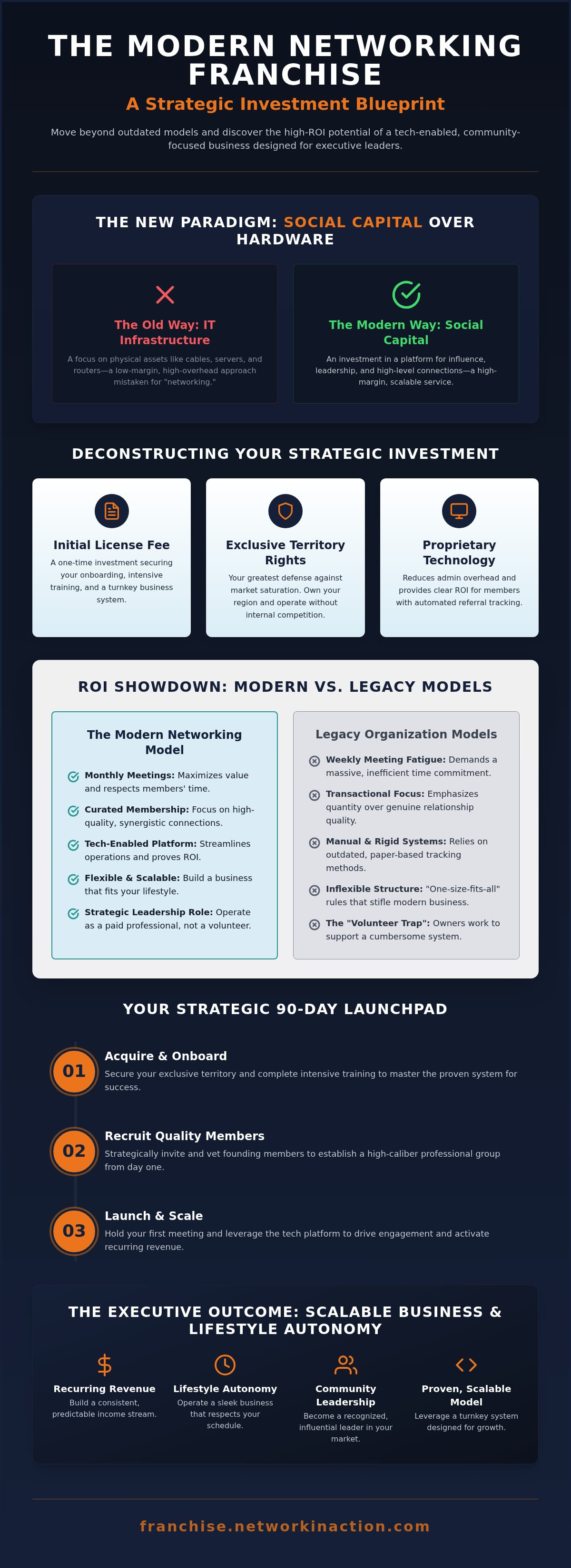
Most search results for the cost to start a networking business focus on fiber optic cables, server racks, and IT labor. They're missing the point. In 2026, the most lucrative networking isn't about hardware. It's about high-level business networking. This is a high-margin service industry where your primary investment is social capital. You aren't buying routers; you're securing a platform for community influence. The shift from transactional cabling costs to strategic leadership investment defines the modern franchise landscape. The primary cost categories for this model include your initial franchise license, proprietary technology access, and exclusive territory rights.
Professional networking has evolved into a sophisticated asset class. It offers a streamlined path to recurring revenue without the overhead of traditional brick-and-mortar operations. You don't need a warehouse or a fleet of vehicles. You need a proven system and the authority to lead. This model prioritizes efficiency and measurable results, positioning itself as the superior alternative to manual, outdated business development methods.
The Social Capital Investment Model
This business is a leadership platform. It's not a job. Executives are increasingly abandoning traditional consulting because it lacks scalability and demands constant prospecting. Owning a group allows you to leverage your existing expertise into a consistent income stream. The cost to start a networking business reflects the value of a turnkey system. Building from scratch requires years of trial and error. A professional franchise model provides the infrastructure on day one. You focus on growth. The system handles the logistics. This creates an immediate competitive advantage in any market.
Professional Networking vs. Legacy Industry Standards
Legacy networking organizations rely on weekly morning meeting fatigue. These outdated models demand a massive time commitment for minimal returns. They're rigid. They're transactional. They're inefficient. Modern disruption favors efficiency. Monthly meetings create better margins for owners and higher value for members. You avoid the volunteer trap where you work for free to support a cumbersome organization. Instead, you operate a sleek, tech-enabled business that respects your schedule. If you're ready to see where you can lead, check for available territories in your region. The goal is lifestyle autonomy through professional excellence.
Deconstructing the Investment: License Fees, Royalties, and Technology
Understanding the cost to start a networking business requires a shift from viewing expenses as "bills" to viewing them as strategic assets. You aren't just paying to play. You're paying for a refined, tech-enabled engine that generates high-level connections. Before committing, you should calculate your startup costs to ensure you have sufficient working capital for the first six months. This period is critical for building momentum and establishing your local presence. You need liquidity to fuel your initial recruitment efforts while your recurring revenue streams mature.
Initial Franchise License Fees Explained
The license fee is a one-time investment that secures your professional territory. It covers your onboarding, intensive training, and the reservation of your exclusive market. In a crowded professional landscape, exclusive territory rights are your greatest defense against market saturation. Unlike other executive-level business opportunities that might leave you competing with neighbors, this model ensures you own the room. It's a foundational step that positions you as the definitive leader in your region. You aren't just buying a name; you're buying a protected space to grow.
The Technology Advantage: Investing in a Proprietary Platform
A professional referral platform is non-negotiable in 2026. If you're still using paper slips or manual spreadsheets, you're already behind. The digital backbone of your business reduces administrative overhead, allowing you to focus on high-impact leadership rather than data entry. Automated member tracking and referral reporting provide a clear ROI for your members, which in turn secures your recurring revenue. You're investing in a system that does the heavy lifting. No missed opportunities. No manual tracking. High efficiency results in higher margins.
Ongoing Support and Brand Equity
Ongoing monthly royalties aren't a tax on your success; they're an investment in continuous growth. This structure grants you access to a global network of 150+ locations, where shared insights and cross-territory referrals become standard. You also gain immediate access to corporate resources, including battle-tested marketing materials and proven sales scripts. This brand equity allows you to bypass the struggle of building a name from scratch and start from a position of established authority. To see the full breakdown of what's included, you can download the franchise kit and evaluate the alignment with your goals.
Strategic budgeting isn't just about the numbers. It's about the systems those numbers buy. When you franchise a business opportunity like this, you're choosing the modern evolution of the industry over outdated networking models. You're investing in a future where your time is valued and your income is scalable.
The ROI of Modern Networking vs. Legacy Organization Models
Analyzing the ROI of this industry requires looking past the surface. Legacy networking organizations operate on a volume-first mindset. They demand weekly morning meetings, rigid attendance rules, and forced referrals. This high-volume, low-quality approach is a massive time sink for the owner. If you calculate the cost to start a networking business solely based on the entry fee, you're missing the hidden cost: your time. Modern models disrupt this by prioritizing quality over quantity. You don't just want a full room; you want the right room.
The break-even point for a new networking group is reached faster when retention is high. In traditional networking, member churn is a constant battle because the time commitment often outweighs the actual business value. By moving to a monthly meeting structure, you increase the perceived and actual value for high-level executives. They stay longer. They refer better. Understanding the total cost to start a networking business includes accounting for the efficiency of the model. Your recurring revenue stabilizes quickly, allowing you to focus on expansion rather than constant replacement of departing members.
Efficiency as a Revenue Driver
Efficiency is the ultimate engine for growth. Because the NIA model utilizes monthly meetings rather than weekly ones, you can lead multiple groups simultaneously. You scale your income without a linear increase in your workload. This is lifestyle autonomy in action. Curated membership ensures that every person in the room adds value. High-quality interactions lead to better retention. Better retention leads to a more predictable bottom line. You aren't just running meetings; you're managing a high-margin portfolio of professional communities. It's about working smarter, not longer.
Social Capital as a Financial Metric
Your influence is a financial metric. Period. Being the center of influence in your city isn't just a social win; it's a strategic advantage. It opens doors to secondary business opportunities that aren't available to the rank-and-file professional. People want to work with the individual who controls the network. This authority creates a long-term asset that appreciates over time. While legacy networking organizations focus on transactional volume, the modern approach builds high-value equity. You're creating a durable ecosystem. It's built on trust and technology. It's designed for the elite. If you're ready to explore this path, you can get the free book to understand the strategic logic behind our systems.
Strategic Budgeting: Your First 90 Days as a Network Owner
Execution is the only differentiator that matters. Calculating the cost to start a networking business involves more than just the initial fee; it requires a tactical deployment of capital over the first 90 days. This period is your ramp-up phase. You aren't just spending money. You're buying momentum. A structured approach ensures that every dollar contributes to territory dominance and member recruitment. By following a proven timeline, you move from a new owner to a market leader with speed and precision.
- Phase 1: Days 1-30. Focus on territory acquisition and initial onboarding. This is the foundation. You'll complete your training and begin identifying the key power partners in your exclusive region.
- Phase 2: Days 31-60. Shift to member recruitment and foundational marketing. Use your budget to fuel outreach. This is where you establish your credibility and build your "founding member" core.
- Phase 3: Days 61-90. Launch your first group and establish a monthly rhythm. At this stage, your operational systems take over, and you begin to see the first signs of recurring revenue.
Marketing Your New Professional Network
Visibility requires a strategic budget. You'll need to allocate funds for a professional digital presence and targeted local LinkedIn outreach. This isn't about cold calling; it's about relationship-driven growth. Offering "founding member" incentives can accelerate your early groups by creating a sense of exclusivity and urgency. To streamline this process, savvy owners leverage the Network In Action franchise kit for rapid deployment. This kit provides the battle-tested assets needed to attract high-level executives without the need for expensive, custom marketing agencies.
Managing Operational Expenses
Modern networking is a lean business model. You don't need a physical office, which dramatically reduces the cost to start a networking business compared to traditional franchises. Venue costs are kept low by utilizing high-end restaurants or country clubs for monthly meetings. Your primary operational expenses will center on technology subscription management for your member groups. These tools enable you to generate the first "Referral ROI" report for your members by day 90. Providing this data early proves your value and secures long-term retention. It's a tech-forward approach that eliminates the administrative bloat of legacy networking organizations.
If you're ready to secure your market and lead a high-value community, the first step is to check available territories in your area. Align your investment with a model built for the 2026 economy.
Scaling Your Influence: Why NIA is the Ultimate Executive Business Opportunity
The transition from a high-level professional to a visionary community leader is the final stage of your entrepreneurial evolution. You've already analyzed the market. You've looked at the numbers. Now, it's time to consider the long-term trajectory of your investment. While the initial cost to start a networking business secures your first group, the real wealth is built through multi-territory expansion. This model isn't designed for those who want a small side project; it's for leaders who want to dominate a region and build a durable, recurring revenue stream that scales without a linear increase in effort.
Scaling your influence means moving beyond the day-to-day management of a single group. It involves identifying market gaps and deploying the NIA system across multiple high-value territories. You aren't just facilitating conversations. You're architecting a professional ecosystem. This path allows you to leverage your social capital into a significant financial asset. The goal is clear: move from the "employee" mindset of trading hours for dollars to the "visionary" mindset of owning a high-margin service business. For those ready to lead, the next step is to check available territories and secure your market before your competitors do.
Scalability and Lifestyle Autonomy
True success isn't just about the bottom line; it's about time freedom. You shouldn't have to choose between a thriving business and your personal life. The monthly meeting model is the engine behind this lifestyle autonomy. By focusing on a results-oriented culture rather than frequent, low-value meetings, you ensure high member retention and lower operational stress. This efficiency allows you to manage multiple groups or territories while maintaining a schedule that works for you. For a deeper dive into how this works for high-level professionals, read the Business Networking Franchise: The Executive Guide to Modern Ownership. It's about designing a business that fits your life.
Joining the Next Evolution of Professional Networking
The era of rigid, transactional networking is over. Traditional networking models are losing ground because they fail to respect the time and sophistication of today's business owners. You have a competitive advantage when you offer a tech-enabled, curated experience with no forced referrals. This modernized approach attracts a higher caliber of member, which in turn justifies higher margins and ensures long-term stability. You aren't just buying a franchise; you're joining the next evolution of the industry. When you evaluate the cost to start a networking business, remember that you're paying for a proven, elite system that has already solved the flaws of legacy organizations. Ready to begin your evaluation? Download the NIA Franchise Kit today and see how your leadership can transform your local business community.
Secure Your Market: The Next Evolution of Business Leadership
You've seen the breakdown. You understand the shift. The cost to start a networking business in 2026 isn't about buying hardware; it's about investing in a proven, high-performance leadership system. Legacy networking organizations are struggling with outdated, time-consuming models that drain your schedule. You have the opportunity to disrupt the status quo by prioritizing high-level results over transactional volume. By leveraging a proprietary technology platform and a monthly meeting structure, you create a business that works for you.
Success is already documented across 150 successful locations globally. You aren't building from scratch. You're joining an elite network that provides executive-level support and specialized training from day one. This is your path to lifestyle autonomy and community influence. The opportunity is finite. Exclusive territories are being secured by professionals who recognize the value of social equity. Don't wait for the market to saturate. Take the first step toward building a scalable, recurring revenue stream. Explore Available Territories and Secure Your Network today. Lead the room. Own the results.
Frequently Asked Questions
What is the total initial investment required for a networking franchise?
The total investment includes the franchise license fee, initial training, and working capital for the first several months. This capital covers territory acquisition and early marketing efforts. Unlike equipment-heavy industries, the cost to start a networking business focuses on intellectual property and exclusive territory rights. It's a strategic entry into the professional services sector that avoids the overhead of inventory or heavy machinery typical of other business models.
How do networking franchise costs compare to traditional retail franchises?
Networking franchise costs are typically a fraction of the investment required for traditional retail or food-service models. Retail franchises demand significant capital for leasehold improvements, inventory, and physical equipment. In contrast, a professional networking model is a service-based business with minimal physical requirements. This lower barrier to entry allows you to allocate more resources toward recruitment and community leadership rather than facility maintenance and complex supply chain logistics.
Are there ongoing technology fees associated with running a professional network?
Yes, ongoing technology fees cover access to a proprietary platform designed for member connectivity and referral tracking. This digital backbone is essential for modern operations. It automates administrative tasks that would otherwise require manual labor or additional staff. These fees represent an investment in efficiency, ensuring that your time is spent growing the network rather than managing spreadsheets or paper referral slips used by legacy networking organizations.
Can I start a networking business as a part-time venture?
The monthly meeting model is specifically designed for high-level professionals who value time freedom. While it requires dedicated leadership, it doesn't demand the 60-hour workweeks typical of outdated networking models or retail operations. Many owners successfully manage their groups alongside existing consulting practices or other business ventures. It's a scalable opportunity that provides lifestyle autonomy while building a consistent, recurring revenue stream in your exclusive local market.
What kind of training is included in the initial license fee?
The initial license fee includes comprehensive onboarding and executive-level training. This program covers the proprietary systems needed to recruit members, facilitate high-value meetings, and utilize the technology platform effectively. You gain access to proven sales scripts and marketing materials that have been successful across 150 locations globally. This support ensures you can launch your first group with confidence, skipping the trial and error associated with building a business from scratch.
Is there a requirement for a physical office or storefront?
There is no requirement for a physical office or storefront. This "no-office" model is a key factor in keeping the cost to start a networking business low. Meetings are typically held at upscale local venues, restaurants, or professional boardrooms. This flexibility eliminates the burden of monthly rent, utilities, and long-term commercial leases. You operate as a lean, modern executive, leading your community from anywhere while maintaining a sophisticated professional image.
How does the monthly meeting model impact the cost of operation?
The monthly model significantly reduces operational costs and increases owner margins. Traditional networking models that require weekly meetings often result in higher venue fees and greater time commitments for the owner. By meeting once a month, you lower your per-meeting overhead and improve member retention among busy executives. This structure allows you to lead multiple groups simultaneously, maximizing your revenue potential without exhausting your personal or financial resources.
What is the expected timeframe for a return on investment?
The timeframe for a return on investment depends on your recruitment speed and territory management. Because the model relies on recurring revenue, the financial objective is to reach a break-even point within the first few groups. Most owners focus on a strategic 90-day ramp-up period to establish their foundational membership. Once the initial groups are filled, the low overhead and consistent membership fees create a predictable path toward a return on the initial investment.