Most professional networking groups are a liability, not an asset. They demand your most valuable resource, time, and return nothing but forced, low-quality leads and rigid, outdated protocols. You've likely felt the exhaustion of weekly meetings that prioritize attendance over actual revenue. It's time to disrupt the status quo. By shifting your focus to a modernized networking group business model, you can transform from a frustrated participant into an influential community leader who owns a scalable, high-impact asset. Strategic growth. Measurable ROI. Elite influence.
You deserve a system that respects your schedule and maximizes your professional influence. This blueprint provides the strategic steps to launch a tech-enabled group that delivers consistent, high-value referrals without the inefficiencies of legacy networking organizations. This guide explores how to leverage proprietary tools, curate an elite membership, and build a recurring revenue stream that offers true lifestyle autonomy. From operational logistics to strategic positioning, this is the definitive path to mastering the next evolution of professional connection. It's time to stop attending meetings and start leading a community that drives real results.
Key Takeaways
- Adopt a modern networking group business model that prioritizes strategic ROI and professional influence over the social noise of traditional clubs.
- Identify your Ideal Member Profile to curate an elite Founders Circle composed of local decision-makers rather than low-level sales reps.
- Replace the time-consuming weekly grind of outdated networking models with a high-impact monthly cadence that respects the schedules of top-tier executives.
- Follow a structured phase-by-phase launch blueprint to move from initial market research to a fully operational, scalable professional community.
- Learn the critical shift from being a manual DIY organizer to becoming a professional owner who utilizes a turnkey, tech-enabled system for growth.
Why Traditional Networking Fails—and Why You Should Lead the Evolution
Professional networking isn't a social hour. It's a strategic business engine. Most professionals treat it like a casual hobby, but the highest earners treat it as a high-performance system. Legacy systems are failing because they prioritize activity over results. They confuse attendance with achievement. If you're still operating under a 20th-century mindset, you're leaving money and influence on the table. A modernized networking group business model functions as a sophisticated lead-generation engine, not a social gathering. Modern networking is a high-efficiency, technology-led referral system designed for the modern executive.
The Problem with Legacy Networking Organizations
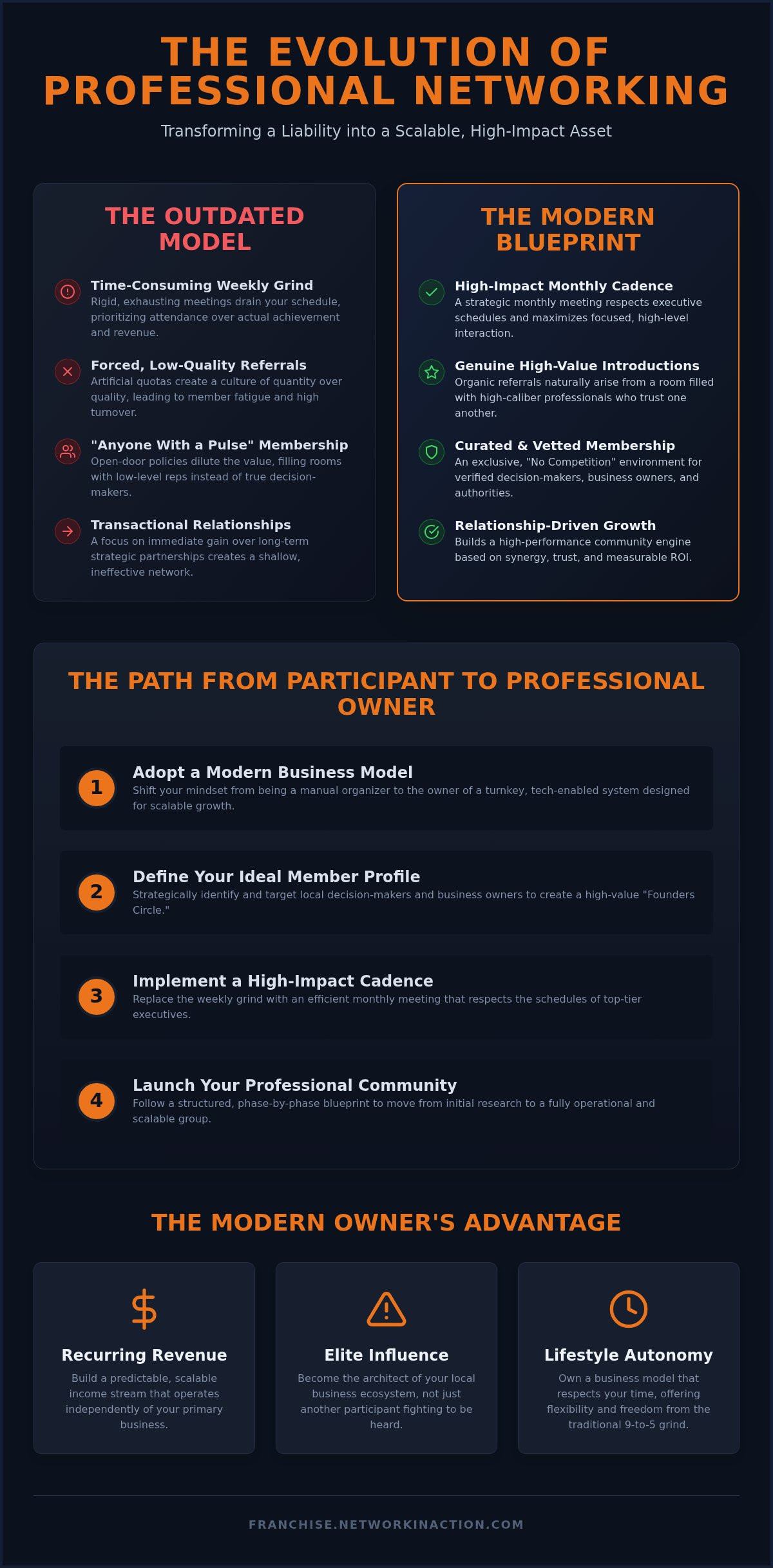
The traditional model is broken. Legacy networking organizations rely on a rigid weekly meeting structure that drains time without guaranteeing a return. For a busy executive, committing ninety minutes every single week is a significant investment. When that time is spent listening to low-level transactional pitches or meeting forced referral quotas, the ROI disappears. Forced referrals create a culture of quantity over quality. You don't need fifty lukewarm leads; you need five high-value introductions. Outdated networking models focus on the former, leading to member fatigue and high turnover. Transactional relationships. Wasted hours. Diminishing returns.
The 2026 Shift: High-Quality over High-Quantity
Modern business demands a more refined approach. High-efficiency, technology-led referral systems are the new standard for 2026. This shift moves away from the "anyone with a pulse" membership strategy. Instead, it focuses on curated communities where every member is a decision-maker. When you curate for quality, the referral floor rises naturally. There's no need for artificial quotas when the room is filled with high-level professionals who actually have the capacity to help one another. Quality over quantity. Results over activity.
Becoming the owner of such a group positions you as the ultimate local authority. You aren't just another attendee fighting for a chance to speak; you're the architect of the ecosystem. This transition from participant to owner is the most direct path to scaling your influence. For those ready to lead, exploring a Business Networking Franchise: The Executive Guide to Modern Ownership reveals how to professionalize this process. Ownership provides recurring revenue, lifestyle flexibility, and a position of power in your local market. Stop following the old rules. Start building the new ones.
Defining Your Strategic Vision: Audience, Objectives, and Value
A successful networking group business model starts with a precise vision. You aren't building a social club; you're engineering a high-performance community. This requires identifying your Ideal Member Profile (IMP). Focus exclusively on business owners and decision-makers who have the authority to sign checks and authorize partnerships. Free local meetups often fail because they lack this barrier to entry. Your value proposition rests on exclusivity and territory protection. By offering a curated space where members aren't competing with three other people in their same field, you create immediate, high-level demand. This strategic clarity ensures that every minute spent in the group is an investment in growth, not a donation of time.
Curating the Right Professional Mix
Selection is everything. You must intentionally select complementary industries to maximize referral potential. A real estate agent, a mortgage broker, and a home inspector form a natural referral loop. To protect this synergy, a strict "No Competition" rule is non-negotiable. One professional per industry per group. This ensures that every member is the sole recipient of leads in their category, fostering genuine trust rather than internal competition. Vetting is the final safeguard. You must verify professional credibility and commitment before granting access to the room. High standards attract high performers. Positioning your group as a premium destination requires a commitment to these high-level standards from day one.
Setting Measurable Goals for Your Members
Stop counting handshakes and start tracking revenue. A modern networking group functions as a Business Growth Engine. You must establish clear, ROI-driven objectives. Transition your members from simply "exchanging cards" to actively closing deals. This requires a system to track the financial impact of every introduction. When members see a direct correlation between their time in the room and their bottom line, retention becomes effortless. This focus on measurable financial metrics is what separates a professional organization from a legacy networking model. It's about social capital meeting real-world capital. If you want to build this level of influence, you can explore available territories to see where you can lead your own community and drive real economic impact.
The Logistics of High-Impact Networking: Monthly Cadence vs. Weekly Grinds
Legacy networking organizations operate on a flawed premise: that more meetings equal more value. This couldn't be further from the truth. For a high-level executive, a weekly meeting is a recurring tax on their productivity. By contrast, a sophisticated networking group business model utilizes a monthly cadence. This shift from weekly to monthly isn't just about saving time; it's about elevating the entire professional atmosphere. High-impact networking requires a setting that mirrors the boardroom, not a casual coffee shop or a chaotic breakfast diner. Efficiency is the new currency of professional connection.
Maximizing Efficiency for the Executive Member
Busy professionals don't have time for the weekly grind. Committing to 90 minutes once a month is a strategic appointment. Committing to 60 minutes every single week is a logistical burden. The psychology of quality time plays a massive role here. When meetings occur monthly, they're treated with higher importance. Attendance stays high, and the energy in the room is focused on closing deals rather than just filling a seat. This approach drastically reduces meeting fatigue while actually increasing referral velocity. You're creating a space where every interaction counts and every minute is accounted for in the pursuit of ROI.
The Role of Technology in Member Retention
How do you maintain momentum when you aren't meeting every week? You leverage a proprietary technology platform to bridge the gap. Manual spreadsheets are the death of professional groups. They're slow, prone to error, and invisible to the membership. Modern owners use dedicated digital tools to track referral activity and member engagement 24/7. This transparency builds trust and keeps the group connected between physical sessions. Proprietary technology replaces the need for redundant weekly check-ins by providing real-time data on every member's contribution. This tech-first approach ensures that the networking group business model remains scalable and efficient. It allows the owner to focus on high-level strategy rather than administrative minutiae, ensuring the group stays focused on the only metric that matters: member success.
A Step-by-Step Blueprint for Launching Your Professional Referral Group
Building a high-impact networking group business model requires more than a casual interest in connecting people. It demands a disciplined, phase-based execution strategy. You aren't just starting a meeting; you're launching a professional community designed for scale and ROI. Strategic planning. Precise execution. Proven results. This blueprint moves you from initial research to a fully operational, revenue-generating asset that commands respect in your local market.
Recruiting Your Anchor Members
Phase one begins with market research and territory identification. You must understand the local economic landscape to ensure your group serves high-growth industries. Once the territory is set, phase two focuses on the Founders Circle. These are your first 5-10 anchor members. Target the super-connectors in your market professionals who already possess deep influence and a wide reach. When pitching them, emphasize the modernized, tech-forward nature of your network. Contrast this with the rigid, time-consuming nature of legacy networking organizations. You can available territories to identify where executive demand is currently highest and most underserved.
Scaling Through Professional Systems
Phase three is about establishing your digital infrastructure. Legacy models fail because they rely on manual processes and inconsistent follow-up. You must leverage professional collateral and proprietary technology to differentiate your group immediately. This leads into phase four: the Vision Meeting. This is a high-stakes session where you secure commitments from your anchor members by demonstrating the tangible value of the system. You aren't asking for a favor; you're offering a seat at an elite table.
Scaling requires automation. You shouldn't spend your time chasing RSVPs or manually tracking referrals. A professional system automates invitations and member activity, allowing you to focus on high-level relationship management rather than administrative grunt work. This ensures accountability and prevents lead decay.
- Automate invitations and RSVPs to protect your time and maintain a consistent meeting rhythm.
- Deploy digital referral tracking to ensure every connection is documented and measurable.
- Structure the first meeting to deliver immediate, tangible value that justifies the membership.
Phase five is the official launch. By this stage, your group should function as a well-oiled machine. Ongoing management becomes a matter of curation and facilitation rather than logistical firefighting. If you're ready to bypass the trial-and-error of a DIY approach, you should download the franchise kit to access a proven, turnkey blueprint for professional leadership and community impact.
Transitioning from DIY Organizer to Professional Network Owner
A hobby costs you money. A business makes you money. Most people who try to start a professional group fall into the trap of being a "DIY organizer." They spend their weekends drafting emails, their evenings chasing payments, and their meeting times managing personality conflicts. This isn't leadership; it's administrative burden. The shift to a professional networking group business model represents the line between being a volunteer and being a visionary. You aren't just running a group. You're owning a scalable asset that generates recurring revenue while cementing your status as a local community leader. Ownership is about systems, not sweat equity.
The ROI of Ownership: Beyond Just Referrals
Professional ownership delivers a dual-stream ROI that a casual DIY approach can't match. First, you build a consistent income stream through membership fees. This isn't just "extra money." It's a predictable, monthly revenue model that scales as your influence grows. Second, you leverage the network to grow your own primary business. When you own the room, you don't have to fight for attention. You are the trusted authority who curates the connections. This high-level positioning accelerates your own business growth by putting you at the center of every major local referral loop. To master this, you must understand the underlying Referral Marketing Strategy: Unlocking Growth through Trust and Connections. It's about turning social capital into measurable financial gain.
Why a Turnkey Model Wins in 2026
The business landscape in 2026 doesn't reward trial and error. It rewards speed and precision. Starting from scratch means wasting months, or even years, trying to build the technology and training protocols that a franchise system already perfected. Network In Action (NIA) provides a turnkey solution that bypasses the logistical hurdles of the legacy industry. With over 150 locations globally, the model is proven, tested, and ready for deployment. You gain access to proprietary technology that automates member tracking and engagement, freeing you to focus on high-level strategy and lifestyle autonomy. You aren't alone; you're part of a global brand and a network of fellow owners who share best practices for growth. Stop trying to invent the wheel. Instead, take the keys to a high-performance machine. If you're ready to move from participant to professional leader, download the franchise kit to see if you qualify for NIA ownership and begin your journey toward time freedom and elite influence.
Own the Room: Your Evolution into Professional Leadership
The transition from a frustrated attendee to a high-impact owner is a strategic shift that redefines your local influence. By adopting a modernized networking group business model, you move beyond the transactional noise of legacy networking organizations. You've learned that monthly meetings attract elite executives, and that proprietary technology is the only way to scale without sacrificing your time. This isn't just about referrals. It's about building a predictable revenue stream and a legacy of community leadership.
Network In Action offers a turnkey system designed by business owners for business owners. With over 150 successful territories worldwide, this model is the next evolution of the industry. You gain access to exclusive digital tools that automate the heavy lifting, allowing you to focus on high-level strategy and lifestyle autonomy. It's time to stop managing spreadsheets and start leading a powerhouse community. Explore high-level ownership with the NIA Franchise Kit to see if you're ready to secure your territory. Your future as a professional network owner starts with a single strategic move.
Frequently Asked Questions
How much time does it take to manage a professional networking group?
Managing a professional group requires significantly less time than traditional networking models suggest. A monthly 90 minute meeting is the core commitment. When you utilize a tech enabled networking group business model, administrative tasks like RSVP tracking and referral logging are automated. Most owners spend five to ten hours per month on high level facilitation and member recruitment. This efficiency allows you to build a recurring revenue stream without sacrificing your primary career.
How do I find high-quality members for my new networking group?
High quality members are found by targeting local decision makers and super connectors rather than low level sales representatives. Start by identifying the top professionals in complementary industries like real estate, law, and finance. Use professional platforms like LinkedIn to vet candidates for their local influence and professional credibility. A curated invitation process ensures that the room remains exclusive, which naturally attracts other high performers who value their time and social capital.
What is the best way to charge for membership in a referral group?
The most effective way to charge for membership is through an annual or monthly recurring fee structure. This creates a consistent income stream for the owner while ensuring members have skin in the game. High level professionals expect to pay for a premium environment and exclusive access. Avoid the low cost models of outdated networking organizations, as these typically attract transactional members who provide little value to the community.
Should I start a DIY group or invest in a networking franchise?
Investing in a franchise is the superior choice for those seeking a scalable business rather than a time consuming hobby. A DIY group requires you to invent your own technology, marketing collateral, and training protocols from scratch. A franchise provides a turnkey system with proven results and a global brand. This allows you to launch faster and with greater authority, bypassing the expensive trial and error phase of independent management.
How do I handle industry exclusivity in my networking group?
Industry exclusivity is maintained through a strict one person per category rule. This policy is non negotiable in a modernized networking group business model. It eliminates internal competition and ensures that every member is the sole recipient of referrals for their specific field. By protecting territories, you build a culture of trust where members feel safe sharing their best leads, knowing their colleagues aren't also their competitors.
What kind of technology do I need to run a successful networking group in 2026?
Successful groups in 2026 require a proprietary digital platform to manage connections and track ROI. Manual spreadsheets and email chains are inefficient and prone to error. You need technology that automates invitations, facilitates 24/7 member communication, and provides real time data on referral velocity. This tech forward approach replaces the need for redundant weekly check ins and keeps the group engaged and accountable between physical monthly meetings.
Can I run a networking group while working a full-time job?
You can absolutely lead a professional community while maintaining a full time executive role. The monthly meeting cadence is specifically designed for busy professionals who cannot commit to the weekly grind of legacy networking organizations. Automated systems handle the administrative heavy lifting, such as payment processing and meeting reminders. This model offers the lifestyle autonomy needed to scale a secondary income stream without overwhelming your existing professional schedule.
How do I ensure members actually pass high-quality referrals?
High quality referrals are a byproduct of curated membership and trust, not forced quotas. Outdated networking models use pressure tactics that result in low value leads. Instead, vet members for their existing referral capacity and professional reputation. When decision makers are placed in an exclusive, tech enabled environment, they naturally identify opportunities for collaboration. Tracking the financial impact through a digital platform ensures that every introduction is meaningful and results oriented.