Why are the most talented executives still trading sixty hours a week for a corporate salary when they could own the system instead? You've likely spent years building a powerhouse network, only to feel trapped by the grind of corporate culture or the high overhead of traditional retail franchises. Finding sophisticated service-based franchise opportunities shouldn't feel like a compromise. You deserve a business that reflects your professional standing and respects your time. High margins. Low overhead. Scalable impact.
This executive guide reveals how to leverage your professional background to own a high-margin, tech-enabled service franchise that prioritizes ROI over manual labor. You'll discover how to achieve genuine time freedom while building a recurring revenue stream that scales without the friction of legacy networking organizations. This guide breaks down the shift toward relationship-driven growth, the elimination of manual labor through exclusive digital tools, and the strategic path to becoming a community leader in the 2026 economy. It's time to stop prospecting and start leading.
Key Takeaways
- Identify why expert-led, service-based franchise opportunities outpace traditional retail by prioritizing intellectual capital over physical inventory.
- Distinguish between the "employee trap" of labor-heavy franchises and elite executive models that focus on high-level relationship management.
- Calculate your "Time-ROI" to ensure your business investment delivers lifestyle autonomy through proprietary technology and automated administration.
- Learn to vet high-level opportunities by auditing the caliber of their professional community and the efficiency of their meeting structures.
- Transition from corporate burnout to community leadership by leveraging a modern, tech-enabled referral system that replaces outdated networking models.
What Are Service-Based Franchise Opportunities in 2026?
Traditional franchising often evokes images of fast food and retail storefronts. In 2026, the landscape has fundamentally shifted toward intellectual capital. Service-based franchise opportunities represent a business model where you monetize expert-led solutions rather than physical products. You aren't selling burgers; you're selling results. You aren't managing complex supply chains; you're managing professional systems. It's a pivot from the tangible to the strategic.
Executives are increasingly abandoning the high-overhead traps of traditional retail. The shift is clear. Professional services offer a faster path to profitability because your capital isn't locked in "dead" assets like inventory or expensive commercial leases. You leverage your professional background to lead a business that rewards strategy over manual labor. This is franchising for the modern executive who values efficiency over the "grind" of legacy models.
The Rise of Professional Service Franchising
The industry is moving beyond basic maintenance services into the high-stakes world of business consulting and strategic networking. Digital transformation has lowered entry barriers while raising the ceiling for professional prestige. You don't need a massive physical footprint to exert influence. Modern owners use proprietary technology platforms to automate administrative friction, allowing them to focus on high-value relationship building. It's a sophisticated alternative to the "employee trap" found in many outdated networking models.
- Elite Positioning: Maintain your professional status by leading a community of peers.
- Tech-Enabled Efficiency: Use exclusive digital tools to replace manual administrative tasks.
- Scalable Impact: Grow your business without the linear increase in headcount required by traditional models.
Economic Resilience of Service Models
B2B services provide a level of stability that consumer-facing retail often lacks. In volatile markets, businesses prioritize growth and efficiency. This makes high-level service franchises essential infrastructure rather than luxury expenses. Membership-based models are particularly attractive because they build consistent income streams through recurring revenue. This creates a predictable financial foundation that many legacy networking organizations often fail to provide.
When you compare capital requirements, the choice is logical. Retail franchises demand heavy upfront investment and ongoing inventory costs. In contrast, service-based franchise opportunities offer high-margin scalability with minimal physical overhead. It's a strategic move for those who value ROI and time freedom. You build equity in a system that works for you, rather than spending your life working for the system. For those ready to move beyond corporate burnout, exploring the franchise kit is the first step in auditing these modern systems.
Executive vs. Labor-Intensive Service Franchises
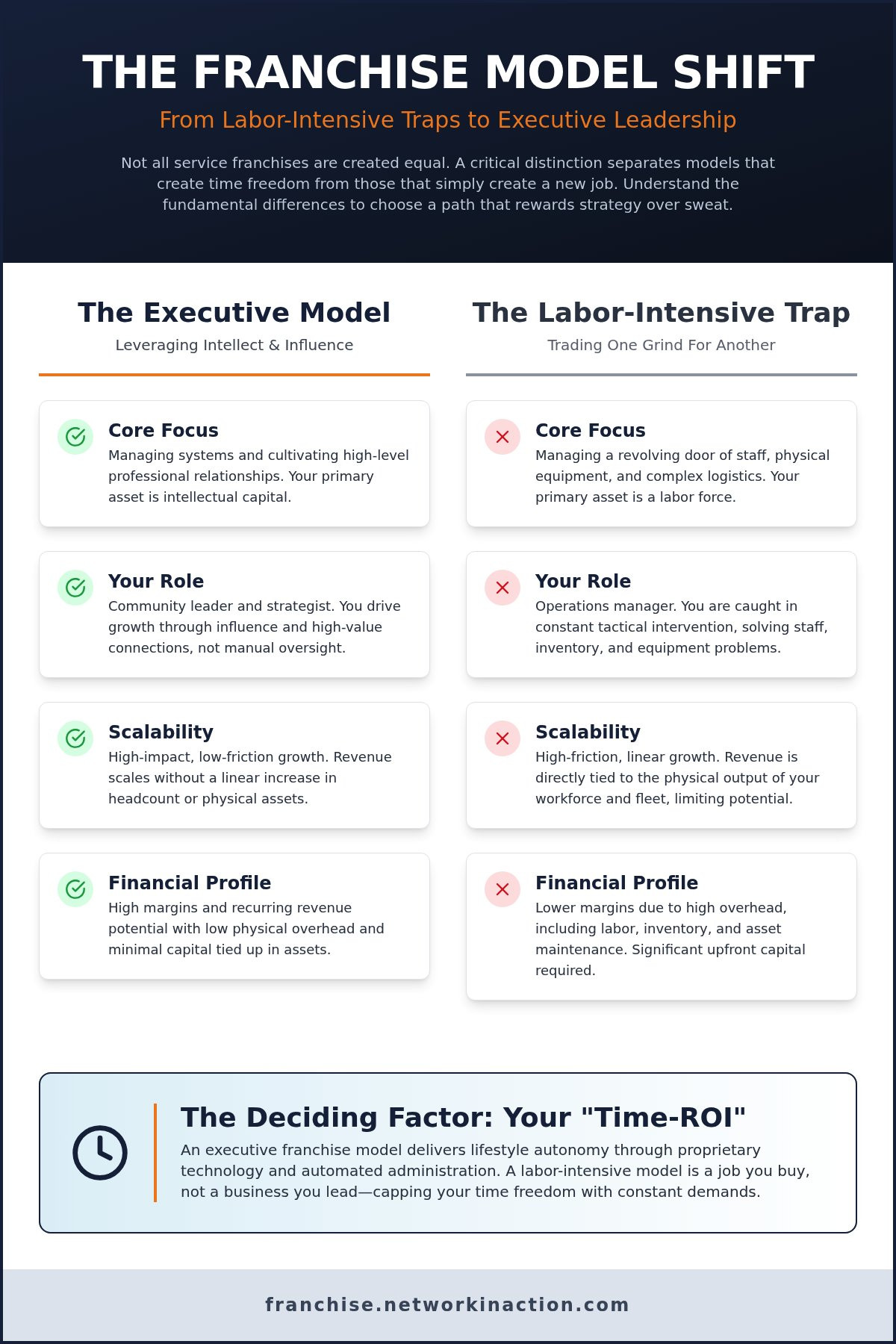
Not all service-based franchise opportunities are created equal. Many professionals mistakenly lump high-skill consulting models with low-skill labor businesses. This is a critical error. Traditional service franchises often lead to the "Employee Trap," where you spend your days managing a revolving door of entry-level staff and maintaining physical equipment. It's a high-friction environment. High stress. Low autonomy. You didn't leave the corporate world to become a high-paid babysitter for a fleet of trucks.
The executive model operates on a different plane. Instead of managing labor, you manage systems. Instead of supervising technicians, you cultivate relationships. You leverage your existing professional skill set to drive results through strategy rather than sweat. This shift ensures higher margins per hour worked because your revenue isn't tied to the physical output of a massive headcount. You scale through influence. High impact. Low friction.
The Hidden Costs of Labor-Intensive Models
Traditional service sectors suffer from chronic turnover. Managing logistics for a fleet of vehicles or a crew of technicians creates a constant drain on your most valuable asset: time. Every mechanical failure or staffing shortage becomes your problem. These models often cap your time freedom because the business cannot function without your constant tactical intervention. It's a job you bought, not a business you lead. It's the opposite of the lifestyle autonomy most executives seek.
- Logistics Friction: Constant maintenance of physical assets, inventory, and supply chains.
- Staffing Volatility: High turnover rates in entry-level sectors require constant recruiting and training cycles.
- Capped Scalability: Growth is strictly limited by your ability to hire, train, and manage more manual labor.
The Sophisticated Alternative: Professional Networking
Visionary leaders prioritize "Social Capital" over physical inventory. By building a business around high-level referral generation, you position yourself as an essential hub in your local economy. This is the modern evolution of the industry. You aren't chasing cold leads; you are facilitating high-value connections within a curated community of professionals. To understand the full scope of this model, explore our Business Networking Franchise: The Executive Guide to Modern Ownership.
This approach replaces the rigid, transactional nature of legacy networking organizations with a technology-enabled platform designed for efficiency. You achieve professional prestige and recurring revenue without the headache of manual labor. If you are ready to audit your local market, you can check available territories to see where this model fits your goals. Choose the system that respects your background and secures your future.
Analyzing the ROI and Efficiency of Modern Service Models
Financial returns are only half of the equation for a modern executive. The true measure of success is Time-ROI. You didn't leave a high-stakes corporate career to trade one high-pressure environment for another. You seek lifestyle autonomy. High-level service-based franchise opportunities in 2026 prioritize this by replacing manual processes with sophisticated systems. While traditional retail models tie you to a physical location, modern service franchises allow you to monetize your influence through a streamlined, tech-enabled framework.
The efficiency of your business determines its ultimate value. Legacy networking organizations often rely on rigid, weekly commitment models that demand excessive time for minimal return. This is the "grind" of the past. Modern models utilize a monthly meeting structure designed for maximum impact with minimum time commitment. You facilitate high-value connections while proprietary technology handles the administrative friction. This shift ensures you are working on the business, not just in it. Efficiency matters. Results count.
Monetizing Efficiency Through Technology
In a sophisticated service model, technology is your primary differentiator. A centralized platform for member tracking and referral management isn't a luxury; it's an essential tool for scaling. Traditional networking models fail to provide measurable ROI because they lack the data-driven infrastructure to track connectivity. A tech-enabled platform solves this by providing transparency and accountability for every member in your group. It eliminates the guesswork of professional networking.
- Automated Administration: Use digital tools to manage memberships, track referrals, and schedule meetings without manual intervention.
- Measurable Member Value: Provide members with real-time data on their referral activity and ROI, ensuring high retention rates.
- Lead Generation: Replace cold prospecting with a structured, technology-led referral system that feeds your growth pipeline automatically.
Scalability and Recurring Revenue Streams
The economics of a membership-driven franchise are inherently superior to transactional retail. You build a foundation of recurring revenue that provides financial stability and predictable growth. By analyzing territory-based professional demographics, you can project your expansion with surgical precision. You aren't guessing where the next sale comes from; you are building a community of professionals who invest in your system month after month. This creates a high-margin asset that grows in value as your network expands.
This model allows you to scale without the linear increase in overhead or headcount that plagues labor-intensive businesses. You leverage your network to build a legacy of influence and income. If you are ready to see how these numbers work in your specific market, you should Calculate Your Potential with our NIA Franchise Kit. This is the modern evolution of business ownership for those who value their time as much as their capital.
Due Diligence: Evaluating High-Level Service Opportunities
Due diligence for elite service-based franchise opportunities requires an executive lens. You aren't just looking at a profit and loss statement; you're auditing the operational engine. Start by dissecting the technology stack. If the system relies on manual spreadsheets or outdated software, it's a liability. A modern platform must automate the "grunt work" of referral tracking and member management. High efficiency. Low friction. Next, evaluate the membership caliber. A network is only as strong as its participants. You want a curated, high-level community that reflects your professional status. Quality over quantity is the only metric that matters.
Lifestyle design is the ultimate goal of your transition. When analyzing service-based franchise opportunities, look closely at the model's flexibility. Does it demand a 40-hour week of tactical execution, or does it allow for strategic leadership? Investigate the support systems provided. You need training that focuses on community leadership and relationship management, not just high-pressure sales tactics. Finally, verify territory exclusivity. Your growth potential depends on protected markets that allow for long-term scalability without internal competition. Secure your perimeter. Build your legacy.
Red Flags in Legacy Service Franchises
Outdated networking models are easy to spot. They often enforce rigid referral quotas and mandatory weekly meetings that serve no strategic purpose. These are "time-vampire" activities. They drain your productivity without delivering proportional ROI. If a franchise requires constant, low-value manual intervention, it won't scale. Prioritize models that value results over attendance records. Forced referrals lead to low-quality, transactional relationships; curated connections build real social capital. Avoid any system that feels like a job rather than an investment.
The Discovery Process for Professionals
The discovery phase is your opportunity to pressure-test the model. Conduct validation calls with current owners to verify their real-world experience. Ask about the specific time commitment required to maintain profitability. When analyzing the Franchise Disclosure Document (FDD), look beyond the initial investment. Focus on the recurring revenue potential and the efficiency of the technology platform. This is a strategic move. You're auditing a system to see if it's worthy of your leadership. To see where the most lucrative markets remain, you should View Available Territories for Strategic Expansion and begin your audit of the modern networking landscape.
Network In Action: The Modern Evolution of Service Franchising
Network In Action (NIA) represents more than just a new entry among service-based franchise opportunities. It is the informed disruption of a legacy industry. While outdated networking models cling to rigid, weekly structures that feel like a second job, NIA prioritizes executive-level efficiency. You lead a community of high-level professionals through a monthly meeting model. This structure ensures maximum impact with minimum time commitment. You aren't just running a business; you're engineering a local ecosystem of success. It's the next evolution of professional connectivity.
The secret weapon in this model is NIA’s proprietary technology platform. It automates the "busy work" that plagues traditional franchises. Member tracking, referral metrics, and community engagement happen within a sleek, integrated digital environment. This allows you to focus on high-value leadership rather than tactical administration. You maintain professional prestige while the system handles the friction. It’s a sophisticated approach for a tech-forward era that values results over activity. You lead. The tech executes.
Building a Referral-Based Empire
Positioning yourself as the ultimate connector in your local market is a strategic move. You become the hub where high-stakes deals are initiated and professional credibility is cemented. NIA facilitates relationship-driven growth, moving far beyond the transactional nature of legacy networking organizations. You build an empire based on trust and curated quality rather than forced quotas. This model transforms your social capital into a scalable business asset. To master this transition, review the Referral Marketing Strategy: Unlocking Growth through Trust.
- Curated Membership: Build a group of elite professionals who value quality over quantity.
- Relationship-First Growth: Replace cold prospecting with a community built on mutual success.
- Leadership Authority: Establish yourself as the premier business authority in your territory.
Next Steps for the Results-Oriented Entrepreneur
The transition from corporate executive to franchise owner can happen in as little as 90 days. You leverage your existing network and professional acumen to launch a business that offers genuine lifestyle autonomy. This is a strategic alignment for those who value efficiency and measurable ROI. You've spent years building someone else's dream; now, use those same skills to lead your own community and secure a recurring revenue stream that scales. It is time to audit your future and see where your leadership fits. Start your journey by getting the Free Book on Modern Networking Leadership. Your evolution from executive professional to community business leader begins with a single, strategic decision.
Secure Your Professional Legacy
The corporate grind is a relic of the past. You've seen how the landscape of service-based franchise opportunities has evolved to prioritize intellectual capital and lifestyle autonomy over manual labor. By choosing an executive-led model, you replace the friction of legacy networking organizations with a streamlined, tech-enabled system. You leverage your background to build a recurring revenue stream while maintaining your professional status. Results matter. Freedom counts.
Network In Action has solved the inherent flaws of the old guard. With over 150 successful locations globally, our model uses exclusive proprietary technology to eliminate administrative busy work. The monthly meeting model is specifically designed for executive schedules, ensuring you maximize impact without sacrificing your freedom. It's time to stop working for a system and start owning one that works for you. Take the next step in your professional evolution. You're ready to lead your community and secure your financial future through informed disruption.
Download the NIA Franchise Kit to Explore Modern Ownership. Your future as a visionary business leader starts today.
Frequently Asked Questions
What makes a service-based franchise better than a retail franchise for executives?
Service models prioritize your intellectual capital over physical inventory. You avoid the high-overhead trap of retail storefronts and the burden of managing large, low-skill labor forces. These service-based franchise opportunities allow you to leverage your professional status to lead a community rather than managing supply chains. It's a cleaner, more scalable path to high-margin results.
How do service-based franchise opportunities handle recurring revenue?
Modern service franchises utilize membership-driven economics to build predictable, month-over-month income. You aren't trapped in a transactional cycle where you start at zero every month. By building a curated community of professionals, you secure a consistent revenue stream that scales as your influence grows. It provides the financial stability that legacy networking organizations often fail to deliver.
Is it possible to run a professional networking franchise part-time?
Yes, specifically through a monthly meeting model. This structure allows you to manage your business in approximately 20 to 30 hours a month while maintaining your professional standards. You achieve maximum impact with a minimum time commitment. It's the ideal bridge for executives who want to build a business without immediately abandoning their current income streams.
What is the typical investment for a high-level professional service franchise?
Professional service models generally require significantly less capital than brick-and-mortar retail because they lack construction and inventory costs. Your investment focuses on securing territory and building your network. While exact figures vary based on your specific market and scale, you should always audit the Franchise Disclosure Document (FDD) for precise financial requirements before moving forward.
How does modern networking technology improve franchise ROI?
Proprietary technology automates administrative friction, ensuring your time is spent on high-value leadership. It replaces the manual tracking systems used by legacy networking organizations with a streamlined digital platform. By reducing the "busy work," you increase your Time-ROI and ensure every connection within your group is tracked, measured, and monetized. Efficiency is the key to profitability.
What should I look for in a service franchise's technology platform?
Look for integrated member tracking, automated referral reporting, and mobile connectivity. The platform must solve the administrative "grind" of traditional models to be truly effective. If the technology doesn't provide real-time data on member ROI and connectivity, it isn't a modern solution. A superior system allows you to manage your community with surgical precision from anywhere.
Can I own a service-based franchise while keeping my current executive role?
Many owners use the monthly meeting structure to bridge the gap between their corporate career and full-time ownership. It allows you to build your groups and prove the model while keeping your current role. This strategic approach creates a secure exit plan without sacrificing your immediate lifestyle. It's a sophisticated way to transition into community leadership.
Why is the monthly meeting model superior to weekly networking formats?
Weekly models often become "time-vampires" that prioritize attendance over actual business results. Monthly meetings respect the schedules of elite professionals and high-level executives. You get higher quality interactions and more meaningful connections without the burnout associated with outdated networking models. It is a more efficient, results-oriented approach that aligns with a high-performance lifestyle.