Your 401k shouldn't be a passive observer of market volatility. In 2026, the most secure harbor for retirement capital isn't a fluctuating index fund or a stagnant bond. It's an asset-light B2B franchise. Most executives feel the weight of the golden handcuffs, watching their savings sit idle while they crave the autonomy of ownership. You want to know: is a B2B franchise a safe investment for my 401k? It's a valid concern for any professional looking to transition from the corporate grind to a scalable business model.
This executive analysis reveals how to leverage retirement funds into a high-leverage franchise while minimizing risk and maximizing professional freedom. You'll discover the mechanics of using ROBS to fund your venture penalty-free, allowing you to build a predictable income stream without sacrificing your lifestyle. This breakdown examines why modern, tech-forward systems have replaced outdated networking models as the premier choice for seasoned leaders. By the end of this guide, you'll understand the strategic path to converting your professional equity into a results-driven enterprise that offers both time freedom and measurable ROI.
Key Takeaways
- Leverage the Rollovers as Business Startups (ROBS) mechanism to deploy retirement funds into a business venture without incurring taxes or early withdrawal penalties.
- Understand how the asset-light nature of professional services answers the question of whether a B2B franchise is a safe investment for my 401k while protecting your principal capital.
- Identify the structural flaws of traditional networking models and why technology-enabled platforms offer a superior ROI for high-level executives.
- Analyze the Franchise Disclosure Document for recurring revenue indicators and a modern tech stack that drives member value and business scalability.
- Transition from the corporate grind to professional ownership with a lifestyle-friendly model that prioritizes quality relationships over transactional, forced referrals.
Leveraging Your 401k for a B2B Franchise: The ROBS Strategy
Idle capital is wasted potential. For executives trapped by the golden handcuffs of corporate life, the primary obstacle to business ownership is often liquidity. You've spent decades building a retirement nest egg, but it's often locked away in a volatile market you can't control. This is where the strategy of Rollovers as Business Startups (ROBS) becomes your competitive advantage. ROBS is a strategic tool for executive transition that allows you to fund your business using retirement capital without debt or tax penalties.
When you ask "is a B2B franchise a safe investment for my 401k," you're really asking about risk control and professional leverage. Unlike retail or food service franchises that burn through capital on real estate and inventory, B2B models are asset-light. You're investing in your own professional expertise and a proven system, not a deep fryer or a high-rent lease. This preserves your principal while putting your 401k to work in a business you actually lead. With 2026 employee contribution limits set at $24,500, simply contributing to a standard plan isn't enough to achieve true financial independence; you need to own the engine of your income.
How ROBS Works for Service-Based Franchises
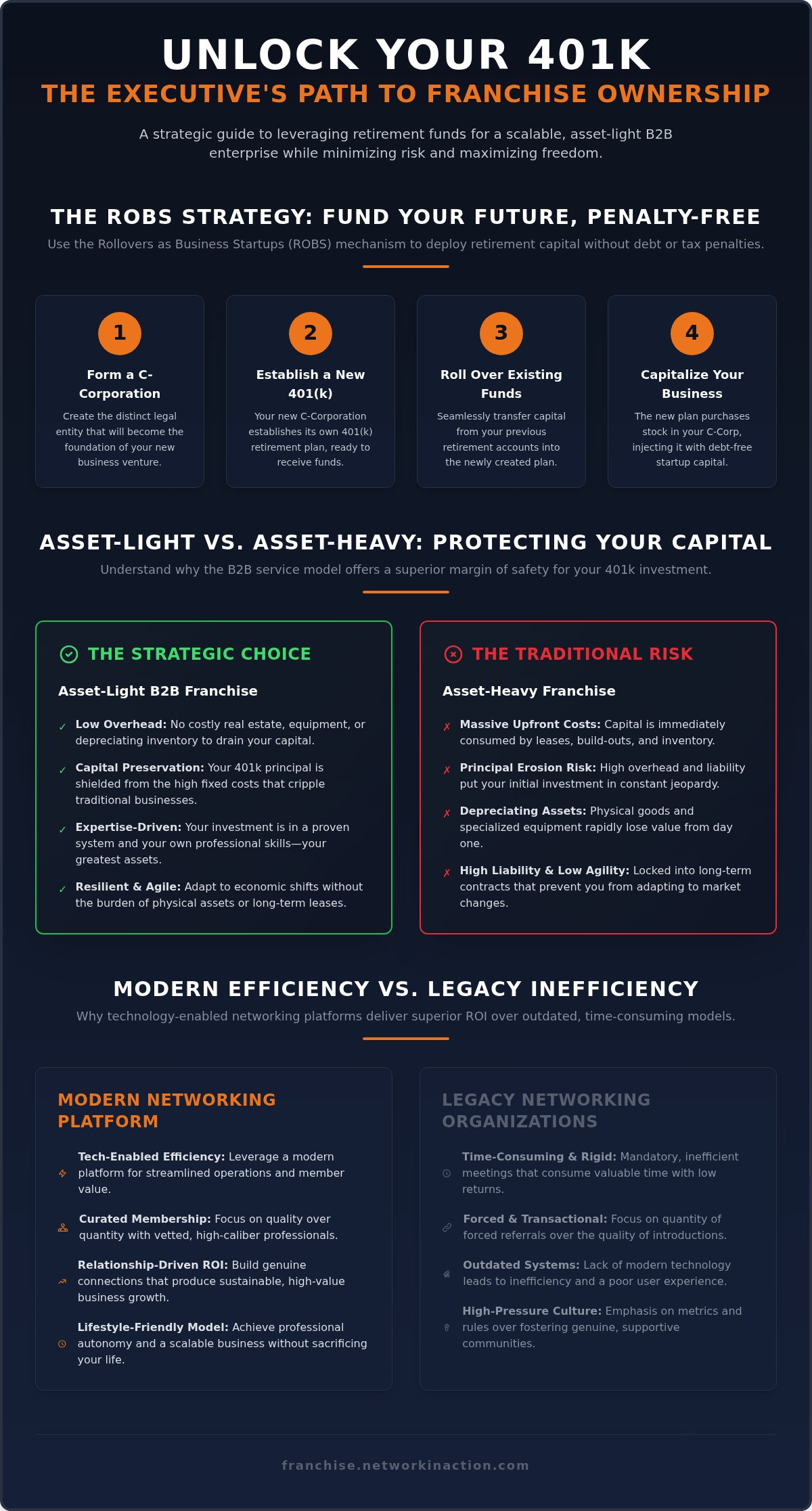
The transition from employee to owner follows a precise, four-step legal framework. First, you form a new C-Corporation. Second, that corporation establishes a new 401k plan. Third, your existing retirement funds roll over into the new plan. Finally, the plan purchases stock in your corporation, providing the liquid capital needed to launch. This isn't a loan; it's an investment in your own entity.
In 2026, compliance is non-negotiable. Proper valuation and adherence to Department of Labor regulations ensure your funding remains tax-free. Because B2B service models require lower initial capital investments compared to legacy brick-and-mortar operations, you keep more of your retirement funds in a diversified portfolio while launching your enterprise. This creates a safety net that traditional startup models simply cannot match.
Risk Mitigation in the B2B Sector
Safety in business ownership is found in predictability. Independent startups face high failure rates because they lack a blueprint. A B2B franchise provides a modernized approach with built-in systems and a technology-enabled platform. You aren't guessing; you're executing. This is the next evolution of the industry, moving away from the inefficiency of legacy networking organizations and outdated networking models.
The "Professional Capital" advantage is your greatest risk mitigator. You already possess the C-suite skills required to lead a community. By leveraging an established network rather than cold prospecting, you reduce the time to ROI. You're simply applying your existing expertise to a more efficient, scalable engine. It's a strategic move that turns your retirement fund into a high-growth asset while maintaining the lifestyle autonomy you've earned.
Asset-Light vs. Asset-Heavy: Why B2B Protects Your Capital
Capital preservation is the first rule of sophisticated investing. When you move funds from a traditional retirement account, the risk of principal erosion is your biggest threat. Traditional franchise models, specifically in food and retail, are notoriously asset-heavy. They demand massive upfront costs for real estate, equipment, and physical inventory that depreciates the moment you buy it. In contrast, B2B service models offer a "Margin of Safety" that protects your 401k principal by keeping overhead low and agility high.
When investigating if a B2B franchise is a safe investment for my 401k, consider the resilience of professional services. Businesses don't stop needing revenue or high-level connections during economic shifts; they actually need them more. While retail consumers might cut spending, B2B entities double down on strategic growth. The SBA on B2B Franchise Opportunities notes that these models often require less initial capital and focus on specialized expertise, making them a more stable play for executives who value efficiency over storefront management.
Eliminating the Burden of Traditional Overhead
No storefront means no lease liability. By removing the physical footprint, you eliminate the single largest point of failure for most small businesses. This asset-light approach ensures that your 401k funds aren't swallowed by high-rent contracts or employee turnover in a low-skill labor market. Instead, capital is deployed into high-ROI areas like technology and relationship building. Modern networking models utilize proprietary digital tools to replace expensive physical infrastructure, creating a streamlined operation that runs on monthly meeting cycles rather than daily retail grinds. This structure generates consistent, recurring revenue that’s predictable and scalable.
Scalability Without Significant Reinvestment
In a brick-and-mortar business, doubling your revenue usually means doubling your rent and staff. In a B2B networking franchise, growth happens through relationship compounding and digital leverage. You can expand your influence across multiple territories without the need for massive capital injections. You're building a community of high-level professionals; it's an asset that grows in value as the quality of the network increases. For a deeper dive into how this works for leaders, see the Business Networking Franchise: The Executive Guide. If you're ready to see where you can lead, you should explore available territories to secure your professional future.
The Hidden Risks of Legacy Networking Organizations
Not all B2B models are created equal. When evaluating if a B2B franchise is a safe investment for my 401k, the operational structure is just as critical as the financial setup. Traditional networking franchises often hide significant operational risk behind a facade of "proven history." For an executive looking to protect their 401k principal, the danger lies in models that demand high-frequency, low-impact activity. Legacy networking organizations typically mandate weekly meetings, creating a rigid environment that feels more like a mid-management job than a strategic business ownership opportunity. This structure is the antithesis of the lifestyle autonomy you're seeking.
The most damaging element of these outdated networking models is the concept of "forced referrals." When members are required to provide a specific number of leads each week, the quality of those leads plummets. It becomes a transactional numbers game rather than a relationship-driven growth engine. For a high-level professional, participating in a system that prioritizes quantity over quality is a fast track to brand dilution and executive burnout. You're building a business to lead a community, not to police a quota of low-value transactions.
The Opportunity Cost of Inefficient Models
Time is your most valuable asset. Weekly meetings total over 50 sessions a year, excluding travel and prep time. When you calculate the true cost of this time sink, the ROI of a legacy model often fails to justify the investment. These high-pressure environments struggle to attract top-tier C-suite members who value efficiency. In a 2026 market where the average B2B buying committee involves 11.2 stakeholders for deals over $50,000, a simple forced referral is insufficient. You need a platform that fosters deep relationships and professional credibility. Investing in an outdated industry standard is a risk your retirement fund cannot afford.
Modern Alternatives: Quality Over Quantity
The industry has evolved. Modern relationship-driven growth focuses on monthly, high-impact gatherings that respect your schedule and your professional standing. By utilizing a technology-enabled platform, you maintain high connectivity without the meeting fatigue associated with traditional brands. This shift allows you to curate a high-quality membership that drives real-world business outcomes. Modern networking is a results-oriented social capital investment that leverages your expertise rather than your stamina. It's the strategic choice for those who want to lead their community without sacrificing their time freedom. If you're ready to see how this fits your market, you can check available territories to secure your future.
Due Diligence Checklist for 401k Franchise Investors
Due diligence is the primary defense against capital erosion. When determining if a B2B franchise is a safe investment for my 401k, you must move beyond surface-level excitement. You're looking for a business that aligns with your professional standing and protects your principal capital. The Franchise Disclosure Document (FDD) is the most powerful tool in your arsenal. In 2026, a record 87.2% of franchisors now disclose unit-level financial performance data in Item 19. This transparency allows you to model potential ROI with surgical precision. You aren't just buying a job; you're investing in a system designed for executive-level scalability.
Market saturation is a silent killer in many industries. You must assess territory availability to ensure your local market has the professional density to support a high-level network. Traditional networking models often over-saturate markets, leading to internal competition and diluted lead quality. A modern, tech-forward system prioritizes exclusive territories and provides the proprietary digital tools necessary to manage them efficiently. This ensures the investment is protected by a sustainable competitive advantage rather than just a brand name.
Financial Metrics for Retirement Fund Protection
Protecting your 401k recovery requires a deep dive into royalty structures. You need to understand how top-line fees impact net margins. Outdated networking models frequently bury hidden technology fees or mandatory marketing contributions in the fine print of their agreements. These costs can erode profits before you've even broken even. To see a transparent breakdown of a modern model, you should Download the NIA Franchise Kit. This document outlines the lean operational structure that allows for faster capital recovery.
The Validation Call: What to Ask Current Owners
The FDD tells you what's possible; the validation call tells you what's real. When speaking with current owners, focus on lifestyle autonomy. Ask specifically about the actual time commitment required to maintain the business. Are they stuck in the weekly meeting grind of legacy networking organizations, or are they leveraging a monthly meeting model for maximum efficiency? Verify the effectiveness of proprietary member-tracking tools. These systems should automate the grunt work of networking, allowing you to focus on high-level relationship compounding. For a better understanding of how these connections drive value, review the Referral Marketing Strategy Guide. If you're ready to see where you can lead, explore available territories to find your strategic fit.
Network In Action: The Strategic Choice for Your 401k
Network In Action (NIA) represents the next evolution of the professional networking industry. It's a modernized approach designed specifically for the executive mindset. While legacy networking organizations rely on outdated, manual processes, NIA utilizes a sophisticated, tech-forward framework to drive measurable results. When you weigh whether a B2B franchise is a safe investment for my 401k, the answer lies in the structural efficiency of the system. With over 150 locations worldwide, NIA has proven that a monthly meeting model outperforms the exhausting weekly grind of traditional networking. You aren't just buying a business; you're securing a high-leverage asset that respects your time and maximizes your professional influence.
The NIA model thrives on quality over quantity. Instead of a room full of transactional leads, you lead a curated community of high-level professionals and business owners. This focus on high-impact relationships ensures a predictable, recurring revenue stream. It's a strategic move for any executive looking to transition from corporate life into a role that offers both lifestyle autonomy and significant growth potential. By leveraging your existing C-suite skills within this streamlined system, you protect your retirement capital while building a scalable enterprise.
A Technology-Led Solution for a Manual Industry
Efficiency drives profit. NIA's proprietary technology platform is the core differentiator that sets it apart from outdated networking models. This exclusive digital tool automates referral tracking, member engagement, and ROI reporting, removing the administrative burden common in legacy systems. For the franchisee, this means higher profit margins and less time spent on "grunt work." Technology replaces the need for expensive physical infrastructure, allowing you to run an elite business from anywhere. To understand how this tech-driven efficiency translates into a superior business model, Get the Free Book on Modern Networking. It's the blueprint for leading a results-oriented professional community.
Building a Legacy Beyond the 9-to-5
True professional freedom is the ability to lead on your own terms. As an NIA franchisee, you step into the role of a community visionary and connector. You're the authority figure who facilitates growth for other businesses, building immense social capital in the process. This isn't just a career change; it's a way to build a meaningful legacy without the constraints of a traditional corporate structure. You trade the golden handcuffs for professional autonomy and the power to influence your local economy. If you're ready to align your retirement investment with a modern, scalable opportunity, you should Check Available Territories today. Secure your market before another visionary does.
Secure Your Professional Legacy
Transitioning from the corporate grind to business ownership requires more than ambition. It demands a strategic deployment of capital. By leveraging the ROBS strategy, you can unlock retirement funds to fuel a scalable B2B enterprise without tax penalties. B2B service models provide a superior margin of safety compared to high-overhead retail. When you evaluate if a B2B franchise is a safe investment for my 401k, the focus must remain on asset-light resilience and professional leverage.
Network In Action offers the modern solution for high-level leaders. With 150+ global locations and a proprietary tech platform, NIA eliminates the inefficiencies of legacy networking organizations. You gain the freedom of a monthly meeting model while building a community of elite professionals. It's time to trade corporate limitations for a visionary role that yields measurable ROI and lifestyle autonomy. Align your financial future with a system built for 2026 and beyond.
Explore NIA Territories and Protect Your Future
Your leadership is the missing link in your local business community. Start building your results-driven future today.
Frequently Asked Questions
Is using my 401k to fund a franchise legal?
Yes, it's completely legal through the Rollovers as Business Startups (ROBS) structure. This IRS-compliant method allows you to use your retirement funds to purchase stock in your own C-Corporation. You must follow strict ERISA guidelines and maintain a qualified retirement plan for your employees to ensure the funding remains penalty-free.
What are the tax implications of a ROBS franchise investment?
ROBS is not a distribution or a loan; it's a rollover. You avoid the 10% early withdrawal penalty and immediate income tax liability. Taxes are deferred until you take distributions from the plan in the future. Proper administration is critical to avoid plan disqualification, which could trigger immediate tax consequences on the entire rollover amount.
How much liquid capital do I need for a B2B networking franchise?
Liquid capital requirements for asset-light models are significantly lower than retail or food service. For a professional networking franchise, you typically need at least $35,000 in liquid capital. This ensures you can cover the initial franchise fee and operating expenses while you build your recurring revenue stream and community influence.
Can I keep my current job while starting a B2B franchise?
Some executives begin their transition while still employed, but true scalability requires dedicated leadership. Modern networking models offer more flexibility than legacy networking organizations because they operate on monthly meeting cycles. This structure allows you to manage your time effectively during the initial growth phase before moving into full-time business ownership.
How long does it take to see a return on a networking franchise?
ROI timelines vary based on your market density and execution speed. Because these models have low overhead and focus on recurring revenue, many owners reach profitability faster than in capital-intensive industries. High-level professionals often find that leveraging their existing network accelerates the member recruitment process and shortens the path to a positive return.
What happens to my 401k if the franchise business fails?
If the business fails, the value of the stock held by your 401k plan may drop to zero. You lose the principal capital invested in the venture. However, you aren't liable for taxes or penalties on that capital unless the IRS determines the ROBS structure was non-compliant from the start.
Why is B2B considered safer than B2C for 401k investors?
B2B models are generally more resilient because they don't rely on fickle consumer spending habits. When asking if a B2B franchise is a safe investment for my 401k, the answer lies in the asset-light structure. You avoid high-rent leases and inventory risks, focusing instead on professional services that businesses need regardless of the economic climate.
What makes Network In Action different from traditional networking models?
Network In Action disrupts the industry by replacing the weekly, time-consuming grind with a streamlined monthly meeting model. It utilizes a proprietary technology platform to automate referral tracking and member engagement. Unlike outdated networking models that rely on forced referrals, NIA focuses on curated, high-quality relationships that drive actual revenue for professional members.