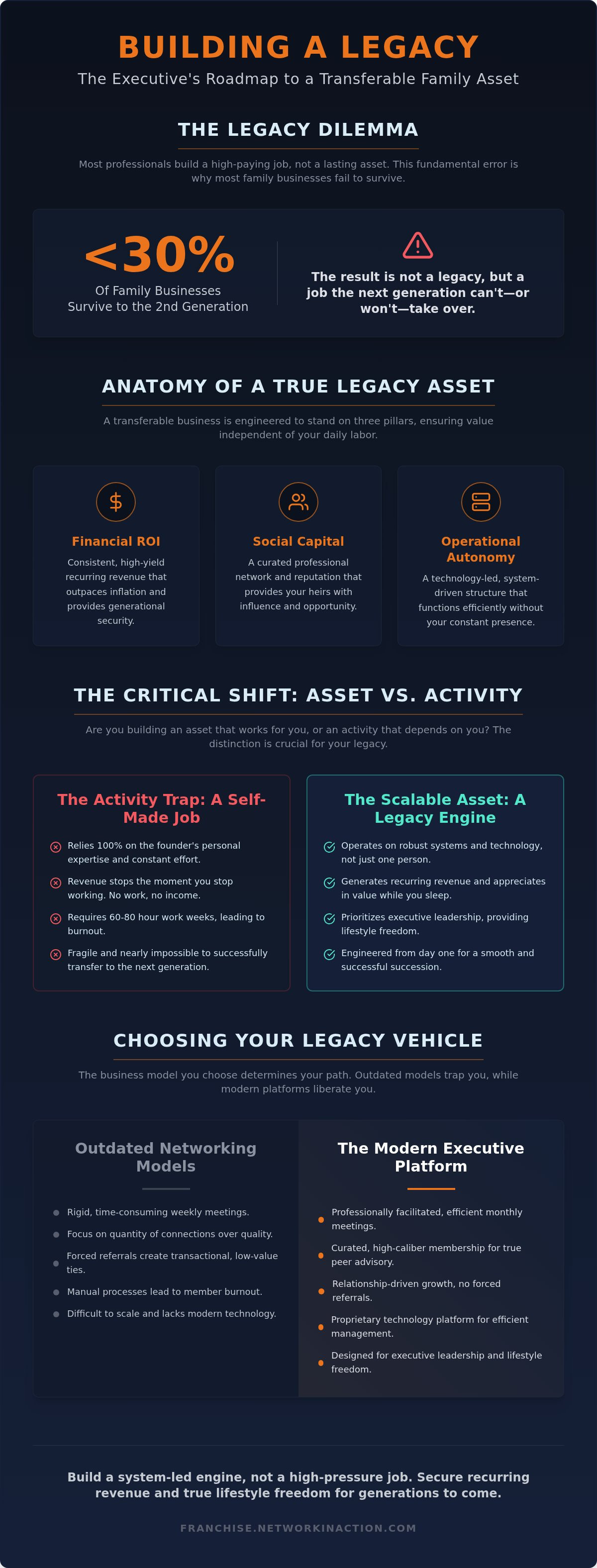
Fewer than 30% of family businesses survive into the second generation. This statistic isn't just a warning; it's a call to disrupt the way you think about wealth. Most high-level professionals spend decades building a career only to realize they've created a job they can't leave, not an asset they can pass down. Building a legacy business for your family requires a departure from outdated networking models and manual operations. You need a scalable system that generates value through social capital and technological efficiency rather than 80-hour work weeks. Results matter.
The 2026 economic environment demands a more sophisticated approach to succession. With the federal estate tax exemption now at $15 million per individual under the One Big Beautiful Bill Act, the opportunity to transfer significant wealth is unprecedented. However, wealth alone isn't a legacy. This guide provides the executive roadmap to owning a tech-enabled asset that delivers recurring revenue and lifestyle freedom. It examines how to move beyond the grind by leveraging proprietary platforms and elite community leadership. Discover the transition from a corporate leader to the architect of a modern, scalable family asset.
Key Takeaways
- Distinguish between a "job" and a true "asset" that generates value independent of your daily labor.
- Identify the strategic framework for building a legacy business for your family by selecting scalable models that prioritize executive leadership.
- Leverage social capital and curated professional networks, which are more resilient and transferable to heirs than traditional physical assets.
- Implement robust systems and proprietary technology to ensure business autonomy and a seamless transition to future generations.
- Secure recurring revenue and lifestyle freedom by replacing outdated networking models with a modern, tech-forward franchise.
What Defines a True Legacy Business in the 2026 Economy?
Building a legacy business for your family isn't about creating a high-paying job for yourself. It's about engineering a self-sustaining asset. In the 2026 economy, the line between a lifestyle business and a legacy asset has become a chasm. Most professionals build the former. They create entities that rely entirely on their personal expertise and 60-hour work weeks. When they stop, the revenue stops. A true legacy asset generates value independent of your daily labor. It uses technology to scale and systems to survive. This is the shift from being the engine to being the architect.
To survive a generational handoff in today's market, your business must stand on three specific pillars:
- Financial ROI: Consistent, high-yield returns that outpace inflation and market volatility.
- Social Capital: A curated community and reputation that recognizes your family's leadership.
- Operational Autonomy: A technology-led structure that functions without your constant presence.
If your heirs inherit a "grind," they'll likely sell it or watch it fail. If they inherit a system-led engine, they inherit a future. The goal is to build something that appreciates while you sleep and remains relevant as markets shift.
Wealth vs. Value: Why Cash is Not a Legacy
Cash is a static resource. It's easily depleted and offers no structural protection. A recurring income stream, however, provides permanent security. Many executives fall into the trap of building businesses based on their personal "grind." These models are fragile. They collapse during the first succession because the founder's unique energy was the only thing holding them together. A Legacy Asset is a system-driven business that appreciates over time while requiring minimal founder intervention. You aren't just looking for a payout. You're looking for a machine that produces wealth and maintains its own momentum.
The Role of Social Capital in Generational Success
In 2026, who you know is just as valuable as what you own. Social capital is the most durable form of business influence. While physical assets can depreciate or become obsolete, a curated professional network remains transferable and adaptable. By building a legacy business for your family that centers on community leadership, you're giving your heirs an "in" with the most influential players in their territory.
This transition is critical. Outdated networking models rely on manual, transactional interactions that don't scale. Modern legacy businesses leverage proprietary technology to manage these relationships efficiently. You aren't just leaving your children a bank account. You're leaving them a seat at the table and a reputation that opens doors. Community leadership isn't just a soft skill; it's a hard asset that pays dividends for decades through relationship-driven growth.
Asset vs. Activity: Selecting a Scalable Model for Your Heirs
Building a legacy business for your family requires more than just capital; it requires the right vehicle. Many high-level professionals mistakenly "buy a job" when they invest in traditional service franchises. If the model requires you to manage a fleet of trucks or oversee dozens of retail employees, you've simply traded one corporate grind for another. A true legacy asset allows for executive-level leadership. It prioritizes systems over manual labor and social capital over physical inventory. High margins. Low overhead. These are the markers of a transferable enterprise.
Consider the networking franchise model as a high-performance alternative to retail. Scalability is the priority. You want a business that grows without a linear increase in your personal time. By owning a territory and leveraging a tech-enabled platform, you create a scalable engine that your heirs can manage with sophisticated oversight rather than manual sweat. The goal is to build an entity that functions as a community asset, providing consistent value even when you aren't in the room.
The Pitfalls of Traditional Networking Models
Legacy networking organizations often rely on rigid, weekly requirements that feel like a chore rather than a strategic advantage. These outdated networking models prioritize quantity over quality. They force transactional relationships through forced referrals, which often leads to low-value connections and member burnout. For an executive seeking to build a durable family enterprise, these time-consuming systems are inefficient and difficult to scale. Modern leaders require a tech-enabled referral system that respects their schedule and focuses on high-level ROI for every participant.
The Service Franchise Advantage for Executives
Executives excel at relationship management and strategic leadership. These skills are best utilized in relationship-based businesses where the primary product is connection. By leveraging a proven referral marketing strategy, you lower the barrier to entry and accelerate growth through trust. This approach focuses on recurring revenue through membership and licensing models, creating a predictable income stream for future generations.
You aren't just looking for an investment; you're looking for a position of influence. This is why many professionals are currently exploring available territories to secure their family's future. The objective is lifestyle autonomy. You want to lead a community, drive high-impact results, and maintain the freedom to enjoy the wealth you've created. By choosing a model built on social capital, you ensure your legacy is both profitable and prestigious.
The Social Capital Advantage: Why Networks Outlast Physical Assets
Physical assets are often liabilities in disguise. Warehouses of inventory require maintenance, depreciate in value, and remain vulnerable to market shifts. A curated group of high-level business owners is different. Social capital is the only asset that compounds over time without the burden of overhead. When building a legacy business for your family, you aren't just looking for cash flow. You're looking for a diversified relationship portfolio. This is the ultimate hedge against market volatility. Relationships don't depreciate; they appreciate.
Owning a professional network in your local territory creates a powerful Multiplier Effect. You don't just participate in the local economy; you facilitate it. This positions your family as community pillars. You become the gatekeeper of high-value connections. While traditional business models struggle with obsolescence, a leadership-driven network remains relevant because it adapts to the needs of its members. It's a living asset that grows in value as the community it serves expands.
- Resilience: Networks survive economic downturns that crush retail and manufacturing.
- Prestige: Your family name becomes synonymous with professional growth and local leadership.
- Compounding Value: Every new high-quality connection increases the ROI for the entire group.
Building a Community of Influence
Stop cold prospecting. It's inefficient, transactional, and exhausting. The modern executive moves toward relationship-driven growth. By positioning yourself as the central connector in your local ecosystem, you gain immediate professional credibility. You aren't selling a service; you're providing a platform for elite success. To start this journey, you must identify available territories that offer high growth potential. Securing the right geography is the first step in establishing a lasting community presence that your heirs can step into with confidence.
Technology as the Legacy Safeguard
A legacy is only as strong as its systems. Proprietary technology platforms ensure that your business remains relevant for the next generation. These tools allow you to manage referrals and track ROI with surgical precision. Technology removes the human error from business networking operations by automating the tracking and follow-up processes that often sink manual, outdated models. This data-centric approach turns abstract "networking" into a measurable, scalable asset. When building a legacy business for your family, tech-enabled systems ensure the transition to your heirs is seamless, professional, and grounded in hard data.
Designing Your Exit Strategy: Building for Autonomy and Succession
Your exit strategy shouldn't be an afterthought. It must be baked into the business architecture from the first day of operations. Building a legacy business for your family demands a transition from operator to owner. If the entity breaks when you take a three-week vacation, you haven't built an asset; you've built a high-stress job. Succession is the ultimate test of any business model. When your heirs eventually step into leadership roles, they need a functioning engine, not a manual grind that requires 80-hour weeks. A true legacy provides a path to wealth that doesn't sacrifice your family's time.
The roadmap to a successful handoff involves moving beyond the daily minutiae. You must implement systems that automate connection and track member ROI without your constant intervention. This allows you to focus on the high-level strategy and relationship management that drives long-term growth. By leveraging franchise support and corporate training, you ensure that the next generation has the tools and knowledge to maintain the business's momentum. You aren't just leaving them a company. You're leaving them a proven system for success.
Creating Lifestyle Autonomy from Day One
Autonomy isn't a luxury. It's a requirement for long-term owner retention and eventual succession. Outdated networking models trap owners in a cycle of weekly, rigid meetings that lead to inevitable burnout. These legacy networking organizations value frequency over impact. In contrast, the Network In Action monthly meeting model focuses on efficiency. It allows you to lead a high-impact professional community while maintaining your personal freedom. This balance is essential. It ensures you can build a community pillar without sacrificing the family time your legacy is meant to protect.
The Roadmap to Ownership
Transitioning from an "Operator" to an "Owner" requires a sophisticated structure. Utilizing a business networking franchise framework simplifies this transition by providing the blueprints for operational excellence. You aren't forced to reinvent the wheel. Instead, you follow a roadmap designed for executive leadership and scalable growth. To begin evaluating your legacy roadmap, you can download a franchise kit to review the underlying systems and technology.
Setting clear milestones for family involvement is the final piece of the puzzle. Start by training the next generation in relationship management and community leadership early. Show them how to leverage proprietary platforms to manage referrals and track member satisfaction. This hands-on experience, combined with a system-led business model, ensures a smooth handoff. If you're ready to move from corporate leader to asset architect, evaluate available territories to secure your family's future today.
Network In Action: The Executive Path to a Lasting Family Enterprise
Network In Action (NIA) doesn't just participate in the industry; it disrupts the status quo. For high-level professionals seeking executive business opportunities, the NIA model provides a turnkey solution for building a high-ROI asset. Unlike legacy networking organizations that demand weekly attendance and forced referrals, NIA utilizes a streamlined monthly meeting model. This efficiency respects your time and your lifestyle. It allows you to lead a community of peers while maintaining the autonomy required to focus on long-term growth. Building a legacy business for your family requires a partner that values measurable results over busy work.
The NIA disruption is rooted in a simple truth: quality beats quantity. By replacing outdated networking models with a technology-led platform, NIA allows franchise owners to scale their influence without a linear increase in labor. You receive the support of a global brand, currently operating in over 150 locations, combined with proprietary tools that automate the most cumbersome aspects of group management. This is the next evolution of professional connection. It’s a sophisticated engine designed for the modern executive who demands efficiency, structure, and recurring revenue.
Why NIA is the Modern Evolution of Networking
Traditional networking is transactional, rigid, and often ineffective. NIA eliminates the "fluff" of legacy organizations to focus on real business outcomes. The model prioritizes curated, high-level membership, ensuring that every interaction delivers value. This isn't a mass-market group; it's an elite professional community. The proprietary tech platform serves as the business's backbone, keeping members connected 24/7. This removes the need for the time-consuming weekly meetings found in legacy networking organizations. Technology manages the connections, while you lead the strategy. It’s a modern approach that ensures your business remains relevant and profitable for the next generation.
Your Next Strategic Move
Succession planning is only effective if the business you're passing down is worth keeping. Building a legacy business for your family means choosing a model that offers scalability, recurring income, and prestige. Evaluate the alignment between your professional goals and the NIA framework. If you're ready to move beyond the corporate grind and become the architect of a community asset, the path is clear. You can get your free book to see how NIA is fundamentally changing the networking landscape. This is your first step toward securing a social and financial future that outlasts your career. Take the lead. Build the legacy.
Architect Your Family's Professional Future
True legacy is built on systems, not sweat. You've discovered that building a legacy business for your family requires a strategic pivot from high-intensity activity to scalable asset ownership. By leveraging social capital and proprietary technology, you move beyond the limitations of outdated networking models and create a transferable engine of wealth. This isn't just about income; it's about securing your family's social and financial standing for generations to come. You are no longer just an executive. You are the founder of a community asset.
Network In Action provides the framework for this transformation. With over 150 global locations and an executive-level recurring revenue model, the system is designed to maximize ROI while protecting your time freedom. The transition from corporate leader to asset owner is a smart, strategic move for those who value efficiency and measurable impact. It's time to stop trading hours for dollars and start building a foundation that thrives without your constant presence.
Start building your family's legacy. Download the NIA Franchise Kit today. Your next chapter of leadership begins now.
Frequently Asked Questions
What is the best business to leave to my family in 2026?
The best business to leave your family is a scalable, system-driven asset that generates recurring revenue without requiring your daily presence. In 2026, this means moving away from inventory-heavy retail toward technology-enabled service models. A professional networking franchise allows your heirs to inherit a prestigious position of community leadership. This type of business offers high margins and low overhead, making it a more resilient legacy than traditional brick-and-mortar operations.
How do I start building a legacy business while still working my 9-to-5?
You can begin building a legacy business for your family by selecting a model designed for executive efficiency. NIA’s monthly meeting structure is specifically built for professionals who don't have 40 hours a week to dedicate to a new venture. By leveraging proprietary technology, you can manage group growth and member ROI during off-hours. This strategic approach allows you to transition from employee to owner without risking your primary salary.
What are the most profitable service franchises for executives?
For executives, the most profitable service franchises are those that monetize relationship management and social capital. These businesses avoid the "grind" of manual labor and high equipment costs. Networking franchises are particularly lucrative because they focus on membership-based recurring revenue. You aren't just selling a one-time service; you're building a community asset that appreciates in value as your local influence and network density increase over time.
Can a professional networking group really be a family legacy?
A professional networking group is a powerful legacy because social capital is the most durable form of wealth. Unlike physical inventory, a curated network of business leaders doesn't become obsolete. When you focus on building a legacy business for your family through connection, you're giving your heirs a seat at the table. They inherit a reputation and a system for generating opportunities that cash reserves simply cannot match in a volatile economy.
How much time does it take to manage a networking franchise?
Managing a modern networking franchise typically requires only a few hours per month per group. Unlike outdated networking models that demand weekly attendance and manual tracking, NIA uses a proprietary tech platform to handle connections and ROI reporting. This technology-led approach removes the administrative burden from the owner. You spend your time on high-level leadership and relationship building rather than getting bogged down in the transactional details of legacy networking organizations.
What happens to my network if I decide to retire?
Your network remains a fully transferable and saleable asset upon your retirement. Because the business is built on a standardized franchise framework, it isn't dependent on your personal labor to survive. Your heirs or a successor can leverage the existing tech platform and established community reputation to continue operations seamlessly. This structural autonomy is what separates a true legacy asset from a career that simply ends when you stop working.
Why is social capital more important than cash for my heirs?
Social capital is superior to cash because it provides a perpetual engine for growth and security. While inheritance taxes and inflation can erode cash reserves, a high-quality network provides your heirs with immediate professional credibility and access to elite opportunities. It is a diversified portfolio of relationships that acts as a hedge against market shifts. Leaving a network means leaving a system that generates value rather than a finite pile of capital.
How does NIA compare to traditional networking organizations for owners?
NIA disrupts the industry by replacing the rigid, time-consuming requirements of traditional networking with an efficient, tech-forward model. Legacy networking organizations often rely on forced referrals and transactional interactions that lead to member burnout. NIA focuses on high-quality ROI and curated membership. For owners, this means a more professional image, higher retention rates, and a business model that fits into a sophisticated executive lifestyle rather than a high-pressure sales environment.