Most franchise calculators are built on "best-case" fantasies that ignore the friction of real-world operations. If you're looking at a traditional model with high fixed costs, your path to profitability might be longer than the sales deck suggests. You're right to feel skeptical about the ramp-up period and the hidden costs that generic spreadsheets often overlook. Uncertainty is the enemy of the executive mindset. Results matter. Overhead kills.
Mastering how to calculate a realistic break-even point for a new franchise is the only way to move from speculation to strategy. You need a clear roadmap that accounts for the 2026 economic landscape, where SBA loan rates sit between 9.0% and 13.5% and every percentage point of royalty matters. This article delivers a precise, executive-level framework designed to help you reach profitability faster by focusing on high-margin, tech-enabled systems. We'll break down the vital distinction between monthly cash-flow break-even and total investment recovery. You'll learn to validate a low-overhead business model that prioritizes your time and your bottom line; this ensures your new venture is a vehicle for freedom rather than a burden of legacy inefficiency.
Key Takeaways
- Distinguish between monthly cash-flow break-even and full investment recovery to accurately track your path to true ROI.
- Master the activity-based accounting framework for how to calculate a realistic break-even point for a new franchise by identifying your net revenue per member.
- Factor in the "Franchise Factor" by accounting for royalties and tech fees as essential components of your modern business model.
- Leverage low-overhead strategies and proprietary technology to bypass the high fixed costs associated with legacy networking organizations.
- Transform abstract financial goals into concrete membership targets that drive consistent, recurring income streams and professional credibility.
Beyond the Spreadsheet: Defining Break-Even for Modern Franchisees
Break-even is the critical equilibrium point where your networking franchise stops consuming capital and starts generating it. It is the moment your vision becomes a self-sustaining engine. For the modern executive, this is not just a line item on a profit and loss statement; it is the psychological threshold that separates a risky venture from a proven asset. Understanding how to calculate a realistic break-even point for a new franchise requires looking past basic accounting to see the strategic mechanics of your specific industry.
In economic terms, the break-even point occurs when total costs and total revenues are equal. However, sophisticated entrepreneurs recognize that not all profit is created equal. You must distinguish between the immediate relief of monthly sustainability and the ultimate goal of full capital recovery. Results matter. Momentum is everything. Reaching this milestone quickly validates your leadership and provides the financial oxygen needed to scale your territory.
Cash Flow vs. Investment Recovery
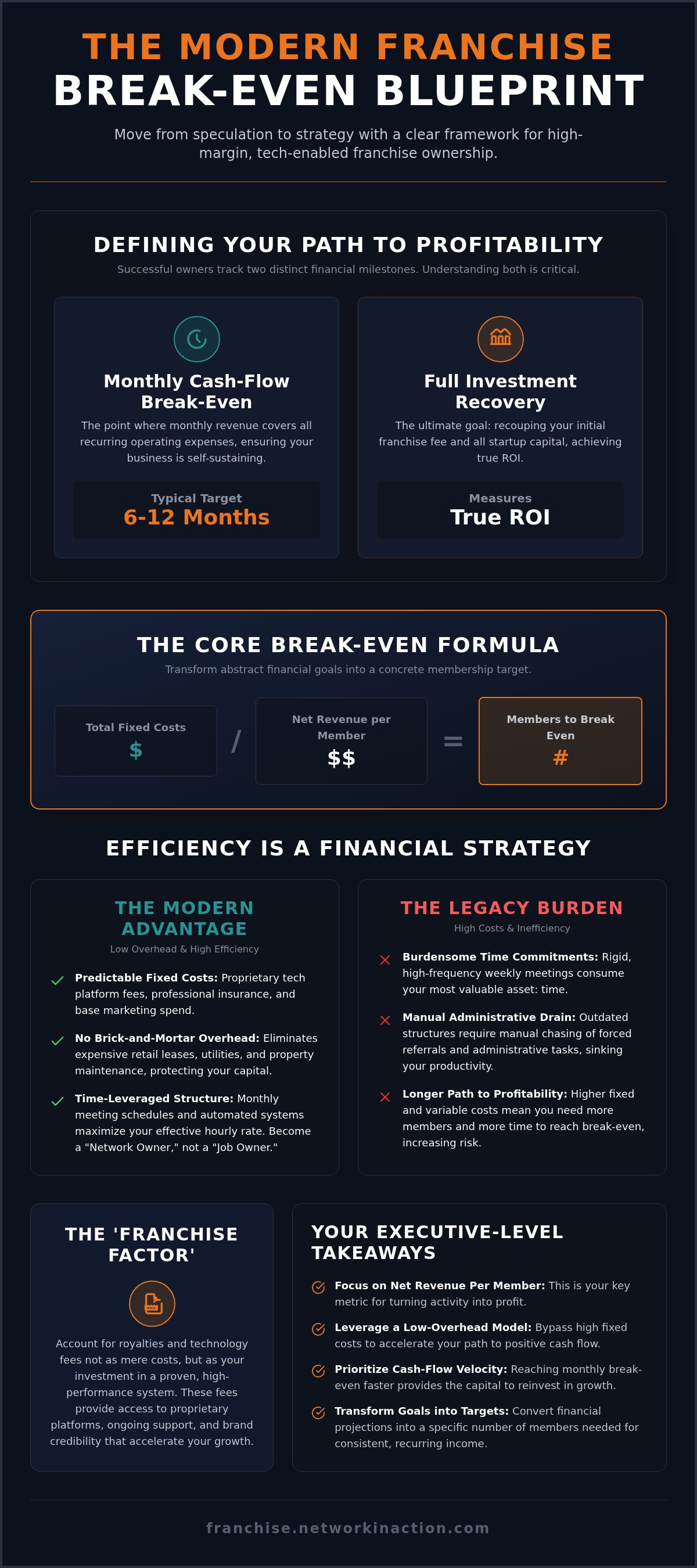
Successful franchise ownership demands a dual-track financial perspective. First, you must define your cash-flow break-even. This is the specific monthly revenue required to cover all recurring operating expenses, including your tech fees, marketing spend, and desired base salary. Most high-level professionals aim to hit this target within the first six to twelve months to ensure the business is not a drain on personal reserves.
Second, you must calculate your timeline for full investment recovery. This involves recouping your initial franchise license fee and any startup capital deployed. Sophisticated entrepreneurs prioritize cash flow velocity in the early stages. By reaching monthly profitability faster, you can reinvest that surplus into growth, effectively shortening the duration until your total initial outlay is returned to your pocket.
The Cost of Inefficiency in Legacy Models
Traditional networking models often have a longer, more arduous path to profitability because they rely on outdated operational structures. Legacy networking organizations frequently impose rigid, high-frequency meeting requirements. These weekly commitments drive up variable costs and consume your most valuable asset: time. When you are forced to manage manual administrative tasks or chase forced referrals, your effective hourly rate plummets. You become a "job owner" instead of a "network owner."
Modern, tech-enabled models solve this inherent flaw. By leveraging exclusive digital tools and a monthly meeting structure, you reduce the labor hours required to maintain the business. This efficiency is the core differentiator. Lower fixed overhead and streamlined systems allow you to reach your break-even units with fewer members, providing a faster route to lifestyle autonomy and professional impact. Efficiency is not just a perk; it is a financial strategy.
The Franchise Break-Even Formula: Mastering Your Financial Equilibrium
Calculations provide clarity. Clarity drives execution. To truly master how to calculate a realistic break-even point for a new franchise, you must deconstruct your operation into two distinct buckets: fixed overhead and variable costs. While generic tools like the SBA’s break-even analysis calculator offer a foundational framework, they often miss the percentage-based royalties and tech fees that define the franchise experience. You aren't just running a business; you're managing a system. Understanding how that system consumes and generates cash is the difference between struggling and scaling.
Identifying Your Fixed Overhead
Modern service-based franchises enjoy a massive advantage over brick-and-mortar models. Low overhead. High efficiency. In a networking franchise, your fixed costs are predictable and manageable. You aren't paying for expensive retail leases, heavy equipment, or massive utility bills. Instead, your fixed overhead consists of proprietary platform access fees, professional insurance, and your base marketing spend. These costs remain constant regardless of whether you have ten members or two hundred.
By eliminating the need for a dedicated office space, you protect your initial capital. Technology and platform access fees are fixed recurring items that provide the essential infrastructure for your community. These aren't just expenses; they're the engine of your business. Accounting for territory-specific administrative needs is vital, but in a streamlined model, these costs remain lean and focused. If you are ready to lead your own professional community without the burden of legacy costs, you can explore available territories that fit your professional goals.
Calculating the Net Contribution Margin
The contribution margin is the fuel for franchise growth. It is the specific amount of every membership dollar remaining after you've covered your variable costs. To find this number, you must subtract royalties and any per-meeting expenses from your gross revenue. Many entrepreneurs overlook the "Legacy Tax" found in outdated networking models. These organizations often demand high royalty percentages and rigid meeting frequencies that aggressively erode your margin. This delays your break-even point and forces you to recruit an unsustainable volume of members just to stay afloat.
Modern business referral platforms utilize exclusive digital tools to slash administrative variable costs. When you reduce the labor hours required per member through automation and curated systems, your contribution margin expands. This creates a faster path to profitability and allows you to focus on high-quality relationships rather than a desperate volume game. High margins allow for rapid scalability. Low margins lead to burnout. Results matter, and a superior financial model ensures those results reach your bank account sooner. Every member added after your break-even point contributes directly to your lifestyle autonomy.
Factoring in the 'Franchise Factor': Royalties, Tech Fees, and Ramp-Up
Generic financial models fail because they ignore the specific DNA of a franchise system. When you determine how to calculate a realistic break-even point for a new franchise, you must account for recurring fees that independent business owners never face. These aren't just expenses. They're the price of a proven system. In 2026, the average royalty fee across U.S. franchises sits at approximately 5.4% of gross revenue, with marketing fund contributions typically adding another 1% to 3%. If you don't subtract these from your gross margin before calculating your break-even units, your projections will be dangerously optimistic.
Technology fees represent another critical variable. In a modern networking model, proprietary tech should function as a profit-multiplier rather than a simple overhead cost. Exclusive digital tools automate the manual labor of member connection and referral tracking. This efficiency allows you to manage a larger community in fewer hours. If your technology platform doesn't reduce your administrative burden, it's a liability. If it does, it accelerates your path to profitability by expanding your capacity to lead without increasing your headcount.
The Impact of Royalties on Profitability
Royalties are a variable cost that scales with your success. You must evaluate whether your franchisor uses a flat-fee or a percentage-based model. Percentage-based models can feel equitable during the startup phase, but they can become a significant "success tax" as your revenue climbs. Protecting your margins during the initial growth phase requires a deep understanding of the value-to-cost ratio of your support system.
Sophisticated entrepreneurs look for systems where the royalty provides tangible ROI through lead generation, brand authority, and operational support. If the franchise support system doesn't actively shorten your sales cycle or lower your member acquisition costs, it erodes your net contribution margin. Results matter. Every dollar paid in royalties must be justified by the efficiency and scalability the system provides to your territory.
Budgeting for the Launch Phase
The "Ramp-Up" reality is the period where your business is operational but hasn't yet reached its full group launch. For professional networking, this typically spans 3 to 6 months. During this time, you must budget for a consistent "burn rate." This includes your fixed overhead, local marketing spend, and the time equity required to curate a high-quality initial membership. Unlike a traditional service franchise that might require massive equipment purchases, your primary investment is your professional credibility and network development.
You can significantly shorten this period by leveraging turnkey business opportunities that provide a structured onboarding process. Effective onboarding is your best defense against a delayed break-even. It ensures you aren't reinventing the wheel while trying to build a community. Professional networking scales differently because it's built on recurring revenue and relationship-driven growth. By focusing on quality over quantity during the first 90 days, you build a stable foundation that reaches the break-even point with momentum rather than desperation.
Activity-Based Accounting: Turning Membership Goals into Profit
Accounting for the modern executive is about activity, not just static figures. To understand how to calculate a realistic break-even point for a new franchise, you must translate your financial obligations into specific membership targets. This activity-based approach removes the guesswork and provides a clear, tactical objective for your first 90 days. Results matter. Clarity wins. Follow this four-step framework to define your path to profitability.
- Step 1: Determine Total Monthly Fixed Costs. Sum your proprietary tech fees, insurance, and base marketing spend. Crucially, include your desired base salary or draw. If the business doesn't pay you, it isn't truly breaking even.
- Step 2: Calculate Net Revenue Per Member. Take your gross membership fee and subtract the variable costs. This includes royalties and any per-member meeting expenses.
- Step 3: Identify Your Magic Number. Divide your total fixed costs by your net revenue per member. This is the specific number of members required to achieve operational equilibrium.
- Step 4: Map Against Territory Capacity. Validate that your Magic Number fits comfortably within your territory demographics. A sustainable model should reach break-even using only a small fraction of the available professional community.
The 'Magic Number' Framework
Translating abstract financial goals into concrete targets changes how you lead. Your Magic Number is the threshold where you move from defense to offense. Legacy networking organizations often focus on sheer volume, which leads to high churn and administrative burnout. By contrast, a modern model prioritizes quality over quantity. High-quality members provide better ROI for the group and stay longer; this drastically reduces the cost of acquisition and stabilizes your recurring revenue stream. Retention is the silent engine of profitability. When you hit your target with the right people, the business becomes an asset rather than a job.
Scalability and Lifestyle Autonomy
The beauty of a business networking franchise is the relationship between growth and overhead. Once you reach your Magic Number for your first group, adding a second or third group creates exponential revenue growth with only linear increases in cost. You don't need additional office space or a massive payroll to scale. Tech-enabled platforms do the heavy lifting, allowing you to manage multiple professional communities without sacrificing your time freedom. This is the path to true lifestyle autonomy. If you are ready to see how these mechanics apply to your specific market, you should download the franchise kit to review the full financial framework and group capacity metrics.
Optimizing the Timeline: How Modern Models Accelerate Profitability
Velocity is the ultimate measure of a successful launch. While legacy networking organizations focus on rigid activity, modern leaders focus on outcome-based efficiency. Legacy models fail the efficiency test because they prioritize high-frequency, weekly meetings that consume your time and increase your variable costs. When you are stuck in a weekly grind, your overhead remains high and your growth stalls. To truly understand how to calculate a realistic break-even point for a new franchise, you must look at how quickly a system can move you from capital consumption to capital generation.
Reducing fixed overhead is the most direct path to profitability. By eliminating the need for a dedicated office space, you remove one of the largest financial burdens found in traditional business models. You don't need a storefront to lead a professional community. You need a platform. Modern systems leverage technology to automate member tracking and referral reporting, effectively replacing the need for administrative staff. This lean approach ensures that more of your revenue stays in your pocket, significantly shortening the distance to your break-even milestone.
Efficiency as a Financial Strategy
The NIA advantage is built on a monthly meeting model. This is a strategic shift from the outdated weekly grind found in legacy networking organizations. Monthly meetings respect the schedules of high-level professionals and reduce the operational friction of running your business. When you spend less time on logistics, you spend more time on community leadership. This positioning allows you to drive organic, low-cost member acquisition through your own professional credibility.
Maximizing your referral marketing strategy is the most effective way to lower your acquisition costs. Unlike generic business advice that suggests lowering prices to reach break-even faster, NIA focuses on high-value, quality-driven growth. Lowering your price is a race to the bottom that erodes your brand and delays your ROI. Instead, use proprietary digital tools to prove the ROI of your group to potential members. High-value pricing combined with low-cost acquisition creates a profit-multiplier that legacy models simply cannot match.
The Path Forward for High-Level Leaders
Smart professionals evaluate executive business opportunities based on their break-even velocity and scalability. You aren't just looking for a business; you're looking for a vehicle for time freedom and meaningful impact. NIA represents the modern evolution of professional networking, designed for those who value results over activity. Our model provides the systems, the technology, and the structure to reach your financial goals without the burden of legacy inefficiency.
The roadmap to profitability is clear. It requires a lean overhead, a tech-forward platform, and a focus on high-quality relationships. If you are ready to stop prospecting and start leading, it's time to validate these mechanics for yourself. You can Download your franchise kit to see the full economic model and discover how our streamlined approach accelerates your path to a self-sustaining, recurring income stream.
Lead the Evolution of Professional Networking
Mastering the financial mechanics of your business is the first step toward true lifestyle autonomy. You've seen that the path to profitability isn't found in generic spreadsheets. It's built on a foundation of low overhead and high-efficiency systems. By focusing on activity-based accounting and leveraging proprietary technology, you can bypass the "legacy tax" inherent in outdated networking models. Understanding how to calculate a realistic break-even point for a new franchise allows you to move from speculation to strategic leadership with total confidence.
Redefining networking for the 21st century requires a shift in mindset. With a proven model featuring over 150 locations globally, this opportunity combines professional credibility with technology-led efficiency to protect your margins. Stop settling for transactional, time-consuming systems that drain your resources. It's time to align yourself with a model that values your expertise and your schedule. Request your free NIA Franchise Kit and analyze the economics of ownership. Your future as a community leader starts with a single strategic move. Build something that lasts.
Frequently Asked Questions
How long does it typically take to reach break-even in a networking franchise?
Service-based franchises typically reach monthly cash-flow break-even within 6 to 18 months. Because NIA eliminates the high fixed costs of traditional networking, you can often find your "Magic Number" faster than the industry average. Your success depends on your professional credibility and the velocity of your initial launch. Efficient models prioritize speed. Results follow focus. Reaching this milestone early ensures the business is an asset, not a drain.
What are the most common hidden costs that delay franchise break-even?
Unforeseen administrative labor and high-frequency meeting expenses are the most common culprits. Outdated networking models often hide the true cost of your time. This forces you into a "job owner" role that delays profitability. You must also account for territory-specific marketing and the "Legacy Tax" of high royalties. These costs aggressively erode your net contribution margin. Managing these variables with precision is the only way to protect your bottom line.
Is it better to have a high-volume/low-price or low-volume/high-price model for break-even?
A low-volume, high-price model is the strategic choice for executives. High-volume models suffer from massive churn and administrative burnout. By focusing on curated, high-quality memberships, you stabilize recurring revenue. You reach your break-even point with fewer members. This protects your time. It ensures a higher ROI for your professional community. Quality acquisition always beats a desperate volume game. Efficiency is your most valuable asset.
How do royalties affect my monthly break-even calculation?
Royalties are a variable cost that you must subtract from gross revenue before identifying your contribution margin. When you're determining how to calculate a realistic break-even point for a new franchise, failing to account for these percentage-based fees leads to flawed projections. Modern models justify these fees by providing proprietary tech. This tech reduces your overall labor hours. Every dollar paid in royalties should buy you back time and efficiency.
Can I reach break-even faster by running multiple networking groups simultaneously?
You can reach break-even faster by scaling your revenue against static fixed overhead. Once you've covered your base costs with your first group, the margin on subsequent groups is significantly higher. NIA's technology-led platform allows you to manage multiple professional communities without a linear increase in workload. This accelerates your path to full investment recovery. Scalability is the engine of wealth. Technology makes it possible without burnout.
What is a realistic marketing budget for a new franchise during the ramp-up phase?
Budget for a focused, local marketing spend that targets high-level professionals in your territory. While national marketing fees typically range from 1% to 3% of sales, your local "burn rate" should prioritize relationship-driven growth. Leveraging organic network connections yields a higher ROI than expensive cold-prospecting campaigns. Efficiency matters. Quality acquisition wins. Focus your resources on high-impact activities that build your professional credibility quickly.
How does NIA's technology platform specifically help in reaching break-even?
The platform automates member tracking and referral reporting to eliminate the need for administrative staff. By reducing the labor hours required per group, you lower your variable costs. This expands your contribution margin. This efficiency is the core differentiator. It allows you to hit your financial targets with a leaner, more agile operation. You aren't just buying a business; you're investing in a streamlined, tech-forward system designed for ROI.
What happens if I don't reach my break-even point within the first year?
You must conduct an activity-based audit to identify where your system is stalling. Most delays stem from poor member retention or inefficient time management. When learning how to calculate a realistic break-even point for a new franchise, you must realize that a pivot requires real-world metrics. Refocusing on quality-driven growth can help you regain momentum. Aligning your execution with a proven system of 150+ locations ensures you aren't guessing.