What if your retirement account isn't a safety net for the future, but the engine for your immediate professional liberation? Most high-level executives feel trapped by low-yield stock market returns and the rigid structure of legacy employment. You've worked decades to build a substantial nest egg. However, the fear of losing those savings to IRS penalties often keeps your entrepreneurial ambitions grounded. Strategic growth. Total autonomy. You want results, but the math doesn't seem to add up.
The solution is simpler than traditional lenders want you to believe. By using a 401k to buy a franchise through a Rollovers as Business Start-ups (ROBS) structure, you can deploy your capital without debt or taxes. This is not a withdrawal. It's a strategic asset reallocation into a business you control. This guide provides the definitive 2026 roadmap for leveraging your existing funds to build a scalable income stream. You'll discover the specific IRS compliance steps, the mandatory C Corporation setup, and why this model represents the next evolution of the industry. Stop watching the market. Start leading your own growth.
Key Takeaways
- Learn how to execute a Rollover as Business Start-up to access your capital without triggering early withdrawal penalties or high-interest debt.
- Discover the exact legal framework for using a 401k to buy a franchise by converting your retirement assets into company stock through a compliant C-Corporation.
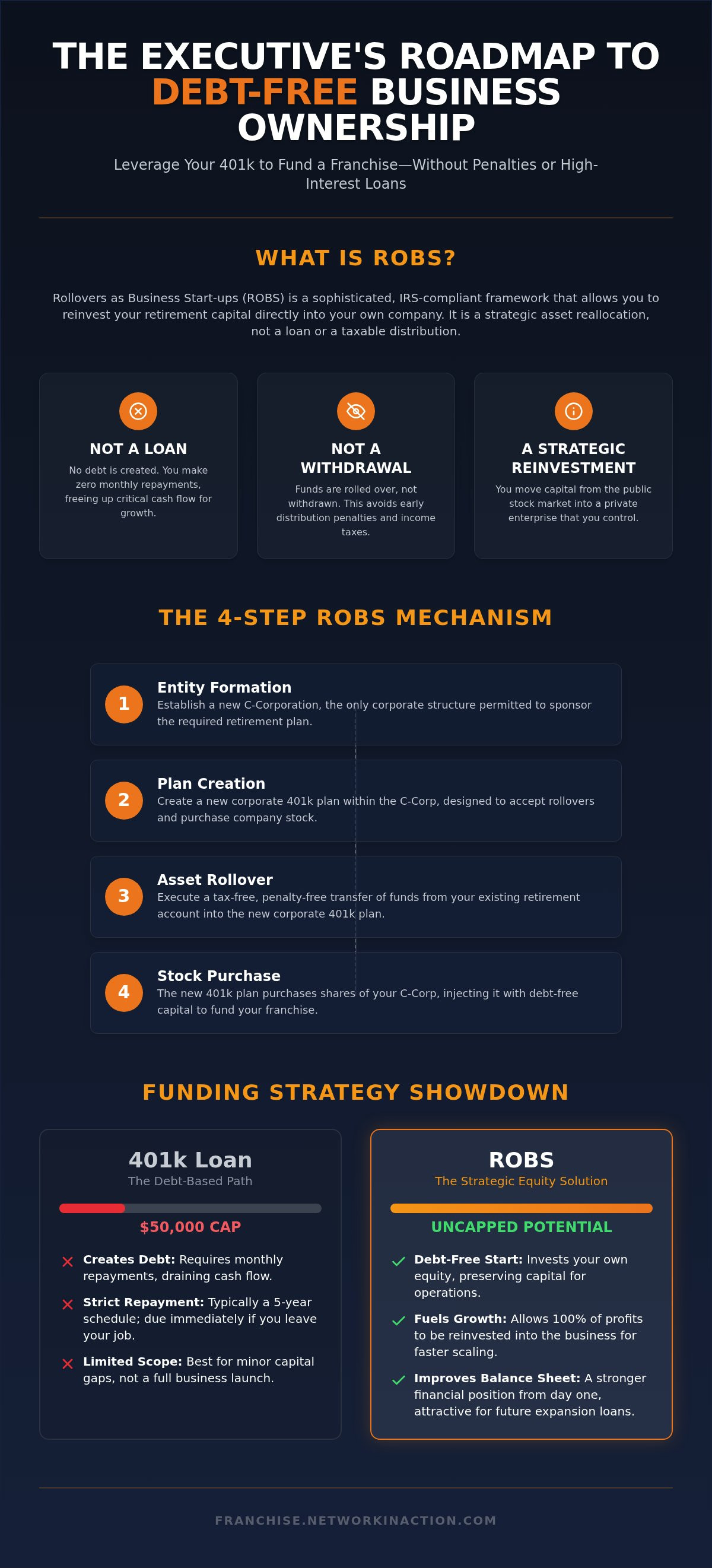
- Compare the $50,000 limitation of standard 401k loans against the uncapped potential of ROBS funding to maximize your starting capital.
- Identify why low-overhead, tech-enabled franchise models provide a superior safety net for your retirement savings compared to capital-heavy legacy businesses.
- Follow a streamlined roadmap to transition from a corporate executive role to a high-growth business owner with a recurring revenue stream.
What is ROBS? Understanding Rollovers for Business Start-ups
Traditional financing is slow. Interest rates are high. For executives ready to pivot, Rollovers as Business Start-ups (ROBS) offer a sophisticated alternative to traditional bank debt. ROBS isn't a loan you pay back with interest, nor is it a taxable distribution that depletes your savings. It's a legal framework that allows you to reinvest your retirement capital directly into your own company. By using a 401k to buy a franchise, you're essentially moving assets from the public stock market into your private enterprise.
Most qualified plans are eligible for this transition. This includes 401ks, 403(b)s, Thrift Savings Plans (TSP), and traditional IRAs. While there's no legal minimum, a $50,000 threshold is the industry standard for viability. For those using a 401k to buy a franchise, staying above this floor ensures that setup fees and administrative costs don't outweigh the tax benefits. Above this mark, you're looking at a powerful, debt-free launchpad for a high-growth business.
The 4-Step ROBS Mechanism
The process is precise and requires strict adherence to corporate formalities. It follows a logical progression from entity creation to capital injection:
- Step 1: Entity Formation. You establish a new C-Corporation. This specific corporate structure is the only one permitted to sponsor the necessary retirement plan.
- Step 2: Plan Creation. You create a new corporate 401k plan within the C-Corp. This plan must include provisions allowing it to invest in qualifying employer securities.
- Step 3: Asset Rollover. You transfer funds from your existing retirement account into the new corporate plan. This is a non-taxable event.
- Step 4: Stock Purchase. The new 401k plan purchases shares of the C-Corp. The corporation now has liquid capital to fund franchise fees, equipment, and working capital.
Why ROBS is Legal in 2026
The IRS and ERISA guidelines explicitly permit retirement plans to invest in employer securities. This isn't tax avoidance; it's portfolio diversification. To remain compliant, you must maintain 'Bona Fide' employee status. You aren't just a passive investor. You're the active leader of the organization. This distinction is critical for maintaining the plan’s tax-deferred status and avoiding prohibited transaction audits. The model is built on transparency and practical business logic, ensuring your capital works for your future while you build your legacy today.
401k Loan vs. ROBS: Choosing the Right Funding Strategy
Funding is the pulse of your new venture. You have two primary paths when using a 401k to buy a franchise: taking a loan against your assets or utilizing an equity-based rollover. One creates a liability. The other builds a foundation. Understanding the technical difference between debt and equity is the first step toward professional autonomy. It's the difference between starting with a weight around your neck or a full tank of fuel.
A 401k loan is debt-based funding. You borrow from your own retirement account and pay yourself back with interest. However, the IRS caps these loans at $50,000 or 50 percent of your account balance, whichever is less. For most high-growth franchises, $50,000 is barely a down payment. You're also bound by a strict five-year repayment schedule. If you leave your primary job to run your business, that loan often becomes due immediately. If you can't pay, it converts into a taxable distribution with heavy penalties.
When to Choose a 401k Loan
Loans work for minor capital gaps. If you're $30,000 short on a low-overhead service model, a loan is fast and simple. But it's a side-hustle tool, not an executive strategy. The monthly repayments drain your early-stage cash flow right when you need to reinvest in growth. It's a rigid model that limits your ability to scale. For those looking to build a significant legacy, the loan's ceiling is simply too low.
The Strategic Advantage of ROBS for Executives
ROBS is equity-based funding. You aren't borrowing money; you're investing it. There are no monthly loan payments to a bank or back into your retirement plan. This debt-free start is a massive competitive edge. It allows you to pour every dollar of profit back into the business to drive faster growth. Because you have no debt on the books, your balance sheet looks significantly better to lenders if you decide to layer on an SBA loan for expansion later.
While the benefits are clear, this strategy requires professional oversight to maintain legal standing. The IRS ROBS Compliance Project monitors these arrangements to ensure they aren't used for simple tax avoidance. You must follow the rules. This includes offering the plan to all eligible employees and maintaining fair market valuations. For those seeking a lifestyle-friendly business model with recurring revenue, using a 401k to buy a franchise provides the necessary liquidity without the drag of interest. If you're ready to see how this capital can build a modern networking empire, download our franchise kit to explore the NIA model.
Risk Mitigation: Why Low-Overhead Franchises Protect Your Retirement
Fear is a natural response to uncertainty. When you consider using a 401k to buy a franchise, the primary concern is often the safety of the capital you've spent decades accumulating. However, risk isn't a monolith. It's a variable you can control by selecting the right business model. Traditional retail and food franchises represent the legacy model trap. These businesses require massive upfront investments in high-rent real estate and perishable inventory. They're brittle. If the market shifts, your capital is locked in physical assets that depreciate daily. You need a model that values agility over square footage.
Service-based efficiency creates a wider safety margin for your retirement assets. To see the data for yourself, use the Network In Action ROI calculator to project returns based on actual business metrics. By stripping away the costs of physical storefronts, you ensure that more of your capital goes toward growth and market penetration. This isn't just about saving money. It's about protecting your future by investing in a system designed for resilience.
Inventory vs. Intellectual Capital
Service models prioritize intellectual capital over physical stock. When your business is built on relationships and proprietary systems, your break-even point is significantly closer. You eliminate the sunk cost of equipment and storefronts. This focus on recurring revenue streams stabilizes your retirement portfolio. You aren't just using a 401k to buy a franchise; you're investing in a scalable system that rewards your professional network. Intellectual capital doesn't rot on a shelf. It scales without the drag of overhead.
The Safety of a Proven System
Franchises outperform independent startups because they provide a battle-tested blueprint. When you deploy ROBS funds, you aren't guessing. You're leveraging corporate support and proprietary technology to bypass the common pitfalls of new business ownership. This is especially true for top executive business opportunities in 2026. These models are designed for professionals who value time and efficiency. They offer a lifestyle-friendly approach that protects your capital while delivering the scalability you expect from a high-yield investment. Stop gambling on unproven ideas and start leading a system built for results.
The Step-by-Step Roadmap to ROBS Implementation
Execution is the bridge between strategy and results. When using a 401k to buy a franchise, the implementation phase must be handled with surgical precision. It isn't a DIY project. It's a structured corporate transaction that requires a specific sequence of legal and financial maneuvers. Miss one step, and you risk plan disqualification. Follow the roadmap, and you unlock a debt-free future. 2026 regulations demand strict adherence to these five milestones.
- Initial Consultation. You must first determine if your current retirement plan is eligible. Most 401ks from previous employers and traditional IRAs qualify, but active plans with a current employer typically do not.
- Entity Formation. You must incorporate as a C-Corporation. This is the only legal structure the IRS permits for ROBS because it allows the issuance of private stock to a retirement plan.
- Plan Adoption. Your new C-Corp installs a specialized 401k plan. This plan must explicitly permit the purchase of 'Qualifying Employer Securities,' allowing it to hold stock in your own company.
- Fund Transfer. You execute a tax-free rollover of your existing assets into the new corporate plan. Because this is a plan-to-plan transfer, it does not trigger taxes or early withdrawal penalties.
- Stock Purchase. The new plan purchases shares in your C-Corp. The capital moves from the retirement plan into your business bank account, ready to fund your franchise fee and working capital.
Maintaining Compliance Post-Launch
Ownership comes with rigorous responsibility. You must file an annual Form 5500 with the Department of Labor to maintain the plan's standing. You must also adhere to strict parity rules. If you hire employees who meet the plan's eligibility requirements, you are legally required to offer them the same 401k participation opportunities. Avoid 'Prohibited Transactions' at all costs. You cannot use business funds for personal expenses or pay yourself an unreasonable salary before the business is fully operational. Compliance is the price of tax-free capital.
Selecting Your Franchise Territory
Timing is critical. You must coordinate your funding timeline with your franchise agreement to ensure capital is liquid when the initial fee is due. Check available territories early to ensure your preferred market is open for development. Professional due diligence is mandatory. Always consult with a tax professional specialized in ROBS before executing a rollover. If you're ready to align your capital with a high-growth opportunity, download our franchise kit to start your evaluation.
Beyond Funding: Building Your Legacy with Network In Action
Capital is a tool. Strategy is the lever. Using a 401k to buy a franchise is the tactical move that launches your journey, but the model you choose determines your ultimate trajectory. Network In Action (NIA) represents the modern evolution of the networking industry. It's a tech-forward solution designed for those who value efficiency over activity. While legacy networking organizations cling to rigid weekly commitments and transactional noise, NIA utilizes a sophisticated, monthly model. You don't just join a group. You own the system.
Owning the network creates a unique compounding effect. Your financial investment generates social capital that is far more resilient than any stock market index. By positioning yourself as a community leader, you build a recurring revenue stream that doesn't depend on physical inventory or high-rent retail spaces. It's a strategic shift from passive retirement holding to active legacy building. You are the architect of a professional ecosystem that grows more valuable with every high-level connection you facilitate.
The ROI of Relationships
Top-tier professionals are fleeing outdated networking models. They're tired of the time-consuming, manual processes that define the leading brand's approach. NIA solves this by leveraging a proprietary technology platform to drive member ROI and ensure franchise retention. This technology streamlines connectivity, making the business both efficient and highly scalable. To understand the mechanics of trust-based growth, explore our referral marketing strategy for unlocking deeper professional connections.
Your Path to Time Freedom
The transition from corporate executive to franchise owner is about more than balance sheets. It's about reclaiming your schedule. Using a 401k to buy a franchise with NIA offers a lifestyle-friendly business model that respects your time. Consider the benefits:
- No Weekends. Your business operates during professional hours.
- No Inventory. You trade in intellectual capital, not physical goods.
- No Forced Referrals. Quality is curated, never mandated.
- Recurring Revenue. Build a predictable income stream that scales with your influence.
You lead your professional community on your terms. This is the path to professional autonomy and meaningful impact. If you're ready to see if our model aligns with your high-growth investment goals, download the NIA franchise kit today. Stop watching your retirement funds sit idle. Start building the future you've earned.
Your Strategic Pivot Starts Now
The corporate world offers stability, but business ownership offers true autonomy. You've seen how the ROBS framework provides a legal, tax-free path to immediate liquidity. By using a 401k to buy a franchise, you move from a passive observer of market volatility to an active leader of a high-growth community. You aren't just funding a business. You're securing a scalable income stream without the drag of interest or debt. This is about leveraging your past success to fuel your future impact. Proven results. Total control.
Network In Action has solved the inherent flaws of outdated networking models. With over 150 global locations and a proprietary technology platform, we empower you to build a business that values your time and professional credibility. You'll lead an executive-level professional community using streamlined systems designed for the modern economy. The blueprint is ready. The capital is yours. It's time to execute on your vision of professional freedom.
Ready to lead? Download the NIA Franchise Kit and explore our tech-enabled model.
Frequently Asked Questions
Is using a 401k to buy a franchise considered an early withdrawal?
No, this process is not a withdrawal or a loan. When you are using a 401k to buy a franchise through a ROBS arrangement, you are rolling over funds into a new corporate plan to purchase stock in your own C-Corporation. Since the capital stays within a qualified retirement structure, you avoid the 10 percent early withdrawal penalty and immediate income taxes. It's a strategic asset reallocation, not a taxable event.
What is the minimum 401k balance required for a ROBS setup?
There is no legal minimum, but $50,000 is the widely accepted industry standard for viability. Setting up a ROBS involves specific legal and administrative costs. If your balance is below this mark, the setup fees may outweigh the tax benefits. For high-growth models like NIA, starting with at least $50,000 ensures you have enough liquid capital to cover the initial franchise fee and early operational expenses without straining your resources.
Can I use my 401k to buy a franchise if I am still working at my current job?
You typically cannot use funds from a 401k plan with your current employer while you are still active with that company. Most plans don't allow "in-service distributions" for this purpose. However, you can use any "orphan" 401k plans from previous employers or traditional IRAs. Once you transition out of your current role, those funds become accessible for using a 401k to buy a franchise through the ROBS structure.
Do I have to pay back the money I take from my 401k for a ROBS?
No, you don't have to pay back the funds because this is an equity investment, not a debt-based loan. Your new corporate 401k plan owns shares in your company. There are no monthly principal or interest payments required. This debt-free start is a primary advantage for executives. Instead of servicing a loan, you can reinvest your profits directly into scaling your business and driving recurring revenue.
What happens to my retirement funds if the franchise business fails?
If the business fails, the value of the stock held by your 401k plan drops to zero. Since your retirement funds are invested in your company's equity, you lose the capital used for the initial purchase. This risk highlights the importance of choosing a low-overhead, service-based model. Unlike outdated networking models with high costs, the NIA system provides a resilient structure designed to protect your investment through technology and recurring revenue streams.
Are there specific types of retirement accounts that cannot be used for ROBS?
Roth IRAs and inherited IRAs are the primary accounts that cannot be used for a ROBS setup. Roth 401k accounts may be eligible, but they involve complex tax considerations. Most other qualified plans, including traditional 401ks, 403(b)s, and Keogh plans, are fully compatible. It's essential to verify the specific language of your plan document with a professional to confirm your eligibility before initiating any fund transfers.
How long does the ROBS funding process typically take from start to finish?
The entire process typically takes three to four weeks from start to finish. This timeline covers C-Corp formation, plan installation, and the final rollover. It is significantly faster than the months-long wait for traditional bank financing. Precision is required to meet your franchise agreement deadlines. Working with a specialized custodian ensures the capital is liquid and ready for your initial investment without unnecessary delays.
Is a ROBS audit-proof if I follow all the IRS guidelines?
No financial structure is entirely audit-proof, but strict adherence to IRS guidelines makes you "audit-ready." The IRS monitors ROBS through its compliance project to prevent prohibited transactions. By filing your annual Form 5500, offering the plan to all eligible employees, and maintaining a fair market valuation of your company stock, you remain in good standing. Professional oversight is the key to maintaining a compliant, high-growth business foundation.