What if the biggest obstacle to your professional freedom isn't the market or the capital, but the conversation happening at your own dinner table? For many high-level executives, the fear of partner rejection or the anxiety of replacing a stable salary with business ownership creates a paralyzing stalemate. Learning how to present a franchise investment to your partner is not about asking for permission. It's about demonstrating a strategic asset acquisition. With the corporate refugee phenomenon at an all-time high in 2026, more professionals are trading the grind for ownership. You must show your partner why a modern, tech-enabled model is the superior alternative to outdated networking models that demand too much time for too little return.
You likely agree that a career change feels risky when the roadmap is blurry. This article promises to equip you with a logic-driven framework that emphasizes ROI, lifestyle autonomy, and strategic growth. You will discover how to justify the investment with a clear financial roadmap, replace the day-to-day grind of traditional retail with a high-margin service model, and build a shared vision of freedom. It's time to stop pitching a job and start presenting a legacy. This approach transforms a stressful kitchen-table talk into a sophisticated business proposal that secures enthusiastic alignment.
Key Takeaways
- Reframe the discussion from a career change to a strategic asset acquisition focused on long-term wealth preservation.
- Discover the logic-driven framework for how to present a franchise investment to your partner while emphasizing ROI and lifestyle autonomy.
- Contrast the efficiency of tech-enabled monthly meetings against the rigid, time-consuming schedules of legacy networking organizations.
- Utilize a five-step strategy to align on a shared vision and demonstrate the local market demand for a modern networking alternative.
- Shift from an employee mindset to community leadership by leveraging a proven corporate support system designed for high-impact scalability.
Understanding the Partner Perspective: Why Skepticism is a Strategic Asset
Your partner's skepticism isn't a hurdle. It's an asset. When you begin learning how to present a franchise investment to your partner, you must recognize that their hesitation often stems from a protective instinct. They aren't rejecting your ambition. They're safeguarding your family's stability. Shift the narrative immediately. Don't approach this as a job seeker looking for a new boss. Approach it as a strategic investor acquiring a scalable system. This requires an executive mindset, not a sales pitch. Skepticism is simply a form of due diligence that strengthens the eventual business plan. Embrace it. Use it to stress-test the model.
The primary fear is the "7-to-11" trap. Most people associate business ownership with a relentless grind that consumes evenings and weekends. They see the owner of a retail shop or a restaurant chained to the floor. You must disrupt this perception. Use logic. Show them that modern models prioritize lifestyle autonomy over manual labor. By understanding the franchise model as a system of leveraged expertise, you can demonstrate how a service-based business operates without the overhead of physical inventory or constant staffing crises. Move the conversation from "working more" to "earning more efficiently."
The "Buying a Job" vs. "Owning an Asset" Debate
Many traditional service franchises are just high-priced jobs. You buy the equipment, you do the work, and you own the stress. This is the "Buying a Job" trap. Contrast this with executive models that leverage existing professional networks. Modern systems automate the manual labor of legacy business models. Instead of cold prospecting or manual data entry, you lead a professional community. It's about high-impact leadership. Results matter. Efficiency wins. You aren't looking for another 40-hour grind; you're looking for a strategic asset that buys back your time.
Validating the Risks: Financial and Lifestyle Security
Transparency builds trust. Acknowledge the weight of initial franchise license fees and ongoing royalties. Don't hide the numbers. Discuss how a career pivot impacts your family's current professional standing. A partner needs to know you've considered the "worst-case" scenario. In 2026, the FTC requires a 14-day disclosure period for the Franchise Disclosure Document (FDD). Use this time. Review the data together. When you master how to present a franchise investment to your partner, you prove that the risk is calculated, managed, and mitigated by a proven system. Financial security isn't found in a salary; it's found in ownership.
The Financial Logic: Presenting the ROI and Wealth Preservation
High-level professionals don't just need a paycheck. They need wealth preservation. When you master how to present a franchise investment to your partner, the conversation must shift from short-term income replacement to long-term asset growth. This isn't about replacing a salary; it's about acquiring a strategic hedge against market volatility. Service-based models offer a distinct advantage here. Unlike retail or food service, you aren't managing physical inventory or complex supply chains. You're leveraging social capital. This is a measurable financial metric that grows in value as your professional community expands. You aren't buying a job for two; you're building an empire for the family.
Transparency is the foundation of partner alignment. You should start by reviewing the official FTC guidance to understand the rigorous disclosure requirements that protect your investment. By applying the logic found in the NIA Franchise ROI calculator, you can project growth based on real-world systems rather than optimistic guesswork. This data-driven approach moves the discussion from emotion to execution. Financial clarity builds confidence. Logic drives alignment.
Recurring Revenue and Scalability
Stability is the ultimate goal. Membership-based models create predictable, monthly cash flow that eliminates the "feast or famine" cycle typical of traditional sales. Legacy networking organizations often rely on manual, transactional interactions that don't scale. In contrast, modern networking franchises use proprietary technology to automate member connectivity. This efficiency allows you to manage multiple territories without doubling your workload. You can scale your influence without sacrificing your weekends. It's about high-margin growth with low-overhead requirements. Results matter. Efficiency wins.
Tax Efficiency and Investment Diversification
Strategic investing requires tax intelligence. Many professionals use pre-tax funds for franchise acquisition, turning dormant retirement accounts into active business equity. This diversification serves as a critical buffer against the unpredictability of the stock market. Beyond monthly returns, you're building a tangible asset with significant long-term equity. Upon your eventual exit, a well-established territory represents a valuable piece of sellable property. You're creating a legacy, not just a career change. If you're ready to see where these opportunities exist, you can check available territories to begin your market analysis.
Modern vs. Legacy Models: Choosing the Right "Lifestyle Brand"
Legacy networking organizations are built on an outdated 1980s blueprint. They demand 7:00 AM weekly meetings, rigid attendance policies, and manual referral tracking. This is a time tax most executives simply cannot afford. When you evaluate how to present a franchise investment to your partner, you must highlight this fundamental shift in operations. Traditional networking models fail the modern professional because they prioritize quantity over quality. They focus on the number of referrals rather than the value of the connection. This creates a high-pressure, transactional environment that feels desperate and inefficient. It's the opposite of the professional image you've spent years building.
Instead, position a modern networking franchise as a lifestyle-first asset. This is informed disruption in action. By replacing the weekly grind with efficient monthly meetings, you reclaim dozens of hours every month. This model isn't a "mom and pop" shop that requires your partner to quit their job or manage a large staff. It's a professional leadership role designed for the high-level executive who values time efficiency and measurable results. You aren't just buying a franchise; you're leading the next evolution of professional connectivity.
The Efficiency of Technology-Led Systems
Proprietary technology platforms are the engine of modern growth. They replace the manual grunt work that plagues outdated networking models. There are no paper referral slips or clunky spreadsheets here. Everything is digital. Everything is tracked. This level of automation allows you to lead a professional community from anywhere. Whether you're in a home office or traveling, the system keeps members connected. This flexible model ensures that business ownership supports your lifestyle. You gain the freedom to scale without the burden of high staffing requirements or fixed retail hours. Efficiency is the ultimate luxury.
Quality Over Quantity in Professional Relationships
Strategic leadership requires a focus on high-impact interactions. Outdated networking models often rely on forced referrals, which leads to low-quality leads and wasted time. Modern systems prioritize curated memberships. You bring together established business owners who understand the ROI of trust. Monthly meetings are focused, professional, and results-driven. This approach builds deep professional credibility without the forced feel of legacy organizations. You aren't selling memberships; you're curating a high-level inner circle. This distinction is vital when considering how to present a franchise investment to your partner, as it positions the business as an elite professional service rather than a high-pressure sales environment.
The 5-Step Presentation Strategy for Your Partner
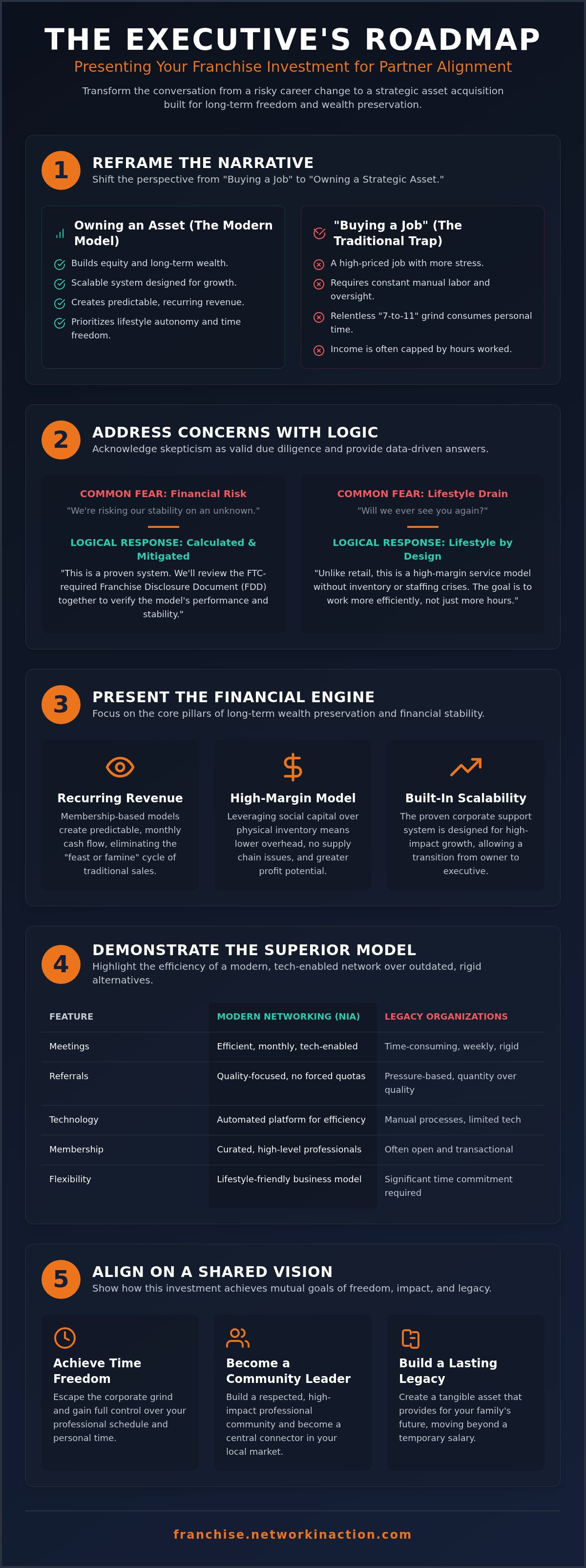
A successful pitch requires more than enthusiasm. It requires a sequence. When you master how to present a franchise investment to your partner, you must treat the discussion like a high-stakes board meeting. Vision first. Logic second. Start with Step 1: Vision Alignment. Focus on the "why" before the "how." Discuss the desire for time freedom and professional impact. Step 2 is the Market Analysis. Demonstrate the specific gap in your local area where outdated networking models are failing. Step 3 is the Financial Blueprint. Present the license fees and royalty structure with absolute clarity. Transparency is non-negotiable.
Step 4 focuses on the Lifestyle Impact. Outline exactly how your schedule will change for the better by replacing the weekly grind with an efficient monthly model. Finally, Step 5 is the Discovery Phase. Don't make the decision for them; invite them into the process. This five-step roadmap transforms a potentially emotional confrontation into a logical, strategic asset acquisition. You're building a partnership, not just seeking permission. Results matter. Alignment wins.
Building Your Internal Pitch Deck
Preparation is your greatest differentiator. Before you sit down, gather concrete data on available territories to show the immediate local opportunity. Use a professional franchise kit as a leave-behind document that speaks for itself. You should also prepare answers for the top three objections: financial risk, time commitment, and market saturation. By addressing these points proactively, you prove that you've done the heavy lifting of due diligence. This level of detail signals that you're moving as a strategic investor, not a corporate refugee making a frantic pivot.
The Art of the "Discovery Call" Invitation
The final hurdle is external validation. Invite your partner to join a call with the founder and executive team. Frame the call as a "fact-finding mission" rather than a final commitment. This lowers the pressure and encourages them to ask the tough questions you might have missed. Meeting the leadership team provides a human connection to the technology and systems you've described. It's about alignment. If you're ready to take this step, you can request your franchise kit to start building your presentation today. This collaborative approach ensures that the eventual decision is a shared victory for your family's future.
Closing the Gap: Transitioning from Employee to Network Owner
The final step in mastering how to present a franchise investment to your partner is shifting the focus from the investment to the execution. You aren't just buying a logo. You're acquiring a turnkey system designed for high-level leaders. Network In Action (NIA) represents the next evolution of business networking, replacing manual, outdated methods with a tech-forward platform. Remind your partner that you won't be building this alone. The transition from a corporate employee to a network owner is supported by a robust corporate infrastructure. This ensures that your professional credibility remains intact while you build a scalable asset.
This isn't a high-pressure sales experiment. It's a strategic move into community leadership. By positioning the opportunity as a modern, superior alternative to legacy networking organizations, you show your partner that you've chosen a model that values time as much as money. The support system provided during the launch phase is a critical differentiator. It transforms a risky career change into a managed business expansion. Efficiency wins. Results follow.
The 90-Day Launch Roadmap
Initial risk is mitigated through a structured training and onboarding process. The 90-day roadmap is designed to get you from territory reservation to your first successful meeting without the guesswork. Corporate leadership plays an active role in building your first referral group, ensuring you have the momentum needed to reach a lifestyle-sustaining level quickly. This hands-on support allows you to focus on high-level relationships rather than administrative minutiae. You lead. The system works. This clarity is essential when discussing how to present a franchise investment to your partner, as it provides a concrete timeline for success.
Leading Your Local Professional Community
Owning the network grants you unparalleled social capital. You become the central hub for local business growth, gaining influence that far exceeds a traditional executive role. This is about more than monthly meetings; it's about helping other business owners thrive. This meaningful impact creates a legacy-building opportunity for your family that a corporate salary simply cannot match. You're building a professional empire grounded in logic and relationship-driven growth. It's time to stop dreaming and start leading. To take the first step toward this new reality, download the free book and discover the full potential of modern networking ownership.
Secure Your Family’s Professional Future
Mastering how to present a franchise investment to your partner requires a shift from emotional pleading to executive logic. You aren't just pitching a business; you're proposing a lifestyle-friendly asset that buys back your time. By highlighting the efficiency of a monthly meeting model and the power of a proprietary technology platform, you demonstrate why this is the next evolution of professional connectivity. Logic wins. Alignment follows. You must show that this move is a strategic acquisition rather than a risky career pivot.
With over 150 successful locations globally, the NIA model is a proven alternative to the rigid, time-consuming requirements of legacy networking organizations. It offers a turnkey solution for those ready to lead their local professional communities while maintaining lifestyle autonomy. Exclusive territories are still available for high-level professionals who are ready to disrupt the status quo. It’s time to move beyond the corporate grind and start building a legacy of social capital and financial growth. The right conversation starts with the right data.
Take the first step toward strategic ownership today. Download Your Executive Franchise Kit and Start the Conversation. Your path to professional freedom and partner alignment is closer than you think.
Frequently Asked Questions
How do I handle my partner’s fear of losing our steady corporate salary?
Address this fear by shifting the focus from income replacement to wealth preservation. A corporate salary is often a single point of failure; ownership is a diversified asset. Present the business as a strategic hedge against market volatility. Show the math of recurring revenue and membership stability to prove that a systemized business model offers more long-term security than a traditional job.
What if my partner has no interest in being involved in the day-to-day operations?
Position this as an executive leadership opportunity rather than a "mom and pop" operation. The NIA model is designed for a single owner to lead a professional community without requiring a partner to quit their job or manage staff. It's a lifestyle-friendly business that respects family boundaries. Your partner can enjoy the financial benefits and social capital without the burden of operational involvement.
How can I prove the ROI of a networking franchise compared to a retail franchise?
Focus on the low overhead and high margins. Retail franchises demand expensive leases, physical inventory, and large teams. A networking franchise leverages social capital and proprietary technology to generate returns without those heavy costs. Efficiency is the ultimate metric here. You are trading manual labor and high risk for a scalable, service-based model that prioritizes your time and profit.
What are the most common mistakes when presenting a business opportunity to a spouse?
The biggest mistake is treating the conversation like a sales pitch rather than a strategic proposal. When you learn how to present a franchise investment to your partner, you must lead with data and transparency. Hiding license fees or underestimating the time commitment destroys credibility. Provide a clear financial roadmap and a logic-driven framework to secure alignment and enthusiastic support.
How do I explain the value of proprietary networking technology to someone non-technical?
Explain that the technology is an automation layer that replaces manual "grunt work." It’s the difference between a clunky spreadsheet and a streamlined, tech-enabled platform. This system handles the member connectivity and referral tracking that plagues outdated networking models. The technology does the heavy lifting so you can focus on high-level relationship building and community leadership rather than administrative minutiae.
Is it better to present the franchise idea early or after I have done all the research?
Present the idea early but ground it in preliminary data. Transparency builds trust. You don't need every answer yet, but you do need a clear "why." Show that you've already identified the gap in the market left by legacy networking organizations. Involving your partner in the discovery phase ensures they feel like a strategic ally rather than a spectator to your career pivot.
How do we evaluate the "lifestyle fit" of a franchise together?
Compare the time requirements of the NIA model against the "weekly grind" of traditional networking. NIA replaces rigid weekly meetings with efficient monthly sessions. This creates lifestyle autonomy that traditional retail or food service models cannot match. Evaluate how the business supports your family's schedule. A true lifestyle brand should buy back your time while growing your income.
What happens if we disagree on the initial investment amount?
Ground the disagreement in the Franchise Disclosure Document (FDD). Review Item 7 together to understand the full investment range based on verified data rather than assumptions. Use the ROI calculator to project growth and payback periods. Financial disagreements usually vanish when you replace emotion with math and a clear roadmap for wealth preservation and strategic expansion.