Most professional networking groups are nothing more than a glorified social hour where high-value time goes to die. If you've spent years sitting through rigid, weekly meetings that demand transactional referral quotas while delivering zero measurable ROI, you've experienced the failure of the legacy industry firsthand. It's time to stop attending and start owning. By shifting to a modernized networking group business model, you can leverage exclusive digital tools and a monthly meeting structure to drive consistent results without the manual grind of outdated networking models.
You already know that professional relationships are a strategic asset, not a forced obligation. This blueprint provides the exact framework to launch a high-impact community that values quality over quantity. You'll master the logic behind building a scalable, tech-forward organization that eliminates the friction inherent in traditional networking. From automating logistics to curating an elite membership base, this guide prepares you to lead your local market, generate high-quality referrals for your own business, and secure the lifestyle autonomy you deserve.
Key Takeaways
- Shift from a casual social club to a professional networking group business model that prioritizes measurable ROI and strategic referral engines over small talk.
- Identify and recruit your Ideal Member Profile (IMP) to build a high-caliber room of decision-makers and business owners who value quality over quantity.
- Eliminate the burnout of legacy networking organizations by adopting a streamlined monthly meeting cadence that respects the schedules of busy executives.
- Execute a phased blueprint to launch your group, starting with a Founders Circle that establishes immediate credibility and local community leadership.
- Transition from a manual DIY organizer to a professional owner by leveraging tech-enabled systems that provide scalability, recurring revenue, and lifestyle freedom.
Why Traditional Networking Fails-and Why You Should Lead the Evolution
Professional networking is not a social club. It's a strategic business engine. For too long, the industry has been defined by casual meetups and surface-level interactions that offer little more than free coffee and a stack of irrelevant business cards. In a high-growth environment, Business networking must be treated as a high-performance asset designed to generate consistent, scalable revenue. The market is currently experiencing a massive wave of legacy model fatigue. Professionals are tired of the "show up or get out" mentality that defines outdated networking models. Modern networking is a high-efficiency, technology-led referral system that prioritizes executive time and measurable outcomes.
The shift is simple. You must move from being a participant in someone else's inefficient system to being the owner of the room. When you control the networking group business model, you control the quality, the culture, and the financial returns. This isn't just about meeting people; it's about building a professional community that functions with the precision of a modern enterprise.
The Problem with Legacy Networking Organizations
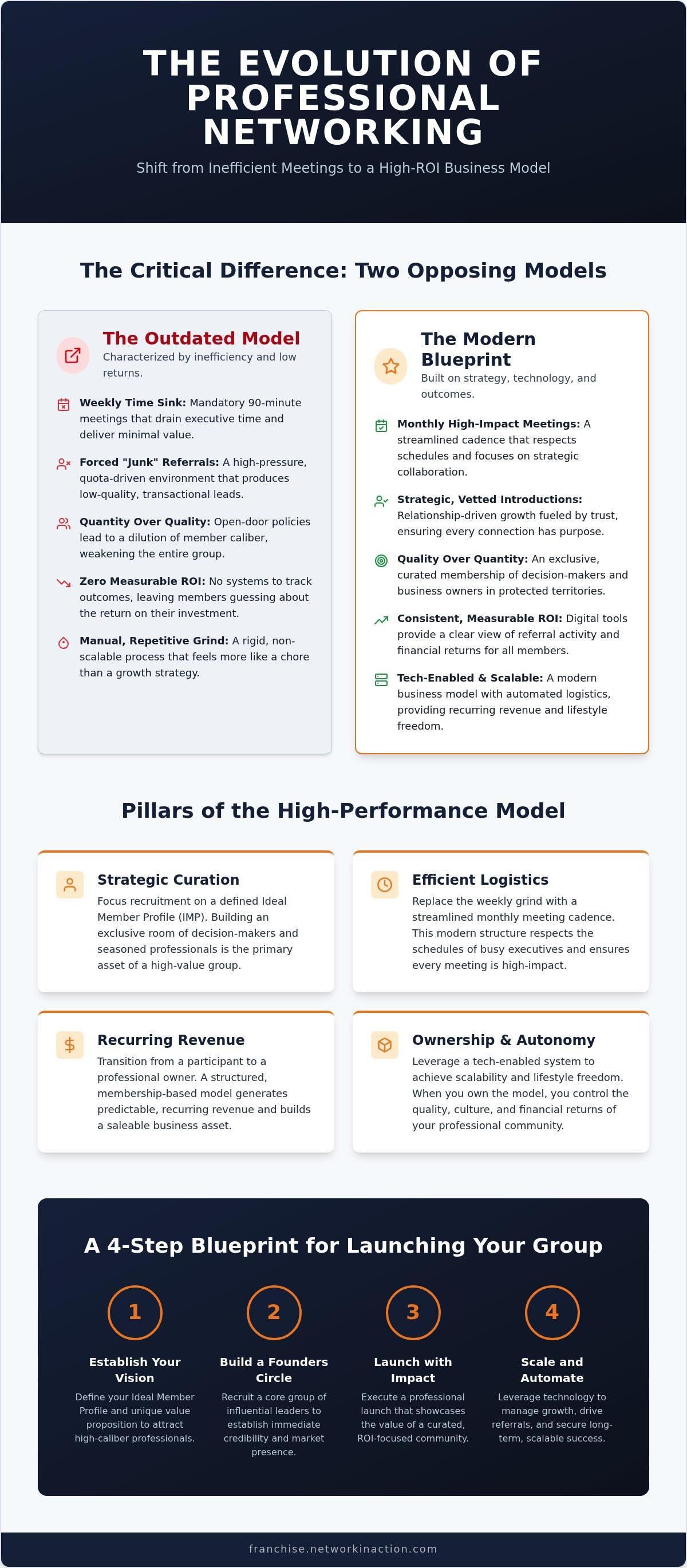
Legacy networking organizations are built on a foundation of inefficiency. They demand a weekly time commitment that most high-level executives simply cannot justify. Spending 90 minutes every Tuesday morning on low-value updates is a poor use of human capital. Beyond the time-cost, these groups suffer from a severe dilution of quality. When a group is built on transactional, quota-driven metrics, the referrals become "junk." Forced referrals are the enemy of trust. They create a high-pressure environment where members pass leads just to hit a number, rather than connecting partners who can actually close a deal. It's a rigid, manual process that feels more like a chore than a growth strategy.
The 2026 Shift: High-Quality over High-Quantity
The future of the industry belongs to curated communities. In 2026, the primary predictor of group success is the caliber of the members, not the size of the roster. A room full of decision-makers and business owners creates significantly more value than a room full of entry-level sales reps. ROI is the only metric that matters. Modern professional communities focus on deep, relationship-driven growth supported by exclusive digital tools. If you are looking to step into a leadership role, understanding the Business Networking Franchise: The Executive Guide to Modern Ownership is the first step toward building a sustainable, tech-forward business. It's time to stop chasing quantity and start investing in quality. This shift ensures that every interaction has a purpose and every connection has the potential for a high-value return.
Defining Your Strategic Vision: Audience, Objectives, and Value
Vision is the bedrock of a successful community. If you don't define the target, you'll end up with a room full of people who have nothing to offer but business cards. A high-performance networking group business model demands a clear Ideal Member Profile (IMP). You aren't looking for everyone; you're looking for the right ones. Many executives choose to start a group of their own when they realize that generic, free meetups and outdated networking models lack the substance required for real growth. Focus your recruitment on decision-makers, business owners, and seasoned professionals who have the authority to refer and the capacity to deliver.
Exclusivity is your greatest asset. High-level professionals value their time and their territory. By establishing a culture of exclusivity, you create a premium environment where membership is earned, not just bought. This differentiation is what separates a strategic business engine from a casual social hour. You must communicate a unique value proposition that centers on high-level collaboration and territory-protected growth. This ensures your group isn't just another meeting on the calendar; it's a closed-door circle of influence.
Curating the Right Professional Mix
Selection is a science. You must identify complementary industries that naturally feed into one another. A real estate attorney, a mortgage broker, and a home inspector form a powerful referral loop. The "No Competition" rule is non-negotiable. One person per industry ensures that every member is the sole authority in their field within the group. This eliminates internal friction and maximizes referral potential. Consider these three pillars of curation:
- Strategic Alignment: Grouping industries that share the same customer base for natural synergy.
- The No Competition Rule: Maintaining one person per industry to protect member interests and authority.
- Rigorous Vetting: Interviewing for professional credibility, proven track records, and long-term commitment.
Setting Measurable Goals for Your Members
Professional networking must move beyond the exchange of business cards. It's about closing deals and driving revenue. Your networking group business model should include specific systems for tracking the financial impact of the group on every member. This data-driven approach positions your community as a Business Growth Engine rather than a social obligation. When members can see the direct ROI of their participation, retention remains high and the group's reputation scales. Transitioning from "meeting" to "measuring" is what defines a modern, results-oriented organization.
Strategic growth requires the right map. If you're ready to move from organizer to owner, you can explore available territories to see where your leadership is needed most in the current market.
The Logistics of High-Impact Networking: Monthly Cadence vs. Weekly Grinds
Time is the most valuable currency an executive possesses. In outdated networking models, that currency is squandered on a weekly basis. The traditional grind of 52 meetings a year creates a culture of attendance rather than a culture of results. A modernized networking group business model recognizes that high-level professionals don't need more meetings; they need more impact. By shifting to a monthly cadence, you respect the schedules of the very decision-makers you want to attract. This logistical pivot transforms the group from a repetitive chore into a high-stakes monthly summit that members actually look forward to attending.
The atmosphere of a monthly meeting is inherently different from a weekly coffee huddle. When you meet once a month for 90 minutes, the energy is focused and the stakes are higher. It allows for a professional atmosphere that mirrors a corporate board meeting rather than a casual social hour. This duration is the sweet spot for deep collaboration. It provides enough time for meaningful relationship building without overstaying its welcome in a busy calendar. Between these physical touchpoints, technology bridges the gap, ensuring the referral engine never stops turning.
Maximizing Efficiency for the Executive Member
Efficiency is the primary driver of member satisfaction. A 90-minute monthly session is significantly more effective than four 60-minute weekly sessions. Why? Because it eliminates the "fluff" and travel time associated with constant check-ins. It leverages the psychology of quality time. When professionals know they only have one window to connect each month, they show up prepared and motivated. This model reduces meeting fatigue and increases referral velocity by focusing on high-value interactions. You're not just saving time; you're concentrating influence.
The Role of Technology in Member Retention
In a modern professional community, manual spreadsheets are the death of growth. They're slow, prone to error, and impossible to scale. A sophisticated networking group business model utilizes a business referral platform to track member activity 24/7. This tech-forward approach allows members to pass referrals, track closed business, and communicate in real-time from their mobile devices. Proprietary technology replaces the need for weekly check-ins by providing a transparent, real-time dashboard for referral tracking and member communication. This ensures that the network stays active and accountable every day of the month, not just during the meeting window. Digital integration isn't just an add-on; it's the infrastructure that supports long-term retention and measurable ROI.
A Step-by-Step Blueprint for Launching Your Professional Referral Group
Launching a high-impact community is a sequence, not a guessing game. To move beyond the limitations of outdated networking models, you must follow a disciplined rollout that prioritizes quality and professional systems from day one. A successful networking group business model relies on a structured five-phase approach that ensures your group isn't just another meeting, but a high-performance business engine.
- Phase 1: Territory Identification. Conduct market research to identify affluent business hubs with a high concentration of decision-makers.
- Phase 2: The Founders Circle. Recruit your first 5 to 10 anchor members who serve as the cultural and professional foundation of the group.
- Phase 3: Digital Integration. Set up your proprietary technology platform to manage referrals and member tracking before the first meeting.
- Phase 4: The Vision Meeting. Host a high-level summit to secure commitments and align on the group's ROI-driven objectives.
- Phase 5: Official Launch. Execute your first monthly session and transition into ongoing management and growth.
Recruiting Your Anchor Members
Your first few members determine the trajectory of the entire group. You are looking for "Super-Connectors" in your local market. These are the established professionals who already have deep networks and are likely experiencing legacy industry fatigue. When you pitch the vision of a modernized, tech-forward network, you are offering them a solution to a problem they already have. They don't want more meetings; they want better connections. You can explore available territories to see where the demand for this high-level leadership is currently highest.
Scaling Through Professional Systems
Professional groups fail when the owner becomes a manual administrator. To scale effectively, you must leverage automation. This means using digital infrastructure to handle invitations, RSVPs, and referral tracking without constant manual intervention. This tech-savvy approach saves you time and signals to your members that they are part of a sophisticated, modern organization. The goal is to ensure the first meeting delivers immediate, tangible value. When members see a technology-enabled system that works, they stop seeing networking as a chore and start seeing it as a strategic investment. This foundation allows you to grow the group while maintaining your own lifestyle freedom.
If you're ready to transition from a participant to a professional owner, you can download a franchise kit to see the full operational blueprint behind this model.
Transitioning from DIY Organizer to Professional Network Owner
Running a networking group as a hobby is a recipe for burnout. Owning a group as a business is a recipe for freedom. The distinction lies in the systems you deploy and the goals you set. When you operate within a professional networking group business model, you aren't just organizing meetings; you're managing a high-yield asset. Network In Action (NIA) provides the turnkey framework to move from a manual DIY approach to a scalable, tech-enabled enterprise. This transition allows you to secure recurring revenue while positioning yourself as a dominant leader in your local business community.
The franchise model solves the inherent flaws of legacy networking organizations by providing a ready-to-use infrastructure. You don't have to waste months testing software or drafting bylaws. Instead, you step into a proven system backed by over 150 locations globally. This is the next evolution of the industry. It's designed for the visionary leader who values efficiency and measurable results over the trial and error of a casual social club.
The ROI of Ownership: Beyond Just Referrals
Ownership delivers a double-sided financial benefit. First, it establishes a consistent income stream through membership fees, turning your social capital into a tangible business asset. Second, it places you at the center of a referral engine that feeds your primary business. You aren't just looking for leads; you're building a fortress of professional credibility. This dual-revenue approach is the hallmark of a sophisticated Referral Marketing Strategy: Unlocking Growth through Trust and Connections. It’s about leveraging your network to achieve lifestyle autonomy without the grind of cold prospecting.
Why a Turnkey Model Wins in 2026
The business landscape of 2026 demands speed and precision. DIY models fail because they lack the professional marketing, training, and proprietary technology required to attract high-level executives. By choosing a turnkey system, you avoid the administrative friction that kills most independent groups. You gain access to a global brand and a collaborative network of fellow owners who share best practices for growth. It’s a support system that empowers you to scale quickly while maintaining complete control over your schedule. If you're ready to see if you qualify for NIA ownership, you can Download the Franchise Kit to explore the full operational blueprint.
Lead the Next Evolution of Professional Networking
The transition from attending meetings to owning the room is a defining step for any serious professional. You now have the blueprint to move beyond the inefficiencies of legacy organizations and build a community that values quality, ROI, and executive time. By shifting to a monthly cadence and leveraging a modernized networking group business model, you eliminate the burnout associated with outdated networking models while securing a scalable path to recurring revenue. This is not just about referrals; it is about establishing yourself as a central leader in your local market.
Success in this industry requires more than just a good network; it requires professional systems. Network In Action offers a turnkey solution designed by business owners for business owners, backed by over 150 successful territories worldwide. With proprietary technology that automates the heavy lifting, you can focus on high-level relationships instead of manual administration. It's time to stop settling for transactional interactions and start building a high-impact legacy. Explore high-level ownership with the NIA Franchise Kit today and discover how to align your professional influence with your personal freedom. Your future as a community visionary starts here.
Frequently Asked Questions
How much time does it take to manage a professional networking group?
Managing a professional group takes significantly less time when you move away from the weekly grind of legacy organizations. By utilizing a monthly meeting cadence and proprietary automation tools, owners typically spend five to ten hours per month on administration and growth. This allows you to focus on high-level relationship building rather than getting bogged down in manual logistics. It's a lifestyle-friendly approach that respects your time while maximizing your community influence.
How do I find high-quality members for my new networking group?
High-quality members are found by targeting decision-makers and business owners who have already outgrown outdated networking models. You should leverage your existing professional network and use digital platforms like LinkedIn to identify "Super-Connectors" in complementary industries. Focus on recruiting individuals who value quality over quantity and are looking for a more sophisticated environment to grow their influence. A rigorous vetting process ensures that only committed professionals enter the room.
What is the best way to charge for membership in a referral group?
The best approach is to establish a clear, value-based fee structure that reflects the ROI your group provides. Most successful owners charge an annual or monthly membership fee that covers the cost of proprietary technology and professional meeting environments. This ensures that members are financially committed and helps filter out those who are not serious about strategic business growth. Positioning the fee as an investment in their business development makes the value proposition undeniable.
Should I start a DIY group or invest in a networking franchise?
Investing in a franchise is the superior choice for those who want a turnkey networking group business model without the risks of trial and error. While a DIY approach might seem cheaper initially, it lacks the proprietary technology, global brand recognition, and structured training required to scale efficiently. A franchise provides a proven blueprint that allows you to focus on leadership and relationship-building rather than reinventing the operational wheel from scratch.
How do I handle industry exclusivity in my networking group?
Industry exclusivity is handled through a strict "one person per category" rule to prevent internal competition and maximize referral potential. This ensures that each member is the sole authority in their field within the group, which fosters deeper trust and collaboration. You must clearly define these categories during the vetting process to maintain a balanced professional mix. This protection of territory is a key reason high-level executives choose exclusive groups over open meetups.
What kind of technology do I need to run a successful networking group in 2026?
Running a successful group in 2026 requires a 24/7 digital infrastructure that tracks referrals and member engagement in real-time. You need a proprietary technology platform that includes a mobile app for instant communication and a dashboard for monitoring financial metrics. This eliminates the need for manual spreadsheets and provides the transparency that high-level professionals demand in a modern networking group business model. Technology bridges the gap between monthly meetings, keeping the referral engine running constantly.
Can I run a networking group while working a full-time job?
You can lead a professional group while maintaining a full-time career, provided you use an efficient, tech-enabled system. Because the model focuses on monthly meetings rather than the time-consuming weekly sessions found in legacy organizations, the time commitment is manageable. Many successful owners use their group to grow their primary business while building a secondary stream of recurring revenue. It is a path to community leadership that doesn't require sacrificing your professional obligations.
How do I ensure members actually pass high-quality referrals?
High-quality referrals are ensured by fostering a culture of genuine relationship-building rather than using the forced quotas typical of outdated networking models. You should vet members for their commitment and track the actual closed business generated by connections. When you bring together high-caliber professionals in a results-oriented environment, quality referrals happen naturally as trust is established through consistent interaction. Accountability is maintained through transparent tracking systems rather than artificial requirements.