The most valuable skill set in business today isn't an MBA or a decade in corporate America. It's the discipline, leadership, and mission-driven focus that military service builds into every veteran who earns an honorable discharge. Yet thousands of veterans leave active duty each year and find themselves navigating a civilian job market that undervalues exactly what they bring to the table. If that tension sounds familiar, it's time to look at franchise opportunities for veterans through a completely different lens.
You already know what it takes to lead people, execute under pressure, and build systems that work. The real question isn't whether you're ready to run a business. It's whether the right business model exists to match your skills, your values, and the life you want to build. Legacy networking organizations are rigid, time-consuming, and built for a different era. The modern franchise landscape has evolved, and the most compelling opportunities in 2026 are designed for leaders who want recurring revenue, community impact, and the freedom to operate on their own terms.
This article breaks down why professional networking franchises are uniquely positioned for veterans, what to look for in a model that delivers real ROI, and how to evaluate whether this path aligns with your long-term vision.
Key Takeaways
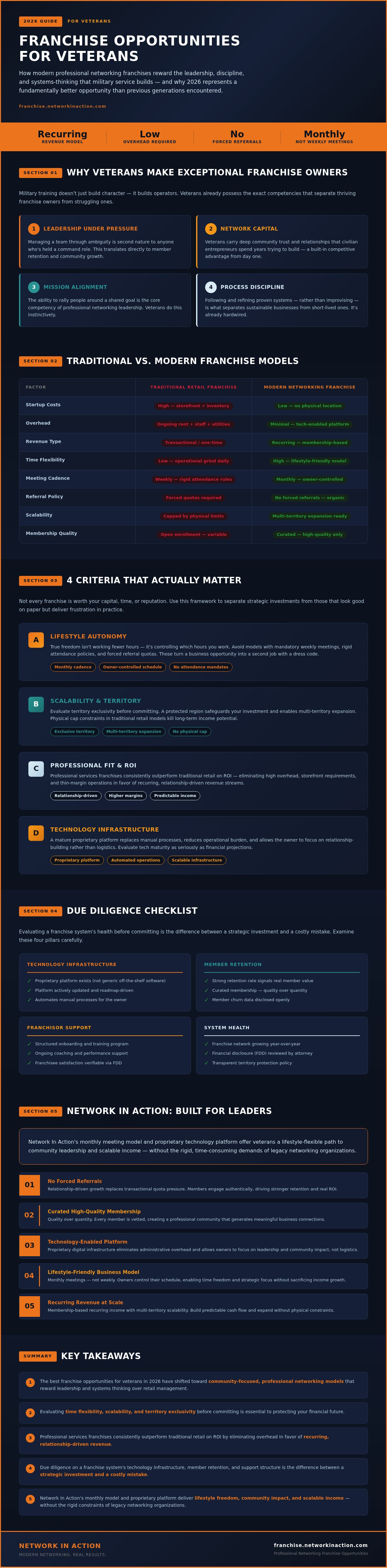
- The best franchise opportunities for veterans in 2026 have shifted away from traditional retail models toward community-focused, professional networking franchises that reward leadership and systems thinking.
- Not all franchise models are created equal - evaluating time flexibility, scalability, and territory exclusivity before committing is essential to protecting your financial future.
- Professional services franchises consistently outperform traditional franchises on ROI by eliminating high overhead, storefront requirements, and low-margin operations in favor of recurring, relationship-driven revenue.
- Due diligence on a franchise system's health - including its technology infrastructure, member retention, and support structure - is the difference between a strategic investment and a costly mistake.
- Network In Action's monthly meeting model and proprietary technology platform offer veterans a lifestyle-flexible path to community leadership and scalable income without the rigid demands of legacy networking organizations.
The Evolution of Franchise Opportunities for Veterans in 2026
The franchise landscape has undergone a fundamental shift. What once meant signing a lease, hiring staff, and managing inventory now includes a growing category of service-based, community-driven models that reward exactly what military service builds: disciplined execution, systems thinking, and the ability to lead people toward a shared mission. For veterans evaluating their next chapter, 2026 represents a genuinely different set of options than what existed even five years ago.
The timing matters. Economic conditions have accelerated demand for trusted professional communities, and the technology infrastructure supporting modern franchise models has matured to the point where a single operator can run a high-impact business without the overhead that once made franchise ownership prohibitive. The franchise opportunities for veterans entering this market now are structurally better than what previous generations of service members encountered.
Why Veterans Make Exceptional Franchise Owners
Military training doesn't just build character. It builds operators. Veterans understand how to follow a proven system while adapting to real-world conditions, which is precisely what successful franchise ownership demands. Consider what transfers directly from service to business ownership:
- Leadership under pressure: Managing a team through ambiguity is second nature to anyone who's held a command role.
- Network capital: Veterans carry deep community trust and relationships that civilian entrepreneurs spend years trying to build.
- Mission alignment: The ability to rally people around a shared goal is the core competency of professional networking leadership.
- Process discipline: Following and refining systems, rather than improvising from scratch, is what separates sustainable businesses from short-lived ones.
These aren't soft skills. They're competitive advantages that directly translate to member retention, community growth, and recurring revenue in a professional networking franchise context.
Moving Beyond Traditional Retail Franchises
Legacy retail franchise models carry significant structural disadvantages: high startup costs, storefront obligations, thin margins, and a daily operational grind that leaves little room for strategic thinking. Many owners report that the business ends up owning them rather than the other way around. That's not a model built for someone accustomed to leading, not just managing.
The modern alternative is what's often called efficient ownership: technology-enabled platforms that eliminate unnecessary overhead, replace manual processes with proprietary digital infrastructure, and allow an owner to focus on relationship-building and community leadership instead of logistics. For veterans exploring franchise opportunities for veterans in 2026, this distinction isn't a minor detail. It's the difference between building a business that serves your life and one that consumes it.
Key Criteria for Evaluating Franchise Opportunities for Veterans
Not every franchise is worth your time, your capital, or your name. The evaluation process matters as much as the opportunity itself, and veterans entering the franchise market deserve a sharper framework than a simple cost comparison. Four criteria separate genuinely strategic investments from models that look attractive on paper but deliver frustration in practice: time flexibility, scalability, professional fit, and technology infrastructure.
Assessing Lifestyle Autonomy in Franchise Models
True lifestyle freedom isn't about working fewer hours. It's about controlling which hours you work and why. For a veteran franchise owner, that distinction is critical. Legacy networking organizations have historically required weekly meetings, mandatory attendance policies, and rigid referral quotas that turn a business opportunity into a second job with a dress code. That's a red flag, not a feature.
The monthly meeting structure used by modern professional networking franchises fundamentally changes this equation. Instead of consuming four to five evenings per month on repetitive, low-value gatherings, an owner runs one high-impact session and spends the remaining time on strategic relationship-building, community outreach, and business development. The calendar stays yours. The business serves your life rather than replacing it.
Ask any franchisor a direct question before signing: what does a typical week look like for an owner in year two? If the honest answer involves constant availability, reactive problem-solving, and no predictable off-hours, that model isn't built for leaders. It's built for managers.
Leveraging Veterans' Skills in Business Ownership
The skills that made you effective in uniform translate with surprising precision to professional networking franchise ownership. Mission planning becomes member recruitment strategy. Unit cohesion becomes community culture. After-action reviews become monthly performance analysis. The vocabulary changes; the discipline doesn't.
Scalability is where this alignment becomes a financial advantage. A well-designed franchise model allows an owner to grow membership and geographic reach without requiring exponential increases in personal labor. Family members can take on defined operational roles, from member communications to event coordination, creating a business that strengthens rather than strains household dynamics. That's not just a lifestyle benefit; it's a structural efficiency that directly protects margins.
Building a referral-based network also compounds professional credibility over time in ways that cold prospecting never can. Members who trust the community become advocates. Advocates generate introductions. Introductions close faster, retain longer, and cost nothing to acquire. For veterans evaluating franchise opportunities for veterans in 2026, this relationship-driven growth model is the clearest path to recurring, defensible revenue.
Technology infrastructure ties everything together. A franchise powered by proprietary digital tools, rather than spreadsheets and manual follow-up, gives an owner real leverage. Connectivity, member tracking, and engagement analytics handled through a modern platform mean less administrative drag and more time spent on the work that actually builds the business.
If you're ready to assess which territories align with your background and goals, explore available territories to see where this model fits your market.
Professional Services vs. Traditional Franchises: The ROI Advantage
Networking gets dismissed as "too social" by serious investors. That objection is understandable, and it's also wrong. When the model is structured correctly, professional networking franchise ownership generates recurring revenue from a relationship-driven asset that compounds in value the longer it operates. The financial case isn't soft. It's measurable, scalable, and structurally superior to what most traditional franchise models deliver.
The Problems with Outdated Franchise Models
Legacy networking organizations built their systems around volume: weekly meetings, mandatory attendance, forced referral quotas. The theory was that more activity equals more business. The reality is that frequency without quality erodes the relationships it's supposed to build. When members feel obligated to pass referrals regardless of fit, trust deteriorates. When owners spend four or five evenings per month running repetitive gatherings, their time-to-value ratio collapses. The business model punishes success by demanding more hours as the network grows.
Traditional retail franchises compound these problems with structural overhead that professional service models simply don't carry. Consider what a storefront-dependent franchise requires before a single dollar of revenue appears:
- Lease obligations that lock capital into fixed costs regardless of performance
- Inventory management that ties up working capital and creates spoilage or obsolescence risk
- Staff-dependent operations that introduce hiring, training, and retention costs as permanent overhead
- Thin margins that make scaling a volume game rather than a value game
For veterans evaluating franchise opportunities for veterans in 2026, these aren't abstract concerns. They're the structural reasons why so many franchise owners report that the business runs them rather than the other way around.
Technology as the Key Differentiator
The modern professional networking franchise has solved the core inefficiency problem through proprietary technology. Member connectivity, engagement tracking, and relationship analytics that once required manual follow-up and administrative labor are now handled through purpose-built digital platforms. The result is that an owner's time gets redirected toward high-value community leadership rather than low-value operational maintenance.
Data-driven performance tracking changes the economics entirely. Instead of guessing which members are engaged or which referral relationships are producing results, an owner can see exactly where value is being created and where attention is needed. That's not a minor convenience; it's the difference between reactive management and proactive strategy.
Veterans are uniquely positioned to leverage this advantage. Military training builds comfort with information systems, performance metrics, and structured reporting, which are the same competencies that allow a tech-enabled franchise owner to operate efficiently at scale. The curated membership model that results from this infrastructure yields higher ROI for both the owner and the members because every relationship in the network is intentional, tracked, and optimized.
That's the core distinction between the modern evolution of professional networking and the legacy models it's replacing. Less noise. More signal. Measurable returns. If you're ready to see how this model translates to a specific market, download the franchise kit to review the full operational and financial framework.
Due Diligence: Securing Your Financial Future as a Veteran Franchise Owner
Commitment without intelligence isn't valor. It's risk. The same discipline that makes veterans exceptional franchise owners also demands a rigorous evaluation process before any capital changes hands. Signing a franchise agreement is a strategic decision, and treating it like one means asking hard questions, verifying real answers, and understanding exactly what you're buying before you buy it.
Three variables determine whether a franchise investment delivers on its promise: the health of the territory, the quality of the support system, and the honest calculation of your time return on investment. Each deserves direct analysis, not marketing language.
Analyzing Territory Potential and Market Demand
Exclusive territory rights aren't a bonus feature. They're the foundation of a defensible business. In professional networking, owning a specific geographic connection hub means becoming the trusted convener for small-to-mid-sized businesses in your market, a position that compounds in value as your reputation grows. Before committing, verify that the territory carries genuine density of active SMBs and that no overlap exists with existing franchise locations.
Professional networking is also structurally resilient in ways that retail models aren't. When economic conditions tighten, businesses don't stop needing clients. They need them more urgently. That dynamic makes relationship-driven franchise opportunities for veterans particularly durable; the value proposition strengthens precisely when discretionary spending contracts elsewhere.
Key territory questions to resolve before signing:
- What is the current SMB density within the defined geographic boundary?
- Are territory rights exclusive and contractually protected?
- What existing competition operates in the market, and how is it differentiated?
- What is the realistic timeline to a self-sustaining member base?
Evaluating the Franchise Support System
A franchise system is only as strong as the infrastructure behind it. Corporate onboarding should deliver more than an orientation packet. Expect structured training that covers member recruitment, platform operations, community facilitation, and performance tracking. If a franchisor can't articulate a clear 90-day ramp plan, that's a signal worth taking seriously.
Ongoing mentorship matters equally. Scaling a family-operated franchise requires access to experienced operators who've solved the problems you'll face in months six through eighteen. The best systems build that mentorship into the model, not as an optional add-on, but as a core component of how franchisees grow.
The final calculation is Time ROI: the ratio of hours invested to revenue generated. A monthly meeting model reduces time commitment dramatically compared to legacy networking organizations, but verify that claim against real owner schedules, not projected ones. Ask to speak with current franchise owners in comparable markets. Their experience is the most reliable data point available.
For a complete picture of what the support framework and operational model look like in practice, download the franchise kit and review the full details before your next conversation with the franchise team.
Network In Action: The Modern Franchise Solution for Veterans
Legacy networking models had their moment. That moment has passed. Network In Action (NIA) represents what professional networking looks like when it's been rebuilt from the ground up with efficiency, technology, and real ROI at the center. For veterans evaluating franchise opportunities for veterans in 2026, NIA isn't just a better option. It's a structurally different category.
The core differentiators are concrete. No storefront. No inventory. No forced referrals. No weekly attendance mandates that turn a business investment into a calendar prison. What replaces all of that is a proprietary technology platform that handles member connectivity and engagement tracking, a monthly meeting model that concentrates value into one high-impact session, and a curated membership approach that prioritizes relationship quality over headcount. Over 150 locations globally have validated this model. The infrastructure is proven.
A Day in the Life of an NIA Franchise Owner
The day doesn't start with cold calls. It starts with strategy. An NIA franchise owner spends time cultivating relationships with established professionals in their territory, following up on warm introductions generated by the network, and preparing for a monthly meeting that delivers genuine business value to every person in the room. The administrative work that would otherwise consume hours is handled through the platform, not through manual effort.
That time recovery changes everything for veteran families. A spouse can manage member communications. A family member can coordinate logistics. The operational structure is clean enough to distribute without losing quality control. For veterans who've spent years in environments where every hour is accounted for, owning a business that respects your time is a non-negotiable. NIA is built that way by design, not by accident. The business networking franchise guide provides a detailed operational breakdown for anyone ready to examine exactly how this model runs day to day.
Next Steps for Veterans Considering Franchise Ownership
The shift from employee to owner isn't just a financial decision. It's an identity decision. Veterans who've led units, managed complex operations, and delivered results under pressure are already thinking like owners. The missing piece is usually a model worthy of those capabilities.
NIA provides a clear path from discovery to territory reservation without pressure and without ambiguity. Start with the free book to build a foundation in modern franchise ownership principles, then review available territories to identify where your background and market opportunity align. The franchise opportunities for veterans who act on this now are real, specific, and time-sensitive. Territories don't stay open indefinitely.
The question isn't whether you're ready to lead a business. You already answered that question in uniform. The question is whether the business you choose is ready for a leader like you.
Your Next Mission Starts Here
The case is clear. Franchise opportunities for veterans in 2026 have moved well beyond retail storefronts and legacy networking organizations that demand your calendar in exchange for mediocre returns. The modern professional networking franchise rewards exactly what military service builds: disciplined execution, community leadership, and the ability to operate a proven system at scale.
Three points are worth carrying forward. First, proprietary technology changes the economics entirely, replacing manual overhead with intelligent infrastructure that gives you real leverage. Second, high-level executive support means you're not building from scratch; you're deploying into a system designed by experienced operators who've already solved the hard problems. Third, redefining networking for the modern era isn't a marketing phrase. It's the structural reality of what NIA delivers compared to everything that came before it.
Territories don't stay open indefinitely, and the right market for your background exists right now. Secure Your Family's Future: Explore Available NIA Territories Today and take the first step toward a business that's genuinely built for a leader like you.
Frequently Asked Questions About Franchise Opportunities for Veterans
What are the best franchise opportunities for veterans with no retail experience?
Veterans with no retail background are actually better positioned for professional services and networking franchises than for traditional storefronts. Retail rewards inventory management and consumer sales instincts. Professional networking rewards leadership, relationship capital, and disciplined execution, which are skills built directly into military service. A franchise model with no storefront requirement, no product inventory, and a community-centered operational structure plays directly to those strengths.
The practical implication is straightforward: look for models where your ability to convene, lead, and build trust does the heavy lifting. That's a fundamentally different skill set than stocking shelves or managing point-of-sale systems, and it's one veterans already possess.
How much time does it realistically take to run a networking franchise?
A modern networking franchise built on a monthly meeting model requires significantly less calendar time than legacy networking organizations, which typically demand four to five gatherings per month plus ongoing administrative follow-up. Realistically, an owner running a well-structured monthly model invests focused time in one high-impact meeting plus ongoing relationship cultivation and member outreach spread across the month. The total commitment is meaningful, but it's predictable and owner-controlled.
The distinction that matters is structured versus reactive time. A technology-enabled platform handles member connectivity and engagement tracking automatically, which means your hours go toward strategic relationship-building rather than administrative maintenance. That's a fundamentally different time profile than most franchise models deliver.
Can a husband and wife team effectively run a professional services franchise?
A husband-and-wife team is genuinely well-suited to this model. The operational structure is clean enough to divide clearly: one partner can lead community facilitation and member recruitment while the other manages communications, event coordination, and platform administration. Those roles don't require constant overlap, which reduces friction and allows both partners to contribute in ways that match their strengths.
The broader advantage is household alignment. When both partners understand the business, share its goals, and contribute to its growth, the franchise strengthens rather than strains the relationship. Families running NIA locations have found that the defined structure makes collaboration sustainable rather than chaotic.
What makes a networking franchise better than a traditional franchise model?
The core advantage is overhead elimination. Traditional franchise models require lease commitments, inventory capital, staff hiring, and thin-margin operations before a single dollar of profit appears. A professional networking franchise carries none of those structural costs. The investment goes into building relationships and community presence, assets that compound in value over time rather than depreciate like physical inventory or equipment.
Scalability also works differently. In a retail model, growth usually means more locations, more staff, and more complexity. In a relationship-driven franchise, growth means deeper community roots, stronger referral networks, and higher member retention, none of which require proportional increases in personal labor or capital expenditure.
How do I know if a specific territory is right for a professional networking business?
Territory fit comes down to three variables: small-to-mid-sized business density, competitive differentiation, and exclusive boundary protection. A market with an active SMB community gives you a ready audience of professionals who need trusted referral relationships. Verify that the territory is contractually exclusive so your investment isn't diluted by overlap with other franchise locations.
Beyond the numbers, consider your existing network in the market. Veterans often carry community credibility and professional relationships in specific regions that civilian entrepreneurs spend years building. If you already have roots in a territory, that social capital becomes a direct business asset from day one rather than something you need to construct from scratch.
Is professional networking still relevant in a technology-driven business world?
It's more relevant, not less. Digital communication tools have made it easier to connect with more people superficially while making it harder to build the deep, trust-based relationships that actually generate business. Professionals are increasingly selective about where they invest relationship capital, which means curated, high-quality networking communities carry more value than ever against the noise of generic online platforms.
The franchise opportunities for veterans entering this space now benefit from that dynamic directly. A professionally led, technology-supported networking community offers something LinkedIn and email chains can't: accountability, face-to-face trust, and a structured environment where business relationships are intentionally cultivated rather than algorithmically suggested.
What is the typical ROI for a veteran-owned service franchise?
Specific ROI figures vary by territory, owner effort, and market conditions, so any honest answer requires reviewing the franchise disclosure document and speaking directly with current franchise owners in comparable markets. What's structurally true is that a service franchise with no storefront, no inventory, and a recurring relationship-driven revenue model carries a fundamentally different cost basis than traditional franchises, which means the path to profitability doesn't require hitting high-volume sales thresholds before overhead is covered.
The more useful metric to evaluate upfront is Time ROI: how many hours does the model require per dollar of revenue generated? A monthly meeting structure with technology-enabled member management produces a favorable ratio compared to legacy networking organizations or retail models that demand constant owner presence. Ask current owners that specific question before signing anything.