Why do so many high-level executives trade a corporate corner office for a 60-hour workweek disguised as business ownership? It's a common trap. You've seen the polished sales decks and the impressive growth charts, yet the fear of hidden operational friction remains. You're likely skeptical of the standard corporate pitch, and you should be. You deserve a business model that respects your time instead of one that creates another manual, legacy burden.
This guide provides the strategic framework you need to cut through the noise. You'll master the specific questions to ask current franchisees before buying to reveal the true ROI and lifestyle potential of any opportunity. The following sections move past surface-level inquiries to expose the difference between a scalable, tech-forward asset and a demanding, outdated job. By the end of this executive guide, you'll have the confidence to verify financial projections and ensure your next move is a modern evolution, not a step backward into professional inefficiency.
Key Takeaways
- Move beyond basic financial verification to uncover the operational friction that separates modern assets from outdated, manual burdens.
- Deploy a high-impact list of questions to ask current franchisees before buying to validate actual income potential and recurring revenue scalability.
- Evaluate the "technology gap" to ensure the brand leverages proprietary tools rather than relying on the rigid, time-consuming methods of legacy networking organizations.
- Uncover the "Day in the Life" reality to confirm the business model supports executive-level lifestyle autonomy instead of creating a 60-hour-a-week job.
- Synthesize feedback to spot red flags, such as transactional cultures or forced referrals, that signal a misalignment with high-quality professional standards.
The Strategic Importance of Franchisee Validation in 2026
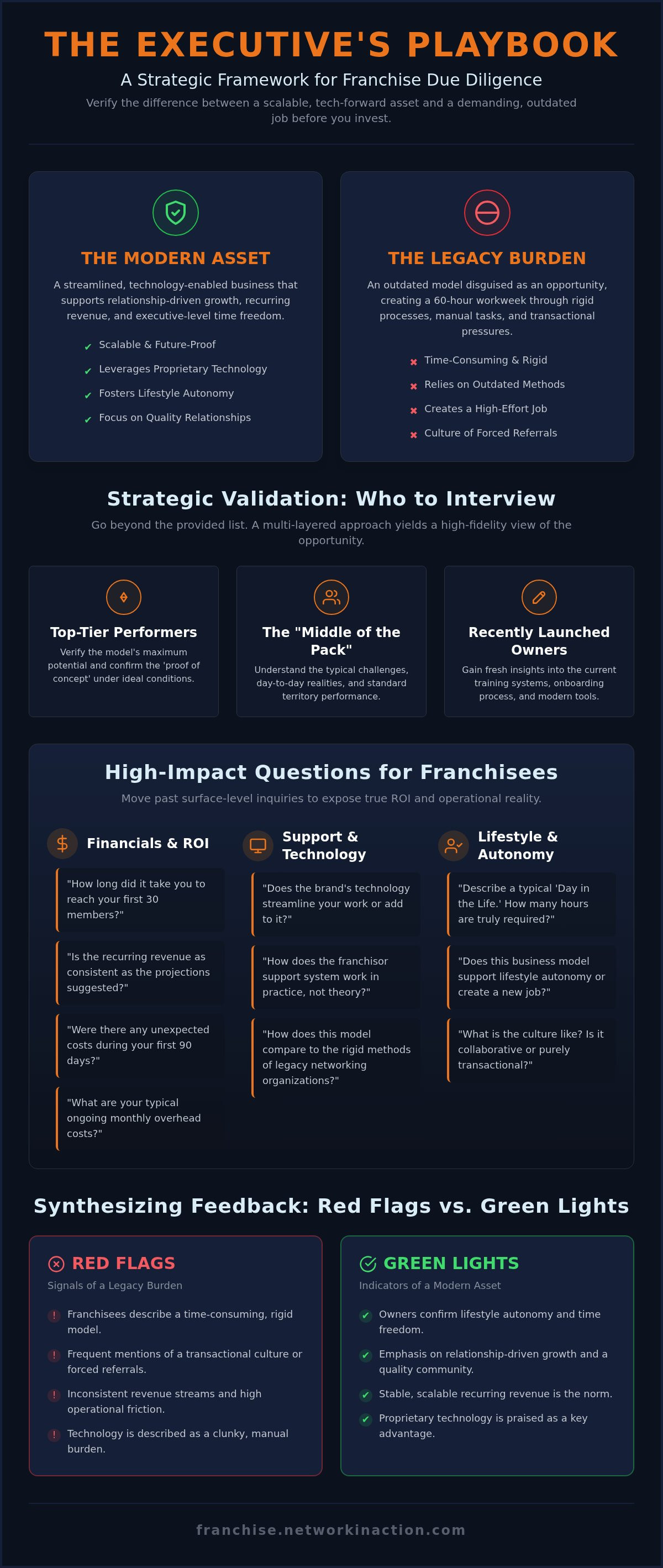
Validation is more than a courtesy call. It's a high-stakes audit. By interviewing current owners, you verify if the franchisor's claims hold up under real-world pressure. In 2026, the gap between tech-forward models and legacy systems has widened into a canyon. You need to know if you're investing in a streamlined asset or a manual burden. This process exposes the "Legacy Trap," where outdated networking models prioritize rigid, transactional interactions over actual ROI. A professional inquiry process ensures you don't just buy into a brand; you buy into a future-proof system.
Moving Beyond the Franchise Disclosure Document (FDD)
Every serious investor starts with the Franchise Disclosure Document (FDD). While this legal requirement covers 23 essential areas of disclosure, it remains a theoretical baseline. Item 19 might show impressive financial representations, but it won't reveal the "hidden" culture of the organization. You need to identify the gap between corporate theory and the daily grind. Your list of questions to ask current franchisees before buying should focus on the friction points that a legal document simply cannot capture. Effective validation uncovers whether the support system is an active partner or a silent bystander.
Selecting the Right Franchisees to Interview
Strategy dictates who you call. Most franchisors provide a list of their top-tier performers. While their success is proof of concept, it isn't the whole picture. Seek out owners in the "middle of the pack" to understand the challenges of a standard territory. Focus on owners who transitioned from an executive background. They share your perspective on efficiency and professional credibility. Additionally, prioritize conversations with owners who launched within the last 12 months. Their experience with current training systems and digital tools provides a fresh look at the brand's modern adaptation. This multi-layered approach ensures your questions to ask current franchisees before buying yield a balanced, high-fidelity view of the opportunity.
A results-oriented inquiry process is about precision. You aren't looking for general satisfaction; you're looking for operational excellence and time freedom. If a franchisee describes a model that is time-consuming and rigid, you've found a legacy burden. If they describe a technology-enabled platform that supports relationship-driven growth, you've found a modern asset. This distinction is the difference between buying a job and building a legacy. Prepare to dig deep into the metrics that matter most to your executive lifestyle.
Financial Performance and ROI: Cutting Through the Noise
Financial projections are just ink on paper. Reality exists in the ledgers of active owners. You must verify income potential without getting distracted by corporate sales pitches. ROI in the context of professional networking franchises is the measurable return on your social capital, quantified by the growth of recurring revenue streams relative to the efficiency of the tech-enabled system you operate. It's about moving from transactional effort to scalable assets. Before finalizing your due diligence, having a specific set of questions to ask current franchisees before buying will protect your capital.
Questions for Real-World Profitability
Use the FTC's guide to buying a franchise to ground your expectations before you start your calls. Your questions to ask current franchisees before buying must target the speed of growth and the stability of the income. Speed to market is everything. Ask owners: "How long did it take you to reach your first 30 members?" This reveals the effectiveness of the training and the market's hunger for a modern alternative to outdated networking models. Follow up by asking if the recurring revenue is as consistent as the initial projections suggested. If the income fluctuates, the model likely lacks the structure required for executive-level stability. Finally, ask about ongoing monthly overhead costs. High-energy businesses should have lean operations, not heavy manual burdens.
Understanding the Total Investment
Corporate brochures often gloss over the "on-ramp" costs. You need the ground-level truth about the total investment. Ask franchisees: "Were there any unexpected costs during your first 90 days?" This exposes hidden fees or marketing requirements that weren't clear at the start. Inquire about the actual working capital needed before the business became self-sustaining. With SBA 7(a) loan interest rates currently ranging from 9.5% to 11.75% for loans over $250,000 as of July 2026, understanding your debt service is critical. Ask how these payments impacted their early-stage cash flow. You can calculate your potential with our franchise ROI calculator to see how these variables impact your bottom line. Understanding these financial realities ensures you're buying a strategic path to time freedom.
Ready to see where this model is expanding? Explore available territories and find your fit in the modern evolution of networking.
Evaluating Support, Training, and the Technology Gap
Modern franchising is a technology play. In 2026, the difference between a high-growth asset and a demanding job is the quality of the tech stack. Outdated networking models often force owners into a cycle of manual tracking, weekly administrative slogs, and inefficient data entry. You need to ensure the business you're buying leverages automation to protect your most valuable resource: time. This is a critical phase of due diligence where your questions to ask current franchisees before buying must focus on operational speed and digital adaptation.
The Proprietary Platform Litmus Test
A proprietary platform should be a primary differentiator, not a digital headache. If a franchisor claims to be modern but their owners are still using manual spreadsheets to track member referrals, the system is broken. A tech-forward business referral platform should automate connectivity and provide real-time ROI metrics for every member. Use these inquiries to evaluate the system's effectiveness:
- Does the technology platform actually save you time, or is it just another administrative burden?
- How often is the software updated to reflect modern networking trends and executive-level expectations?
- Can you manage your entire territory through the provided digital tools, or are you forced to invent your own tracking systems?
Ongoing Support vs. Initial Onboarding
Initial training is expected. Strategic, ongoing support is what scales a business. Many legacy networking organizations offer comprehensive onboarding but fail to provide the high-level guidance necessary to navigate shifting market conditions. You aren't just looking for a "how-to" manual. You're looking for a corporate team that acts as an informed disruptor in the industry. As you refine your questions to ask current franchisees before buying, analyze the responsiveness of the headquarters. Ask owners: "When you face a unique local challenge, how quickly does the corporate office respond with a solution?" Verify if the ongoing training is relevant to growing your professional credibility or if it's just repetitive "maintenance" content. True support should empower you to lead your community with confidence, not tie you down with rigid, transactional requirements that mirror a traditional corporate job. If the support feels sluggish or outdated, the model likely lacks the agility required for 2026 success.
Lifestyle, Autonomy, and the 'Day in the Life' Reality
Most executives exit the corporate world to reclaim their time. They don't want to trade a corner office for a 60-hour workweek disguised as "business ownership." If a model feels like a high-pressure job, it's an investment failure. Traditional networking models often trap owners in a cycle of weekly meetings and rigid attendance rules that mirror the very grind you're trying to escape. You need a business that respects your calendar. When preparing your list of questions to ask current franchisees before buying, focus on the operational rhythm and the reality of time freedom.
Time Commitment and Operational Flow
The monthly meeting model is an informed disruption of the industry status quo. It replaces the weekly slog with high-impact, curated connections that drive results without the administrative exhaustion. This shift allows you to prioritize relationship-driven growth over mere attendance. Use these specific inquiries to expose the true workload:
- How many hours a week do you realistically spend on business development versus manual administration?
- Does the monthly meeting structure allow you to maintain other professional interests, consulting roles, or family commitments?
- What does your typical "Tuesday" look like compared to the rigid, time-consuming schedule of a legacy networking organization?
Freedom and Scalability
True business ownership means the system works even when you don't. You need to know if the digital tools and automated platforms discussed in the previous section actually provide travel flexibility. Can you take a two-week vacation without the business collapsing? A modern, tech-forward asset should offer lifestyle autonomy. Inquire about the potential for expansion without a linear increase in your personal hours. As you refine your questions to ask current franchisees before buying, push for clarity on scalability. Ask owners if they can manage multiple territories without doubling their workload. If the model requires your constant physical presence, it isn't a scalable asset; it's a job. You can check for available territories to begin planning an expansion strategy that aligns with your lifestyle goals.
Don't settle for a legacy burden that dictates your every move. Discover how a modern networking franchise provides the strategic path to time freedom by exploring available territories today.
Synthesizing Answers: Identifying Red Flags and Green Lights
Data collection is only half the battle. The true value of your due diligence lies in your ability to synthesize feedback into a clear decision-making framework. You aren't just looking for happy owners; you're looking for high-performing partners who operate with executive efficiency. Conflicting advice is inevitable in any large system. To find the truth, weigh the responses from franchisees who share your professional background and lifestyle goals more heavily than those from different sectors. Your goal is to separate standard entrepreneurial growing pains from systemic flaws inherent in outdated networking models.
The 'Buy Again' Question
This is the ultimate litmus test in your validation process. When you've exhausted your list of questions to ask current franchisees before buying, end with this: "Knowing what you know now, would you make this investment again?" The answer tells you everything. A confident, immediate "yes" is a green light. It signals that the ROI, support, and lifestyle autonomy align with the brand's promises.
Pay close attention to the tone of the response. A hesitant "yes" followed by a list of "buts" is often a "no" in disguise. It usually indicates that the owner feels trapped by rigid, transactional requirements or that the business has become a high-pressure job rather than a scalable asset. If multiple owners warn you about the manual burden of legacy networking organizations, take it as a definitive red flag. Modern assets should inspire enthusiasm, not exhaustion.
Next Steps: From Validation to Ownership
Use your validation notes to drive your final negotiations. If you've identified specific market challenges or operational friction points, bring them to the corporate team. Their responsiveness to these concerns will reveal the true nature of the partnership. For those seeking a sophisticated, tech-forward alternative to the status quo, the choice becomes clear. You need a model that replaces weekly administrative slogs with monthly, high-impact leadership.
Your next move should be exploring a business networking franchise that prioritizes quality over quantity and ROI over activity for activity's sake. The modern evolution of this industry is built on proprietary platforms and curated memberships, not forced referrals and legacy burdens. You've done the work to verify the potential. Now, it's time to align your professional future with a system designed for 2026 and beyond. Download your Franchise Kit to begin your own validation journey and secure your territory in a results-oriented community.
Strategic Clarity for the Modern Executive
Due diligence in 2026 requires more than a cursory glance at an FDD. It demands a sophisticated analysis of operational friction and digital leverage. By utilizing a targeted list of questions to ask current franchisees before buying, you've moved beyond corporate sales pitches to uncover the ground-level truth of business ownership. You now understand how to distinguish between a time-consuming legacy burden and a tech-forward asset designed for high-impact growth. True success comes from selecting a system that aligns with your values and your schedule.
Network In Action represents the next evolution of the industry. With over 150 successful global locations already disrupting the status quo, the NIA model replaces the weekly slog with a proprietary tech-enabled referral platform built specifically for executive-level lifestyle autonomy. This is an opportunity to lead a professional community while maintaining the freedom you've earned. Leverage your experience into a business that prioritizes meaningful impact over busy work. The transition from corporate leader to strategic business owner starts with a commitment to excellence and efficiency.
Secure your strategic future—Download the NIA Franchise Kit today.
Frequently Asked Questions
How many franchisees should I talk to before buying?
Aim for five to ten owners to secure a statistically significant sample of the network. This range allows you to hear from top performers, those in the middle, and newer owners who launched in 2025 or 2026. Speaking with a diverse group ensures you understand how the model performs across different territories and professional backgrounds. It prevents you from basing a major investment on a single, outlier experience.
What is the biggest red flag during a franchisee validation call?
A hesitant or defensive response to the "would you buy again" question is the most critical warning sign. If an owner describes the business as a high-pressure job rather than a scalable asset, the model likely lacks the efficiency you require. Watch for consistent complaints about rigid, transactional requirements or a lack of corporate responsiveness. These red flags indicate a legacy burden that will drain your time without delivering expected returns.
Should I ask franchisees about their specific salary or income?
Focus on gross revenue and profit margins rather than personal salary to maintain professional boundaries. Ask about the time it took to reach a specific member count or the average length of a member's tenure. These metrics are more useful for your financial projections. Your questions to ask current franchisees before buying should target the scalability of recurring revenue streams rather than a single individual's take-home pay.
How do I handle a franchisee who seems overly negative about the brand?
Listen for specific operational failures rather than general emotional venting. Ask the owner to pinpoint where the system failed; was it the technology, the training, or their local market execution? Cross-reference their negative feedback with other owners to see if it's a systemic issue or an isolated incident. An objective executive filters through the noise to find actionable data points about the business model's actual limitations.
Can I ask to see a franchisee's actual profit and loss statements?
You can ask, but be prepared for a professional refusal as most owners treat P&L statements as confidential. Instead, ask for percentage-based data, such as the ratio of marketing spend to new member acquisition. This provides the financial clarity you need without overstepping. It's a more effective way to verify the Item 19 figures provided in the Franchise Disclosure Document while respecting the owner's privacy.
What if the franchisor only lets me talk to a specific list of owners?
This lack of transparency suggests a legacy brand is hiding systemic friction. A confident, modern franchisor provides a full list of all active owners as required by law. If you're restricted to a "hand-picked" list, use professional networks to find other owners independently. Genuine questions to ask current franchisees before buying require a random sample to ensure you aren't just hearing a polished corporate script.
How do legacy networking organizations compare to modern NIA models in validation?
Validation for legacy networking organizations often reveals a culture of forced referrals and time-consuming weekly meetings. Owners in those systems frequently report high administrative burnout and rigid, transactional rules. In contrast, modern models emphasize quality over quantity. Validation calls with NIA owners focus on the efficiency of a proprietary platform and the lifestyle freedom afforded by a monthly meeting structure that respects executive-level time.
Is it okay to ask about the franchisor's relationship with the owners?
This is essential for understanding the long-term support you'll receive as a partner. Ask if the corporate team acts as a visionary leader or a bureaucratic obstacle. You want to know if they're responsive to market shifts and if they actively invest in the technology platform. A supportive, tech-forward relationship is a primary measure of social capital and ensures your territory remains a competitive, modern asset.