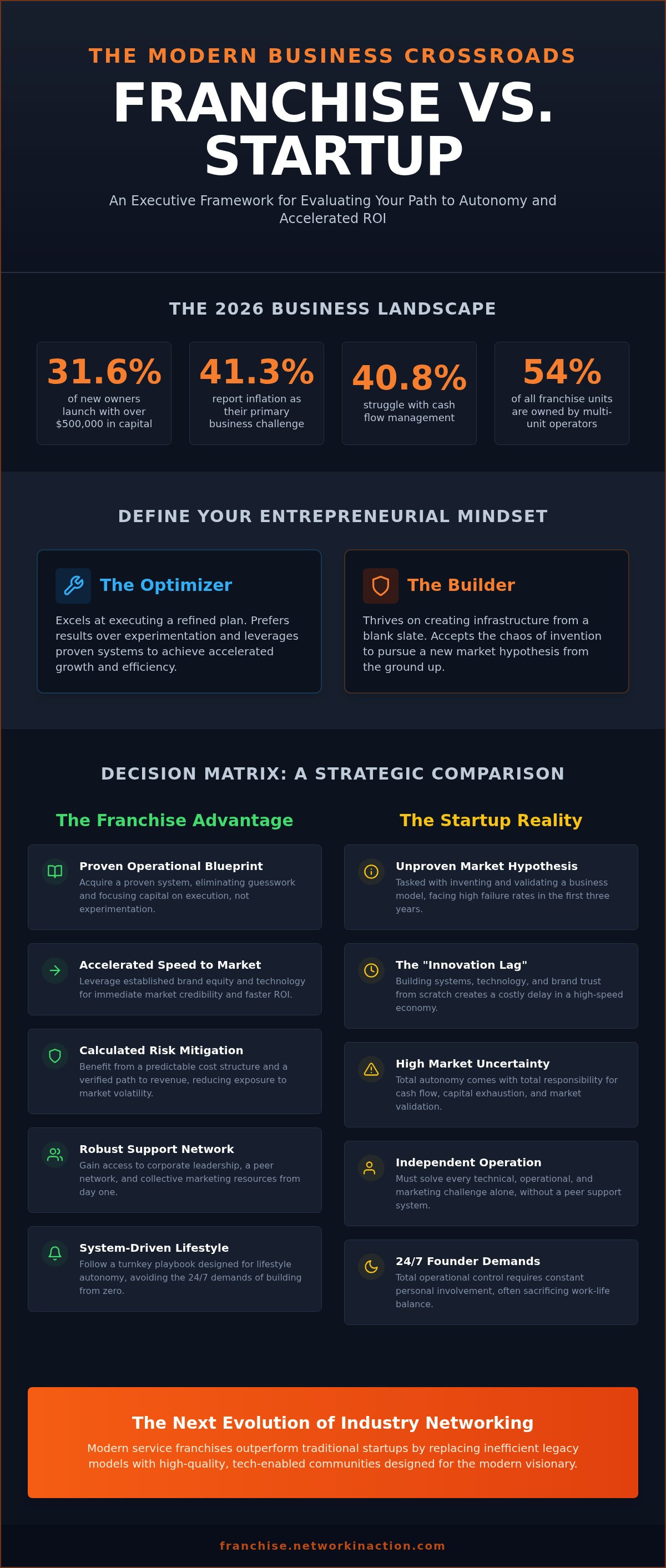
Building a business from the ground up is no longer a badge of honor; in 2026, it is often a strategic liability. You've spent your career mastering efficiency and leadership. Wasting capital on an unproven startup idea is a risk you don't need to take. When weighing the franchise vs startup pros and cons, the decision isn't just about brand recognition. It is about speed to market and the cost of innovation. With 31.6% of new business owners now launching with over $500,000 in capital, the stakes for your ROI have never been higher.
You deserve a model that respects your time. It should leverage your existing professional network instead of forcing you into "cold prospecting" or the rigidity of traditional networking organizations. This guide provides a clear executive framework to determine your fastest path to lifestyle autonomy. You'll discover how the latest FTC disclosure changes and modern technology platforms have transformed franchising into a sophisticated, tech-forward investment. It's time to move past legacy industry practices. Embrace a system designed for the modern visionary.
Key Takeaways
- Identify the fundamental trade-offs between a proven system and a market hypothesis to ensure your business model aligns with your long-term vision.
- Learn how to bypass the "innovation lag" by leveraging proprietary technology and established brand equity for immediate market credibility.
- Evaluate the franchise vs startup pros and cons through a strategic lens, focusing on recurring revenue potential versus total operational control.
- Identify the specific financial and time commitments required to achieve lifestyle autonomy, contrasting monthly meeting models with the 24/7 demands of a startup.
- Discover why modern service franchises are the next evolution of industry networking, replacing inefficient legacy models with high-quality, tech-enabled communities.
Scaling Your Vision: The Fundamental Choice Between Franchise and Startup
The decision to launch a business in 2026 requires a clinical assessment of your professional goals. You aren't just choosing a brand. You're choosing a lifestyle. The choice rests between the franchise model and the startup path. A franchise is a strategic partnership where you acquire a proven operational blueprint. It's about execution. Conversely, a startup is an independent pursuit of a new market hypothesis. It's about invention. When weighing the franchise vs startup pros and cons, you must account for the "innovation lag." Building systems from scratch costs time. In a high-speed economy, that delay is a tax on your future ROI.
Market dynamics in 2026 favor speed. With 18.7% of business owners now investing heavily in AI resources, the technical barrier to entry is rising. Understanding the Franchise Model allows you to skip the expensive trial-and-error phase. You buy into a system that has already solved the technical and operational hurdles. This eliminates the opportunity cost of building infrastructure from zero, allowing you to focus on high-level strategy and community leadership from day one.
The Entrepreneurial Mindset: Builder vs. Optimizer
Are you a builder or an optimizer? Builders thrive on creating infrastructure from zero. They enjoy the "blank slate" but accept the chaos that comes with it. Optimizers, however, excel at executing a refined plan. For most corporate executives, the psychological shift to business ownership is smoother when the system is already "turnkey." You don't need to guess how to lead. You just need to follow the playbook. This allows you to focus on growth rather than troubleshooting. If you prefer results over experimentation, you are an optimizer.
Risk Mitigation in a Volatile Economy
Risk is inevitable, but it should be calculated. Startups face staggering failure rates within their first three years, often due to unproven models or capital exhaustion. Modern professional networking models offer a distinct advantage over traditional retail because they prioritize social capital over heavy physical inventory. In 2026, business owners report that inflation (41.3%) and cash flow (40.8%) are their primary challenges. A franchise model mitigates these risks by providing a predictable cost structure and a verified path to recurring revenue. You can explore these systems further by reviewing our franchise kit to see how a structured model protects your capital. According to 2026 industry data, businesses listed in the SBA Franchise Directory enjoy streamlined access to capital, reinforcing the stability of the franchise model over independent startups.
The Franchise Advantage: Leveraging Proven Systems for Accelerated ROI
Execution is the only metric that matters in 2026. While a startup forces you to build the engine while driving, a franchise provides the keys to a high-performance machine. This isn't just about safety; it's about velocity. When you evaluate the franchise vs startup pros and cons, the primary differentiator is the immediate acquisition of brand equity. You don't spend years convincing the market of your credibility. You step into a role backed by over 150 locations and a verified track record of success. Systems scale. Manual labor is a choice you no longer have to make.
Success in modern business is often a byproduct of collective intelligence. As a franchisee, you gain access to a corporate leadership team and a network of peers who've already solved the problems you'll face. This support structure includes collective buying power and shared marketing resources that independent startups simply cannot match. With 54% of all franchise units now owned by multi-unit operators, the scalability of this model is proven. You aren't just buying a business. You're acquiring a sophisticated ecosystem designed to maximize your financial returns from day one.
Technology as an Operational Force Multiplier
Manual operations are a relic of the past. Modern networking franchises utilize exclusive digital tools to automate the "grunt work" that plagues legacy networking organizations. These proprietary platforms handle member connectivity and referral tracking with surgical precision. It's the difference between a high-tech hub and a rigid, transactional meeting room. By adopting a monthly meeting model instead of the outdated weekly structures, you reclaim your most valuable asset: time. You can explore The Tech That Powers a Network In Action Group to see how these systems replace manual prospecting with automated efficiency.
Streamlined Marketing and Referral Systems
Cold prospecting is inefficient and beneath your professional standing. The modern franchise model shifts the focus toward relationship-driven growth. You receive a ready-to-use referral marketing strategy that prioritizes high-quality connections over sheer volume. A key differentiator in this space is the "no forced referrals" policy. Unlike traditional networking models that demand transactional quotas, modern systems protect your professional integrity. You only share referrals when they add genuine value. This curated approach builds deeper trust and higher ROI within your community. Discover how these systems align with your goals by reviewing the franchise kit today.
The Startup Reality: Balancing Total Autonomy Against Market Uncertainty
The startup path offers a seductive promise: absolute freedom. You own the brand. You dictate the pricing. You control every service offering without seeking corporate approval. For the visionary who refuses to compromise on a specific market hypothesis, this independence is the primary draw. When evaluating the franchise vs startup pros and cons, the absence of royalty fees and ongoing financial obligations to a franchisor is a significant factor. Every dollar earned stays within your ecosystem. Total control. No oversight. You can pivot instantly if the market shifts, a flexibility that rigid legacy models often lack. If your goal is to build a brand that becomes a global disruptor, the long-term valuation of an independent startup can be immense.
Independence requires an appetite for high-stakes decision-making. You aren't just the CEO; you're the architect of every system. While this allows for a unique market position, it also places the entire weight of innovation on your shoulders. In a 2026 economy driven by rapid technological shifts, the ability to move without corporate red tape is a clear advantage. However, this agility must be balanced against the reality of market uncertainty. You are testing a theory in real-time with your own capital. The rewards are yours alone, but so are the risks of a market that doesn't yet recognize your name.
The Hidden Costs of Total Autonomy
Absolute freedom comes with absolute responsibility. You must build every operational manual, safety protocol, and training module from zero. This is a time-intensive process that often leads to "operational exhaustion." While a franchise provides a tech-forward platform, a startup requires you to fund and develop your own custom technology. In 2026, where 38.6% of business owners are forced to invest heavily in digital marketing just to stay visible, these development costs can deplete your capital before you even launch. There is also the "Isolation Factor." Without a peer network or a corporate leadership team, you are solving complex problems in a vacuum.
The Challenge of Establishing Credibility
Winning high-level executive clients as an unknown brand is a steep climb. Professional credibility takes years to build from scratch. In contrast, an established franchise offers "Instant Authority" that opens doors immediately. Sophisticated clients often view independent startups with skepticism until they prove their staying power. Many independent owners find themselves trapped in outdated networking models to compensate for this lack of brand equity. These legacy networking organizations are often too transactional and rigid for a modern professional. They prioritize quantity over quality, forcing you into "cold prospecting" rather than leveraging a high-level network. You can see a more efficient alternative in our available territories, where established systems replace the uncertainty of the startup grind.
Decision Matrix: Evaluating Your Professional Goals and Lifestyle Requirements
Choosing between these models isn't a matter of preference. It's a calculation of leverage. You've already mastered the art of leadership. Now, you must decide where to apply it. When you weigh the franchise vs startup pros and cons, you're essentially choosing between being an architect or an operator. A startup demands 24/7 immersion into every granular detail. A modern franchise allows you to step into a community leadership role from day one. In 2026, where inflation remains a top concern for 41.3% of business owners, the predictability of a proven system is a strategic asset. You aren't just buying a business. You're buying back your time.
Scalability is the next factor in your matrix. Can your chosen model expand without a linear increase in your workload? A startup often hits a ceiling when the founder's personal capacity is reached. Modern service franchises solve this through multi-unit potential and territory rights. You can lead multiple professional communities across different regions using the same proprietary technology. This creates a path to recurring revenue that doesn't require your presence in every room. Alignment with your personal values matters. If you value community impact and professional growth, leading a high-level network provides a platform that a solo startup rarely can.
Lifestyle Autonomy vs. Operational Burden
Efficiency is the ultimate currency for the modern executive. Brick-and-mortar startups are currently facing rising construction and real estate costs. This creates a heavy operational burden before you even open your doors. A service-based model bypasses these "Main Street" hurdles. You focus on building high-quality relationships rather than managing inventory or physical sites. This is a lifestyle-friendly approach that prioritizes your autonomy. You should Download the Franchise Kit to see how a modernized model replaces the daily grind with a structured, monthly meeting cycle.
Analyzing the Return on Investment (ROI)
True ROI isn't just a line on a balance sheet. It is the value of your time. In a startup, your "hourly rate" often plummets during the first three years of system-building. A franchise allows you to bypass this phase. You convert your existing social capital into financial capital immediately. This is the modern evolution of business growth. Your existing professional network becomes your primary asset, not a cold prospecting list. Because the SBA has reinstated its Franchise Directory, securing capital for these proven models is more streamlined than ever. Ensure you check Available Territories early in your process to secure the most lucrative markets before they're gone. If you're ready to align your career with a high-growth, tech-forward system, explore our current territory opportunities today.
Beyond the Legacy Model: Why Modern Service Franchises Outperform Traditional Startups
Legacy networking organizations are a relic of a previous era. They operate on rigid, transactional models that prioritize quantity over quality. For a high-level executive, attending weekly meetings with low-level service providers is an inefficient use of social capital. Modern networking represents the next evolution of industry growth. By choosing a tech-led franchise model over a traditional startup, you bypass the operational exhaustion of building these systems yourself. You gain a streamlined, technology-led solution that addresses the specific market pain points that legacy models ignore. This is the ultimate "Informed Disruption" of the traditional startup risk.
The core of the franchise vs startup pros and cons debate in 2026 is the technological divide. A solo startup must fund and develop its own connectivity tools from zero. This is a massive capital drain. In contrast, a modern franchise provides a proprietary platform that automates referrals and member tracking with surgical precision. You aren't just starting a business. You're acquiring a solution to the inherent flaws of a manual, outdated industry. This model allows you to focus on community leadership and high-level strategy rather than administrative troubleshooting.
Quality Over Quantity: The Executive Networking Standard
Time is your most valuable asset. Weekly meeting models are designed for those who need a job; monthly meeting models are designed for those who lead an industry. Higher-level professionals gravitate toward the NIA model because it respects their schedule while delivering a higher ROI. Building a high-quality referral group requires a curated approach that legacy networking organizations simply cannot replicate. You can explore how this fits into the broader market by reading about the Top Executive Business Opportunities in 2026. Focus on building relationships that scale, not just filling seats in a room.
The Path Forward: Exploration and Alignment
The path to professional freedom requires a strategic shift. You have the skills to lead. You have the network to grow. Now, you need the system to support your vision. Moving toward community leadership isn't just a career change; it's a move toward lifestyle autonomy. For a deeper understanding of how this philosophy transforms the networking landscape, you should read the Free Book offered by our leadership team. This is about more than just business ownership. It is about aligning your professional influence with a model that rewards your expertise. You are a smart professional making a strategic move. Explore the possibilities and secure your place as a leader in the modern evolution of business networking.
Secure Your Professional Legacy
Navigating the franchise vs startup pros and cons requires a clear-eyed look at the value of your time. Startups offer autonomy but often lead to operational exhaustion. A modern franchise provides a shortcut to ROI by replacing manual system-building with a proven, tech-forward blueprint. You've already built the social capital; now it's time to leverage it through a model that scales. Efficiency wins. Results matter.
With over 150 locations globally and a proprietary technology platform, the NIA model is the next evolution of the industry. It replaces the time-consuming nature of legacy networking organizations with a streamlined, executive-level networking model designed for high-impact leaders. This isn't just a business move; it's a strategic alignment with the future of professional connectivity. It's time to trade the "blank slate" for a turnkey system that respects your lifestyle. Discover the NIA Difference and Download Your Franchise Kit to begin your transition from executive to community leader. Your fastest path to autonomy starts here.
Frequently Asked Questions
What is the success rate of a franchise vs. a startup in 2026?
Success rates in 2026 remain significantly higher for franchises because they bypass the "innovation lag" inherent in independent ventures. Startups often struggle with market fit or operational inefficiency during the critical first three years. A franchise offers a verified blueprint that mitigates these risks from day one. This predictability is a primary factor when analyzing franchise vs startup pros and cons for executive-level investors seeking stable returns.
How much capital do I really need to start a professional service franchise?
Initial investment requirements for franchises in 2026 typically range between $50,000 and $200,000 for most national brands. However, service-based models often require lower liquid capital because they eliminate the need for expensive construction, equipment, and real estate. You should focus on models that offer high recurring revenue potential without the heavy overhead of "Main Street" retail locations or high-inventory businesses.
Can I keep my current job while starting a networking franchise?
You can maintain your current professional role while launching a networking franchise if the model prioritizes efficiency over manual labor. Legacy networking organizations often demand weekly time commitments that are impossible for busy executives. A modern monthly meeting model is specifically designed for lifestyle autonomy. It allows you to lead your community and build your network without sacrificing your primary income stream during the growth phase.
What are the most common reasons why startups fail compared to franchises?
Startups frequently fail due to unproven market hypotheses and the high cost of developing custom technology from scratch. In 2026, cash flow and capital access remain top challenges for 40.8% of small business owners. Franchises solve this by providing proprietary technology and a ready-to-use brand identity. You don't waste capital on expensive trial and error; you invest in a system that's already been optimized for the market.
Is a franchise better for someone with an executive background?
Executives are uniquely positioned to succeed in franchising because they are natural optimizers rather than builders of infrastructure. While building systems from zero is time-consuming, executing a sophisticated plan is a core executive skill. A franchise allows you to apply your leadership experience to a proven framework. It's the fastest path to community leadership and professional credibility without the "isolation factor" of a solo startup venture.
How do franchise royalty fees impact long-term profitability?
Royalty fees are a strategic investment in your business's future innovation and scalability. In 2026, the average ongoing royalty fee is 7.1% of gross sales. This fee funds the proprietary technology and corporate support that keep your model competitive against legacy networking organizations. When evaluating franchise vs startup pros and cons, consider that the cost of developing these systems independently would far exceed the annual royalty payment.
What happens if I want to sell my franchise business later?
Selling a franchise is often more straightforward than selling an independent startup because the business is a "turnkey" asset. Prospective buyers value the structure, documented systems, and brand equity that a franchise provides. This established framework makes the business more attractive to investors who want a predictable income stream. You aren't just selling a job; you're selling a high-performing asset with a verified track record of success.
How does modern technology reduce the overhead of a franchise?
Modern technology reduces overhead by automating the manual tasks that once required a full administrative staff. Exclusive digital tools now handle member connectivity, referral tracking, and marketing automation with surgical precision. This tech-forward approach allows you to run a sophisticated operation with minimal headcount. You replace the rigid, transactional methods of outdated networking models with a streamlined platform that maximizes your ROI and time freedom.