Why are you still trading your most valuable asset, your time, for a paycheck that resets to zero every thirty days? For many executives and high-level consultants, the constant pressure of the next sale creates a ceiling on both income and freedom. You've likely considered business ownership, yet the thought of managing fifty employees or maintaining a retail storefront feels like a step backward. You need a vehicle that leverages your professional capital. This is why recurring revenue franchise models have become the strategic choice for the modern leader. They offer a path to predictable growth without the friction of legacy industries.
You already know that transactional business is a race to the bottom. It's exhausting, inconsistent, and ultimately unscalable. This guide promises to show you how to transition from a time-for-money trap into a relationship-driven powerhouse. You'll discover how to secure consistent monthly income while leading a community of elite professionals. We will preview the systems that make these models work, contrast them against outdated networking organizations, and outline your roadmap to a lifestyle defined by autonomy and measurable results.
Key Takeaways
- Leverage "Influence Equity" to build a high-margin business that rewards your professional reputation rather than your manual labor.
- Understand why recurring revenue franchise models are the superior choice for executives seeking predictable growth and lifestyle autonomy in 2026.
- Eliminate the inefficiencies of legacy networking organizations by replacing forced referrals and rigid schedules with a curated, technology-led approach.
- Calculate the true ROI of your network by focusing on member lifetime value and streamlined operational costs to ensure rapid revenue generation.
- Transition into a community leadership role that fits a flexible executive schedule while securing a scalable, asset-light income stream.
The Architecture of Financial Freedom: What Are Recurring Revenue Franchise Models?
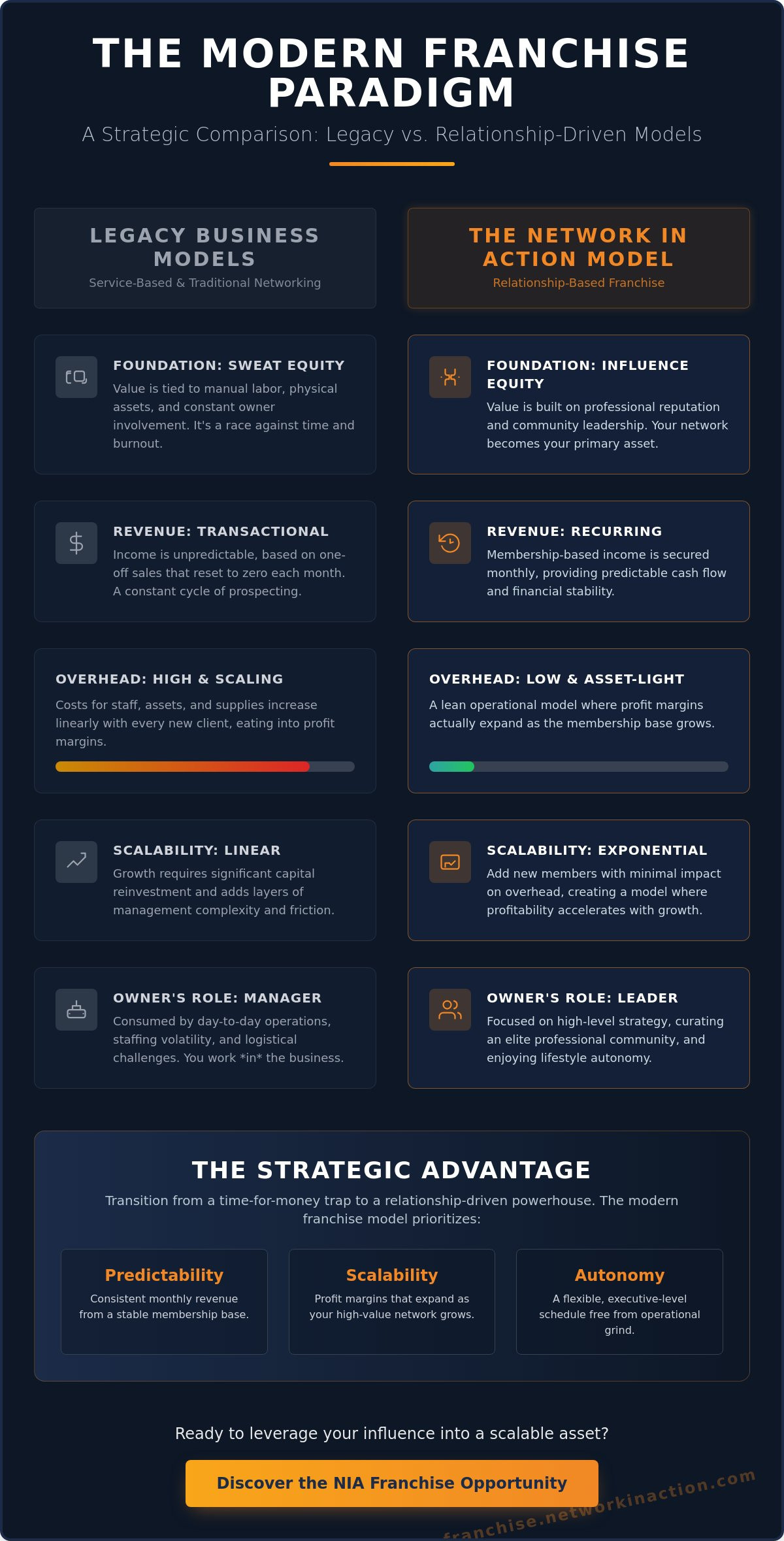
Transactional business is a hamster wheel. You sell, you deliver, you reset to zero. It's a legacy approach that drains executive energy and limits long-term growth. To understand What Are Recurring Revenue Franchise Models?, you must first recognize the shift from one-off sales to consistent, subscription-based income. In 2026, savvy investors are abandoning the "sweat equity" of traditional service franchises. They're moving toward models where income is secured by a membership base rather than a single, high-friction transaction. This isn't just a different way to bill; it's a different way to exist in the business world.
Revenue density is the new gold standard for the modern executive. It isn't about how much money passes through your hands; it's about how much stays there. High-volume, low-margin businesses like food or retail require massive staffing and physical assets that eat your profits. Modern recurring revenue franchise models flip this script. They prioritize high-margin, relationship-driven growth that rewards your professional influence. This is the foundation of Social Capital Franchising, a system where your network becomes your most valuable strategic asset. It's the next evolution of professional services, designed for those who value efficiency over activity.
The Three Pillars of Recurring Revenue
Successful franchises in 2026 aren't built on hope. They're built on systems that prioritize three specific outcomes:
- Predictability: Stop wondering where next month's revenue is coming from. A membership-based model ensures your capital hits the bank on the first of the month, every month.
- Scalability: Traditional models require more staff for every new client. In this model, you add members without a linear increase in overhead. Your profit margins actually expand as you grow.
- Retention: Community-driven loyalty beats contract-driven obligation. When members see a clear ROI, they don't just stay; they become advocates for your brand.
Why 2026 is the Year of the Membership Model
The economic environment has shifted. High-overhead retail is struggling under the weight of rising costs and staffing headaches. Investors now crave lean, asset-light models that rely on professional trust and technology. A recurring revenue franchise in professional networking is a strategic asset that transforms your social capital into a scalable, predictable income engine. It's the informed disruption the industry has needed for decades. By focusing on curated memberships rather than the forced referrals found in outdated networking models, you position yourself as a leader in a modernized ecosystem.
Service-Based vs. Relationship-Based Franchises: A Strategic Comparison
Most franchise discussions center on "sweat equity." These are the labor-intensive models. Cleaning crews. Repair vans. Junk removal. While these businesses offer demand, they also demand everything from the owner. You aren't just buying a business; you're buying a high-stakes management role in a volatile labor market. For the executive seeking recurring revenue franchise models, the goal is "influence equity." This shift moves the focus from managing manual labor to leveraging professional reputation. It's the difference between owning a fleet of trucks and owning a platform of professionals.
The margin gap between these two worlds is staggering. Traditional service models are buried under high overhead. Every new client requires more supplies, more fuel, and more hourly wages. Relationship-based models operate on a different logic. Your primary asset is your network. Your overhead remains lean while your membership base scales. This efficiency creates a higher take-home ROI because you aren't constantly feeding the operational beast. You can explore the executive business opportunities that prioritize this type of time freedom over the daily grind of traditional service management.
The Hidden Costs of Traditional Service Models
Labor-heavy industries face a constant battle with employee turnover. In 2026, finding and training reliable staff is more expensive than ever. Beyond payroll, you face equipment depreciation and the "truck roll" expense. Every time a vehicle leaves your lot, your profit margin shrinks. You're also trapped by geographic boundaries. Your growth is limited by how far your team can drive in a day. It's a rigid system that lacks the agility required for modern executive growth.
The Leverage of a Networking Franchise
Contrast that with a model that requires zero inventory. No warehouses. No fleet maintenance. A business networking franchise converts your existing social influence into a tangible, income-generating asset. You provide the structure and the technology; the members provide the value. The membership fees are high-margin because the value is intellectual and relational, not physical. This allows you to lead a community of high-level professionals from a home office or a co-working space. If you are ready to see where this model can take you, you should download the franchise kit to review the specific systems that drive this efficiency. It's a streamlined path to professional leadership that fits a modern, flexible lifestyle.
The Efficiency Gap: Why Legacy Networking Models Fail Modern Owners
The biggest objection to business networking isn't the cost. It's the clock. High-level executives and seasoned entrepreneurs are often skeptical because they view networking as a chronic time sink. This skepticism is well-founded. For decades, legacy networking organizations have relied on a model that demands weekly 7:00 AM meetings and mandatory attendance. It's a rigid, transactional approach that feels more like a second job than a strategic growth engine. When you evaluate recurring revenue franchise models, you must look at how they respect your calendar. Time is your only non-renewable resource. Spending it on outdated rituals is a poor investment.
The "Efficiency Gap" is the divide between the time you invest and the professional value you extract. In outdated networking models, you might spend ten hours a month in meetings just to receive one mediocre referral. That's a failing ROI. Modern owners don't have time for performative attendance. They need a system that prioritizes impact over presence. Results matter. Efficiency wins. If your business model requires you to babysit a room of people who are only there to avoid a penalty, you haven't built a business; you've built a liability. The modern executive demands a more sophisticated alternative.
The Problem with Forced Referrals
Traditional networking relies on artificial quotas. If you don't bring a referral, you're penalized. This "quantity over quality" mandate erodes professional credibility. High-level members don't want to be forced to pitch their colleagues' services to their own valued clients just to satisfy a weekly requirement. It's a psychological burden that drives the most successful professionals away. Executives are fleeing these environments in search of curated groups where relationships are built on genuine synergy, not mandatory quotas. In 2026, social capital is too valuable to squander on forced transactions. You want a community of leaders, not a room of desperate salespeople.
Technology: The Great Modernizer
Modern systems have moved beyond the manual tracking of the past. While legacy groups still use paper slips or clunky, outdated spreadsheets, the next evolution of this industry uses proprietary technology platforms to drive connection. These tools allow members to stay connected 24/7, sharing opportunities and insights in real-time. You no longer need to be physically present in a room every Tuesday morning to maintain your influence. Technology-led platforms eliminate the manual administrative busy work of traditional group leadership. This allows you to focus on high-level relationship building and strategic growth. By leveraging exclusive digital tools, you close the efficiency gap and maximize the return on your social capital. This is the informed disruption that turns a simple network into a high-performance recurring revenue franchise model.
Calculating the Real ROI: Metrics for a Relationship-Driven Franchise
Stop obsessing over the franchise fee. It's a distraction. Sophisticated investors focus on unit economics and yield. To evaluate recurring revenue franchise models, you must analyze the relationship between the Cost of Acquisition (CAC) and the Lifetime Value (LTV) of a member. In traditional models, you're constantly paying to find new customers. In a relationship-driven model, you acquire a member once and realize revenue for years. This is the definition of financial efficiency. Yield matters. Efficiency wins.
Speed to market is equally critical. The "90-Day Launch" protocol is designed for rapid revenue generation. It bypasses the months of construction, permitting, and staffing required by brick-and-mortar concepts. By leveraging a proven referral marketing strategy, you turn your existing professional capital into a cash-flowing asset almost immediately. Results are the only metric that count.
The Membership Economics of Professional Networking
Revenue density is the engine of growth. High-level networking groups offer a significant revenue-per-member ratio compared to low-cost social clubs. Because these groups are curated, retention rates are naturally higher. Members aren't just joining; they're investing in an exclusive ecosystem. As you scale, multi-group ownership creates a compounding effect. You manage the same technology platform, but you multiply your income streams without doubling your effort.
Lifestyle ROI: The "Monthly Meeting" Advantage
Monetary returns are only half the story. Lifestyle autonomy is the ultimate executive dividend. Contrast the 40-hour grind of a retail owner with the 4-hour meeting schedule of a modern network leader. You aren't tethered to a physical location. Proprietary technology keeps your community connected while you travel or work remotely. To see how these hours actually break down, you should download the franchise kit for a full operational overview. It's time to own a business that fits your life, not the other way around.
If you are ready to stop trading time for money and start building a scalable legacy, you can check available territories to see where your influence is needed most.
The Network In Action Evolution: Owning the Modern Referral Engine
Network In Action (NIA) represents the informed disruption of a stagnant industry. For decades, legacy networking organizations have relied on manual processes, rigid rules, and the hope that volume would eventually lead to value. They were wrong. NIA has solved the inherent flaws of these legacy systems by integrating a proprietary, technology-led platform into a traditionally manual space. This isn't just another networking group; it's one of the most sophisticated recurring revenue franchise models available in 2026. It replaces the "busy work" of outdated networking models with a streamlined engine designed specifically for the executive class.
The core of this evolution is the focus on quality over quantity. Modern professionals don't want to be part of a crowd; they want to be part of a curated community. NIA’s "No Forced Referrals" policy is a critical differentiator that protects your professional credibility. Instead of artificial quotas, the model relies on genuine synergy and high-level connection. This approach attracts high-level professional service providers who avoid the transactional nature of traditional groups. You aren't just selling a membership. You're leading a boardroom of local business experts. Results matter. Efficiency wins.
Why Executives Are Choosing NIA Over Legacy Brands
Success at the executive level requires a schedule that works. Traditional networking models demand weekly commitments that most busy leaders simply can't maintain. NIA utilizes a "Monthly Meeting" model that respects your time while maximizing your impact. This structure allows you to maintain professional prestige without the 40-hour grind of retail or service-based ownership. You lead the room. You facilitate the connections. You own the asset. This is Social Capital Franchising at its peak, providing a lifestyle-friendly business that rewards your influence and your expertise.
Next Steps: From Executive to Owner
Transitioning from a high-pressure corporate role to business ownership requires a strategic roadmap. You can start by evaluating available territories to secure your local market before it's gone. For those who want a deeper dive into the underlying networking science that makes this model so effective, you should request the free book to see the data for yourself. This is your opportunity to move beyond the time-for-money trap and secure a scalable, technology-backed income stream. Stop managing someone else's vision. Start leading your own professional community. Explore available NIA territories and start your transition to recurring revenue ownership today.
Secure Your Strategic Advantage
The era of trading time for money is over. You've seen how the shift toward relationship-driven growth eliminates the overhead and headaches of traditional service models. By focusing on influence equity and high-margin memberships, you can build a business that rewards your professional reputation while providing genuine lifestyle autonomy. Recurring revenue franchise models are no longer just an alternative; they're the modern standard for the executive class. Results matter. Efficiency wins. You have the capital and the network. Now, you need the system.
Since 2015, Network In Action has been redefining networking through a proprietary technology platform and a commitment to quality over quantity. With over 150 global locations, the system is proven, scalable, and built for measurable results. It's time to transition from managing a career to owning a professional community that scales with you. Alignment is the first step toward strategic ownership. Build your legacy on a foundation of trust and technology. Discover the NIA difference—download your free franchise kit today.
Frequently Asked Questions
What is the most profitable recurring revenue franchise model?
Relationship-based models typically outperform labor-heavy service franchises because they eliminate the high costs of staffing, equipment, and inventory. While home services are often marketed as high-demand, their margins are consistently squeezed by rising labor costs and operational friction. Professional networking represents one of the most efficient recurring revenue franchise models because it leverages your influence equity rather than manual labor or physical assets.
How does a networking franchise generate recurring revenue?
Revenue is generated through a membership-based subscription model where local business owners pay for access to a curated professional community. This creates a predictable monthly income stream that scales without the need for additional storefronts or vehicles. Unlike transactional businesses that reset to zero every month, this model compounds as you grow your groups and maintain high retention rates through technology-backed results.
Can I own a networking franchise while keeping my current executive role?
You can absolutely maintain your executive position while launching this type of franchise. The model is designed for high-level leaders who value time efficiency and want to build a secondary income stream. Because it utilizes a monthly meeting structure rather than the exhausting weekly requirements of outdated networking models, the time commitment is manageable for busy professionals seeking a strategic investment.
How is modern networking different from traditional networking organizations?
Modern networking prioritizes quality and efficiency over the rigid attendance and forced referral quotas of legacy networking organizations. Traditional groups often feel like a second job with their 7:00 AM weekly meetings and mandatory referral slips. Modern alternatives use proprietary technology to keep members connected 24/7, allowing for once-a-month meetings that focus on high-level strategy and genuine relationship building.
What kind of technology is used to manage a referral-based business?
Owners use proprietary technology platforms to automate the administrative busy work that plagues traditional group leadership. These digital tools track referrals, manage member engagement, and provide transparent ROI data to every participant. This tech-forward approach ensures your community remains active and connected between physical meetings, allowing you to scale your recurring revenue franchise models without increasing your personal workload.
What are the typical startup costs for a relationship-driven franchise?
Relationship-driven franchises are asset-light, meaning you avoid the massive capital expenditures associated with retail storefronts or service fleets. Costs focus on the franchise fee and initial marketing rather than equipment, leases, or inventory. This lower barrier to entry, combined with the lack of physical overhead, allows for a faster path to profitability compared to traditional brick-and-mortar investments that require years to recoup.
Is previous networking experience required to be a successful franchise owner?
You don't need prior networking experience; you need professional credibility and leadership skills. Successful owners are typically executives or consultants who already understand how to manage relationships and lead a room. The system provides the structure and the technology, so your primary role is to act as a community leader who facilitates high-level connections among other business owners.
How does the "no forced referral" policy impact the business model?
A "no forced referral" policy significantly increases member retention by protecting the professional integrity of every participant. In legacy organizations, the pressure to meet quotas leads to low-quality leads that frustrate high-level members. By removing this requirement, you attract a more sophisticated membership base that stays longer because they value the genuine, high-quality connections your group provides.