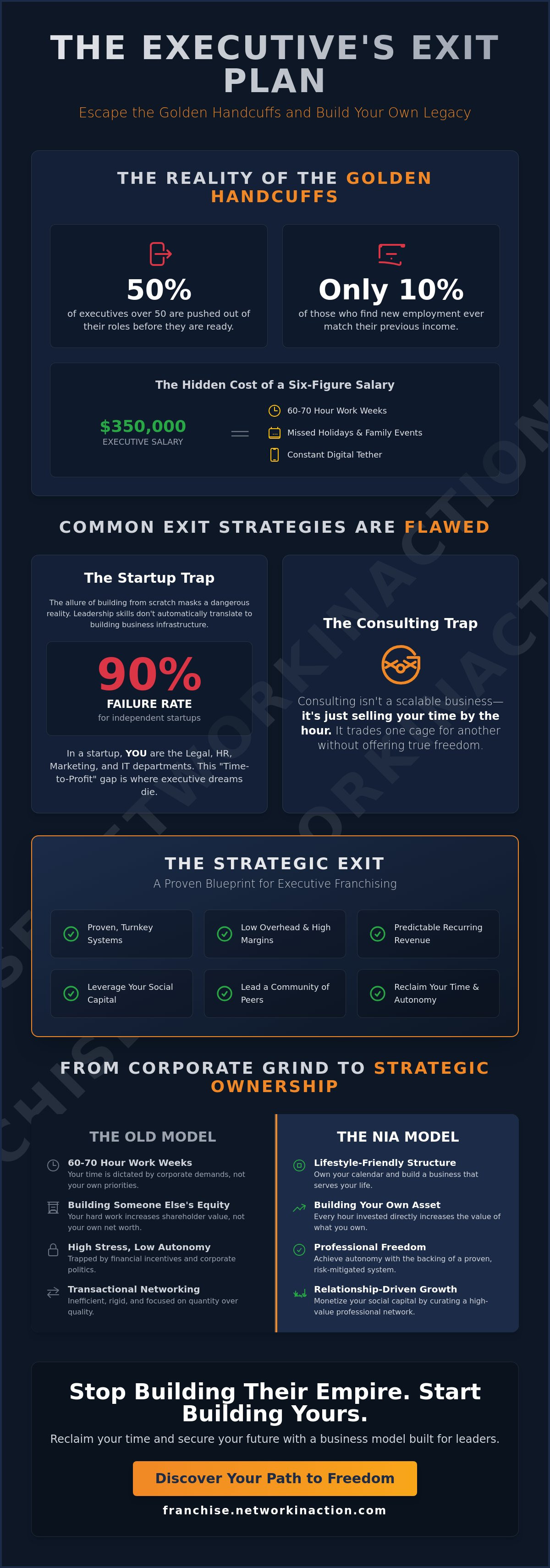
50% of corporate executives over age 50 are pushed out of their roles before they're ready, and only 10% of those who find new employment ever match their previous income. It's a sobering reality that makes the "golden handcuffs" feel more like a trap than a trophy. The fear of lifestyle creep making a pay cut feel impossible often keeps high-performers stuck in 60 hour work weeks. However, transitioning from corporate executive to franchise owner offers a path to reclaim your schedule without sacrificing your professional identity or your bank account.
Elite results. Proven systems. Professional freedom. This article provides a strategic, high-leverage exit plan to replace executive income with predictable recurring revenue. It's about moving beyond the inefficiency of legacy networking organizations and embracing a modern, tech-forward business model built for autonomy. Discover how to leverage years of leadership into a role that offers both massive impact and the time freedom you've earned.
Key Takeaways
- Identify the specific components of the "golden handcuffs" trap and learn why traditional executive security is a myth in the current corporate landscape.
- Master the process of transitioning from corporate executive to franchise owner by leveraging proven systems that eliminate the high failure rates associated with independent startups.
- Monetize your existing social capital by shifting from transactional, legacy networking organizations to a modernized, high-leverage referral model.
- Evaluate the financial metrics of service-based franchising to secure predictable recurring revenue and a streamlined path to professional autonomy.
- Reclaim your time with a lifestyle-friendly business structure that replaces 60-hour work weeks with efficient, technology-led community leadership.
Decoding the 2026 Golden Handcuffs: Why Executives Feel Trapped
High compensation isn't just a reward; it's a calculated retention tactic. The term Golden Handcuffs describes the financial incentives, such as deferred bonuses and stock options, that keep you anchored to a role that no longer fulfills you. In 2026, the corporate environment is more demanding than ever. "Quiet quitting" isn't an option for leadership. You're expected to be always on, always driving, and always delivering. It's a high-stakes game where the only prize is more work and less autonomy. The cycle of high pay and high stress creates a paradox where you're too successful to leave but too exhausted to stay.
The psychological block is often the greatest hurdle. High earners frequently fear a $0 starting point more than they fear another year of total burnout. You've spent decades building a professional identity and a reputation for excellence. Walking away feels like losing your status and starting from scratch. Consulting is the common fallback, but it's a trap. Consulting is just selling your time by the hour. It doesn't scale. It doesn't provide freedom. Transitioning from corporate executive to franchise owner is the only way to pivot your skills into a scalable, high-value asset without the risks of an unproven startup.
The Hidden Cost of the Six-Figure Payday
Break down the numbers. A $350,000 salary sounds impressive until you factor in the 70-hour weeks, the missed holidays, and the constant digital tether. Your true hourly rate is likely lower than a mid-level manager with a genuine work-life balance. Sustained stress has a compounding effect on your health and family dynamics. Corporate bonuses are fleeting and taxed heavily. Equity ownership is permanent. You're currently building a legacy for a board of directors that sees you as a line item. It's time to build one for yourself. Transitioning from corporate executive to franchise owner allows you to redirect that same intensity into an asset you actually own.
Why Lifestyle Creep is Your Biggest Obstacle
Your salary has likely dictated your spending. High fixed expenses create a cage that prevents significant career pivots. This is the difference between being rich and being wealthy. High income is temporary and dependent on your daily presence; owned assets are durable and provide long-term leverage. Moving from an employee mindset to an owner mindset requires a total shift in perspective. You must stop chasing the next promotion and start chasing the next acquisition. This transition provides the structure to make this shift while maintaining your professional status and your income requirements. It allows you to own the system rather than being a cog in it.
Strategic Exit: Startup Risks vs. Executive Franchising
Ninety percent of independent startups fail. That isn't just a statistic. It's a warning. For an executive seeking a "second act," the allure of building something from scratch often masks a dangerous reality. You've spent decades managing complex systems and leading high-level teams, not sourcing office furniture or troubleshooting basic IT infrastructure. Why waste your most valuable years building the engine when you can buy a proven one? Franchising provides the blueprint. It eliminates the experimental phase. When making the decision to franchise, you're choosing to skip the trial-and-error that sinks most independent ventures and move directly into a role of leadership and execution.
Service-based models win every time. Low overhead. High margins. No inventory headaches. Transitioning from corporate executive to franchise owner in a professional services sector allows you to leverage your existing social capital immediately. You aren't flipping burgers or managing retail staff. You're leading a community of business owners. This is the Executive Franchise concept. It's a business designed to be led by a visionary, not just operated by a manager. It offers a turnkey system that facilitates a fast, clean transition out of the corporate world without the three-year ramp-up period typical of independent startups.
The Startup Trap for Former Executives
Leadership is not the same as infrastructure. In the C-suite, you have departments for legal, HR, and marketing. In a startup, you are those departments. This "Time-to-Profit" gap is where most executive dreams die. You cannot afford to wait years for a return on your capital. Buying a proven model is the smartest use of your investment. It mitigates risk by providing a pre-built operational framework. It respects your time. It ensures that transitioning from corporate executive to franchise owner is a strategic move, not a desperate gamble. Focus on scaling, not building the foundation.
Identifying High-ROI Executive Business Opportunities
A 2026-ready business must meet three criteria: recurring revenue, low overhead, and extreme scalability. Professional services franchises are the elite choice for retiring leaders because they value relationships over physical assets. You can explore the executive business opportunities available today to see how these modernized models differ from legacy industry standards. This is about redeploying your skills into a high-leverage asset that works for you. If you're ready to analyze the data behind a successful transition, you might download a franchise kit to review the specific systems that drive this recurring revenue model.
Monetizing Social Capital: The Power of Owning the Network
Social capital is the most valuable asset on your balance sheet. After decades in the C-suite, your professional network isn't just a list of contacts. It's a high-leverage engine for growth. Most executives leave their roles and let this asset wither away. They treat their connections as a memory rather than a tool. Transitioning from corporate executive to franchise owner allows you to monetize that reputation. You aren't just starting a business. You're deploying years of credibility into a system designed to scale. Real wealth isn't found in your next salary; it's found in the network you control.
Legacy networking organizations are failing the modern professional. They rely on outdated networking models that prioritize quantity over quality. These groups often force referrals, leading to low-value introductions and transactional relationships. It's a rigid, time-consuming process that feels more like a chore than a strategic advantage. Network In Action represents the next evolution of the industry. It's a modern, technology-led approach that focuses on curated, high-quality relationships. This shift from forced participation to intentional connection is the key to maintaining your professional influence while building a profitable enterprise. When reviewing the FTC’s guide to buying a franchise, the importance of choosing a model that aligns with your specific skill set becomes clear. For an executive, that skill is leadership through connection.
Owning the Network vs. Participating in It
There is a massive financial difference between joining a group and owning the platform. When you participate, you're a customer. When you own, you're the connector. You become the epicenter of your local business community. This position of authority allows you to build a business around your existing credibility rather than cold prospecting or high-pressure sales. By investing in a business networking franchise, you convert your social capital into a recurring revenue stream. You stop asking for business and start facilitating it. It’s a move from a participant mindset to a leadership mindset.
Modernizing the Referral Marketing Strategy
Traditional, weekly meeting models are inefficient for high-level leaders. You don't have time for fluff. The NIA difference is built on efficiency and results. We utilize monthly high-impact meetings and proprietary technology platforms to keep members connected without the "busy work" of legacy networking organizations. This streamlined referral marketing strategy ensures maximum ROI for your members and total lifestyle freedom for you. It’s about leveraging technology to drive growth while you focus on the high-level community leadership you’ve already mastered throughout your career. Transitioning from corporate executive to franchise owner has never been more efficient.
The Financial Blueprint: Replacing a Salary with Recurring Revenue
Executives think in ROI. Transitioning from corporate executive to franchise owner is not a career change. It's a strategic asset allocation. Your goal is to replace a volatile C-suite salary with predictable, recurring revenue. This requires a shift from chasing annual bonuses to building a monthly cash flow engine. In a service-based networking model, your primary revenue comes from membership dues paid by the business owners in your groups. Because these models lack the heavy inventory or retail overhead of traditional franchises, your path to profitability is significantly shorter. Low overhead. High margins. This is the financial formula for professional autonomy.
Calculating your breakeven point is the first step in your due diligence. In a professional services franchise, this usually involves a simple ratio of active members to fixed operating costs. Funding your transition often involves leveraging executive savings or utilizing 401(k) rollovers through specialized financial structures. With SBA 7(a) variable rates hovering between 9.0% and 11.5% in June 2026, many savvy investors prefer using their own capital to maintain higher equity. The objective is to build a self-sustaining ecosystem where your social capital does the heavy lifting, allowing you to focus on high-level leadership rather than daily operations.
Modeling a Professional Networking Business
Operating costs in this sector are lean. You don't need a 10 year lease or a fleet of vehicles. Your primary investment is the franchise fee and your time. The NIA financial model is a high-margin executive asset designed for maximum efficiency. Scalability comes from territory expansion. Once you've mastered one group, the system is designed to be replicated across multiple territories. This allows you to build a regional empire rather than just replacing one job with another. To begin your financial analysis, you should download a franchise kit to review the specific unit economics.
Due Diligence for High-Level Investors
Your expertise in risk management is your greatest advantage. When reviewing a Franchise Disclosure Document (FDD), focus on the transparency of the support systems and the historical performance of existing owners. Territory exclusivity is a non-negotiable requirement in 2026’s competitive market. You need a protected space to grow your influence without internal competition. Outdated networking models often lack this protection, leading to saturated markets and diluted value. Before committing capital, it's essential to view available territories to assess the local market potential in your region. Transitioning from corporate executive to franchise owner requires a clear view of the competitive landscape and a proven system for capturing it.
The Network In Action Escape: A Turnkey Solution
Network In Action (NIA) is the next evolution of the networking industry. It's a technology-led system designed specifically for high-level leaders who are finished with the corporate grind but not with professional impact. Transitioning from corporate executive to franchise owner is a strategic move that requires a model as sophisticated as your previous career. Outdated networking models rely on manual, volunteer-led processes that are rigid and transactional. NIA disrupts this status quo by offering a streamlined, professional alternative that prioritizes quality over quality. It's a modern solution for those who value efficiency and results above all else.
The primary differentiator is the lifestyle-friendly structure. While legacy networking organizations demand weekly 7 AM commitments, NIA operates on a high-impact, monthly meeting model. This respects your time. It allows you to lead a community of elite business owners without becoming a slave to a calendar. You aren't managing forced referrals or tracking attendance manually. Instead, you're facilitating high-level connections that drive measurable ROI for your members. It's a shift from the administrative burden of traditional networking to a role of visionary community leadership. You provide the structure; the technology handles the noise.
Technology as the Great Liberator
Digital tools are the engine behind the NIA model. Our proprietary technology platform automates the grind of member management, referral tracking, and group communication. This is the business-in-a-box solution that executives value. It provides a consistent income stream with minimal manual labor. While outdated networking models struggle with manual data entry and inefficient communication, NIA owners use technology to scale their influence. This tech-forward approach ensures that your time is spent on high-leverage activities like relationship building and territory growth rather than administrative tasks. It's the ultimate tool for maintaining a high professional status with a fraction of the traditional workload.
Your Next Step Toward Autonomy
The path to professional freedom is structured and predictable. The transition process moves you from initial licensing to launching your first curated group with full support and a proven blueprint. This isn't a high-pressure sales pitch; it's an invitation to a more sophisticated way of doing business. Transitioning from corporate executive to franchise owner with NIA means you own the platform, the technology, and the recurring revenue. You are the connector. You are the authority. You are the leader of a community that values your expertise. You're no longer building someone else's dream; you're scaling your own asset.
The only thing more valuable than your corporate salary is your freedom. If you're ready to explore a strategic exit that preserves your professional status while granting you time autonomy, it's time to analyze the data. You should download the franchise kit for a deep dive into the systems, metrics, and territories available in 2026. Stop selling your time to a corporation and start owning a network that works for you. Your next act starts with a single strategic decision.
Reclaim Your Professional Autonomy
The corporate cage only feels secure until you realize the door has been unlocked all along. You've analyzed the inherent risks of independent startups and the deep inefficiency of legacy networking organizations. Now it's time to act. By leveraging your years of C-suite experience and deploying a proprietary technology platform built for member ROI, you can secure your financial future without the 70-hour work weeks. Transitioning from corporate executive to franchise owner isn't just about a career change. It's about a total lifestyle redesign.
Network In Action offers a proven system with over 150 locations worldwide and a monthly meeting model specifically designed for executive lifestyles. You don't have to choose between professional impact and personal freedom. The infrastructure is ready. The technology is active. The community is waiting for your leadership. Take the first step toward freedom. Download your NIA Franchise Kit today and discover how to monetize your network while reclaiming your time. The next evolution of your career starts now.
Frequently Asked Questions
What are golden handcuffs in a corporate setting?
Golden handcuffs are financial incentives like high salaries, deferred bonuses, and stock options designed to keep executives tethered to their roles. These rewards make the perceived cost of leaving higher than the actual cost of burnout. In 2026, this trap is often compounded by lifestyle creep, where high fixed expenses create a salary cage that prevents meaningful career pivots.
How much does a networking franchise owner typically earn?
Earnings for a networking franchise owner depend on membership volume and the number of territories managed. Because the model operates with low overhead and high margins, owners retain a significant percentage of revenue compared to retail or food franchises. Success is driven by your ability to leverage social capital and provide measurable ROI to members through curated professional relationships.
Can I start a franchise while still working my corporate job?
Yes, many high-level professionals begin transitioning from corporate executive to franchise owner while still in their current roles. The monthly meeting model and proprietary tech platform are designed for maximum efficiency, allowing you to build your foundation without a 60 hour weekly commitment. This strategy provides a strategic bridge from salary dependency to business ownership and autonomy.
How do I know if I am ready to be an entrepreneur?
You are ready when you prioritize owning a scalable asset over receiving a bi-weekly paycheck. If you have mastered high-level leadership and possess a deep professional network, you already have the core components for success. Most executives find that the structure of a franchise provides the necessary guardrails to move from employee to owner without the chaos of a startup.
What is the difference between NIA and traditional networking organizations?
The primary difference lies in the quality of relationships and the efficiency of the model. Traditional networking organizations often rely on rigid, weekly meetings and forced referrals that prioritize quantity over actual results. NIA utilizes a monthly meeting model and exclusive digital tools to curate high-quality connections. We eliminate the busy work of legacy networking organizations to focus on member ROI.
How much capital is required to escape the golden handcuffs via franchising?
Capital requirements vary based on territory scale and specific business models. Beyond the initial franchise fee, you should account for operational runway and industry costs. SBA 7(a) variable rates in June 2026 are approximately 9.0% to 11.5%, and many executives utilize 401(k) rollovers to fund their exit. This allows for a strategic deployment of capital into a high-leverage business asset.
What skills from my corporate career will transfer to NIA ownership?
Your experience in P&L management, strategic leadership, and community building translates directly to NIA ownership. As an executive, you already know how to identify talent and facilitate high-level partnerships. NIA provides the turnkey system. You provide the professional credibility and the ability to lead a community of local business owners toward shared growth and recurring revenue.
Is a networking business recession-proof in 2026?
Networking businesses are historically resilient because professional connections become more critical during economic shifts. In 2026, business owners are seeking efficient ways to grow without the high cost of traditional advertising. A relationship-driven model provides a consistent, low-cost lead source. This makes it an essential service for businesses navigating market volatility and ensures transitioning from corporate executive to franchise owner is a durable move.