What if the next evolution of your career didn't require sacrificing your weekends or your sanity? Most high-level professionals are exhausted by the corporate grind, yet they hesitate to pivot because they fear buying a "low-paying job" instead of a true asset. It's a valid concern. Legacy networking organizations still rely on rigid, time-consuming manual processes that offer zero efficiency for the modern executive. High effort. Low return.
Creating a semi-passive income stream with a franchise is now a strategic reality for those who leverage modern systems. You can achieve elite professional status and scalable financial growth without the constant time sacrifice. This guide reveals how proprietary technology and sophisticated structures deliver lifestyle autonomy and recurring revenue. The approach moves beyond outdated, transactional methods to focus on high-ROI results. You'll discover how to transition from a manual operator to a visionary leader by using a model built for the 2026 economy. Proven systems. Measured growth.
Key Takeaways
- Learn how to move beyond the owner-operator trap by creating a semi-passive income stream with a franchise that prioritizes system-driven oversight over manual labor.
- Discover why professional service models offer superior ROI compared to brick-and-mortar franchises by eliminating high overhead and the complexities of managing hourly staff.
- Master the transition to a high-efficiency schedule where monthly meeting structures replace the rigid, time-consuming requirements of legacy networking organizations.
- Leverage proprietary technology and automated platforms to maintain professional credibility and community leadership with as little as five hours of weekly commitment.
- Build a scalable asset that delivers lifestyle autonomy through recurring revenue and a curated, high-quality membership base.
The Reality of Semi-Passive Income in the 2026 Franchise Market
Semi-passive income isn't a corporate fairy tale; it's a structural choice. In 2026, creating a semi-passive income stream with a franchise means moving away from the manual labor of the past and toward high-efficiency oversight. This specific model requires an investment of 5 to 20 hours of weekly management. It's a sharp departure from the "owner-operator" trap. Many professionals buy a business only to become its most overworked, underpaid employee. They don't own a business. The business owns them. True semi-passive ownership uses systems to replace the owner's physical presence, turning the franchise business model into a sophisticated wealth-building engine rather than a time-intensive job.
High-level professionals are increasingly pivoting toward executive business opportunities that prioritize social capital over physical assets. In 2026, social capital is the primary revenue driver. Your influence, your connections, and your ability to curate professional communities are more valuable than inventory or real estate. This shift allows for a leaner operation with higher margins. It moves the needle from "selling hours" to "leveraging networks."
- System-Driven: Technology handles the logistics. You handle the strategy.
- Scalable: Growth doesn't require a linear increase in your time.
- Asset-Focused: You are building a sellable entity, not just a paycheck.
The Myth of the Hands-Off Investment
No franchise is 100% passive from the first hour. Achieving long-term autonomy requires "front-loading" your effort. You must establish the culture, vet the initial members, and master the proprietary tools. Strategic ownership is different from absentee management. An absentee owner is disconnected and vulnerable. A strategic owner is efficient and informed. You don't need to be in the room to lead the room, but you do need the systems in place to ensure the room runs without you. Success in creating a semi-passive income stream with a franchise depends on this initial discipline.
Why Legacy Networking Organizations Fail the Efficiency Test
Traditional networking models are fundamentally broken for the modern executive. They rely on rigid, transactional structures that demand exhausting weekly commitments. These outdated networking models prioritize attendance over results, leading to a massive burnout factor. When a business model requires you to spend 20 hours a week on "administrative fluff" and forced referrals, it's no longer a semi-passive investment. It's a burden. Modern alternatives solve this by stripping away the inefficiency. They replace the "leading brand's" dated manual processes with streamlined, technology-led solutions. Results matter. Busy work doesn't.
Evaluating Franchise Models for Lifestyle Autonomy
Not all franchises are created equal. Some are just high-priced jobs disguised as investments. If a model demands 60 hours of your time just to keep the lights on, it isn't an investment; it's a burden. When creating a semi-passive income stream with a franchise, you must look for three non-negotiables: recurring revenue, minimal overhead, and systems that scale. Many traditional franchise models, such as entertainment centers or retail outlets, suffer from massive fixed costs and staffing nightmares that tether you to the location. In contrast, professional service models leverage your existing social capital to generate high-margin returns. Low drag. High velocity.
Before committing, smart investors utilize the Federal Trade Commission's Franchise Rule to perform rigorous due diligence on potential partners. This legal transparency is vital when building a business that supports your professional credibility. A solid referral marketing strategy serves as the bedrock of this model, turning trust into a tangible financial asset. To see the specific mechanics of how this works, you can download the franchise kit and analyze the system for yourself. It's about working smarter, not harder.
Recurring Revenue vs. One-Time Sales
Membership-based models are the gold standard for semi-passive income. In a transactional business, you start every month at zero. You're only as good as your last sale. This creates a high-pressure environment that requires constant owner intervention to drive new leads. A membership model provides predictable, recurring dues. It builds a floor under your income. This stability allows you to focus on high-level strategy rather than daily survival. It's the difference between hunting for every meal and owning the farm. Predictability is power.
The Technology Multiplier
Modern systems have eliminated the need for a large administrative staff. Technology is the ultimate multiplier. Proprietary software can now handle member engagement, referral tracking, and automated reporting. This "tech-first" approach means you aren't managing people; you're managing a platform. Automated dashboards provide a 30,000-foot view of your business performance in minutes. This is how you maintain oversight without getting bogged down in the weeds. Efficiency is the key to autonomy. It's the only way to succeed when creating a semi-passive income stream with a franchise that actually respects your time.
If you're ready to move beyond outdated networking models, exploring available territories is the first step toward a more sophisticated business model.
Professional Services vs. Brick-and-Mortar: The Efficiency Gap
Conventional wisdom often suggests that semi-passive income requires a physical asset. You've heard the pitch: buy a retail space, hire a manager, and wait for the checks. This is a legacy mindset that ignores the massive overhead and staffing headaches inherent in physical locations. Brick-and-mortar operations are anchored by high capital expenditures, property maintenance, and complex regulatory hurdles. Creating a semi-passive income stream with a franchise in 2026 is far more efficient when you remove the walls. Professional service models represent the next evolution of ownership, prioritizing social capital over real estate.
The "Staffing Headache" is the primary killer of lifestyle autonomy in traditional business. Managing hourly labor involves high turnover, constant training, and the endless drama of shift scheduling. In contrast, a business networking franchise positions you to lead professionals rather than manage employees. You are dealing with peers, executives, and business owners who are self-motivated and results-oriented. While many semi-absentee franchise models still rely on physical storefronts, the most sophisticated investors are moving toward asset-light structures. Less friction. More freedom.
Overhead and Margin Analysis
Net profit margins soar when you delete rent, utilities, and property insurance from your balance sheet. Service-based models operate with surgical precision. You can run an entire territory from a home office or a high-end co-working space. This flexibility doesn't just save money; it accelerates your speed-to-market. You don't have to wait months for construction permits or equipment deliveries. You can launch in weeks. When your primary costs are technology and marketing, every new member contributes directly to your bottom line. High margins. Low drag.
Scalability without Physical Constraints
Physical locations have a ceiling. To grow a retail franchise, you must build another store, sign another lease, and double your staffing problems. Service models offer a different path. One owner can manage multiple networking territories by leveraging the same technology and systems. Scalability is built into the framework. You can expand your influence across an entire region without ever laying a brick. If you're an ambitious entrepreneur, you should check available territories to see how quickly you can scale your footprint. The territory advantage is real. It's about owning the market, not the building.
This asset-light approach ensures that your time is spent on high-value leadership rather than fixing broken equipment or managing inventory. It's the most logical path for any executive seeking true financial autonomy.
Implementing the 5-Hour Work Week: System-Driven Ownership
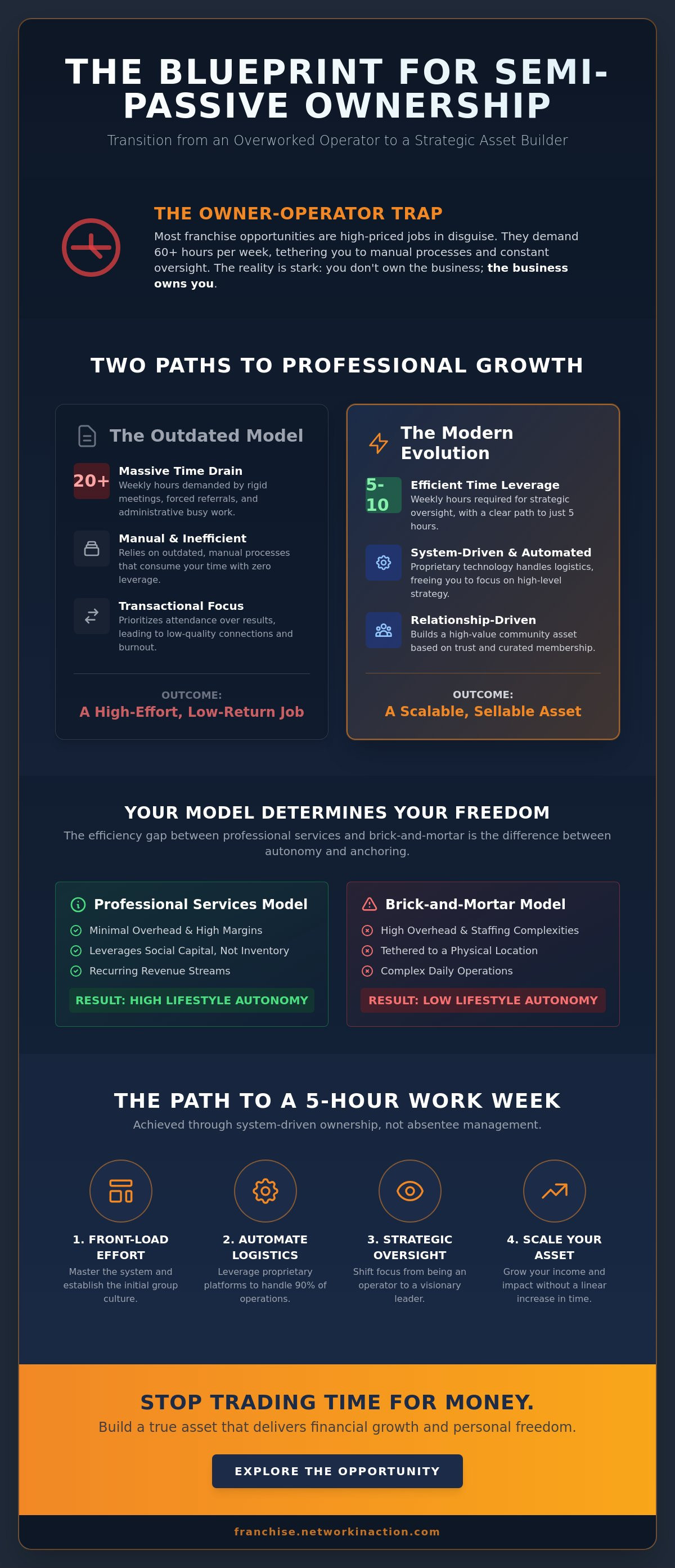
Five hours. That's the benchmark for a mature territory. Creating a semi-passive income stream with a franchise isn't about doing less work; it's about doing only the work that moves the needle. While legacy networking organizations trap owners in a 15-hour weekly cycle of administrative "busy work" and mandatory attendance, a modern system-driven model cuts through the noise. You aren't a sales manager breathing down the necks of your members. You are a community leader. You curate the room, set the strategy, and let the technology handle the heavy lifting. Efficiency realized. Autonomy achieved.
The transition from a high-energy launch to a semi-passive maintenance phase follows a clear, three-step framework. First, you front-load your effort to seed the group with high-caliber professionals. Second, you implement the proprietary tech platform to automate member communication. Third, you shift your focus to strategic oversight. Your weekly schedule becomes a lean, high-impact routine: 90 minutes for the monthly meeting, two hours for member vetting, and a final hour for strategic growth. This is how you leverage your network for financial gain without tethering yourself to a desk. It's the ultimate executive pivot.
Leveraging Monthly Meeting Efficiency
The "Monthly Meeting" revolution is the core differentiator of the NIA model. Outdated networking models demand weekly attendance, which inevitably leads to member fatigue and low-quality interactions. High-level executives don't have time for weekly coffee. They want high-density ROI. By meeting once a month, you increase the value of every minute spent in the room. This curated approach naturally reduces member churn because it respects their time. When members see consistent results without the burden of a rigid weekly schedule, they stay. Retention is the key to recurring revenue. High quality. Low friction.
Automating the Referral Engine
Traditional groups suffer from the "forced referrals" problem, where members pass low-value leads just to hit a quota. It's transactional and inefficient. Modern systems replace this with a "Referral-on-Demand" engine that runs 24/7. Proprietary software tracks connections and facilitates introductions without your direct intervention. This technology ensures that the networking continues even when you aren't working. To understand the psychology behind these high-trust connections, you can download the free book that outlines the future of referral dynamics. It's a blueprint for a more sophisticated way to grow.
If you're ready to see how these systems integrate into a scalable business, you should download the franchise kit to review the full operational breakdown.
Network In Action: The Modern Evolution of Semi-Passive Ownership
Success in 2026 requires a clean break from legacy systems. Network In Action (NIA) represents the premier choice for creating a semi-passive income stream with a franchise because it was engineered to solve the inherent flaws of traditional networking. While legacy networking organizations remain tethered to manual processes and rigid, time-consuming attendance rules, NIA leverages a tech-forward approach designed for the modern executive. It's a sophisticated move for those who value time as their most precious asset. You aren't just buying a business; you're investing in a streamlined engine of professional influence. Efficiency is the standard. Results are the focus.
The core differentiators are clear and uncompromising. By eliminating forced referrals and replacing weekly coffee meetings with high-impact monthly sessions, NIA respects the schedules of high-level professionals. This structure ensures that your community remains curated and high-quality, naturally driving a higher ROI for every member. You lead the room. The system handles the grind. It's a lifestyle-friendly business model that allows for significant financial returns without the exhausting weekly commitment required by outdated networking models. Proven systems. Measured growth.
The NIA Technology Ecosystem
Technology is the differentiator that makes semi-passive ownership a reality. The NIA internal platform functions as a digital nerve center, connecting members and tracking ROI automatically. This proprietary app reduces your administrative burden to near zero by automating the tracking of referrals and facilitating member engagement. It's a prime example of informed disruption in an industry that has remained stagnant for decades. You have total visibility into your business performance through data-driven dashboards, allowing you to manage multiple territories with surgical precision. Tech-led. Growth-oriented.
Building Your Professional Legacy
Ownership offers more than just recurring revenue. It places you at the center of a high-level business network, boosting your professional credibility and social capital. This model creates a tangible, exit-ready asset that grows in value as your community strengthens. You're building a legacy of influence that pays dividends long after the initial setup. To understand the full scope of this strategic opportunity, you should explore the franchise kit and see how the numbers align with your financial goals. Invest in yourself. Lead your community. Secure your future.
The Future of Executive Ownership
You've seen the shift. Outdated networking models are failing because they refuse to evolve. True lifestyle autonomy in 2026 comes from replacing manual management with high-efficiency systems and social capital. By choosing an asset-light model, you bypass the overhead of physical locations and the turnover of hourly staff. You transition from a manager to a community leader. Leadership redefined. Wealth secured.
NIA has perfected this blueprint. With 150+ locations globally and a proprietary technology platform, the system is built for scale. The monthly meeting model ensures maximum efficiency for you and your members. Creating a semi-passive income stream with a franchise is no longer a distant goal; it's a strategic move for the modern executive. It's time to leverage your network and build an asset that respects your time. Systems run. Profits grow.
Explore the NIA Franchise Opportunity Today and align your career with your lifestyle goals. The next evolution of your professional journey starts here.
Frequently Asked Questions
What is the definition of semi-passive franchise income?
Semi-passive franchise income is revenue generated through a business system where the owner provides strategic oversight rather than daily operational labor. This model typically requires an investment of 5 to 20 hours per week. It relies on automated technology and proven systems to manage the logistics while you focus on high-level community leadership. It's about owning an asset that produces results without consuming your entire schedule.
How many hours a week does a Network In Action franchise owner work?
A mature territory typically requires approximately five hours of weekly commitment. While you will invest more time during the initial launch phase to curate the membership and seed the group, the workload drops significantly once the systems are in place. The monthly meeting structure and proprietary tech platform allow you to maintain professional credibility without the burnout associated with traditional networking. Efficiency is the standard.
Can I keep my full-time job while running a networking franchise?
Yes, the NIA model is specifically engineered for high-level professionals and executives who want to maintain their current roles. Because the system replaces the exhausting weekly requirements of outdated networking models with a high-impact monthly schedule, it fits into a corporate calendar with ease. You can build a scalable income stream while continuing to lead in your primary industry. You own the business; it doesn't own you.
How does NIA technology reduce the owner workload compared to legacy models?
NIA technology replaces the manual administrative tasks that make legacy networking organizations so time-consuming. The proprietary platform automates referral tracking, member ROI reporting, and engagement notifications. Traditional models require owners to spend hours on paperwork and forced referral logs. NIA's tech-first approach eliminates this "busy work," allowing you to manage your territory through a streamlined digital dashboard. Technology handles the grind.
Is a networking franchise better than a brick-and-mortar franchise for passive income?
Professional service models are far more efficient for creating a semi-passive income stream with a franchise than physical retail or entertainment centers. Brick-and-mortar franchises are anchored by high rent, property maintenance, and the constant headache of managing hourly labor. A networking franchise is asset-light and focuses on leading professionals rather than managing employees. Higher margins. Lower risk. Total flexibility.
What kind of recurring revenue can a professional networking business generate?
The model generates predictable, membership-based recurring revenue that provides financial stability. Transactional businesses force you to start every month at zero, requiring constant sales pressure. In contrast, a networking franchise builds a floor of consistent monthly dues. This predictability allows you to focus on strategic growth and territory expansion rather than daily survival. It's a scalable asset built on long-term professional relationships.
Do I need a background in sales to own a networking franchise?
A background in corporate leadership, executive management, or community building is the ideal foundation. You are not a high-pressure salesperson; you are a curator of elite professional talent. Success in this model comes from leveraging your existing social capital and facilitating high-value connections. If you have the professional credibility to lead a room, the NIA systems and technology will handle the operational logistics. Leadership matters most.
What are the main risks of semi-passive franchise ownership?
The primary risk is failing to front-load the necessary effort during the initial group setup. No franchise is 100% passive from day one. You must be disciplined in vetting the right members and establishing a results-oriented culture during the first few months. Neglecting the proprietary systems or failing to use the provided technology can lead to member churn. The system is designed for autonomy, but it requires a strategic owner to launch it correctly.