Most executives view a 200-page legal filing as a bureaucratic hurdle. Visionaries see it as a diagnostic tool. Mastering the art of understanding the franchise disclosure document is the critical difference between buying a job and investing in a high-leverage, scalable asset. In a market saturated with legacy networking organizations and outdated business models, your ability to dissect this document determines your future ROI. Efficiency matters. Results count. Proven systems. Maximum leverage.
You've likely felt the frustration of marketing claims that don't align with reality. It's easy to feel overwhelmed by legal jargon or the fear of hidden fees buried in inefficient, manual systems. This executive guide changes that. You'll learn to identify red flags quickly and decode the true financial commitment of any opportunity. This analysis explores how to align a business model with your lifestyle goals, ensuring you move toward a modern, technology-led solution that prioritizes curated quality and professional credibility over forced referrals and rigid, transactional structures.
Key Takeaways
- Transform the FDD from a legal hurdle into a strategic roadmap for growth. Use the mandated review period to validate transparency and ensure a data-driven investment decision.
- Prioritize high-impact financial data by mastering the art of understanding the franchise disclosure document, specifically focusing on Items 7, 19, and 20 to verify real-world profitability.
- Detect the "time tax" and hidden inefficiencies of legacy networking organizations before you commit. Modern systems prioritize curated quality over the rigid, transactional requirements found in outdated models.
- Identify critical red flags by scrutinizing litigation history and corporate stability. Use these metrics to separate unstable ventures from high-leverage opportunities that align with your professional standards.
- Leverage low-overhead, technology-enabled platforms to achieve lifestyle autonomy. Choose a model that replaces manual prospecting with elite community leadership and recurring revenue streams.
Beyond the Paperwork: Why the FDD is Your Strategic Blueprint
Stop viewing the Franchise Disclosure Document (FDD) as a pile of paperwork. It is a transparency instrument. It is a competitive intelligence tool. For the executive investor, understanding the franchise disclosure document is about auditing operational maturity. You aren't just looking for rules; you're looking for the systems that drive ROI. Legacy networking organizations often rely on manual, outdated processes. A modern FDD exposes these inefficiencies before you write a check. It reveals the franchisor's track record, the health of the network, and the true cost of entry. High-energy growth. Proven results. Maximum impact.
The 14-Day Rule: Your Window for Due Diligence
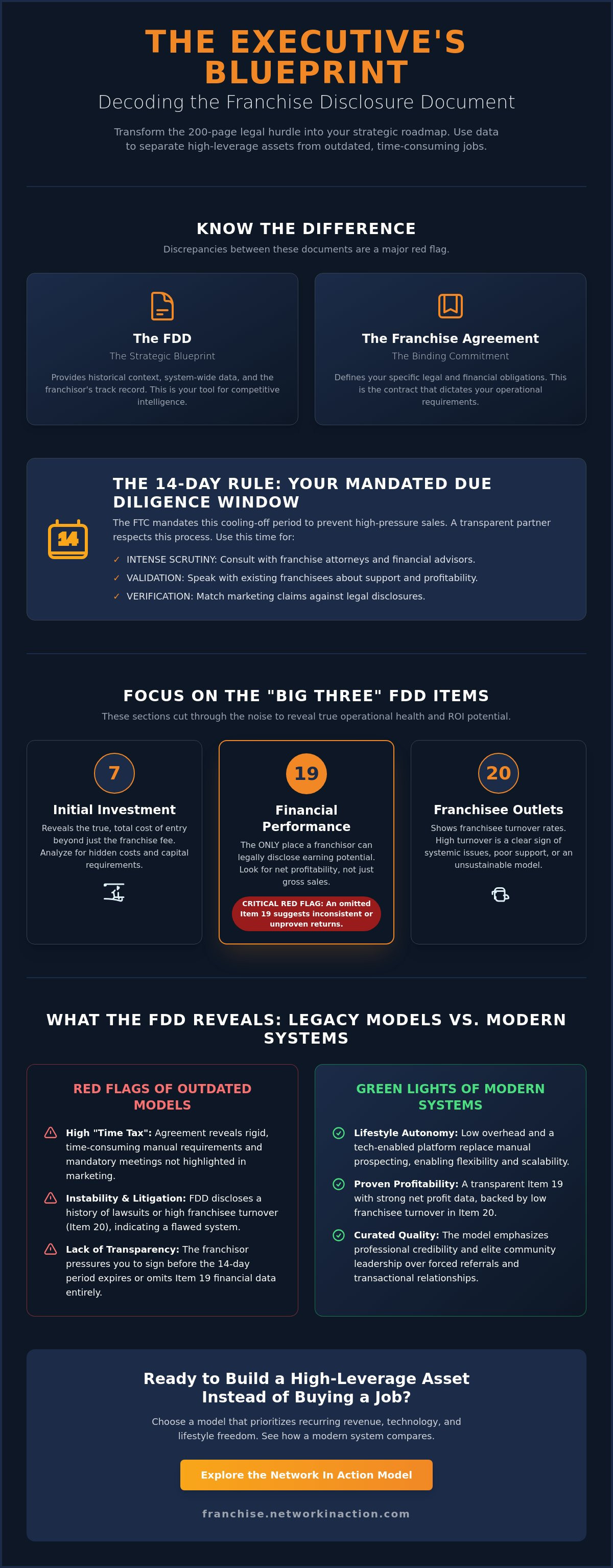
The Federal Trade Commission (FTC) mandates a 14-day review period. This isn't a suggestion. It's a mandatory cooling-off period designed to prevent high-pressure sales tactics. Sophisticated entrepreneurs value this time. They don't rush. They use these two weeks to consult with franchise attorneys and financial advisors. It's a period for intense scrutiny. You're verifying marketing claims against legal disclosures. If a franchisor pushes you to sign sooner, walk away. That's a legacy move. Modern, transparent models respect the process. Use this window to speak with existing franchisees. Validate the support structure. Confirm the scalability. This is where you separate marketing fluff from business logic. Elite leadership. Strategic patience.
FDD vs. Franchise Agreement: Know the Difference
The FDD is the history and the rules. The Franchise Agreement is the binding commitment. One tells you what the system has done; the other tells you what you must do. Discrepancies between these documents are a major red flag. If a franchisor promises high-leverage technology in a presentation but the Agreement focuses on manual, time-consuming requirements, there's a disconnect. Mastering the process of understanding the franchise disclosure document ensures you aren't caught in a legacy trap where the legal framework hasn't kept pace with modern innovation.
- The FDD provides the historical context and system-wide data.
- The Agreement defines your specific legal and financial obligations.
- Operational Integrity is proven when the two documents work in harmony.
Ensure the modern tech tools promised in the sales process are reflected in the legal language. For those ready to move beyond outdated networking models, clarity is the first step toward freedom. You can start your deep dive by reviewing a franchise kit to see how modern systems compare. A strategic investment requires a strategic blueprint. Don't settle for less. Visionary thinking. Practical execution.
Decoding the 23 Items: Identifying Efficiency and ROI
Efficiency is the ultimate metric. While every section of the FDD contains data, executive investors prioritize the "Big Three": Item 7, Item 19, and Item 20. These sections reveal the capital requirements, the earning potential, and the operational health of the network. Mastery of understanding the franchise disclosure document means looking past the surface. You're looking for a business that scales. You're looking for a model that avoids the manual grind of legacy networking organizations. Data doesn't lie. Systems deliver results.
Item 19: The Financial Performance Representation
Item 19 is the only place where franchisors can legally provide historical financial data. If a franchisor omits this section, it's a loud signal. It often suggests a lack of consistent data or a model that hasn't been optimized for predictable returns. Sophisticated investors look for net profitability, not just gross sales. High gross numbers can hide the inefficiencies of outdated networking models that require massive time commitments for low margins. You want consistent income streams. You want proof that the technology-led platform actually drives revenue. Use the FTC's Guide to Buying a Franchise to understand why this transparency is your greatest asset in risk mitigation.
Items 5, 6, and 7: The True Cost of Entry
Item 7 isn't just about the initial license fee. It's about the total capital required to reach "breakeven" status. This includes working capital, marketing costs, and the "Technology and Platform Access Fees" that empower your business. In a modern system, these tech fees replace the need for expensive, manual administrative staff. You're buying efficiency. Evaluate the ROI of corporate support and brand equity. If the fees are high but the support is rooted in legacy practices, the investment doesn't align with high-level professional goals. You need a model designed for lifestyle autonomy. If you're skeptical about how these numbers translate to real-world growth, consider reading a strategic guide on modern networking to see the logic in action.
Item 20: Analyzing Network Health
Item 20 tracks the growth and turnover of the network. High turnover rates are a red flag for franchisor-franchisee friction. You want to see a stable or growing outlet count. This data reflects the sustainability of the business model. A healthy network of high-quality professionals is a measure of social capital. It proves the system works for those who lead their communities. Don't just look at the numbers; look at the trajectory. Results-oriented leaders choose stability and scalability every time.
Legacy Models vs. Modern Systems: What the FDD Reveals
The FDD is more than a disclosure. It's a mirror. It reflects the operational philosophy of the franchisor. Legacy networking organizations often rely on manual, time-consuming systems that haven't evolved in decades. When you're understanding the franchise disclosure document, you must look for the "time tax" hidden in the fine print. Outdated networking models thrive on volume, not quality. They demand your presence more than they respect your performance. Modern systems disrupt this. They replace the weekly grind with technology-led efficiency. Data-driven growth. Strategic leverage. Elite performance.
Look closely at Items 15 and 16. These sections detail your personal involvement and the restrictions on your operations. In legacy networking organizations, these items are often filled with rigid, transactional requirements. They might mandate specific referral counts or force you to accept any member who pays the fee. This dilutes quality. It turns a professional network into a high-pressure sales environment. Modern systems use the FDD to protect the brand's elite status. They focus on curated membership. They value quality over quantity. This shift is critical for executives who value their social capital. Don't buy into an outdated model that forces you to prospect like it's 1985. Choose a system that leverages your existing network. Choose a system that respects your expertise.
The Inefficiency of Traditional Networking Models
Review Item 11 carefully. This section outlines the franchisor's obligations, specifically their proprietary technology platform. If you find vague descriptions or a lack of digital tools, you're looking at a manual industry. Traditional models often include "mandatory attendance" clauses. These are lifestyle killers. High-level professionals are fleeing weekly meeting requirements in favor of flexibility. For a deeper dive into these legal requirements, consult the FTC Consumer's Guide to Buying a Franchise. It provides the framework needed to audit these operational demands. If the system relies on manual reporting and rigid schedules, it isn't built for a modern executive.
NIA’s Informed Disruption: A Leaner, Faster Model
Contrast the weekly grinds of the leading brand with NIA’s monthly meeting structure. The FDD reveals how much time the franchisor expects you to sacrifice. NIA prioritizes curated relationship-driven growth over forced referral quotas. This is the next evolution of the industry. Exclusive digital tools replace manual reporting. You gain time freedom. You gain lifestyle autonomy. You're building professional credibility through a business networking franchise designed for the modern executive. Efficiency isn't just a goal. It's the standard. Results matter. Time is your most valuable asset. Spend it wisely. Lead your community. Scale your income.
Due Diligence for Executives: Red Flags and Green Lights
Executives don't just read documents; they audit them for systemic risk. Understanding the franchise disclosure document is your primary defense against investing in a failing culture. Start with Item 3. Litigation isn't just a legal footnote. It is a measure of franchisor-franchisee harmony. While the FTC reached a record $17 million settlement with a major fitness franchisor in March 2026 for rule violations, your goal is to find a partner with a clean record. High litigation suggests a disconnect between corporate promises and real-world results. Stability is non-negotiable. Results matter. Logic wins.
Item 4 reveals bankruptcy history. A franchisor with a history of financial instability cannot support your growth. You're looking for corporate maturity and a proven track record of sustaining a technology-led platform. Modern systems require consistent reinvestment. If the franchisor is financially underwater, their "exclusive digital tools" will likely become obsolete. You need a partner that values time, efficiency, and measurable results as much as you do. Outdated networking models often hide their lack of stability behind aggressive marketing. The FDD strips that away.
Validation: The Ultimate Litmus Test
Item 20 provides the "Franchisee List." This is your most powerful tool for due diligence. Sophisticated entrepreneurs use this list to conduct validation calls. Don't settle for the "success stories" provided in marketing brochures. Call existing owners and ask about the "time tax." Are they trapped in the weekly grinds of the leading brand, or do they enjoy lifestyle-friendly operations? Ask about recurring revenue and the actual ROI of the corporate support structure. If owners report they're just paying fees without receiving high-leverage support, you've found a legacy trap. Real-world feedback is the only metric that counts.
The Scalability Audit
Analyze Item 12 to ensure your territory is protected and scalable. Restricted territories can stifle your growth potential if they're too narrow or poorly defined. Visionary leaders look for "multi-unit" or "territory reservation" options that allow for expansion as their influence grows. A modern business model should offer flexibility and freedom, not rigid boundaries that limit your impact. You want a system that rewards community leadership rather than one that forces you into a small, saturated market. Strategic investment requires clarity. Download your franchise kit today to compare modern systems against the legacy status quo.
Check for territory exclusivity and the right of first refusal for adjacent areas. This ensures that as you build professional credibility, you have the room to scale your income and your impact. Ready to lead your own professional community? Explore available territories and see where your strategic influence can scale.
From Disclosure to Ownership: The Network In Action Advantage
The transition from the analytical phase of due diligence to active business ownership is where your strategic vision takes flight. Understanding the franchise disclosure document confirms that Network In Action (NIA) is the modern evolution of the networking industry. While legacy networking organizations often burden owners with high overhead and manual administrative tasks, the NIA model is built for the high-level professional who values efficiency. It solves the market pain points of rigid schedules and low-quality connections by providing a streamlined, results-oriented framework. This is the path for those ready to lead their communities with authority. Confidence in the system. Practical results. Elite status.
The NIA FDD highlights a business model that leverages social capital through proprietary systems. By eliminating the need for physical storefronts or large payrolls, you maximize your margins and focus on what matters: relationship-driven growth. You aren't just joining a franchise; you're adopting a technology-led solution that has fixed the inherent flaws of outdated networking models. The move from disclosure to ownership is a move toward professional freedom. Strategic investment. Measurable impact. Proven success.
A Tech-Forward Approach to Professional Networking
The ROI of the NIA model is driven by a proprietary technology platform that automates member connections and ROI tracking. This ensures that your network remains a high-value asset without the manual grind associated with traditional networking. The NIA advantage is a blend of elite networking and cutting-edge software. It allows you to curate a high-quality membership that values quality over quantity. By utilizing these exclusive digital tools, you establish professional credibility and provide a sophisticated experience that legacy brands cannot match.
Your Path to Lifestyle Autonomy
Time freedom is the core promise of the NIA model. Franchisees achieve this through a structured 90-day launch system that accelerates the path to recurring revenue. Unlike the weekly grinds found in outdated networking models, NIA’s monthly meeting structure allows you to build a scalable business without the 9-to-5 corporate grind. You gain the flexibility to lead your professional community while maintaining the lifestyle autonomy you've earned. Ready to see the data behind the disruption? Download the NIA Franchise Kit to explore how this modern system aligns with your goals. Lead the evolution. Own your future.
Master the Blueprint for Modern Growth
Strategic investment requires a shift in perspective. You've seen how mastering the art of understanding the franchise disclosure document separates visionary leaders from those trapped in the rigid, transactional cycles of legacy networking organizations. Efficiency is the only metric that guarantees ROI. By prioritizing high-leverage technology and curated relationships, you move beyond manual grinds and toward true lifestyle autonomy. Logic dictates that a business should work for you, not the other way around.
With over 150 locations worldwide and a proprietary technology platform designed for the modern executive, Network In Action offers a proven path to community leadership. The monthly meeting model ensures maximum efficiency, allowing you to build professional credibility without sacrificing time freedom. It's the next evolution of the industry. This is your opportunity to disrupt the status quo and lead a high-quality professional network that delivers measurable results. Success is a choice. Make the strategic one.
Download a comprehensive Franchise Kit to see the NIA model in action.
The opportunity to lead is here. Align your investment with your lifestyle goals and start building a high-leverage asset today. Build your legacy. Own your time.
Frequently Asked Questions
What is the most important section of the Franchise Disclosure Document?
Items 7, 19, and 20 are the critical pillars for any executive audit. Item 7 details the total capital required for breakeven; Item 19 provides the financial performance representations; and Item 20 lists the health of the current network. Mastery of understanding the franchise disclosure document begins with these sections. They reveal the efficiency and ROI of the system. Logic dictates that you focus on these metrics first. Results matter. Data wins.
Can I negotiate the terms found in an FDD?
You cannot negotiate the disclosures in the FDD, but the attached Franchise Agreement is often subject to discussion. High-level professionals frequently negotiate territory rights or specific operational clauses to ensure alignment with their goals. However, modern franchisors maintain consistency to protect the brand's integrity. Negotiating legacy networking models is often a battle against rigid, outdated rules. NIA offers a streamlined framework built for executive flexibility. Strategic leverage is key.
How much does it cost to have a lawyer review an FDD?
Legal review fees vary based on the attorney's expertise and the complexity of the document. This is a critical investment in risk mitigation. A franchise attorney identifies hidden liabilities and ensures the contract matches the marketing claims. Executives don't skip this step. It's the cost of clarity. Protect your capital by securing professional oversight. Never sign without an expert audit. Efficiency requires precision. Results-driven leaders value this protection.
What happens if a franchisor does not provide an Item 19?
If a franchisor omits Item 19, they are choosing not to disclose historical financial performance. This is a significant red flag for results-oriented investors. It often signals a lack of consistent data or an unproven business model. Without these numbers, validating the ROI of the system becomes nearly impossible. High-growth brands lead with transparency. Outdated models often hide their inefficiencies behind this omission. Demand data before you commit.
How often is the Franchise Disclosure Document updated?
Franchisors must update the FDD annually within 120 days of their fiscal year-end. This ensures that the data you review is current and reflects the latest regulatory changes. For calendar-year franchisors, the federal renewal deadline was April 30, 2026. Proactive updates are a sign of operational maturity. Understanding the franchise disclosure document requires checking the issuance date. Always ensure you are reviewing the most recent version. Stay current. Stay informed.
Is the FDD a legally binding contract?
The FDD itself is not a contract; it is a disclosure document designed to inform your decision. The Franchise Agreement, which is typically found as an exhibit at the end of the FDD, is the legally binding contract. One provides the history and rules; the other creates the commitment. Executives distinguish between the two to ensure every verbal promise is reflected in the legal language. Clarity is power. Know what you're signing. Avoid legacy traps.
What is the difference between a legacy networking model and the NIA model in an FDD?
The differences are stark and immediately visible in Item 11 and Item 15. Legacy networking organizations often mandate weekly meetings and manual reporting systems that drain your time. The NIA FDD highlights a monthly meeting structure and a proprietary technology platform. This shift prioritizes curated quality over forced volume. It replaces the "time tax" of outdated models with lifestyle autonomy. Choose the modern evolution. Efficiency is the differentiator.
How long do I have to review the FDD before signing?
The FTC mandates a 14-day cooling-off period before you can sign any agreement or pay any fees. This window is your time for deep due diligence and validation calls. Sophisticated entrepreneurs never rush this phase. Use these two weeks to audit the support structure and verify the financial claims. If a franchisor pressures you to bypass this window, walk away. It is a mandatory protection for your investment. Use it wisely.