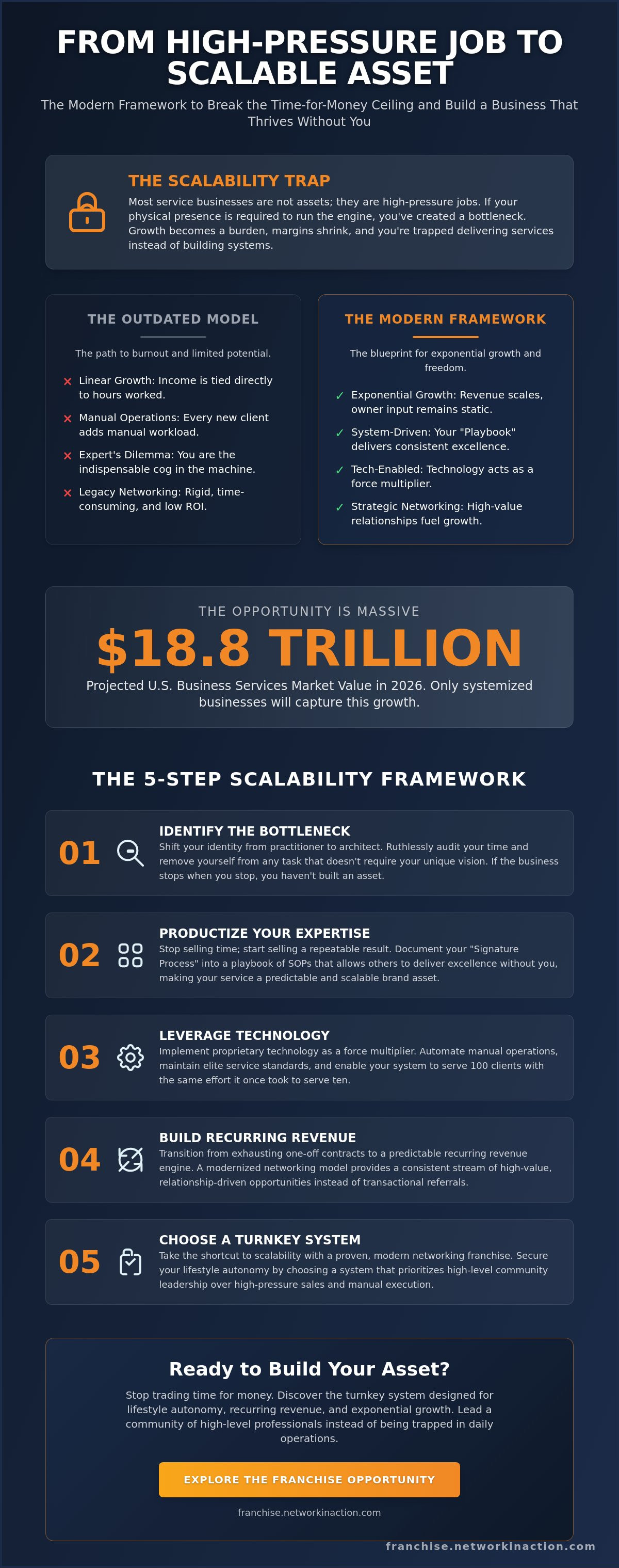
Most service business owners aren't building an asset; they're building a high-pressure job. If physical presence is the only thing keeping the engine running, the result isn't a business, it's a bottleneck. It's a common trap. Scaling to a point where every new client feels like a burden rather than a victory leaves owners stuck in the weeds of daily operations while overhead climbs and margins shrink.
The legacy approach to growth is dead. With the U.S. business services market projected to reach $18.8 trillion in 2026, the opportunity for expansion is massive, but only for those who move beyond manual effort. Learning how to build a scalable service business is the only way to capture this growth without burning out. This guide delivers the exact framework to transition from a time-intensive model to a high-margin, tech-enabled business that thrives without constant owner presence. Discover how to implement systems that ensure predictable recurring revenue and total lifestyle autonomy. The focus remains on moving past outdated networking models and manual workflows toward a future of elite, systemized leadership.
Key Takeaways
- Break the cycle of linear growth by identifying and removing the time-for-money bottlenecks that keep you trapped in the role of primary service provider.
- Discover the exact framework on how to build a scalable service business by productizing your expertise into repeatable, high-margin packages.
- Utilize proprietary technology as a force multiplier to eliminate manual operations and maintain elite service standards as you grow.
- Shift from exhausting one-off contracts to a predictable recurring revenue engine through a modernized networking franchise model.
- Secure your lifestyle autonomy by choosing a turnkey system that prioritizes high-level community leadership over high-pressure sales and manual execution.
The Scalability Trap: Why Most Service Businesses Fail to Grow
Many high-level professionals reach a plateau where growth feels more like a punishment than a reward. This is the time-for-money ceiling. In traditional service models, every dollar of revenue requires a corresponding unit of manual labor. If you want to double your income, you have to double your hours or your headcount. This linear path is the enemy of true wealth. It creates a "bespoke" trap where every client engagement is a unique, manual project that requires your specific expertise to execute. While this might feel elite, it's actually an architectural flaw that prevents you from ever truly stepping away.
The "Expert's Dilemma" is the primary culprit. Because you are the best at what you do, you become the indispensable cog in the machine. You're too busy delivering the service to build the systems that would replace you. To break this cycle, you must learn how to build a scalable service business that functions as an asset, not a job. Transitioning from a manual, expert-led model to a systemized, tech-enabled one is the only way to achieve exponential growth without a proportional increase in stress.
Linear vs. Exponential Growth in Services
Traditional growth strategies often suggest that adding more employees is the solution to scaling. In reality, increasing headcount without a systemized framework usually decreases profit margins. Each new hire adds complexity, management overhead, and training requirements. A truly scalable service business is one where revenue grows while owner input remains static. This requires a deep understanding business scalability and a commitment to high-margin, low-overhead offerings. Exponential growth happens when your system does the heavy lifting, allowing you to serve 100 clients with the same effort it took to serve ten.
Identifying Your Scalability Ceiling
Are you the bottleneck? If your business stops when you stop, you haven't built a company; you've built a cage. Many executives exacerbate this by participating in legacy networking organizations. These outdated networking models demand hours of rigid attendance and force transactional referrals that rarely lead to high-value partnerships. They prioritize "busy work" over ROI. In a modernized business architecture, "busy" is a red flag. It indicates a lack of systems and a reliance on manual effort. Use this diagnostic to see if you're stuck: If you can't take a thirty-day vacation without checking your email, your scalability ceiling is already crushing your potential. Learning how to build a scalable service business starts with auditing your time and ruthlessly automating or delegating every task that doesn't require your unique vision.
Standardizing Excellence: The 5-Step Scalability Framework
Scaling requires a fundamental shift in identity. You aren't just a practitioner; you're an architect. To understand how to build a scalable service business, you must first stop selling your time and start selling a result. This begins with productization. Strip away the bespoke elements that drain your energy and don't contribute to the core outcome. By creating a "Signature Process," you transform your expertise into a repeatable brand asset that can be delivered by others without sacrificing quality. Results matter. Systems win.
Productization: Turning Services into Systems
Productization is the ultimate differentiator. It allows you to move away from the transactional feeling of outdated networking models and toward a high-value, relationship-driven approach. When your service is a product, growth becomes predictable. This strategy relies heavily on a robust Referral Marketing Strategy where trust is built into the system itself. Instead of cold prospecting, you leverage a network of high-level peers who understand your value proposition because it's clearly defined and easily communicated.
Excellence must be documented to be duplicated. Your "Playbook" is the collection of Standard Operating Procedures (SOPs) that ensure your team delivers consistent results every time. This isn't just about task lists; it's about capturing the "why" behind the "what." Consult the SBA guide to business growth for foundational insights on how to structure these organizational assets. Without a playbook, you aren't scaling; you're just creating chaos at a higher volume.
The Architecture of a Self-Managing Team
Stop hiring for task execution. Start hiring for leadership. The "Second Penguin" strategy involves bringing in individuals who are willing to take the first leap into new territories of responsibility. You need an Operations Leader, not just a personal secretary. This role manages the systems so you can lead the vision. Incentivize your team by tying their success to the business's scalability. This creates a culture of informed disruption where team members are encouraged to find more efficient ways to deliver value. Scalability secured. Freedom achieved.
Your lead engine should eventually run on autopilot. Move away from exhausting cold prospecting and toward relationship-driven growth. Implement rigorous feedback loops to ensure quality stays high as you increase volume. This ensures your professional credibility remains intact while your time commitment drops. If you're ready to lead a professional community with a proven, systemized framework, you can explore how a turnkey franchise model accelerates this transition.
Leveraging Technology as a Force Multiplier in 2026
Manual operations are a death sentence. In 2026, relying on spreadsheets and manual follow-ups is no longer a viable strategy for growth. It’s a liability. True scalability requires a tech-forward mindset that replaces human effort with digital precision. When you are figuring out how to build a scalable service business, technology isn't just an accessory. It is the engine. Research indicates that 53% of small and medium-sized businesses are already using AI in 2026, with another 29% planning to start. Those who lag behind will find their margins squeezed by competitors who move faster and operate leaner.
The Proprietary Platform Advantage
Generic, off-the-shelf tools often create more work than they solve. They lead to technology fragmentation where you spend your time syncing data rather than closing deals. A proprietary platform solves this. It replaces the burden of weekly manual tasks with monthly efficiency. High-level professional clients don't just want promises. They want data. They want proof. Technology allows you to track ROI and engagement metrics in real time, providing the transparency needed to retain elite members. This shift from manual tracking to automated reporting is a core pillar of a modernized business model. Data-backed results win. Every time.
AI and Automation for Executive Leaders
Automation handles the "invisible work" that usually drains an owner's time. Streamlining the member onboarding process through automated workflows ensures a consistent, high-quality experience for every new partner without your direct involvement. AI-powered tools can now match high-quality referrals within your network, identifying synergies that a human might miss. This isn't about replacing the human element. It's about enhancing it. Technology should enhance, not replace, human connection. It removes the friction of administration so you can focus on the high-value activity of building relationships.
Outdated networking models fail because they rely on manual, transactional interactions. They are rigid and time-consuming. A tech-enabled platform, like the one offered within the NIA franchise system, allows you to lead a professional community with surgical precision. It automates the tracking of social capital and financial metrics, ensuring that every interaction delivers measurable value. This is the next evolution of the industry. It’s about being smart, not just busy. Efficiency creates freedom. Scalability requires tech. Discover available territories where you can implement this modernized, tech-led solution today.
The Recurring Revenue Engine: Scaling Through Networks
One-off service contracts are the enemy of true business scale. They force you into a perpetual cycle of hunting, closing, and delivering, only to start again at zero every month. This is the antithesis of freedom. To break this cycle, you must build a recurring revenue engine that thrives on consistency. A Business Networking Franchise offers exactly this: a model built on monthly royalties and predictable income streams. It’s about moving from the role of the worker to the role of the owner. Ownership is power.
Your influence is your greatest asset. By building a "Network of Networks," you create a system where your revenue scales alongside the success of your members. This is how to build a scalable service business that actually works. You aren't just selling a service; you're owning the infrastructure where professional relationships flourish. This shifts your business from a manual operation to a high-margin, tech-enabled platform that rewards your leadership rather than your labor. Systems deliver. People lead.
Relationship-Driven Growth vs. Cold Prospecting
Cold calling is an outdated, unscalable relic of legacy organizations. It’s inefficient. It’s exhausting. It’s transactional. In 2026, the market has shifted toward social capital as a measurable financial metric. Smart leaders leverage a curated membership to drive high-quality referrals through trust, not force. Outdated networking models rely on rigid, mandatory referrals that often lack value and integrity. A modernized approach focuses on quality over quantity, ensuring that every connection made within your network has a high ROI. You lead the community. The community drives the growth.
Territory Expansion and Market Leadership
Scaling doesn't have to mean working harder. It means expanding your footprint. The number of franchise establishments in the U.S. is projected to grow by 1.5% in 2026, reaching 845,000 units. This growth is driven by executives who understand that systemized expansion is the fastest path to market dominance. With a proven system, you can scale from one local group to a multi-territory empire with minimal increase in administrative overhead. You become the market leader by owning the platform where other businesses grow. This is the ultimate strategic move for professionals seeking lifestyle autonomy and meaningful impact. If you're ready to secure your position at the top of your local market, you should explore available territories to see where you can lead your own professional community.
The Turnkey Shortcut: Scaling via a Modern Networking Franchise
Building a scalable system from scratch is the hard way to entrepreneurship. It requires years of trial and error, expensive software development, and the constant risk of operational failure. Most professionals spend too much time reinventing the wheel instead of driving the vehicle. If you're looking for how to build a scalable service business without the typical startup struggle, the turnkey shortcut is the only logical choice. By leveraging a pre-scaled business model, you skip the "expert's dilemma" entirely and move straight into a leadership role. Systems win. Freedom follows.
The NIA difference is built on informed disruption. Unlike legacy networking organizations that rely on rigid, time-consuming weekly requirements, this modern approach focuses on high-quality curation and lifestyle-first design. It replaces the burden of forced referrals with a relationship-driven framework that respects your time. You don't have to spend years developing a playbook; it’s already written. You can launch your own professional community in as little as 90 days, using a proven brand and proprietary technology to secure your market position immediately. It’s about being an owner from day one.
Why Executives Choose Modern Models Over Legacy Organizations
High-level professionals value efficiency. Outdated networking models demand a weekly commitment that often delivers low-quality, transactional results. Modern models prioritize monthly meetings that focus on deep connection and strategic growth. This shift alone saves hundreds of hours per year while delivering superior ROI. Skeptical, high-level members require data-backed results, which is why proprietary, ROI-driven technology is essential. You aren't a group administrator; you're a community leader. Positioning yourself at the center of a tech-enabled network is how to build a scalable service business that commands respect and delivers consistent financial returns. Results matter. Relationships scale.
Your Path to Lifestyle Autonomy
- Freedom and Flexibility: The franchise model allows seasoned professionals to design their own schedules while maintaining an elite professional image.
- Recurring Revenue: A mature networking territory generates consistent income streams through monthly royalties, providing long-term financial security.
- Scalability Secured: Transition from an "employee" of your own business to a true "owner" who manages systems rather than manual tasks.
The transition from manual execution to strategic leadership is a move that defines your professional legacy. It’s about creating an asset that works for you, giving you the freedom to lead rather than execute. If you're ready to stop trading your time for money and start building a high-margin business with a proven track record, it’s time to take the next step. Your strategic move starts here. You can Download the Franchise Kit to explore how this modernized networking model aligns with your goals for exponential growth and lifestyle autonomy.
Secure Your Professional Legacy
True growth isn't found in working more hours; it's found in building better systems. The evidence shows how the scalability trap keeps talented experts locked in a cycle of manual delivery and inconsistent returns. By productizing expertise and leveraging proprietary technology, you break the linear link between time and income. Understanding how to build a scalable service business is the final shift from being a practitioner to becoming a true architect of success. Systems win. Leaders scale.
The path to exponential growth doesn't require years of trial and error. A leadership role is available through a proven, results-oriented monthly meeting model that prioritizes quality over quantity. With over 150 global locations and a robust proprietary technology platform, the infrastructure for success is already built. This is the next evolution of professional networking. It’s time to move beyond the limitations of legacy organizations and claim a seat at the center of a high-value community.
Ready to lead a high-growth network? Download the Franchise Kit today. The strategic move toward lifestyle autonomy and recurring revenue starts now.
Frequently Asked Questions
Is a service-based business truly scalable?
Yes, service businesses are scalable when you decouple revenue from your personal labor. Most owners fail because they remain the primary service provider, creating a natural ceiling for growth. By implementing a systemized framework and proprietary technology, you transform a manual practice into a high-margin asset. This shift allows the business to handle increased volume without a proportional increase in your time commitment.
How do I scale a service business without hiring more staff?
You scale through technology and productization rather than increasing your headcount. Adding staff often increases management complexity and overhead, which can erode your margins. Instead, automate administrative tasks and standardize your core offerings into repeatable packages. This approach is the foundation of how to build a scalable service business that maximizes profit per employee while preserving your lifestyle autonomy.
What are the most scalable service business models in 2026?
Tech-enabled franchises and membership-driven networks are the premier models for 2026. These systems leverage proprietary platforms to manage professional relationships and transactions at scale. Unlike legacy networking organizations that demand heavy manual oversight, modernized franchise models provide a turnkey infrastructure. They allow you to own the platform where value is exchanged, creating growth through systems rather than individual effort.
What is the difference between a traditional service and a productized service?
Traditional services are bespoke and manual; productized services are standardized and systemized. A bespoke model requires you to recreate the process for every client, which is inherently unscalable and exhausting. Productization involves stripping away non-essential custom elements to deliver a "Signature Process." This creates a repeatable brand asset that your team can execute with consistent, high-quality results every single time.
How does technology improve the scalability of a networking business?
Technology acts as a force multiplier by automating the "invisible work" of tracking social capital and referral ROI. In a modernized networking business, proprietary platforms handle onboarding, reporting, and matching without human intervention. This eliminates the administrative burden found in outdated networking models. It allows you to lead multiple groups and territories while maintaining elite service standards and delivering measurable results for members.
Can I scale a business while maintaining a full-time executive role?
Yes, provided you choose a model designed for high-level leadership rather than daily administration. A lifestyle-friendly franchise model provides the structure and technology needed to operate efficiently on a flexible basis. By focusing on community leadership and relationship-driven growth, you can build a recurring revenue stream that complements your current professional commitments. It’s about being a strategic owner, not a group administrator.
Why is recurring revenue critical for scaling services?
Recurring revenue provides the financial stability needed to invest in further expansion without the stress of "starting at zero" each month. One-off contracts force you into a constant cycle of prospecting and delivery, which is unpredictable and unscalable. A model built on monthly royalties ensures consistent income. This predictability is essential when learning how to build a scalable service business that functions as a long-term, high-value investment.
What are the common pitfalls when trying to scale a service business?
The most common pitfall is the "Expert's Dilemma," where the owner remains the primary bottleneck for service delivery. Other traps include inconsistent lead generation and a failure to standardize quality across the board. Many owners also waste time in legacy networking organizations that demand rigid attendance for low-value outcomes. Scalability requires you to step away from the execution and focus entirely on the systems and leadership.