The operational noise of a startup kills more executive dreams than market competition ever will. With 50% of independent businesses failing within five years, high-level professionals are increasingly asking if is buying a franchise a safer bet than a startup to protect their capital and professional status. You've already spent decades mastering high-level strategy. You shouldn't have to waste your next chapter building foundational systems from scratch when proven, scalable models are ready for deployment. Proven systems. Predictable growth.
You understand that time is your most valuable asset and that risking your retirement on an unproven concept is a strategic error. This 2026 executive analysis demonstrates why elite leaders are choosing the structure of franchising to achieve predictable ROI and true lifestyle autonomy. You'll learn how to leverage your existing professional network to drive growth rather than grinding through the manual, outdated networking models of the past. We'll explore the current SBA 7(a) lending environment and reveal how modern, technology-led systems allow you to lead a community without the high-risk volatility of independent ventures.
Key Takeaways
- Analyze the 2026 market landscape to understand why is buying a franchise a safer bet than a startup for executives seeking to protect their professional status and capital.
- Discover how proven operating systems eliminate the operational noise of a startup, allowing you to focus on high-value leadership instead of daily troubleshooting.
- Learn to leverage established professional networks for relationship-driven growth, bypassing the time-consuming inefficiency of cold prospecting and manual outreach.
- Evaluate your entrepreneurial risk profile using a five-point checklist designed to distinguish between building a brand from scratch and scaling a model with predictable ROI.
- Explore the modern evolution of business networking that replaces the rigid, weekly grind of legacy organizations with a sophisticated, monthly model built for high-level leaders.
The Risk Reality: Franchising vs. Startups in 2026
The startup dream is often a professional nightmare. While the "blank slate" of an independent venture sounds like total freedom, it usually results in an operational prison. In the current economic climate, the question of whether is buying a franchise a safer bet than a startup isn't just about preference. It's about math. Proven systems. Zero guesswork.
Independent startups are forced to build every system from zero. They invent their own marketing, test their own tech stacks, and struggle to establish brand credibility in a crowded market. This "trial and error" phase is where most capital disappears. In contrast, understanding What is franchising? reveals a model designed to bypass these foundational hurdles. It is a "business in a box" that trades the high-risk volatility of speculation for the stability of a proven architecture. You aren't guessing if the market wants your product; you're executing a model that has already won.
Quantifying the Failure Rate Gap
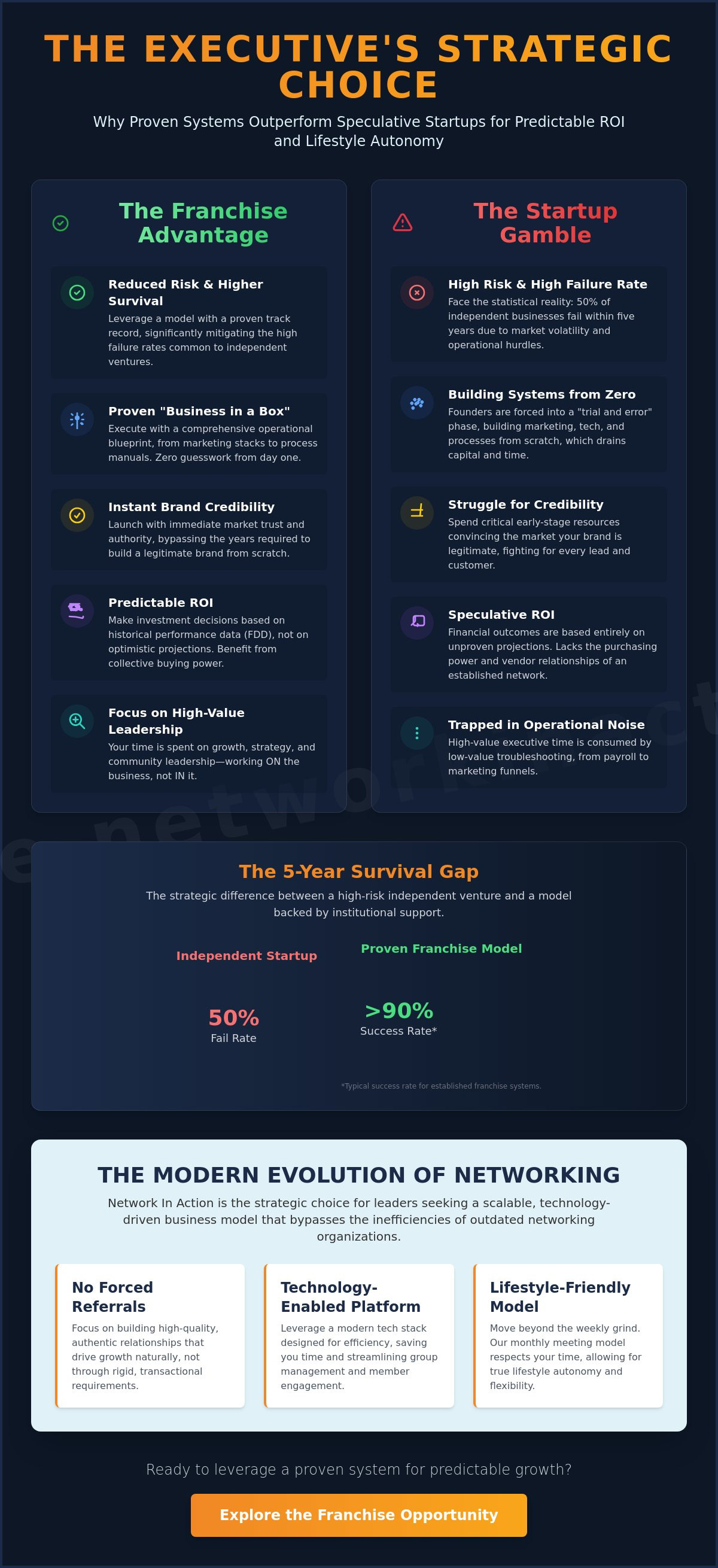
Market data for 2026 confirms a stark reality: approximately 50% of independent small businesses fail to survive past the five-year mark. This survival rate often plummets further when you account for businesses that technically exist but fail to provide a living wage to their owners. The 2026 Success Gap represents the delta between the 50% failure rate of independent ventures and the strategic resilience of a model backed by institutional support and market-tested protocols. Franchising provides an immediate "trust bridge" with consumers. You don't spend months convincing the market you're legitimate; you leverage a brand that has already won that battle. Immediate leads. Immediate authority.
The Executive Opportunity Cost
Your time has a high market value. Every hour you spend troubleshooting a payroll system or testing a lead generation funnel is an hour you aren't leading. Executives are often overqualified for the "startup struggle" of basic operational design. You've already mastered high-level leadership; why go back to the drawing board? Choosing a franchise allows you to skip the noise and move straight to execution. It's a strategic bypass. You're buying a results-oriented system that allows you to focus on growth and community leadership from day one. It's about working on the business, not in it.
- Predictable ROI: Systems designed specifically for financial consistency and growth.
- Brand Authority: Instant credibility in your local market without years of brand building.
- Resource Access: Collective buying power and shared marketing resources that startups simply lack.
Why the Franchise Model is Statistically a Safer Bet
Statistics don't lie. While entrepreneurs often romanticize the "grind" of a startup, seasoned executives prioritize risk mitigation. When analyzing whether is buying a franchise a safer bet than a startup, the answer lies in the structural transparency of the Franchise Disclosure Document (FDD). This federally mandated document provides 23 points of critical data, including Item 19 financial performance representations. You aren't investing based on a founder's optimism; you're investing based on audited history. Proven performance. Real numbers.
Weighing the pros and cons of franchising requires a focus on the safety net provided by ongoing corporate support. If a market shift occurs, you aren't pivoting in the dark. You have a headquarters dedicated to testing new strategies, negotiating vendor contracts, and maintaining the brand's competitive edge. Collective buying power ensures your margins are protected from day one, providing a level of insulation from inflation that independent startups simply cannot match. Shared resources. Reduced overhead.
Operational Blueprints and Manuals
Standardization drives scale. A franchise provides a comprehensive operations manual that acts as an insurance policy for your capital by defining every repeatable process. Startups often fail because the founder's knowledge isn't documented; franchises succeed because the system is the boss. You receive a ready-to-use tech stack and integrated marketing systems that would take years to build independently. This eliminates the "tech debt" that often cripples independent businesses before they can reach profitability. Scalable systems. Predictable results.
Financing and Lender Confidence
Lenders value predictability. Banks are significantly more likely to fund a franchise because the business model has already been de-risked across multiple territories. As of June 2026, variable rates for SBA 7(a) loans hover between 9.0% and 11.5% APR. These rates reflect the market's confidence in proven systems over unproven ideas. While 50% of franchisees use personal savings to fund their venture, another 25% successfully secure financing through SBA loans, proving that institutional confidence is a major advantage for the franchise model. Securing capital is a strategic move, not a desperate plea. You can learn how to fund your transition with our franchise kit to see how these financial structures apply to your specific goals.
Transitioning into business ownership should be about leveraging your leadership, not reinventing the wheel. If you're ready to explore a model built for high-level professionals, check available territories to see where you can lead your community.
The Executive Bypass: Leveraging Systems Over Speculation
Autonomy is the ultimate executive goal, but in a startup, it's often a mirage. If you're building the infrastructure while trying to scale the business, you aren't a leader; you're a mechanic. True freedom doesn't come from a blank slate. It comes from owning a system that works without your constant intervention. When asking if is buying a franchise a safer bet than a startup, consider the value of your mental bandwidth. You can spend years testing lead generation strategies, or you can step into a model where the testing is already complete. Strategic ownership. Scalable impact.
The "Executive Franchise" niche is specifically designed for professionals who value C-suite experience over manual labor. In professional services and networking sectors, your value lies in your ability to build high-level relationships and lead a community. You shouldn't be bogged down by tech troubleshooting or payroll architecture. While some high-performers believe they can "do it better themselves," the statistical evidence on franchise success rates suggests that reinventing the wheel is a poor use of capital. Why compete against a proven brand when you can own it?
Escaping the Tactical Trap
Startup founders typically spend their first 36 months stuck in the "tactical weeds." They're the IT department, the HR manager, and the marketing agency all at once. This operational drag prevents growth. Franchising allows you to bypass this phase entirely. By deploying a ready-to-use business architecture, you assume the role of a Strategic Owner on day one. You focus on the big picture while the system handles the minutiae. For a deeper dive into this transition, review The Executive Guide to Modern Ownership to understand how to align your career goals with a results-oriented model.
Building Equity with a Clear Exit Strategy
A business is only as valuable as its ability to be sold. Independent lifestyle businesses are notoriously difficult to exit because they rely entirely on the owner's personal brand and effort. Franchises, however, are built for resale. They are predictable assets with recognized brand names and standardized financial reporting. When you build within a franchise system, you're creating a turnkey operation that a future buyer can step into with confidence. This compounding effect on your final valuation turns your business into a wealth-generation tool rather than just a high-paying job. Predictable growth. Clear exit.
If you're ready to stop speculating and start leading, it's time to look at a model that respects your time. You don't need a startup; you need a strategic bypass. Get your free book to discover how to leverage your professional network into a scalable business asset.
Evaluating Your Options: When to Build and When to Buy
Deciding if is buying a franchise a safer bet than a startup requires a clinical assessment of your professional goals. Inventors thrive in the chaotic "blank slate" of a startup, but they also accept the high failure risk associated with unproven concepts. High-level executives usually find more value in becoming strategic executors. You aren't here to reinvent the wheel; you're here to drive the vehicle. Strategic alignment. Measured risk.
The "Legacy Factor" is a critical differentiator. Building a brand from scratch in the 2026 market requires a massive time-to-market investment that often exceeds three years. In contrast, a franchise allows you to build a lifestyle and equity from day one. You're leveraging a brand that already has market authority. This allows you to focus on community leadership and relationship-driven growth rather than the manual labor of identity creation. Proven brand. Immediate equity.
- Capital Preservation: Can your savings survive the long burn rate of an unproven startup?
- Operational Speed: Are you willing to spend 18 months building a tech stack or 18 days deploying one?
- Market Exclusivity: Does your model offer protected territory rights to prevent local competition?
- System Dependency: Does the business rely on your constant presence or a repeatable manual?
- Exit Strategy: Is the asset structured for a turnkey sale in five to ten years?
The Modern Networking Advantage
Outdated networking models are failing the 2026 economy. These legacy networking organizations rely on rigid, weekly grinds and transactional, forced referrals that repel high-level professionals. The shift toward tech-enabled, relationship-driven growth is the modern standard. By choosing a model that prioritizes quality over quantity, you create a business that respects your time. It's the next evolution of the industry. Check available territories for a modern networking model to see where you can secure your market exclusivity.
The Financial Metric Test
Calculate your required monthly revenue to replace your current executive salary. Startups face massive "hidden" costs in custom software development, legal compliance, and branding. Franchises streamline these expenses. While you'll pay ongoing royalty fees, typically ranging from 4% to 8%, and marketing fees of 1% to 5%, these are investments in a proven lead-generation engine. Recurring revenue models are the gold standard for executive franchises. They provide the predictable ROI that makes the transition from corporate life feel like a strategic move rather than a gamble. If you're ready to secure your financial future through a proven system, download the franchise kit to review the metrics of success.
The Modern Evolution: Network In Action as a Strategic Choice
Network In Action (NIA) represents the next evolution of the industry. It dismantles the rigid, transactional nature of legacy networking organizations and replaces it with a sophisticated, results-driven model. When you evaluate if is buying a franchise a safer bet than a startup, the answer depends on the quality of the system you're acquiring. NIA offers a streamlined architecture that respects your time and prioritizes high-value relationships over forced, low-quality referrals. You aren't just buying a business; you're choosing a lifestyle-friendly model built for leaders. Efficiency. Structure. ROI.
Traditional networking models rely on a weekly grind that drains executive energy. NIA disrupts this by utilizing monthly meetings, allowing you to maintain professional status without the burnout. There are no forced referrals here. Instead, the focus remains on curated, high-quality membership where trust drives growth. This approach ensures that your professional credibility remains intact while you build a scalable asset. You lead a community of peers, not a room of desperate salespeople. Quality over quantity. Always.
A Tech-Forward Approach to Business Referrals
Modern business requires modern tools. NIA utilizes a proprietary business referral platform to automate the "noise" of networking, keeping members connected without the manual overhead of legacy systems. This technology-led solution allows you to step into the role of a community leader rather than a group moderator. You aren't chasing paperwork or tracking referrals in a spreadsheet. The platform handles the logistics, allowing you to focus on relationship-driven growth and strategic leadership. By centralizing member data and lead tracking, the NIA technology platform enables you to manage multiple groups with the same effort required for one in an outdated networking model, effectively maximizing your social capital and hourly returns.
Your Path to Strategic Freedom
The transition from a corporate employee to a strategic entrepreneur is a calculated move. NIA supports this shift by providing the systems, training, and brand authority needed to bypass the startup struggle. You don't have to guess how to build a network; you deploy a model that has already solved the inherent flaws of the networking industry. This is your opportunity to achieve true lifestyle autonomy while making a meaningful impact on your local business community. You are leveraging a proven system to buy back your time. For a deeper look at how to scale through professional relationships, review our guide on Unlocking Growth through Trust and Connections.
Choosing a business model is a strategic decision that defines your next decade. If you're ready to leave the volatility of startups behind and embrace a results-oriented system, it's time to align with the modern standard. Is buying a franchise a safer bet than a startup? For the executive who values time and predictable growth, the answer is clear. Download the Franchise Kit to explore your next strategic move and see how NIA can transform your professional network into a recurring revenue asset.
The Strategic Path Forward for Modern Executives
Executives in 2026 no longer gamble their capital on unproven startups. They recognize that is buying a franchise a safer bet than a startup when the model is built on operational excellence and technological innovation. You've seen how proven systems eliminate guesswork and why a standardized business architecture acts as a strategic bypass for your career. By choosing a model designed by executives for executives, you prioritize high-value relationship building over the manual grind of outdated networking models.
Network In Action delivers this modernization through a proprietary technology platform and a lifestyle-friendly approach that has already scaled to 150+ global locations. You don't have to choose between professional status and entrepreneurial freedom. You can have both. Leverage your network into a scalable asset that offers predictable ROI and long-term equity. It's about working smarter, not harder, to build a business that reflects your professional caliber.
Explore a Modern Business Model: Download the NIA Franchise Kit
Your next chapter should be defined by leadership, not tactical troubleshooting. Take the strategic step toward a business that respects your time and rewards your expertise. The opportunity to lead your professional community is ready for you.
Frequently Asked Questions
Is buying a franchise actually safer than a startup?
Buying a franchise is statistically safer because it replaces speculation with a market-tested system. When analyzing if is buying a franchise a safer bet than a startup, the answer lies in the elimination of the "trial and error" phase. You aren't guessing if the market wants your product; you're deploying a proven architecture. This structural support protects your capital and significantly reduces the typical operational noise that kills independent ventures.
What is the average failure rate of a franchise versus a startup in 2026?
Market data for 2026 indicates that approximately 50% of independent small businesses fail within their first five years. In contrast, the franchise model is built for resilience by distributing risk across a network of owners. While no venture is without risk, the "Success Gap" favored by franchising is driven by operational predictability. Most franchise failures in this economic climate are attributed to poor financial management rather than a lack of market demand.
Can I still be creative if I own a franchise?
Creativity in franchising shifts from foundational invention to high-level strategic growth and community leadership. You don't waste your creative energy on payroll architecture or testing tech stacks. Instead, you use your professional expertise to build high-value relationships and expand your market share. You're free to innovate within your growth strategy while the operational blueprints handle the tactical minutiae. It's about leading a community, not reinventing the wheel.
How much capital do I need to start a professional service franchise?
Capital requirements vary based on the industry, but professional service models generally avoid the high overhead of real estate or heavy equipment. General 2026 data shows that 45% of franchises require an initial investment of $100,000 or less. You should evaluate the total investment against the potential for recurring revenue and the speed at which the system can scale. These models are designed to leverage your existing professional network for a faster time to ROI.
Are franchise royalties worth the ongoing cost?
Royalties are an investment in the ongoing innovation and technological edge of your business. These fees fund the tech-forward tools, marketing resources, and system updates that keep you competitive in the 2026 economy. When you calculate the cost of developing these exclusive digital tools independently, royalties often represent a significant discount. You're paying for a continuous competitive advantage and a dedicated corporate safety net that prevents catastrophic operational errors.
What happens if the franchisor goes out of business?
Franchise agreements and the 2026 regulatory environment provide specific protections for owners if a franchisor faces financial distress. In many cases, you can continue to operate your business independently or as part of a collective of owners. The FTC Franchise Rule ensures you have full transparency into the franchisor's financial health through the FDD before you invest. Thorough due diligence is your primary defense in ensuring long-term stability for your asset.
How long does it take for a franchise to become profitable compared to a startup?
Franchises typically reach profitability faster than independent startups because they bypass the 18 to 36 month brand-building phase. You start with immediate lead generation systems and a recognized name in your market. This strategic bypass accelerates your path to a predictable ROI. While every territory is unique, the efficiency of a ready-to-use business model allows you to focus on revenue-generating activities from day one rather than foundational setup.
Can I run a franchise while keeping my full-time job?
Certain franchise models are designed specifically for lifestyle autonomy and executive-level leadership. Professional service and networking franchises often replace the rigid "weekly grind" of traditional networking with a more efficient, monthly schedule. This structure allows you to lead your professional community without the manual overhead of a traditional 9-to-5 operation. It's a results-oriented approach that fits into a sophisticated executive schedule, focusing on high-impact relationships rather than tactical busywork.