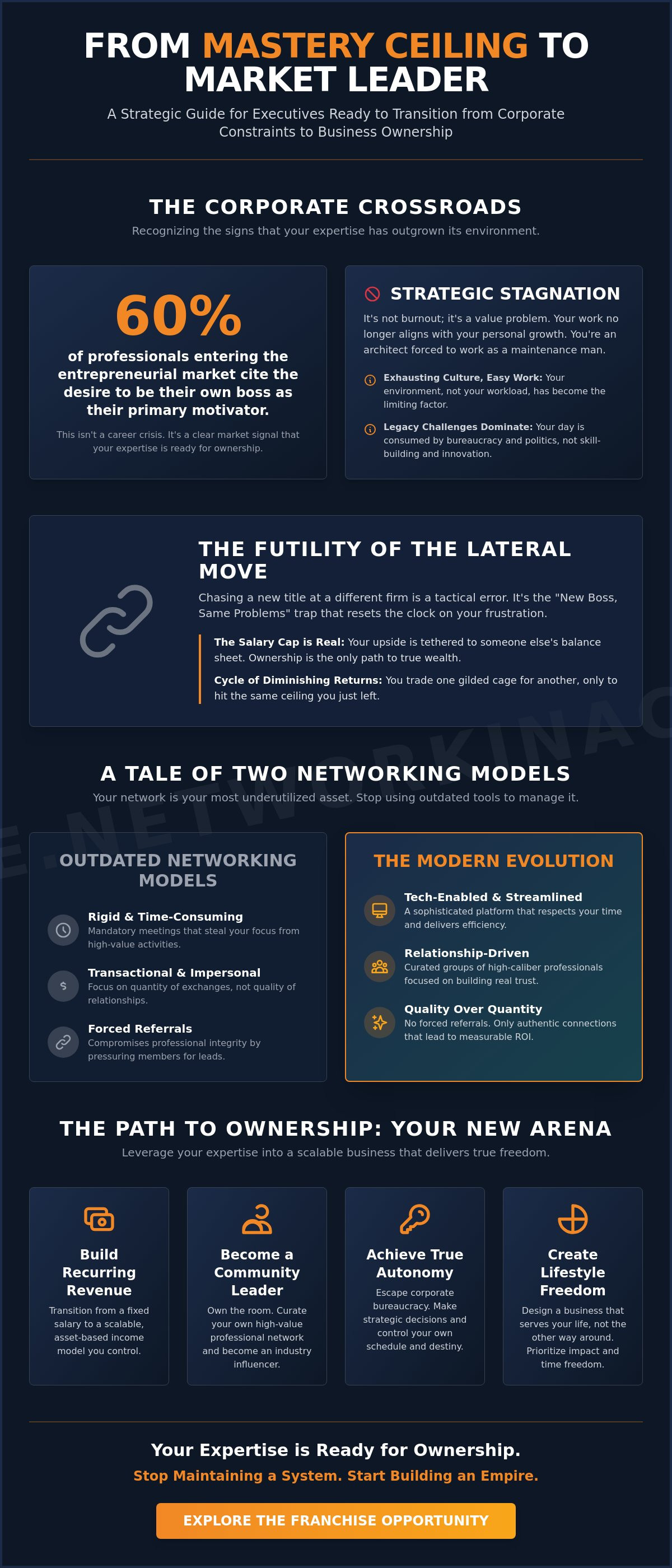
Your seat at the boardroom table has become a gilded cage. You've reached the mastery ceiling where every additional hour of effort yields diminishing returns for your legacy. It's a common inflection point; 60% of professionals entering the entrepreneurial market in 2026 cite the desire to be their own boss as their primary motivator. If you're wondering what to do when you've outgrown your corporate job, understand that this isn't a career crisis. It's a clear market signal that your expertise is ready for ownership.
You've spent decades building high-value relationship capital, yet those assets remain locked behind layers of soul-sucking corporate bureaucracy. You deserve a model that values your time. This article explores how to leverage your professional background into a high-ROI business that prioritizes autonomy and impact. You'll discover a path to community leadership that replaces outdated networking models with a streamlined, technology-led system. It's time to trade the lateral move for a scalable evolution that delivers true lifestyle freedom and consistent growth.
Key Takeaways
- Identify the signs of the mastery ceiling and understand why a lateral move to another C-suite role often fails to solve the frustration of corporate bureaucracy.
- Learn exactly what to do when you've outgrown your corporate job by auditing your social ROI and turning your professional network into a scalable business asset.
- Evaluate high-ROI ownership models that prioritize lifestyle autonomy and time freedom over the diminishing returns of a traditional executive salary.
- Discover how the modern evolution of networking replaces the rigid, time-consuming grind of legacy organizations with a streamlined, technology-led system.
- Explore the strategic path to becoming a community leader through a franchise model that emphasizes quality relationships and consistent recurring revenue.
Recognizing the Mastery Ceiling: Signs You’ve Outgrown Your Corporate Role
The ceiling isn't glass; it's concrete. You've reached the point where additional effort yields zero professional growth. This is the Mastery Ceiling. It's the moment when your ROI on personal output plateaus. You're no longer building a legacy; you're just maintaining a system. High-performers often mistake this for a slump. It isn't. It's a signal. When you're deciding what to do when you've outgrown your corporate job, start by auditing the nature of your obstacles. Impact matters. Results dictate value. Mastery demands a new arena.
Discern between Good Challenges and Legacy Challenges. Good challenges force you to sharpen your edge and acquire new skills. They keep you relevant. Legacy challenges are the soul-sucking hurdles of navigating corporate bureaucracy and managing internal politics. If your day is consumed by the latter, you've stagnated. You're spending your intellectual capital to keep a legacy machine running instead of building your own. You're an architect being forced to work as a maintenance man.
Restlessness is the inevitable byproduct of mastery without impact. Despite the high salary and the executive title, the "What Else?" voice gets louder every quarter. You've transitioned from the exhilaration of learning to the monotony of managing. This shift is a primary indicator of professional decay. You're playing a game you've already won, and the stakes no longer excite you. High-energy leaders don't retire; they pivot to ownership.
The Difference Between Burnout and Strategic Stagnation
Many executives confuse these two states. Burnout is a volume problem; you're doing too much for too long. Strategic stagnation is a value problem; you're doing things that no longer matter to your personal growth. Stagnation carries a heavier psychological toll. It forces you to play small to fit into a rigid corporate structure. Your environment has become the limiting factor. If the work is easy but the culture is exhausting, the problem isn't your workload. It's your lack of autonomy.
Why Your Professional Network is Your Most Underutilized Asset
Stop treating your network as a safety net for your next lateral move. That is an outdated perspective. Your network is the primary engine for entrepreneurship and ownership. Most executives sit on a goldmine of Relationship Capital without a system to extract its value. Social capital is a measurable financial metric that dictates market influence and terminal value in 2026. Transitioning to ownership allows you to leverage these connections into a scalable business model. You've already built the trust; now it's time to own the equity.
The Futility of the Lateral Move: Why Another C-Suite Role Isn't the Answer
Chasing a new title at a different firm is a tactical error. It's the "New Boss, Same Problems" trap. You trade one boardroom for another, but the underlying friction remains. The bureaucracy is systemic. The politics are inevitable. When considering what to do when you've outgrown your corporate job, understand that a lateral move merely resets the clock on your frustration. You spend the first 18 months learning a new culture only to hit the same ceiling you just left. It's a cycle of diminishing returns. New company. Same cage.
The executive salary cap is real. No matter how much value you create, your upside is tethered to someone else's balance sheet. Equity ownership is the only path to true wealth. In the corporate world, you are an expense to be managed. In ownership, you are the asset. By making the transition from employee to entrepreneur, you stop trading hours for dollars and start building terminal value. You stop asking for a raise and start creating an exit strategy.
Breaking Free from Outdated Networking Models
Legacy networking organizations are built for a different era. They are rigid. They are transactional. They rely on forced referrals that compromise your professional integrity. For a high-level leader, these models are inefficient and beneath your status. You need a tech-enabled platform that respects your time and prioritizes quality over quantity. Modern leadership requires a sophisticated system that delivers measurable ROI without the weekly grind of traditional networking. Quality relationships. Real results.
The Opportunity Cost of Corporate Loyalty
Loyalty to a corporation often results in a massive freedom gap. You have the perks, but you lack the autonomy. You have the authority, but you lack the ownership. 2026 is the year of the Franchise Leader. Executives are realizing that their skills in P&L management and team building are more valuable when applied to their own ventures. If you're deciding what to do when you've outgrown your corporate job, stop looking for a recruiter. Instead, explore the Top Executive Business Opportunities in 2026. The cost of staying is your time. The reward for moving is ownership. You can begin this journey by reviewing our available territories to see where your leadership is needed most.
Auditing Your Intellectual Capital: Preparing for the Transition
Your resume is a list of accomplishments. Your intellectual capital is the engine that created them. When you're determining what to do when you've outgrown your corporate job, you must inventory your portable skills beyond the executive title. Leadership. P&L management. Community building. These aren't just corporate functions; they're the foundation of a high-ROI business. You've spent years executing someone else's strategy. Now, your focus must shift toward building your own ecosystem. Executives are uniquely positioned to lead professional referral groups because they understand the mechanics of trust and the logic of business growth.
Evaluate your Social ROI. Look at your network and ask: who would follow your lead? Research into the reasons for leaving employment for entrepreneurship suggests that displacing events often trigger the move, but it's the strength of one's professional connections that ensures long-term success. Your network isn't just a list of contacts. It's a measurable financial asset. If you aren't monetizing the platform where these connections happen, you're leaving capital on the table. Building an ecosystem requires a different mindset than executing a strategy. In the corporate world, you're a cog in a pre-existing machine. As a business owner, you're the architect of the machine itself.
Leveraging Your Network as a Tangible Business Asset
Move from "knowing people" to owning the platform. You can monetize years of professional relationship building without "selling" to your peers. By providing a structured, tech-enabled environment for high-level connection, you offer value rather than seeking a favor. Implementing a sophisticated Referral Marketing Strategy: Unlocking Growth allows you to bridge the gap between social capital and recurring revenue. You become the curator of a high-quality community. This isn't about traditional networking; it's about elite community leadership.
Transitioning from Employee to Visionary Leader
The corporate paycheck is a security myth. It's a high-risk gamble on a single employer's stability. Real security comes from a diversified network and a turnkey system that bridges the gap to ownership. You don't need to reinvent the wheel; you need a modernized framework that works. Lifestyle autonomy is the ultimate executive promotion. It's the transition from managing a department to leading a market. Stop executing. Start owning. The shift from an employee mindset to a visionary leader requires a system that rewards your expertise without demanding your constant presence.
Strategic Pivots: Exploring High-ROI Business Ownership Models
The Mastery Ceiling is your exit signal. But where you land determines your terminal value. When you're deciding what to do when you've outgrown your corporate job, your next move must be strategic, not reactive. You aren't just looking for a job replacement; you're looking for a wealth-building vehicle. This requires a cold, calculated assessment of business models that prioritize high margins and low overhead. You've already done the hard work of building a reputation. Now, you need a model that pays you for it. Results matter. Ownership is the only way to capture them fully.
Success in ownership follows a specific sequence. First, identify your desired lifestyle. Do you want another high-pressure growth project, or are you seeking time freedom? Second, evaluate the asset class. Service-based opportunities typically offer higher ROI than brick-and-mortar models because they aren't weighed down by real estate or inventory. Third, prioritize recurring revenue. Monthly recurring revenue (MRR) is the only metric that buys back your time. Fourth, leverage your executive skill set. Don't waste decades of P&L experience on a business that doesn't require high-level leadership. Finally, assess the technology. In 2026, if the business isn't backed by an exclusive digital system, it's already obsolete. Systems drive results. Technology scales impact.
Why Service-Based Franchising Beats Starting from Scratch
Starting from zero is a rookie mistake for an experienced executive. It leads to the "Founder's Trap," where you spend years building basic infrastructure instead of driving growth. Service-based franchising offers a "Speed to Market" advantage that is impossible to replicate alone. You get the blueprints, the training, and the technology on day one. You focus on leadership and network expansion while the system handles the back-end complexity. Proven systems offer a streamlined path to profitability. For a deeper dive into this transition, read our Business Networking Franchise: The Executive Guide.
Evaluating Scalability and Lifestyle Autonomy
The myth that owning a business requires more hours than a C-suite role is a lie told by people with bad business models. True ownership is about building an asset that scales independently of your presence. Lifestyle autonomy is the ultimate executive promotion, representing the moment your income is decoupled from your physical presence. It's the modern evolution of professional leadership. You can visualize your future impact by exploring our available territories to see where your network is most valuable. If you're ready to see how your expertise translates into ownership, download our franchise kit and start your discovery process.
Network In Action: The Modern Evolution of Professional Leadership
Network In Action represents the informed disruption of a legacy industry. For decades, professional networking was tethered to rigid, manual processes and inefficient commitments. NIA has solved these inherent flaws. By replacing outdated networking models with a streamlined, technology-led system, NIA allows you to lead a high-value community without sacrificing your lifestyle. This is the next evolution. It's built specifically for executives who value efficiency, measurable results, and terminal value. You've spent years managing someone else's assets. Now, it's time to own the platform.
Efficiency by design defines the NIA experience. While traditional networking organizations demand a weekly grind that few high-level executives can justify, NIA shifts the paradigm to high-impact monthly meetings. Proprietary technology maintains connection and referral flow between sessions, ensuring that your community remains active without requiring a 60-hour work week. As a franchisee, you aren't a high-pressure salesman. You are a community leader. You are the curator of a high-growth ecosystem. Your role is to facilitate the relationships that drive local economies, utilizing exclusive digital tools to track ROI and ensure member success. This is leadership at scale.
Quality Over Quantity: The NIA Membership Philosophy
High-level professionals are skeptical of forced interaction. They value their time and protect their reputations. This is why NIA’s curated membership model resonates with the elite peers you already know. The "No Forced Referrals" policy is a critical differentiator. It maintains your professional credibility by ensuring that every recommendation is based on genuine merit, not a rigid quota. This isn't a transactional group; it's a strategic alliance. If you're ready to see the underlying systems that make this possible, download the franchise kit for a deep dive into our modernized model.
Building Your Legacy Outside the C-Suite
Ownership is the only way to ensure your professional impact is permanent. When you're deciding what to do when you've outgrown your corporate job, consider the terminal value of owning a territory. You aren't just building a business; you're building a recurring revenue stream that scales independently of your presence. Leading an NIA group provides the strategic impact often missing from corporate roles, positioning you as the central hub of your local business community. This is your path to lifestyle autonomy and meaningful leadership. The boardroom was just the beginning. Now, it’s time to own the network. Explore the NIA Franchise Opportunity and take the first step toward your strategic evolution.
Own the Network and Secure Your Legacy
The mastery ceiling you've hit is a market signal, not a career plateau. You've discovered that lateral moves to new boardrooms only reset the clock on your frustration. True professional evolution requires a shift from executing strategy to owning the ecosystem. By leveraging your relationship capital through a proven, high-ROI business model, you can finally decouple your income from your presence. It's time to stop navigating bureaucracy and start leading a community of elite professionals who value results over rigid quotas.
Deciding what to do when you've outgrown your corporate job is the final step in your strategic transition to ownership. With over 150 global locations and a proprietary technology platform, Network In Action provides the infrastructure you need to succeed without the weekly grind of outdated networking models. Our monthly meeting model ensures lifestyle flexibility while maximizing your social ROI. Stop trading your time for a salary and start building terminal value in a territory you control. Your executive expertise is your greatest asset. Use it to build something that lasts.
Take the first step toward ownership—Download the NIA Franchise Kit
Frequently Asked Questions
How do I know if I'm ready to leave my corporate job for business ownership?
You are ready when your professional growth has hit a mastery ceiling and you find yourself managing bureaucracy rather than creating impact. If you are constantly searching for what to do when you've outgrown your corporate job, the signal is clear. Look for the shift from learning to maintenance as your primary indicator. When your executive salary no longer compensates for the lack of autonomy, it is time to pivot to ownership.
What are the biggest risks for an executive transitioning to entrepreneurship?
The primary risk is the "Founder's Trap" where you waste your intellectual capital building basic infrastructure from scratch. Executives often struggle with the loss of corporate support systems and the shift to a solo environment. Mitigate this by choosing a turnkey model that provides the systems you are used to. Avoid high-overhead models that drain your capital before you achieve market traction; focus on service-based scalability instead.
How does a networking franchise compare to traditional business consulting?
A networking franchise offers scalable recurring revenue while consulting often becomes another high-pressure job trading hours for dollars. You own the platform rather than just selling your time. Traditional consulting lacks the technology-led automation that NIA provides. By leading a community, you build an asset with terminal value that does not depend solely on your billable hours. It is the difference between being the product and owning the system.
Can I run a Network In Action franchise while still working my corporate job?
NIA is designed for high-level leaders who value time efficiency, but it requires dedicated focus to build a successful territory. While the monthly meeting model offers lifestyle flexibility, the initial launch phase demands your strategic attention. Most successful franchisees use the model as their primary corporate exit strategy. It is a vehicle for full-time autonomy rather than a passive side hustle. Ownership requires a commitment to community leadership.
What kind of ROI can an executive expect from a networking-based business model?
Executives expect high social ROI that translates into consistent monthly recurring revenue. The model leverages your existing relationship capital into a measurable financial metric. Unlike legacy networking organizations that are transactional and inefficient, NIA uses technology to drive member retention and referral volume. This creates a scalable asset with low overhead and significant growth potential within your exclusive territory. Results are driven by the quality of your curated membership.
How much time does it realistically take to manage a professional networking group?
The NIA model prioritizes efficiency by design, replacing the weekly grind of outdated networking models with a high-impact monthly meeting. You spend roughly 10 to 15 hours per month per group once the foundation is established. Proprietary technology handles the referral tracking and member communication between sessions. This structure allows you to lead multiple groups while maintaining true lifestyle autonomy. You manage the strategy; the system handles the manual friction.
Why is a tech-enabled platform critical for modern networking success?
Technology removes the manual friction of referral tracking and communication that plagues legacy networking organizations. A modern platform provides real-time data on member engagement and ROI. It ensures that your community remains active and connected without requiring your constant physical presence. In 2026, a business model without exclusive digital tools is essentially obsolete before it starts. Technology is the differentiator that allows for professional scalability and consistent results.
What happens if I've never owned a business before but have executive experience?
Your executive background in P&L management and team leadership is the perfect foundation for franchise ownership. You do not need to reinvent the wheel. A turnkey system provides the operational blueprints while you provide the community leadership. NIA bridges the gap between corporate mastery and entrepreneurial success by providing the training and support necessary to transition from employee to owner. Your experience in navigating complex business dynamics is your greatest asset in this model.