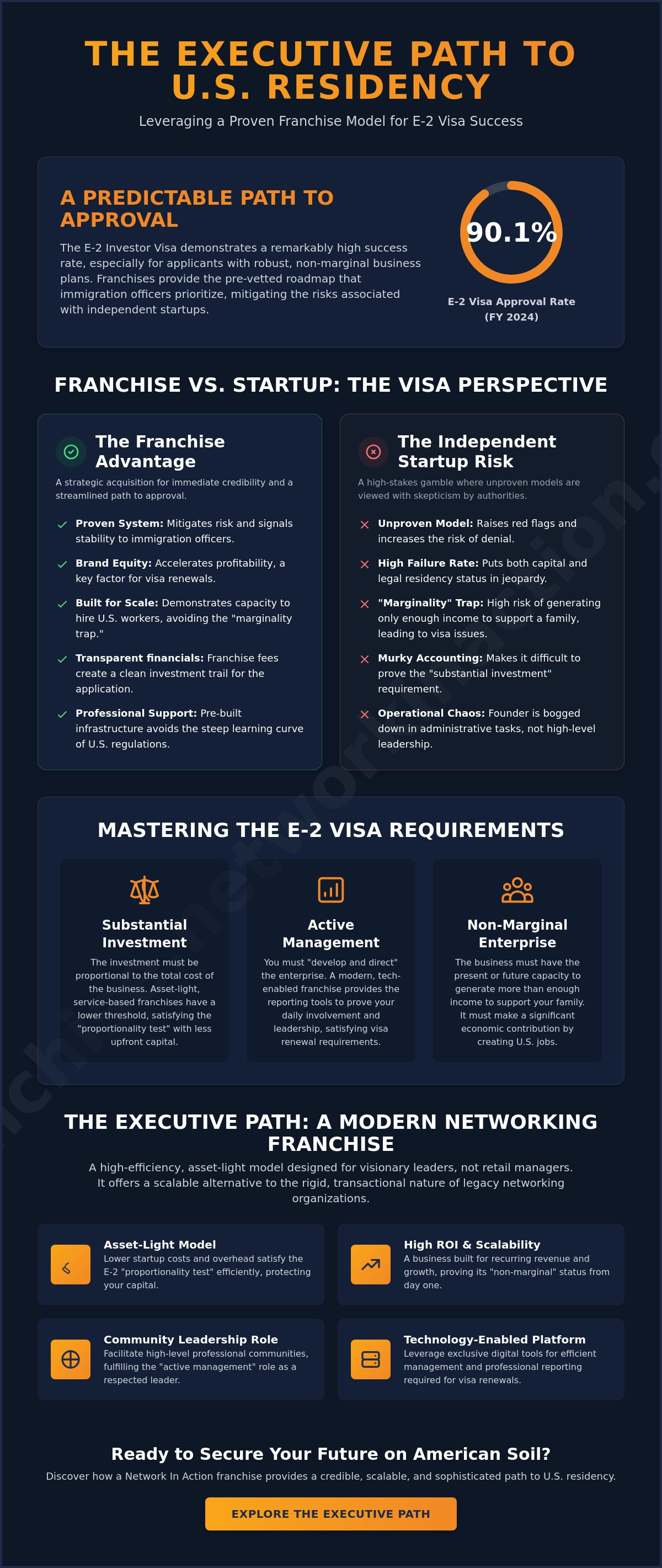
Most investors treat immigration as a legal hurdle, but elite entrepreneurs treat it as a strategic acquisition. You might wonder, is buying a franchise a good way to get a visa in 2026? The answer lies in the data. With E-2 visa approval rates reaching 90.1 percent in fiscal year 2024, the right business model doesn't just satisfy a requirement; it creates a predictable path to residency. You want a vehicle that offers professional credibility without the operational chaos of building from scratch. Proven systems. Measurable results.
It's natural to feel anxious about managing an unfamiliar U.S. workforce or facing a visa denial due to "marginal" business concerns. You deserve an investment that reflects your status as a visionary leader. This guide breaks down the financial thresholds and operational realities of the E-2 and EB-5 pathways. Discover how to bypass the inefficiencies of traditional networking and legacy business models. You'll learn to leverage a technology-led franchise that secures your future while building a high-ROI legacy on American soil.
Key Takeaways
- Understand why U.S. immigration officers prioritize proven business models that mitigate the inherent risks of independent startups for international investors.
- Determine if buying a franchise is a good way to get a visa by mastering the "proportionality test" used to evaluate substantial investments in service-based industries.
- Learn to leverage high-efficiency, asset-light models that satisfy visa requirements while protecting your professional status and capital.
- Discover the "Executive Path" to residency by facilitating high-level professional communities rather than managing a high-overhead retail workforce.
- Evaluate how modern, tech-enabled networking systems offer a scalable alternative to the rigid, transactional nature of legacy networking organizations.
The Strategic Link Between Franchising and US Visa Approval
High-level professionals prioritize certainty over speculation. When you ask, is buying a franchise a good way to get a visa, you're looking for a low-risk bridge to American residency. The E-2 Investor Visa is the most common vehicle for this transition. It requires you to invest in a "real and active" enterprise. Immigration officers are naturally skeptical of independent startups. They see unproven models as a high risk for failure. A franchise reverses this narrative. It signals to the government that you're entering the market with a proven system, a recognized brand, and professional-grade support.
The "marginality" trap is the most common reason for visa denials. This happens when a business only generates enough income to support the investor and their family. Small, independent startups often fall into this category. Franchises are built for scale. By following an established blueprint, you demonstrate the capacity to hire a US workforce and contribute to the local economy. You aren't just buying a business; you're acquiring immediate credibility with the Department of State.
Why the E-2 Visa and Franchising are a Perfect Match
The E-2 requires a "substantial" investment. While there's no fixed dollar amount, the investment must be enough to ensure the business's success. Franchise fees and startup costs create a transparent financial trail. This makes the application process significantly cleaner than the murky accounting of a new startup. In fiscal year 2024, the E-2 approval rate was 90.1 percent. This high success rate is largely due to applicants using robust, non-marginal business plans provided by franchisors. The operations manual serves as a pre-vetted roadmap. It proves the business is legitimate, active, and capable of generating significant ROI.
The Role of Active Management in Visa Success
Passive income isn't an option for visa seekers. You cannot simply "buy and hide." The E-2 requires you to "develop and direct" the enterprise. This means you must be the visionary leader at the helm. Modern technology platforms now make it easier to track and prove your daily involvement. Unlike outdated networking models that rely on manual logs, tech-forward systems provide the professional-grade reporting needed for visa renewals. Active leadership is the differentiator. It transforms you from a passive shareholder into a high-impact community leader. By leveraging exclusive digital tools, you maintain control over the business while meeting the strict "active management" requirements of US immigration law.
Why Franchises Outperform Independent Startups for Visa Applicants
Independent startups are a high-stakes gamble. For an international investor, that gamble involves more than just capital; it involves your legal right to remain in the United States. When evaluating if is buying a franchise a good way to get a visa, you must consider the structural advantages of a proven system. Independent founders often drown in the learning curve of local regulations, tax codes, and labor laws. A franchise provides a pre-built infrastructure. It offers a safety net that protects your investment and satisfies the official E-2 visa requirements for a real and active business.
Brand equity accelerates your timeline. Profitability is a vital metric for visa renewals. Franchises typically reach this milestone faster than unproven concepts because they don't waste time on brand discovery. You gain immediate access to a network of existing owners for real-world due diligence. You aren't guessing about market fit. You're executing a strategy that has already succeeded elsewhere. This level of social proof is invaluable when presenting your case to a skeptical consular officer.
Eliminating the First-Time Founder Risk
Independent startups face significantly higher failure rates in their first five years compared to established franchise systems. You don't have the luxury of trial and error. By leveraging a franchisor's established supply chains and marketing engines, you bypass the most common points of failure. There is a profound psychological benefit to following a roadmap in a new country. It allows you to focus on high-level leadership rather than getting bogged down in manual, administrative tasks. You can explore available territories to see where your professional background aligns with current market demand.
Streamlining the Business Plan for Immigration Officers
A visa application is only as strong as its business plan. Independent founders must rely on hypothetical projections that often invite scrutiny. Franchisees use historical performance data from across the system. This data-driven approach creates credible, defensible projections that immigration officers respect. Franchisors also assist with territory mapping and site selection to ensure your business meets the "active" criteria from day one. Professional training programs further solidify your case. They prove you have the specific capacity to lead the enterprise, which is a critical component of the develop and direct requirement. Many professionals find that is buying a franchise a good way to get a visa because it replaces uncertainty with a documented track record of success.
Evaluating Substantial Investment vs. Professional Impact
Many investors fall into the trap of believing they must purchase a high-overhead retail store or a fast-food outlet to satisfy US immigration requirements. This is a costly misconception. When asking is buying a franchise a good way to get a visa, you must understand the concept of proportionality. The US government doesn't require a specific million-dollar check. Instead, the investment must be substantial relative to the total cost of the business. Service-based models often require lower initial capital, with successful E-2 applications frequently seen in the $75,000 to $250,000 range. You want an asset-light model that prioritizes cash flow over inventory.
Scalability is the antidote to the "marginality" concern. Immigration officers look for businesses that can grow beyond supporting a single family. A high-efficiency franchise allows you to demonstrate significant economic impact through professional job creation and community influence. You aren't just buying a business; you're acquiring a platform for growth. By choosing a model with high growth potential, you ensure your visa renewal process is a formality rather than a fight.
Beyond Brick-and-Mortar: The Rise of Service Franchises
High-margin service models often provide a superior lifestyle compared to low-margin retail. You avoid the crushing weight of high rent, utility costs, and massive inventory during your initial relocation phase. Lower fixed costs mean you can reach profitability faster. Service-based businesses demonstrate substantial impact by employing skilled professionals and providing essential B2B or B2C solutions. This creates a clear narrative of economic contribution that immigration officers find compelling. You can review available territories to identify service gaps in your target US market.
Aligning Your Investment with Your Professional Status
Don't downgrade your professional image. Many investors make the mistake of buying low-skill franchises that require them to manage hourly labor in high-stress environments. This often clashes with an executive background. Networking and referral-based businesses appeal to high-level leaders because they leverage existing skill sets: facilitation, strategic connecting, and community leadership. You should position yourself as a sophisticated authority in your new community. Unlike outdated networking models that feel transactional and rigid, modern systems allow you to build social capital while maintaining an elite professional status. This alignment doesn't just help with your visa; it ensures your long-term fulfillment and success in the American business landscape.
The Executive Path: Why Networking Franchises Fit the E-2 Profile
Many professionals fear that moving to the US means starting over in a low-skill industry. This is a strategic error. When determining if is buying a franchise a good way to get a visa, you should look for a model that mirrors your professional status. Networking franchises represent the executive path to residency. This model requires sophisticated leadership, strategic connecting, and high-level facilitation. Instead of managing inventory or hourly staff, you manage relationships. It is a business of influence. This active leadership role is highly visible to immigration officers, making it an ideal fit for the E-2 "develop and direct" standard. Proven systems. Strategic growth.
Building Social and Financial Capital Simultaneously
For many, the answer to whether is buying a franchise a good way to get a visa depends on the level of professional status they wish to maintain. Relocating to a new market often leaves investors isolated. Leading a professional networking group changes that dynamic instantly. You aren't just another business owner; you are the facilitator of the local economy. This position allows you to build social and financial capital at the same time. You gain immediate access to high-level professionals, from attorneys to CPAs, who provide the support you need in a new country. Unlike outdated networking models that rely on forced, transactional referrals, modern systems focus on curated, high-quality relationships. This relationship-driven growth ensures long-term ROI and professional credibility.
Modern Efficiency vs. Legacy Networking Organizations
The leading brand in traditional networking often forces members into rigid, weekly 7 AM meetings. This is a time-consuming and inefficient model for modern executives. Legacy networking organizations rely on manual tracking and forced participation that creates burnout rather than growth. Modern networking franchises have solved these inherent flaws. By utilizing proprietary technology and exclusive digital tools, you can maintain high member engagement without constant manual oversight. This is the next evolution of the industry.
This tech-forward approach allows for a lifestyle-friendly business model. Monthly, high-impact meetings replace the rigid schedules of the past. You gain the freedom to scale your business while enjoying the time autonomy you've earned. It replaces the transactional nature of the past with a streamlined, technology-led solution that satisfies both your financial goals and your visa requirements. To see how this leadership role creates a professional legacy, download the franchise kit and evaluate the modern alternative to traditional networking.
Securing Your Future with Network In Action (NIA)
Network In Action represents the next evolution of professional networking. It's designed specifically for the strategic investor who values time as much as capital. If you're asking is buying a franchise a good way to get a visa, look at the scalability NIA offers. You can start with a single territory and expand into a multi-group empire. This model builds a consistent, recurring revenue stream while maintaining your professional status. You gain lifestyle autonomy without the 7 AM grind or the rigid, transactional nature of legacy networking organizations. It's a business model that respects your time and your executive background.
The NIA model provides a clear alternative to high-overhead retail investments. You aren't stuck managing a storefront or dealing with the supply chain headaches of traditional business models. Instead, you're building social capital and leading a community of elite professionals. This position of influence is exactly what US immigration officers look for in an active investor. You're contributing to the economy by facilitating growth for other American businesses. It's a high-impact strategy that secures your residency and your professional legacy simultaneously.
A Technology-Enabled Path to Visa Compliance
Documentation is the backbone of a successful visa renewal. NIA’s proprietary platform provides a clear audit trail of your active management. It tracks member engagement, referral quality, and group growth automatically. This technology-led solution replaces the manual, time-consuming tasks found in outdated networking models. For those coming from C-suite or high-level professional backgrounds, the transition is seamless. You lead. The technology handles the logistics. You aren't alone in this process; the US-based corporate team provides comprehensive training to ensure your business reflects the elite image of the brand from day one.
Next Steps for the Strategic Investor
The American market moves fast. Prime territories in high-growth regions are limited. Your first step is to review the available territories to find your new US home. Once you identify a market, consult with your immigration attorney to align the NIA model with your specific visa strategy. Moving quickly is essential. Securing a territory now ensures you enter the market with a competitive advantage. You have the opportunity to build a high-impact professional community while securing your family's future. Download the Franchise Kit today to see why is buying a franchise a good way to get a visa when you choose a model built for the modern executive.
Architect Your American Legacy
Securing a future in the United States requires more than a financial transaction; it demands a strategic alignment of professional background with a proven, scalable system. The evidence clearly shows how franchises mitigate the risks inherent in independent startups and how high-margin service models satisfy the proportionality test for investment. When evaluating if is buying a franchise a good way to get a visa, the answer lies in choosing models that leverage executive leadership rather than manual labor.
Network In Action offers the modern evolution of professional networking. With 150+ locations globally and a proprietary technology platform designed for member ROI, NIA provides the infrastructure needed to thrive. The NIA monthly meeting model ensures you maintain lifestyle autonomy while building a high-impact professional community. There is no need to choose between residency and professional status. The road to US expansion is open for those ready to lead.
Download the NIA Franchise Discovery Kit to explore your US expansion and begin the journey toward a meaningful professional legacy today.
Frequently Asked Questions
What is the minimum investment for an E-2 visa franchise?
There is no official minimum dollar amount set by the U.S. government for an E-2 visa. Instead, the investment must be "substantial" according to a proportionality test. For service-based franchises, successful applications often involve investments ranging from $75,000 to $250,000. This creates a clear financial trail that immigration officers prefer over the unproven projections of independent startups.
Can I get a green card through a franchise investment?
The E-2 visa is a non-immigrant visa, but it can serve as a strategic bridge to permanent residency. Investors often transition to an EB-5 immigrant visa once their investment reaches the $800,000 threshold in a Targeted Employment Area. This allows you to build a high-impact business first and then leverage that success into a green card application later.
Do I need to have experience in the franchise industry to get a visa?
Specific industry experience is not a legal requirement for visa approval. Immigration officers focus on your ability to "develop and direct" the business based on your executive background. Franchisors provide comprehensive training and operational blueprints that prove you have the necessary support to lead. This is one reason why is buying a franchise a good way to get a visa for C-suite professionals switching industries.
What happens to my visa if the franchise business fails?
Your legal status in the U.S. is directly tied to the active operation of your enterprise. If the business fails, you generally lose your visa status and must depart the country or find an alternative legal path. This risk is exactly why high-level investors avoid independent startups in favor of proven franchise systems with established track records and professional support networks.
Can my spouse work in the US if I buy a franchise for a visa?
Spouses of E-2 visa holders are eligible for work authorization and can be employed anywhere in the United States. They don't have to work within your franchise business. This provides your family with the flexibility to pursue multiple income streams while you focus on scaling your investment and building your professional community.
How long does the franchise visa application process take in 2026?
Timelines vary based on your location and application method. For those seeking a change of status within the U.S., premium processing for Form I-129 offers a 15-day guarantee for a fee of $2,805. Consular processing at a U.S. embassy typically takes between two and six months. Moving quickly to secure a territory is vital to stay ahead of these administrative windows.
Can I own multiple franchise locations under one E-2 visa?
You can absolutely operate multiple locations under a single E-2 visa as long as they are part of the same enterprise. Scaling to multiple units actually strengthens your visa case. It proves the business is not "marginal" and demonstrates a significant commitment to U.S. job creation and economic growth. This multi-unit approach is a hallmark of the strategic investor.
Is a networking franchise considered active management for visa purposes?
Leading a networking franchise is a high-level form of active management because it requires constant facilitation and community leadership. You aren't a passive shareholder; you are the driver of professional relationships. Modern platforms replace the manual tasks of traditional networking with technology-led solutions, providing the documented activity logs required for successful visa renewals.