The myth of the "self-made" entrepreneur is the most expensive lie in modern business. While over 500,000 new business applications were filed in April 2026, data confirms that 20% of these ventures will disappear before their first anniversary. You've spent years mastering corporate strategy; it's a mistake to waste that talent reinventing the wheel in a professional vacuum. If you are researching how to start a business with a built-in support system, the solution lies in moving beyond the rigid, transactional nature of traditional networking and legacy networking organizations.
Success requires more than just a good idea. It demands a proven operational roadmap. You likely agree that isolation is the primary enemy of growth and that building brand authority from zero is a massive time sink. This article promises a blueprint for transitioning from executive to owner by leveraging a pre-optimized framework that eliminates solo risk. It outlines a path to lifestyle autonomy and professional sophistication through a scalable model. The focus is on a results-oriented system that prioritizes high-quality relationships and measurable ROI over outdated, manual prospecting methods.
Key Takeaways
- Identify the high-risk pitfalls of the "Solopreneur Trap" and why independent startups often fail without an integrated framework.
- Learn how to start a business with a built-in support system by prioritizing operational technology, strategic training, and peer accountability.
- Discover why franchising serves as the premier strategic path for executives seeking lifestyle autonomy without sacrificing professional sophistication.
- Execute a comprehensive due diligence audit to separate modern, high-growth opportunities from stagnant, legacy networking organizations.
- Leverage relationship-driven growth and established referral networks to build a scalable business with predictable recurring revenue.
The Solopreneur Trap: Why Startups Fail Without an Integrated Framework
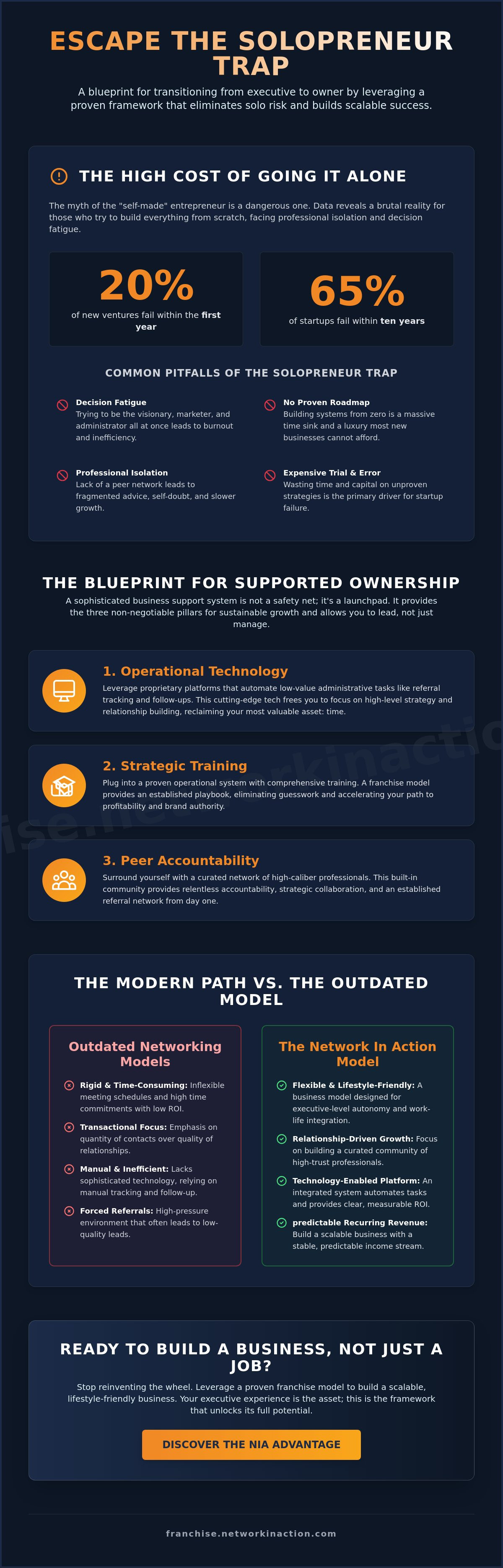
The statistics are brutal. While business applications are surging in 2026, the 10-year failure rate remains anchored at approximately 65%. Most independent startups don't fail because of a bad product. They fail because of decision fatigue. You're trying to be the visionary owner, the technical expert, and the administrative support staff all at once. This is the Solopreneur Trap. It's a state of perpetual friction where you're too busy managing the minutiae to drive the growth. It is exhausting. It is inefficient. Most importantly, it is avoidable.
High-level executives often find the transition to business ownership jarring. In the corporate world, you have departments. You have systems. You have a built-in infrastructure. Stripping that away leads to professional isolation and a lack of a proven operational roadmap. You shouldn't have to build every single system from zero. Learning how to start a business with a built-in support system is about reclaiming your time and focusing on high-value leadership rather than back-office troubleshooting.
The High Cost of Trial and Error
Trial and error is a luxury you can't afford. Building operational processes from scratch consumes months of productive time. This inefficiency often leads to running out of cash, which is a primary driver for startup failure. Beyond the financial cost, there's a psychological toll. Isolation breeds doubt. Seeking advice from generalist mentors often results in fragmented, inconsistent guidance that lacks industry-specific depth. You need a system, not a suggestion. To see how a structured model works, you can download a franchise kit to review a proven framework.
Fragmented vs. Built-In Support Systems
Traditional networking is often a piecemeal solution. You join a group, collect business cards, and hope for the best. This is the hallmark of legacy networking organizations. They are rigid, transactional, and ultimately inefficient. They lack the sophistication required for modern business growth. A built-in support system is different. It's an integrated framework where training, technology, and community are hardwired into the brand's DNA.
Franchising represents the most sophisticated version of this approach. It provides the three non-negotiables: cutting-edge operational technology, strategic training, and a peer network of high-level professionals. When you understand how to start a business with a built-in support system, you stop chasing leads and start leading a community. You shift from a manual, high-pressure sales approach to a modernized, technology-led solution that drives consistent ROI and professional credibility.
Decoding the Elements of a Sophisticated Business Support Structure
Support is not a safety net. It is a launchpad. When you evaluate how to start a business with a built-in support system, you must look for an integrated framework that functions as a single, cohesive unit. This isn't about having a phone number to call when things go wrong; it's about having a system that prevents things from going wrong in the first place. High startup failure rates prove that relying on grit alone is a losing strategy. You need three non-negotiables: operational technology, strategic training, and relentless peer accountability.
Intangible assets are the silent drivers of your ROI. Brand credibility and established referral networks allow you to bypass the years of "invisible" labor usually required to build trust in a market. A sophisticated model automates low-value tasks, such as lead tracking and administrative follow-ups, to free your schedule for high-level leadership. You're an architect, not a bricklayer. By leveraging a pre-optimized structure, you focus on scaling your influence rather than managing minutiae.
Proprietary Technology as a Growth Engine
Manual tracking is the death of efficiency. A specialized business referral platform does more than store contacts; it reduces administrative overhead by automating the referral process. This shifts the focus from "who did I talk to?" to "what is the ROI for my members?" Data-driven decision-making becomes the standard. When your technology provides real-time reporting on member engagement and financial returns, you can manage your business with corporate-level precision. This is the next evolution of the industry, replacing the "hope and pray" method with measurable results.
The Power of Curated Peer Networks
Isolation is a choice you don't have to make. Traditional networking often relies on forced participation and rigid rules that prioritize quantity over quality. A sophisticated support structure replaces this with a curated community of practice. These are fellow owners who understand your challenges because they're navigating them too. Think of this group as your external board of directors. They provide the accountability and insight necessary to scale without the friction of trial and error. If you're ready to see where this model is growing, consider exploring available territories to find your place in a modern professional community.
Why Franchising is the Strategic Path to Supported Ownership
Buying a business shouldn't mean buying a second job. For seasoned professionals, the goal is to leverage existing leadership skills without the friction of building a back-end infrastructure from scratch. This is why franchising is often described as entrepreneurship with training wheels. It provides a turnkey solution where the branding, marketing, and operations are already optimized for the 2026 market. You aren't guessing what works; you're executing a plan that has already been validated. This strategic shift allows you to focus on growth while the system manages the consistency.
If you're investigating how to start a business with a built-in support system, you must distinguish between "help" and "infrastructure." Independent startups often seek external mentors or grants, but these are fragmented solutions. A franchise offers a cohesive ecosystem. This is particularly true for a service based franchise, which prioritizes scalability and relationship capital over the logistical nightmares of product-heavy models. You're investing in a proven framework that values your time and professional sophistication.
Leveraging Established Brand Equity
Instant credibility is a powerful competitive advantage. When you enter a new market under an established banner, the national brand presence acts as a silent partner in every sales conversation. You don't have to spend years proving your legitimacy to skeptical prospects. Independent brand building is a slow, expensive process with no guaranteed ROI. In contrast, franchise entry fees grant you immediate access to a reputation that would otherwise take a decade to build. This trust is an essential asset that accelerates your path to profitability and market leadership.
The Continuous Improvement Loop
Innovation is a full-time job. In a supported model, the franchisor handles the heavy lifting of market research and technological updates. This ensures your business remains at the cutting edge without you having to personally vet every new software or marketing trend. Ongoing monthly royalty fees are not a tax on your success; they're an investment in continuous R&D. This support structure is what separates high-growth owners from those stuck in outdated networking models. A business networking franchise represents the ultimate evolution of this concept. It provides a lifestyle-friendly model that replaces the rigid, transactional nature of legacy networking organizations with a modern, technology-led community focused on measurable results.
Evaluating a Business Opportunity: A Support System Due Diligence Checklist
Due diligence is more than a financial audit; it's a structural stress test. If you're serious about learning how to start a business with a built-in support system, you must look past the marketing deck. You need to verify that the support is active, continuous, and results-driven. A system that only supports you during the launch phase is a liability. You need a model that evolves with you as you scale from a new owner to a community leader. True support isn't a one-time event; it's a permanent operational advantage.
High-level owners don't trade hours for dollars. They trade systems for results. When you examine the operational framework, look for "Lifestyle Autonomy." If a business model requires a 60-hour work week just to maintain baseline operations, it's not a supported system; it's a high-pressure job you bought for yourself. Modern support should automate the mundane, leaving you to focus on high-impact relationship building and professional growth. This balance is what separates sophisticated owners from those trapped in the technician role.
Questions to Ask During Discovery
The discovery process is your opportunity to challenge the status quo. Don't settle for vague promises of "mentorship." Ask direct, metrics-based questions to uncover the actual value of the support structure. Your goal is to identify a partner that values your time as much as you do. Use these questions to pierce through the sales pitch:
- What specific technology tools are included in my platform access fees, and how do they reduce my weekly administrative workload?
- How does the corporate office support my first 90 days of operation to ensure I hit key financial milestones?
- Can I see the referral marketing strategy that members actually use to drive ROI within the groups?
- Is the training a one-time onboarding event, or is there a continuous professional development program for seasoned owners?
Identifying "Red Flag" Support Systems
Beware of models that feel like legacy networking organizations. If the support system prioritizes rigid, transactional attendance over actual business results, it's outdated. You should also avoid any system that lacks a proprietary technology differentiator. In 2026, a generic CRM isn't enough. You need a platform that solves specific market pain points through automation and data. Finally, question any model that doesn't provide a clear franchise roi calculator for your specific territory. Transparency is the hallmark of a sophisticated partner. If you're ready to audit a modern framework, download the franchise kit to see how a results-oriented system operates.
Network In Action: Where the Support System Is the Business
Network In Action (NIA) represents the modern evolution of professional networking. It isn't just a business opportunity; it's a technology-led solution for leaders who value their time. While outdated networking models rely on rigid, weekly commitments and transactional interactions, NIA prioritizes quality and efficiency. This is how to start a business with a built-in support system that actually scales. You aren't just joining a community; you're leading one using a framework designed for the 2026 economy. Results matter. Efficiency is king.
The "No Forced Referrals" philosophy is a critical marker of professional sophistication. Legacy networking organizations often mandate a specific number of referrals, leading to low-quality leads and professional friction. NIA disrupts this by focusing on relationship-driven growth. By removing the pressure of forced metrics, the system fosters genuine trust and high-level connections. This results-oriented approach ensures that every interaction adds value to your portfolio and your members' businesses. It's a superior alternative built for those who demand measurable ROI.
A Tech-Forward Approach to Referrals
Efficiency is the cornerstone of the NIA model. The proprietary platform automates the "busy work" that typically plagues community leaders. Instead of manual tracking and cumbersome follow-ups, the technology handles the administrative heavy lifting. This allows you to focus on high-impact coaching and community building. When you utilize the built-in Franchise Kit, you gain access to a rapid deployment system that solidifies your personal brand as an industry authority. It's a sleek, modern alternative to the manual processes found in traditional networking.
Your Path to Strategic Ownership
Transitioning from executive to owner requires a shift in mindset and infrastructure. You've spent your career managing systems; now it's time to own one. The NIA franchise is a vehicle for financial return and significant community impact. It offers the lifestyle autonomy you crave without sacrificing the corporate sophistication you've earned. By leveraging this pre-optimized framework, you eliminate the risks of solo entrepreneurship and step into a role of visionary leadership.
If you're ready to discover how to start a business with a built-in support system, your next step is alignment with a brand that values measurable results and professional credibility. This is about more than starting a company. It's about leading the next evolution of your industry. Download the NIA Franchise Kit to explore available territories and begin your journey toward strategic ownership.
Lead the Evolution of Professional Networking
The era of trial-and-error entrepreneurship is over. You've spent years building corporate expertise; it's time to apply that talent to a model that rewards your leadership without the friction of a solo startup. Escaping the solopreneur trap requires more than just grit. It demands a proven operational roadmap and a community of high-level peers. When you understand how to start a business with a built-in support system, you stop chasing leads and start managing a high-growth asset.
Network In Action offers a streamlined path to ownership that prioritizes your time and professional credibility. With over 150 global locations and a proprietary technology platform, the infrastructure is already built, tested, and ready for deployment. The monthly meeting model is specifically designed for lifestyle autonomy, allowing you to drive significant community impact while maintaining control over your schedule. This is the sophisticated, results-oriented alternative to outdated networking models.
Don't settle for a business that drains your resources. Choose one that amplifies your influence. Download your Free Franchise Discovery Kit and find available territories to begin your transition from executive to strategic owner. Your market is waiting for a modern leader. It's time to take your place.
Frequently Asked Questions
What is a built-in support system in a business context?
A built-in support system is an integrated infrastructure where operational tools, training, and a peer network are hardwired into the business model. Unlike fragmented support, this framework ensures you don't have to source individual solutions for marketing, technology, or strategy. It provides a cohesive roadmap that eliminates the trial-and-error phase of growth. This allows high-level professionals to leverage a pre-optimized system for immediate impact.
How does a franchise provide better support than a solo startup?
Franchising offers a pre-optimized framework that a solo startup lacks. While independent owners must build every operational process from zero, a franchise provides a turnkey system with established brand equity. This structure significantly reduces the risk of failure by providing a validated blueprint for success. It's a strategic move that allows you to focus on leadership instead of administrative troubleshooting or building systems from scratch.
Is a built-in support system worth the cost of royalty fees?
Royalty fees are a strategic investment in continuous research, development, and technological updates. These fees fund the infrastructure that keeps your business at the cutting edge of the industry. Instead of bearing the full cost of tech innovation and market analysis alone, you leverage the collective power of a larger organization. This investment ensures your business remains competitive and efficient in a rapidly evolving market.
Can I still have autonomy if I use a business support system?
Yes; a sophisticated support system actually increases your autonomy by automating low-value tasks. By offloading administrative burdens to a tech-forward platform, you gain the freedom to focus on high-impact community leadership. This model provides the structure needed for lifestyle autonomy. You own the business; the business doesn't own you. It's about working on the business rather than being trapped as a technician within it.
What should I look for in a franchise training program?
Look for a program that offers continuous professional development rather than a one-time onboarding event. A high-quality program should cover operational technology, relationship-driven growth strategies, and leadership skills. Verify that the training is updated to reflect current market dynamics. Effective training should empower you to navigate the complexities of modern networking and community management with confidence and professional precision.
How does technology play a role in modern business support?
Technology is the engine that drives modern business efficiency. A proprietary platform should automate referral tracking, member engagement, and ROI reporting. This reduces administrative overhead and provides data-driven insights for better decision-making. When you research how to start a business with a built-in support system, prioritize models that use technology to replace the manual, time-consuming processes found in legacy networking organizations.
What is the difference between a mentor and a built-in support system?
A mentor provides external advice, while a built-in support system provides an internal infrastructure. Mentorship is often hit-or-miss and lacks the operational tools needed for daily execution. An integrated system includes the technology, training, and peer networks necessary to run the business. It's the difference between hearing how to succeed and having the actual tools required to achieve that success in a professional environment.
How long does it take to launch a business with a built-in system?
Launching with a built-in system is significantly faster than building an independent brand. Because the branding, marketing materials, and operational technology are already prepared, you can often be operational within 60 to 90 days. Learning how to start a business with a built-in support system is about accelerating your speed to market. This rapid deployment allows you to generate recurring revenue much sooner than a solo venture.