Why are you still sacrificing your most productive hours to legacy networking organizations that prioritize attendance over actual revenue? Most high-level executives are tired of the forced referral grind and the blatant inefficiency of traditional networking models. If you're ready to stop being a face in the crowd and start owning the room, you need to understand how to become a community leader in business. This isn't about joining another group. It's about shifting to a modern, tech-enabled system that converts your professional social capital into a scalable, high-impact asset.
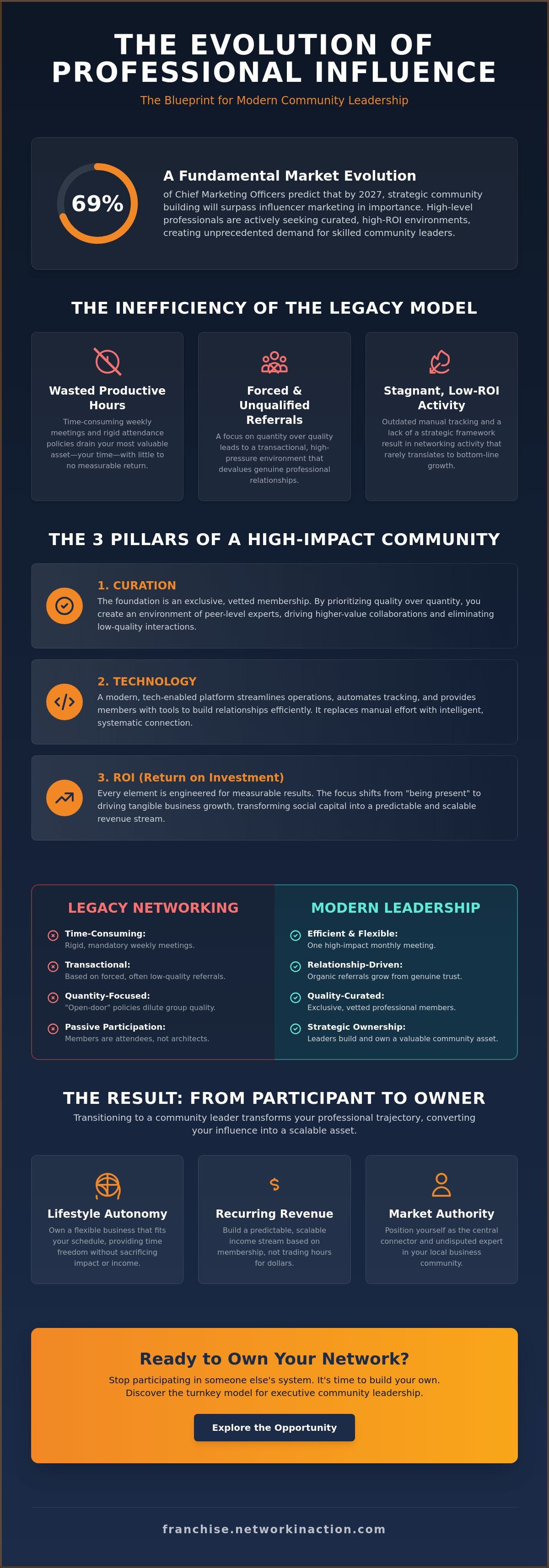
With 69 percent of CMOs predicting that community building will surpass influencer marketing by 2027, the demand for high-quality, curated professional spaces has never been higher. You likely agree that your time is too valuable for low-quality referral groups and manual tracking systems that lead nowhere. This article promises to show you how to transition from a participant to an influential leader who commands a premium local market position. The following sections explore the blueprint for building a tech-forward network that offers true time freedom and the professional authority you've earned.
Key Takeaways
- Learn how to shift from a passive network participant to a strategic architect of influence by curating high-level professional environments.
- Discover the exact roadmap for how to become a community leader in business while avoiding the common pitfalls of outdated networking models.
- Identify the three essential pillars of modern communities, which are Curation, Technology, and ROI, to ensure every interaction drives measurable results.
- Stop wasting time on the forced referrals and rigid schedules typical of legacy networking organizations in favor of a flexible, executive-grade system.
- Explore the path to lifestyle autonomy by leveraging a turnkey business opportunity that scales your professional credibility into a recurring revenue stream.
The Evolution of Professional Influence: Why You Should Become a Community Leader in Business
Influence isn't found in a stack of business cards. It's built through ownership. For years, professionals have been taught to "consume" networking by attending endless breakfast meetings and chasing forced referrals. This is the legacy model. It's inefficient. It's outdated. True power lies in becoming an architect of influence rather than a mere participant. When you learn how to become a community leader in business, you stop asking for a seat at the table and start building the room yourself. You transition from a seeker to a provider.
Business community leadership is the strategic curation of professional talent. It's about selecting the right people, managing the environment, and driving measurable results. By 2026, the market has shifted. High-level professionals are deserting mass-market events. They want curated, high-ROI environments where their time is respected. Research shows that 69 percent of CMOs believe community building will surpass influencer marketing by 2027. This isn't a trend; it's a fundamental market evolution. Leading a community establishes you as the undisputed authority in your local market. You aren't just another service provider. You're the gatekeeper. You're the connector. You're the expert.
The Distinction Between Networking and Leading
Traditional networking is transactional. It’s a hunt for the next lead. Leadership is transformational. It’s relationship-driven. A community leader controls the quality of the room, ensuring that every member meets a specific standard of excellence. Participants are subject to the room's quality; leaders define it. When you own the network, you create a consistent, automated stream of high-value referrals that bypasses the friction of legacy networking organizations. You aren't just attending a meeting; you are facilitating a high-stakes business exchange. This shift from participant to owner changes your professional trajectory overnight.
The Economic Value of Social Capital
Social capital is a measurable business asset in 2026. It is no longer a "soft" skill; it is a line item on your balance sheet. Community leaders leverage this capital to bypass cold prospecting entirely. Why hunt for leads when the leads are already in your ecosystem? This represents informed disruption. You're replacing manual, high-effort prospecting with a streamlined, technology-led system. It’s about working smarter, not harder. By mastering how to become a community leader in business, you transform your social capital into a recurring revenue engine that provides both financial returns and lifestyle autonomy. You stop trading hours for dollars and start building an asset that scales with your influence.
The Anatomy of a High-Impact Business Community in 2026
High-impact communities aren't built on hope. They are engineered. If you're serious about how to become a community leader in business, you must understand that the modern executive group rests on three non-negotiable pillars: Curation, Technology, and ROI. Traditional networking models fail because they lack these foundations. They prioritize warm bodies over high-level talent. In 2026, quality is the only metric that matters. Professionals are no longer willing to tolerate the "open-door" mediocrity of legacy organizations. They want exclusive rooms filled with peers, not prospects. Systematic efficiency. Scalable growth. Measurable returns.
Efficiency is the new currency. Successful executive groups have moved away from the rigid, time-consuming weekly meetings favored by outdated networking models. A monthly commitment respects the executive schedule while maintaining high-intensity momentum. This shift allows for deeper strategic discussions and actual business development rather than repetitive attendance checks. When members spend an average of 32 minutes per visit in engaged communities, that time must be high-value. Every minute must contribute to the bottom line.
Curation: The Art of the Exclusive Room
Vetting members is your most critical task. An open-door policy dilutes the value of a professional group and eventually drives away top-tier talent. To succeed, you must develop strong and credible leadership skills that allow you to filter for quality. Your goal is to identify high-potential members who contribute to a referral-based business empire. You are not just filling seats; you are curating an ecosystem of influence. When the room is exclusive, the ROI is inevitable.
Technology-Enabled Connectivity
Connectivity shouldn't end when the meeting does. Modern leaders use a business referral platform to eliminate the friction of manual tracking. Paper-and-pen referral logs are relics of a slower era. Today, real-time ROI dashboards provide total transparency and accountability. Digital tools foster 24/7 engagement without causing leader burnout. This tech-forward approach ensures that the network remains active and productive between sessions. If you're ready to lead a sophisticated network, you might want to check available territories to see where your influence is needed most.
Moving Beyond the Legacy Model: Why Traditional Networking Fails Modern Leaders
Legacy networking organizations operate on a 1980s playbook. They rely on volume, not value. If you're figuring out how to become a community leader in business, you quickly realize that rigid attendance policies and forced referral quotas are the enemies of executive productivity. Outdated networking models treat high-level business owners like entry-level sales reps. They demand your presence every week, regardless of your schedule or the quality of the room. This is why the leading brand in the industry often sees a revolving door of talent. High-performers don't have time for busywork. They want results. They want impact. They want a system that scales with their ambition, not one that anchors them to a weekly breakfast meeting.
The failure of traditional networking lies in its inability to adapt to the modern executive's needs. These groups focus on "showing up" rather than "leveling up." When the primary metric of success is attendance, the actual business value becomes secondary. Modern leaders understand that influence isn't measured by hours spent in a folding chair; it's measured by the quality of the connections made and the ROI generated from those interactions.
The Problem with Forced Referrals
Forced referrals are a cancer to professional credibility. When a group requires a specific number of leads per week, members stop looking for quality and start passing "junk" leads just to satisfy a quota. This damages trust. It wastes time. A true leader understands that organic, relationship-driven referrals are the only sustainable growth strategy. You aren't a "referral police officer." You are a facilitator of high-trust connections. Programs in Business and Community Leadership highlight that influence is built on trust, not transactions. By removing the pressure of artificial quotas, you foster an environment where only high-value opportunities are exchanged. This creates a culture of excellence where members protect the brand’s integrity as much as their own.
Efficiency as a Competitive Advantage
The most common objection to professional networking is simple: "I don't have time." In legacy systems, that's a valid point. Spending 50+ hours a year in weekly meetings is a massive drain on C-suite resources. Modern leaders offer a streamlined monthly model instead. This respects the executive schedule. It transforms networking from a chore into a strategic monthly event that people actually look forward to attending. When you respect your members' most valuable asset, you attract a higher caliber of professional. You can still reap the benefits of business networking without the soul-crushing time commitment of outdated models. Efficiency isn't just a perk. It's your competitive advantage in a market saturated with low-quality options.
Strategic Implementation: How to Build and Scale Your Business Community
Execution is the differentiator. Many professionals understand the theory of influence, but few possess a tactical go-to-market plan. If you are committed to learning how to become a community leader in business, you must move beyond vague intentions. You need a system. Building a network from scratch is a high-risk, low-reward venture for a busy executive. It requires an immense time investment that most high-performers simply cannot afford. Instead, the strategic path involves five decisive steps to establish a professional ecosystem that runs with precision and delivers a massive ROI.
- Step 1: Define your niche. Identify the specific professional pain points you solve. Don't just build a "local group." Build a strategic alliance of high-level talent.
- Step 2: Secure a turnkey business opportunity. Avoid the friction of building infrastructure from zero. Use a model that is already optimized for the 2026 market.
- Step 3: Leverage tech. Use a technology-led solution to automate membership management and referral tracking. Manual systems are for hobbyists.
- Step 4: Quality-first recruitment. Fill the room with vetted professionals. One high-caliber member is worth ten average participants.
- Step 5: Facilitate for ROI. Meetings must focus on high-level strategy. Eliminate the 60-second elevator pitch. Prioritize deep business development.
Launching with a Proven Framework
Speed to market matters. Attempting to invent your own networking model is often a recipe for burnout. Legacy networking organizations have left a vacuum of quality that you can fill by using an established business networking franchise model. This framework allows you to go from a mere concept to your first high-impact meeting in under 90 days. You bypass the trial-and-error phase. You gain immediate access to proprietary tools. You lead with confidence because the system is already proven to work. This is how you become a community leader in business without sacrificing your current professional commitments.
Scaling Through Community Leadership
Ownership offers scalability. Once you have mastered one group, the potential for multiple groups creates a powerful, recurring revenue stream. This is where lifestyle autonomy becomes a reality. You maintain quality control through standardized systems, ensuring that as the network expands across territories, the executive-level experience remains intact. Community is the ultimate retention tool. When members see consistent, tech-enabled results, they don't leave. They become your strongest advocates. If you are ready to stop participating and start owning, you should download the franchise kit to see the full implementation blueprint.
Owning the Network: The NIA Model for Executive Community Leadership
Network In Action (NIA) represents the modern evolution of professional networking. It is a sophisticated system engineered for high-level executives who are ready to stop participating in inefficient groups and start leading their own. This is the definitive solution for those researching how to become a community leader in business while maintaining their current professional trajectory. NIA removes the friction common in legacy networking organizations. No forced referrals. No weekly grind. No manual tracking. Instead, you lead a curated group of top-tier talent using a model that prioritizes quality, efficiency, and measurable ROI. This is informed disruption in action.
The franchise model provides a strategic path to lifestyle autonomy. You aren't just running a group; you're building a scalable business asset with real equity. NIA supports its leaders with a robust infrastructure that has already solved the inherent flaws of outdated networking models. This allows you to focus on high-value relationship building rather than administrative busywork. To ensure consistent growth, NIA provides its owners with several key pillars of support:
- Comprehensive Training: Master the NIA methodology through expert-led onboarding and continuous education.
- Global Brand Equity: Leverage a recognized name in modern networking to attract top-tier talent in your market.
- Proprietary Tech: Access exclusive digital tools designed to automate the referral ecosystem and reduce overhead.
- Community Support: Benefit from a network of fellow owners and corporate leaders committed to shared success.
The ROI of NIA Leadership
Success is measured in metrics. The NIA model is built on a recurring revenue stream derived from membership fees, creating a consistent and predictable income stream. Unlike one-off sales models, this approach rewards long-term community stability and growth. The proprietary NIA technology platform is a key differentiator, significantly reducing the administrative overhead typically associated with community management. It automates the referral process and tracks ROI in real time. To understand the full economic potential of this system, you should download the franchise kit for a deep dive into the financial framework.
Your Next Step: From Executive to Community Owner
Transitioning from an executive to a community owner is a calculated move. It requires a mindset shift from being a consumer of networks to becoming an architect of influence. The demand for high-quality professional spaces is at an all-time high, and the opportunity to secure your local market is a time-sensitive advantage. You can explore available territories to see where you can establish your footprint. This is not about joining another group. This is about mastering how to become a community leader in business by aligning with a disruptive philosophy that values your time and your results. Own the room. Own the network. Own your future.
Step Into the Future of Professional Influence
The transition from participant to architect is the most strategic move an executive can make in today's market. By prioritizing curation over volume and efficiency over manual effort, you establish a high-ROI ecosystem that benefits every member. You've seen the limitations of outdated networking models and the power of a tech-enabled, relationship-driven approach. Mastering how to become a community leader in business means replacing the weekly grind with a streamlined monthly system that respects your time and maximizes your authority. This isn't just about making connections. It's about owning the network.
Network In Action represents the next evolution of the industry. With over 150 locations globally, the model is proven to deliver results. It leverages a proprietary technology platform to ensure measurable member ROI while maintaining a modernized monthly meeting model that fits the executive lifestyle. This is your opportunity to convert social capital into a scalable, professional asset that provides both financial returns and lifestyle autonomy. Now is the time to align your professional influence with a model built for the modern era.
Discover how to own your local business network and lead with NIA. The path to leadership and meaningful impact is ready when you are.
Frequently Asked Questions
How much time does it take to lead a business community effectively?
Leading a group effectively requires roughly five to ten hours of focused work per month. Unlike legacy networking organizations that demand a weekly presence, the modernized monthly model respects the executive schedule. The proprietary technology platform handles the administrative heavy lifting, such as referral tracking and membership management. This efficiency allows you to focus on high-value relationship building rather than logistics. It is the perfect fit for professionals who want to maximize influence without burnout.
Can I become a community leader while still working a full-time job?
Yes, leading a community is possible while maintaining a full-time career. The NIA system is specifically designed for high-level professionals who value time freedom and lifestyle autonomy. Because the model uses a turnkey infrastructure, there is no need to build the business from scratch. Leaders simply facilitate the monthly meetings and use the digital tools to manage the network. It is a strategic path to ownership that scales alongside existing professional commitments.
What is the difference between a traditional networking group and an NIA group?
The primary difference lies in efficiency and the quality of interactions. Traditional networking models rely on rigid weekly meetings and forced referral quotas that often lead to low-quality leads. NIA eliminates these outdated practices by utilizing a monthly meeting format and focusing on curated, relationship-driven growth. The technology-enabled platform provides real-time ROI tracking, ensuring that every member sees measurable financial value without the fatigue associated with legacy organizations.
Do I need prior experience in franchising to lead a business network?
Prior franchising experience is not required to succeed in this role. NIA provides comprehensive training and ongoing support to help you master how to become a community leader in business. The brand offers a proven framework and global equity that bypasses the trial and error of starting a new venture. If you possess strong leadership skills and a desire to curate a high-impact network, the system handles the operational complexities for you.
How does technology help in managing a professional community?
Technology serves as the backbone of a modern professional community by automating the referral ecosystem. Paper logs are relics of a slower era. The proprietary platform provides real-time ROI dashboards and 24/7 connectivity between members. This reduces administrative overhead for the leader and ensures the network remains active and productive between sessions. It allows for the management of multiple groups with surgical precision and minimal manual effort.
What are the primary revenue drivers for a community leader in business?
The primary revenue driver is a consistent, recurring stream from membership fees. As a community leader, you build a business asset where income is not tied to one-off sales or hourly consulting. This provides a predictable financial return that grows as the network expands. By leveraging the NIA model, you can scale into multiple groups or territories, increasing earning potential while maintaining the lifestyle flexibility that traditional executive roles often lack.
How do I ensure the quality of members in my business network?
Quality is ensured through a rigorous vetting process and a "quality over quantity" philosophy. As a leader, you serve as the gatekeeper of the room. You select members based on their professional talent and their ability to contribute to a high-trust environment. This curation prevents the dilution of value often seen in "open-door" legacy networking organizations. When the room is exclusive and high-caliber, the referral quality and member retention naturally follow.
Is business community leadership a scalable model for long-term growth?
Business community leadership is a highly scalable model designed for long-term equity growth. Once you master the operation of your first group, you can expand into multiple territories or launch specialized niche groups. The recurring revenue model and tech-forward infrastructure allow for expansion without a proportional increase in your time commitment. It is a strategic way to build professional credibility while creating a lasting business asset that provides true time freedom and meaningful impact.