The most profitable asset in 2026 isn't a brick-and-mortar storefront or a fast-food counter. It's the professional ecosystem that fuels every other business in your city. You've likely spent years climbing the corporate ladder only to realize the grind offers no real equity or autonomy. You're rightfully skeptical of high-overhead retail models and the rigid, transactional nature of legacy networking organizations. You want a business that scales without a massive headcount. When asking if a B2B franchise is a good investment, the answer lies in the shift toward recurring revenue and professional influence.
High-level executives are currently abandoning outdated models to secure lifestyle autonomy through a modernized B2B approach. With the U.S. franchise sector projected to generate approximately $921.4 billion in output this year, the opportunity for strategic growth is clear. This executive analysis explores why owning the professional community is the next evolution of the industry. It provides a roadmap for leveraging exclusive digital tools to replace cold prospecting with relationship-driven growth. Discover how to build a business that prioritizes efficiency, structure, and measurable ROI while reclaiming your time and professional status.
Key Takeaways
- Prioritize profitability over visibility by shifting from high-overhead B2C retail to high-margin business service models.
- Analyze how recurring revenue streams and low-overhead frameworks prove why a B2B franchise is a good investment for long-term stability.
- Replace time-consuming legacy networking organizations with a modernized system that values executive time and high-quality professional connections.
- Utilize an investor's checklist to evaluate the lifestyle-to-income ratio, ensuring your business scales without a massive headcount.
- Secure professional influence by owning the ecosystem other businesses depend on, using a tech-forward platform designed for the 2026 market.
What is a B2B Franchise and Why Does it Outperform B2C in 2026?
A business-to-business (B2B) franchise operates on a simple, powerful premise: providing essential services, technology, or professional systems to other companies instead of individual consumers. While retail and food franchises rely on foot traffic and fickle consumer trends, B2B models thrive on corporate necessity and contract-based stability. In the 2026 economy, the focus has shifted from high-visibility storefronts to high-margin service delivery. If you're asking if a is a B2B franchise a good investment, look at the massive shift toward lean, specialized operations. High-level professionals are no longer interested in the "visibility" of a sign on a building. They want the "profitability" of a scalable system that leverages their existing professional expertise.
B2B vs. B2C: The Fundamental Shift in 2026
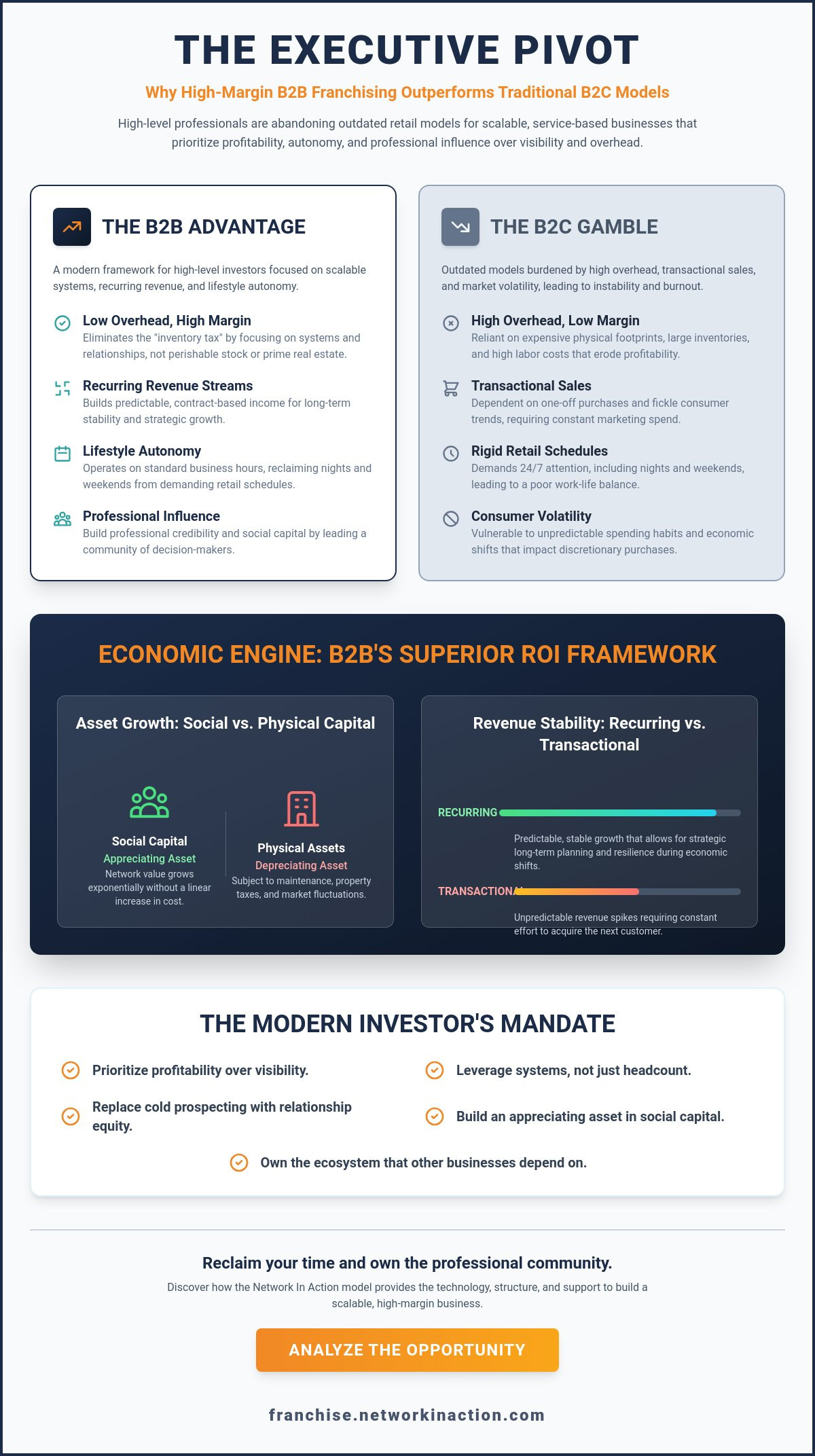
Consumer volatility has become the primary risk factor for traditional retail investments. Between shifting labor costs and unpredictable spending habits, the B2C sector remains a gamble for many. In contrast, the B2B sector offers contract stability. This is the "Executive Pivot." C-suite leaders are increasingly choosing the franchising business model to build professional credibility among peers rather than managing retail customers. You don't want to manage a high-turnover hourly workforce. You want to lead a community of decision-makers. This environment allows you to operate as a consultant and leader, not just a manager of commodities. You can check available territories to see where this leadership is currently needed most.
The Hidden Advantages of the B2B Model
Efficiency is the core differentiator. B2B franchises typically require lower inventory and a significantly reduced physical footprint. You aren't paying for prime retail real estate that sits empty half the day. Instead, you're investing in systems and relationships. Consider the lifestyle benefits. Standard business hours are the norm. You can reclaim your weekends from retail schedules that demand 24/7 attention. B2B models also boast higher average transaction values and superior client retention rates. Once a business integrates your service into their operations, they don't just leave for a cheaper coupon. They stay for the results. This creates a foundation of recurring revenue that retail models simply can't match. It's a sophisticated approach for a sophisticated investor who values time as much as capital.
Analyzing the Economics: Why B2B Models are a Superior Investment
The economic engine of a B2B franchise outperforms traditional retail because it eliminates the "inventory tax" on your time and capital. When analyzing if is a B2B franchise a good investment, the focus must be on the "Low Overhead, High Margin" framework. Service-based models don't require massive warehouses or perishable stock. They require systems. This lean structure ensures that a larger percentage of every dollar earned stays in the business as profit. High-level investors frequently discover that a B2B franchise is a good investment because the scalability is built into the software, not the headcount.
Recurring revenue is the true differentiator. Unlike the one-off transactional sales found in the food or retail sectors, modern B2B models are built on long-term professional relationships. This predictability allows for strategic planning rather than constant firefighting. You aren't chasing the next customer; you're deepening the value of your existing network. This resilience is why B2B franchises are historically more stable during economic shifts. Businesses may cut luxury spending, but they rarely cut the essential services and connections that drive their own growth.
ROI Metrics: B2B Franchising vs. Traditional Real Estate
Traditional investors often default to real estate, yet physical assets depreciate. Maintenance costs rise. Property taxes fluctuate. In contrast, B2B franchising focuses on "social capital." This is an appreciating asset. As your network grows, its value increases exponentially without a linear increase in your labor or rent. Service models often achieve a faster "Time-to-Profit" metric because they lack the long construction and permitting phases of retail. Before committing capital, you should realize investing in a B2B franchise requires a deep dive into these specific economics. To see the numbers in action, you can calculate your potential ROI with NIA's economics.
The Value of Proprietary Technology in B2B
Modern B2B operations in 2026 rely on tech-enabled platforms to maintain high-touch relationships without a massive administrative headcount. Automation handles the heavy lifting of scheduling, data tracking, and reporting. This allows you to focus on high-level strategy and community leadership. Tech-forward systems provide data-driven insights that outdated networking models simply can't offer. You're not just running a business; you're operating a sophisticated digital ecosystem. This efficiency is what allows the model to scale. You don't need more people to make more money. You need better systems. If you're ready to move beyond the limitations of legacy industries, you can explore how NIA's technology drives results in your region.
Relationship Equity: Moving Past Outdated Networking Models
Professional success in 2026 isn't about the number of business cards you collect. It's about the quality of the ecosystem you control. Determining if is a B2B franchise a good investment requires a shift in perspective from transactional sales to relationship equity. For years, the industry has been dominated by legacy networking organizations that prioritize quantity over quality. These models rely on forced referrals and rigid weekly meetings that feel more like a chore than a strategic business activity. They're relics of a pre-digital era. You don't need another obligation on your calendar. You need a platform that turns your existing professional network into a scalable asset.
The executive advantage lies in moving from cold prospecting to community leadership. Instead of hunting for individual leads, you lead the group that generates them. This transition allows you to leverage your years of corporate experience to curate a high-level environment of peers. You aren't a salesperson; you're a facilitator of growth. This distinction is critical for high-level professionals who want to maintain their credibility while building a recurring revenue stream.
The Flaws of Traditional Networking Systems
Outdated networking models are built on inefficiency. They demand a high cost of time for a low quality of return. Mandatory referral requirements often lead to "junk" leads that waste everyone's time. When participation is forced, the value of the connection evaporates. These legacy systems trap members in a cycle of repetitive meetings without providing the modern tools necessary for real-time collaboration. To understand how the market has shifted, you can explore the evolution of professional networking and why these older frameworks are failing today's entrepreneurs.
- Rigid Structures: Fixed weekly schedules that ignore the reality of an executive's life.
- Transactional Focus: A "tit-for-tat" mentality that undermines genuine relationship building.
- High Turnover: Low-quality memberships lead to constant churn and instability.
Informed Disruption: The Modern Networking Alternative
The modern approach to B2B franchising is built on informed disruption. It replaces the "weekly grind" with a monthly high-impact meeting, respecting the time and schedule of busy professionals. This model utilizes a tech-enabled platform to keep members connected and engaged between sessions, ensuring that relationship building happens organically and efficiently. Exclusivity is the draw. By curating a membership of high-level decision-makers, you create an environment where every interaction has a measurable ROI. This results-oriented leadership is what differentiates a modern franchise from a legacy club. It’s about building a business that scales through influence, not just effort. If you're ready to see if your market is open, you can check available territories to begin your transition into community leadership.
The Investor's Checklist: 5 Metrics for Evaluating a B2B Franchise
Rigorous due diligence is the only way to determine if is a B2B franchise a good investment for your specific portfolio. You aren't just buying a brand; you're acquiring a system. Professional investors evaluate opportunities based on measurable scalability and operational efficiency. In 2026, state regulators have increased scrutiny on Franchise Disclosure Documents (FDDs), particularly regarding financial performance representations. You must look past the marketing gloss to find the underlying business logic. Use these five metrics to audit any potential B2B opportunity.
- Financial Transparency: Scrutinize Item 19 of the FDD. Look for audited financials that demonstrate consistent income potential across diverse territories.
- Lifestyle-to-Income Ratio: Analyze the time required to generate a specific return. If the model requires 60 hours a week to maintain, you've bought a job, not an investment.
- Technology Infrastructure: Evaluate the tech stack. A modern platform should automate administrative tasks, leaving you free to focus on high-level relationship building.
- Territory Exclusivity: Confirm your "professional moat." Ensure your territory is protected and offers enough density of high-level businesses to support long-term growth.
- Executive Alignment: Audit the training programs. The franchisor must demonstrate a sophisticated understanding of B2B dynamics and peer-to-peer leadership.
Due Diligence: Beyond the Initial License Fee
The initial investment is only the starting point. You must understand the total cost of ownership, including ongoing royalty structures and technology fees. These costs should be viewed as investments in the system's evolution. In high-growth B2B sectors, territory reservation is critical. Securing a prime market now prevents future saturation and protects your professional equity. You can check available territories for 2026 to see where the most strategic opportunities remain.
Identifying 'Lifestyle' Franchises vs. 'Job' Franchises
The core question is simple: does the business own you, or do you own the business? Legacy networking organizations often trap owners in a "weekly grind" of rigid, mandatory meetings. This is a job franchise. Modern B2B models utilize monthly operational cycles and tech-enabled engagement to deliver superior results with less manual labor. This efficiency is vital for maintaining mental health and achieving a true ROI on your time. To understand how to pivot toward a model that respects your schedule, you should download the 2026 Executive Guide to Modern Ownership. Reclaim your autonomy by choosing a system built for leaders, not employees.
Ready to lead your own professional community? Explore available territories and secure your market today.
Network In Action: The Modern Evolution of B2B Franchise Ownership
Network In Action (NIA) represents the next evolution of the industry. While legacy networking organizations rely on manual tracking and rigid schedules, NIA leverages a tech-forward approach to maximize your professional influence. When you evaluate if is a B2B franchise a good investment, consider the value of owning a system that respects your time. The monthly meeting structure is designed for the executive schedule. It replaces the "weekly grind" with high-impact sessions. This efficiency allows you to build a recurring revenue stream without sacrificing your lifestyle autonomy.
Proprietary technology is the core differentiator. NIA provides an exclusive platform that turns professional relationships into a structured, scalable asset. You aren't just facilitating a group; you're leading a tech-enabled community where every referral and connection is documented. This data-driven approach allows you to scale your influence across multiple territories. You move from the corporate grind to community leadership. This is business ownership designed for the 2026 market.
The NIA Differentiators: No Forced Referrals, Pure ROI
NIA is built on a philosophy of quality over quantity. Unlike outdated networking models that demand "tit-for-tat" transactional referrals, NIA focuses on curated memberships of high-level decision-makers. This ensures that every interaction has genuine professional value. The technology-enabled platform keeps members connected in real-time, removing the "legacy fluff" of manual reporting. You can learn the science of referral marketing through NIA's exclusive resources to see how this modernized approach drives superior outcomes.
- Curated Membership: High-level professionals only, ensuring peer-to-peer value.
- Monthly Meetings: Respects the executive schedule while maintaining momentum.
- Measurable ROI: A commitment to tracking results that legacy models can't match.
Your Path to Community Leadership and Financial Freedom
Owning an NIA franchise enhances your professional brand. You become the center of growth in your region. The transition from a corporate role to a business owner can happen in as little as 90 days, providing a streamlined path to autonomy. This model allows you to leverage your expertise to build a business that offers recurring revenue. To deepen your understanding of how to build trust-based growth, you can read more on referral marketing strategies. If you're ready to secure your professional future, explore how your leadership aligns with the NIA vision. Discover the potential in your market and take the first step toward strategic ownership today.
Secure Your Strategic Professional Legacy
The 2026 executive pivot is about more than just changing careers. It's about securing a business model that prioritizes your time while maximizing your influence. You've seen why high-overhead retail is a liability and why outdated networking models fail to deliver executive-level results. When evaluating if is a B2B franchise a good investment, the evidence points toward systems that leverage social capital through proprietary technology. Modern leadership requires efficiency. Results matter.
Network In Action is the next evolution of the industry. With 150+ global locations and a proprietary technology platform, the brand is redefining networking for the modern executive. Build equity. Reclaim time. Lead your market. This is your opportunity to exit the corporate grind and step into a role of community leadership that scales without a massive headcount. The era of transactional, time-consuming legacy networking organizations is over.
Request your 2026 Franchise Kit and secure your territory today. Your expertise has built success for others for years. Now, it's time to build your own.
Frequently Asked Questions
Is a B2B franchise more profitable than a B2C franchise?
B2B franchises often outperform B2C models because they focus on high-margin professional services rather than volatile consumer goods. You trade the high overhead of retail storefronts and massive inventory for lean, scalable systems. This shift toward service-based contracts creates a foundation of recurring revenue that B2C retail simply cannot match. If you prioritize capital efficiency and professional credibility, the B2B sector offers a superior path to profitability.
What is the best B2B franchise to invest in for 2026?
The best investment for 2026 is a model that disrupts legacy industry practices through technology and executive-level efficiency. Network In Action is the modern evolution of the industry, replacing rigid, time-consuming networking models with high-impact, tech-enabled systems. You want a business that leverages your existing professional network as an asset rather than a list for cold prospecting. This strategic alignment makes NIA a top contender for high-level professionals.
How much does it cost to start a B2B service franchise?
Initial investment costs for a B2B service franchise are detailed specifically within each brand's Franchise Disclosure Document (FDD). These figures vary based on territory size and the specific technology stack provided. Generally, B2B models require significantly less capital than retail or food franchises because they eliminate the need for prime real estate and large headcounts. You should review the FDD carefully to understand the total cost of ownership before deciding if is a B2B franchise a good investment for your portfolio.
Do I need sales experience to own a B2B networking franchise?
You don't need traditional "hard sales" experience to succeed in a B2B networking franchise. Success in this sector relies on executive presence, community leadership, and consultative facilitation. You're building an ecosystem of high-level peers, not cold calling prospects. High-level professionals find that their corporate background provides the exact credibility needed to lead a group of decision-makers. It's about relationship equity, not transactional sales.
What are the biggest risks of B2B franchising?
The primary risks include choosing a model based on outdated networking models that members find inefficient. If a franchise requires mandatory weekly meetings or forced referrals, you'll face high member churn. Regulatory changes in 2026 also mean you must verify the financial transparency of the franchisor through a detailed audit of their FDD. Protecting your time and professional brand requires selecting a tech-forward partner that respects the executive schedule.
Can a B2B franchise be run part-time or as a semi-absentee owner?
A tech-forward B2B franchise can absolutely be run with a focus on lifestyle autonomy. Models like NIA use proprietary technology to handle administrative tasks, allowing you to focus on high-level strategy. By replacing the "weekly grind" with a monthly high-impact meeting structure, you gain the freedom to manage your business around your life. This efficiency is a key factor when considering if is a B2B franchise a good investment for those seeking semi-passive income.
How do B2B franchises handle territory exclusivity?
B2B franchises protect your investment by granting exclusive territory rights based on business density or geographic markers. This exclusivity creates a professional "moat," ensuring you aren't competing with other franchisees for the same pool of local decision-makers. You should verify that your territory includes a sufficient number of high-growth businesses to support your long-term revenue goals. Securing a prime territory is a foundational step in building a scalable professional ecosystem.
What is the typical ROI for a professional networking franchise?
ROI in a professional networking franchise is driven by the growth of your relationship equity and recurring revenue streams. Unlike physical assets that depreciate, a well-curated professional network increases in value as it expands. Tech-enabled platforms accelerate this return by reducing the manual labor required to manage the group. Your return on investment is measured not just in financial metrics, but in the time freedom and professional influence you gain as a community leader.