Transactional business is a trap. It demands constant effort for inconsistent rewards. You likely recognize that the old way of trading hours for dollars is a recipe for burnout. If you want to secure your financial future, you must learn how to start a recurring revenue business with a proven model that prioritizes efficiency over activity. The global subscription economy is projected to reach $738 billion in 2026, yet most professionals remain stuck in unpredictable cash flow cycles because they lack a structured, tech-forward system.
You already possess the professional network and leadership skills required to succeed. You simply need the right vehicle to monetize them. This article reveals the strategic blueprint for engineering a scalable, predictable income stream by leveraging modern systems and community leadership. The following sections examine how to bypass the complexity of building technology from scratch and instead utilize a sophisticated franchise model. You will discover how to move away from legacy networking organizations and toward a results-oriented approach that delivers both monthly recurring revenue and total lifestyle autonomy.
Key Takeaways
- Understand why subscription-based models command 3-5x higher valuation multiples compared to traditional, transactional business structures.
- Discover how to start a recurring revenue business with a proven model by identifying high-value niches where professional social capital drives consistent growth.
- Identify the critical friction points in legacy networking organizations that drain executive time and learn how modern systems replace manual effort with technology.
- Master the essential executive metrics, including the LTV to CAC ratio, required to maintain a sustainable and high-velocity subscription engine.
- Explore the strategic path to scaling a professional community through a franchise opportunity that prioritizes operational efficiency and lifestyle autonomy.
The Strategic Shift: Why Recurring Revenue is the Executive Gold Standard in 2026
Transactional business is a treadmill. It demands constant motion just to stay in place. For high-level professionals, the traditional "hunting" model is no longer sustainable. It leads to burnout, inconsistent cash flow, and a business that is impossible to exit. The most successful executives in 2026 have moved beyond the transactional hustle. They prioritize predictability. They value systems over sweat. They understand that recurring revenue is not just a financial metric; it is a strategic asset that transforms a job into a scalable empire.
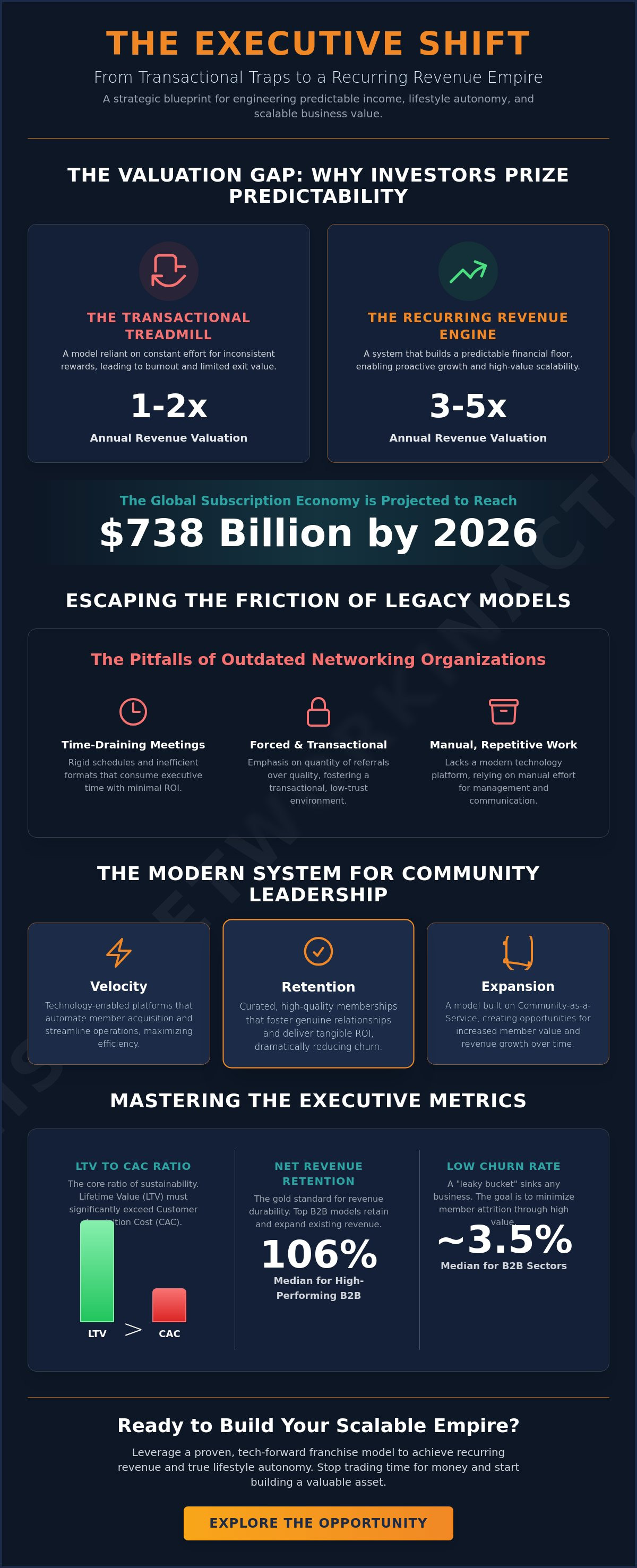
While many associate this shift solely with software, the subscription business model has evolved. It now dominates professional services, community leadership, and high-level networking. This shift is driven by a massive valuation gap. Transactional firms often struggle to achieve a valuation of 1 to 2 times their annual revenue. In contrast, recurring revenue businesses frequently command multiples of 3 to 5 times revenue. With the global subscription economy projected to hit $738.82 billion in 2026, the market is rewarding stability and systemic growth over one-time sales windfalls.
Predictability as a Competitive Advantage
Predictable income changes your psychology. When you master how to start a recurring revenue business with a proven model, you eliminate the "survival mode" that plagues traditional entrepreneurs. Monthly Recurring Revenue (MRR) provides a locked-in financial floor. This stability allows you to focus on proactive innovation rather than reactive firefighting. You stop chasing the next lead and start cultivating a high-value ecosystem. It is the difference between a hunter who must kill to eat and a farmer who harvests from a well-tended field. Predictability buys you time. It buys you focus. Most importantly, it buys you the freedom to lead.
Business Valuation and the Exit Strategy
Investors buy systems, not personalities. If your business depends on your daily presence to generate revenue, it has little value to an outside buyer. Revenue durability is the primary metric for success in 2026. Buyers look for high Net Revenue Retention (NRR), which currently sits at a median of 106% for top-performing B2B models. They want to see low churn rates; ideally around the 3.5% median for B2B sectors. By building a business based on professional social capital and recurring commitments, you create a liquid asset. You are no longer just earning an income. You are building a legacy that can be sold, scaled, or passed on. This is the executive gold standard: a business that works for you, even when you aren't working in it.
The Anatomy of a Sustainable Subscription Model from the Ground Up
Engineering a high-performance income stream requires more than a good idea. It requires a structural hierarchy. You can't scale a mess. To understand how to start a recurring revenue business with a proven model, you must first master the three pillars of sustainability: Velocity, Retention, and Expansion. Velocity measures how quickly you acquire new members. Retention measures how long they stay. Expansion measures how much more value you provide over time. Without all three, your business is a leaky bucket.
In 2026, generic digital subscriptions are failing. Consumers are experiencing "subscription fatigue," with 41% reporting they feel overwhelmed by too many recurring bills. To counter this, elite entrepreneurs are pivoting to Community-as-a-Service. This model prioritizes human connection and professional social capital over static content. It's about results, not just access. By focusing on high-quality professional relationships, you move away from the transactional noise of legacy networking organizations and toward a model built on genuine ROI.
Mastering the Unit Economics
Your success depends on the executive ratio: Lifetime Value (LTV) versus Customer Acquisition Cost (CAC). If it costs you more to find a member than they pay you over their lifetime, you don't have a business; you have an expensive hobby. High-yield empires protect their gross margins through automated systems. By leveraging a technology-enabled platform, you can manage hundreds of relationships without headcount bloat. This ensures you hit your break-even point faster and stay there. You can check available territories to see where this efficiency is currently being deployed and how it supports a scalable empire.
The Retention Engine: Delivering Continuous Value
The sale doesn't end at the sign-up. It begins there. A "stay strategy" is far more valuable than a "sales pitch." In the B2B sector, the median monthly churn rate is 3.5%. Keeping your churn below this threshold requires delivering ROI-driven results every single month. When your business provides systemic value, you no longer need high-pressure sales tactics to keep people around. The technology does the heavy lifting, tracking engagement and ensuring every member sees a tangible return on their investment. Systemic value replaces the need for high-pressure sales. This is how you start a recurring revenue business with a proven model that compounds over time instead of decaying. When you build for retention, you build for freedom.
Legacy Models vs. Modern Systems: Identifying the Friction Points
Most guides on how to start a recurring revenue business with a proven model focus exclusively on Software-as-a-Service (SaaS). This is a strategic oversight. While code is valuable, social capital is the most underutilized asset in the executive toolkit. The friction in the market doesn't lie in a lack of opportunity. It lies in the outdated systems used to manage it. Legacy networking organizations have failed to evolve. They leave high-level professionals trapped in models that feel like a second job rather than a strategic business asset. Transactional networking is broken. It is time for a systemic upgrade.
Traditional networking is rigid. It is transactional. It is fundamentally inefficient. For an executive whose time is valued at a premium, the weekly 7 AM meeting grind is a net loss. These models prioritize attendance over outcomes. They reward quantity over quality. This creates a culture of forced referrals where members feel pressured to pass leads regardless of their value. It is a manual process in a digital world. Modern disruption requires a total shift in perspective. You need a system that leverages technology to remove friction, not add to it.
The Inefficiency of Traditional Networking
High-level executives avoid legacy networking for a simple reason: the ROI isn't there. When a meeting requires two hours of travel and participation every single week, the opportunity cost is staggering. Outdated networking models rely on manual tracking and paper-based systems. There is no transparency. There is no data. You are essentially flying blind, hoping that the volume of people in the room eventually translates into revenue. It rarely does. These groups often become social clubs rather than revenue engines, lacking the professional sophistication required to attract elite partners.
Modern Disruption: Tech-Enabled Leadership
True leadership in 2026 is tech-enabled. Modern platforms use proprietary technology to maintain connection without the need for constant, time-consuming meetings. This allows for curated, high-quality membership. You are no longer managing a mass-market volume of low-tier leads. Instead, you are facilitating elite connections. This is the core of the Business Networking Franchise: The Executive Guide to Modern Ownership. By utilizing a technology-led platform, you remove the friction of forced referrals. You replace it with a system designed for high-level results. This is how you start a recurring revenue business with a proven model that respects your time and maximizes your influence. Efficiency is the new currency of professional growth.
A 5-Step Framework for Building Your Recurring Revenue Engine
Execution beats theory. Most professionals understand the value of Monthly Recurring Revenue (MRR) but stall because they don't know where to begin. Understanding how to start a recurring revenue business with a proven model requires a chronological execution plan that prioritizes momentum over perfection. You must solve the "Cold Start" problem by building community and systems simultaneously. Success follows a specific order of operations.
- Step 1: Identify a high-value niche where professional relationships drive revenue. Focus on industries with high customer lifetime value.
- Step 2: Design a value proposition that solves a recurring pain point. Lead generation is the ultimate recurring need for any business owner.
- Step 3: Implement a technology platform to automate billing and member engagement. Manual administration kills scalability.
- Step 4: Build a founding circle to establish social proof and community culture. Early adopters set the tone for the entire ecosystem.
- Step 5: Scale through referral-based marketing rather than cold prospecting. Leverage your existing network to multiply your reach.
Finding the Right Niche for Recurring Growth
Small to mid-sized business owners are the ideal demographic for a recurring service model. They have the budget for professional growth but lack the time for inefficient legacy networking organizations. Your core offering must be a Referral Marketing Strategy that delivers measurable results. In this model, professional credibility is the ultimate currency. When you provide a structured environment that guarantees high-quality connections, you move from being a vendor to a vital business partner. This transition is essential for maintaining a high-yield subscription engine.
Systematizing the Relationship Economy
Don't waste time reinventing the wheel. Building a platform from scratch often involves a 2-year development cycle and significant capital risk. A turnkey model allows you to skip the trial-and-error phase and move straight to leadership. Community leadership is the secret to long-term member loyalty. It creates a "sticky" environment where members stay because of the culture you've built. To deepen your strategic understanding of this approach, you can download The Free Book which outlines the mechanics of modern networking leadership. Systemic growth requires a proven foundation. Stop guessing. Start building. You can franchise a business opportunity that implements this exact 5-step framework to secure your financial future.
Scaling with NIA: The Turnkey Path to a Recurring Revenue Empire
Building from scratch is a high-risk gamble. Leveraging a sophisticated, battle-tested system is a strategic move. While the previous sections outlined the theoretical framework for success, Network In Action (NIA) provides the physical vehicle for execution. NIA represents the modern evolution of the professional networking industry. It's designed specifically for high-level leaders who demand efficiency, structure, and measurable ROI. You don't have to guess how to start a recurring revenue business with a proven model when the infrastructure already exists.
The core differentiator is ownership. Instead of being a mere participant in a rigid, transactional group, you own the network. You lead the community. This shift from member to owner changes the financial equation entirely. You move away from the time-consuming weekly grind of legacy networking organizations and toward a model that values your expertise. NIA replaces forced referrals and manual tracking with a results-oriented platform. It's the difference between working a second job and running a scalable empire.
The Technology-Led Shortcut
Managing professional communities manually is a recipe for headcount bloat and operational friction. NIA utilizes exclusive digital tools to streamline member engagement and automate administrative tasks. This technology-led approach allows you to focus on high-value leadership rather than chasing paperwork. The revenue model is clear and predictable. It's built on monthly membership dues that create a consistent income stream. To understand the specific economics of this opportunity, Download the Franchise Kit and review the financial blueprint. Success in 2026 requires a tech-forward mindset that prioritizes time over activity.
Lifestyle Autonomy for High-Level Leaders
The ultimate goal of any recurring revenue business is freedom. NIA's lifestyle-first business model is built around monthly meetings, not weekly obligations. This structure respects your calendar and provides the flexibility to lead without the constraints of a traditional 9-to-5 role. You are building professional influence and social capital while securing a predictable financial future. It's a path to meaningful impact that doesn't require sacrificing your time or your health. If you're ready to transition from the transactional hustle to systemic growth, the next step is simple. Check Available Territories to start your recurring revenue journey today. The future of networking is efficient, technology-led, and ready for your leadership.
The Executive Path to Scalable Influence
The choice is clear. You can continue the transactional hustle, or you can pivot to a model that values your time and professional social capital. You now understand how to start a recurring revenue business with a proven model by leveraging community leadership and technology. By focusing on high-yield professional relationships and systemic efficiency, you move from a participant to a visionary owner. Predictable cash flow isn't just a financial goal; it's the foundation of your lifestyle autonomy.
Network In Action represents the next evolution of the industry. With a proprietary technology platform and a modern monthly meeting model, the friction of legacy networking organizations is eliminated. Joining a global network with 150+ locations worldwide provides the structure needed to scale without burnout. It's time to trade the rigid, manual grind for predictable growth and meaningful impact. Align your professional network with a system designed for the 2026 economy. Discover the strategic path to recurring revenue. Download the NIA Franchise Kit. Your future as a community leader starts here.
Frequently Asked Questions
What is a recurring revenue business model?
A recurring revenue model is a business structure where income is predictable, stable, and generated at regular intervals. Unlike transactional models that require a new sale for every dollar earned, this approach focuses on long-term memberships or subscriptions. In the executive landscape, it transforms professional services into a scalable asset that increases business valuation and provides consistent monthly cash flow.
Can I build a recurring revenue business without a software product?
Yes, you can build a highly profitable recurring revenue stream without writing a single line of code. Many high-level professionals are pivoting to "Community-as-a-Service" models. By leveraging professional social capital and community leadership, you can create a service-based subscription that offers more value and higher retention than generic digital tools. This is a primary strategy for those learning how to start a recurring revenue business with a proven model in the professional services sector.
How long does it typically take to build a recurring revenue business from scratch?
Building a subscription business from the ground up often involves an 18 to 24 month development cycle to achieve market fit and systemic stability. This timeline includes designing the value proposition, building the technology stack, and establishing initial social proof. You can significantly compress this timeframe by utilizing a turnkey franchise model that provides the infrastructure and brand authority immediately.
What are the biggest risks when starting a subscription-based business?
The primary risks are high customer acquisition costs (CAC) and involuntary churn from failed payments. If it costs more to acquire a member than their lifetime value (LTV), the business will fail. Successful owners mitigate these risks by using automated billing systems and focusing on high-quality, relationship-driven growth rather than mass-market cold prospecting.
How do I minimize member churn in a service-based recurring model?
Minimizing churn requires a "stay strategy" rooted in measurable ROI. In professional networking, this means moving away from the forced referrals found in outdated networking models and focusing on curated, high-level connections. When members see a tangible return on their time and investment every month, retention remains high and the revenue engine stays healthy.
Why is a networking franchise considered a recurring revenue business?
A networking franchise is a classic recurring revenue business because it operates on a membership dues structure. As a franchisee, you own the network and collect consistent monthly payments from a stable group of professional members. It is a strategic way to learn how to start a recurring revenue business with a proven model while maintaining lifestyle autonomy and professional influence.
Is it better to build a new system or buy into a turnkey franchise for recurring income?
Buying into a turnkey franchise is generally superior for executives who value time and efficiency over manual experimentation. Building a new system requires significant capital and carries a high risk of failure. A franchise provides a battle-tested blueprint, proprietary technology, and a global brand, allowing you to focus on leadership and growth rather than operational troubleshooting.
How much time per week is required to manage a recurring revenue networking group?
Modern, tech-enabled models require significantly less time than legacy networking organizations. While traditional networking often feels like a second job due to weekly meeting grinds, a streamlined model uses technology to handle administration. This allows you to lead high-impact monthly meetings and manage the community in just a few hours per week, securing true time freedom.