The era of trading hours for one-off commissions is over; the future of professional influence belongs to the platform owners. You've likely spent years building an elite network only to watch the real value slip through your fingers in traditional networking groups that favor quantity over quality. Build assets. Own growth. If you're ready to stop being a participant and start being the architect, learning how to start a referral business is the most strategic move you can make in 2026. This isn't about small finder's fees. It's about building a scalable, technology-driven empire that commands respect and delivers consistent, recurring revenue.
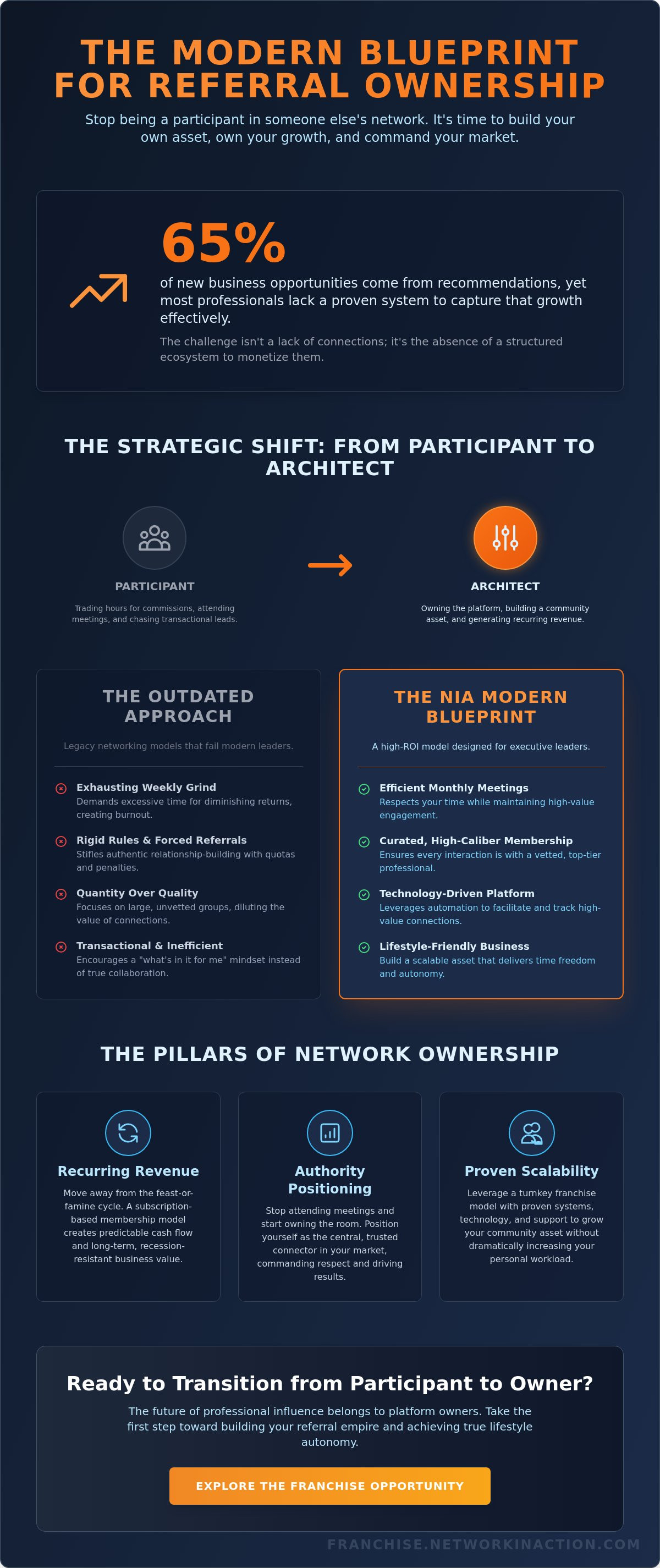
You already understand that 65% of new business opportunities come from recommendations, yet most professionals lack a proven system to capture that growth effectively. This article provides the executive blueprint to transition from a solo consultant to a community leader through a high-ROI franchise model. We'll explore how to leverage modern automation and curated structures to achieve true time freedom while owning a valuable professional asset. It's time to stop chasing leads and start owning the ecosystem.
Key Takeaways
- Stop chasing transactional commissions and learn how to start a referral business that scales by monetizing your professional social capital.
- Replace the inefficiency of legacy networking organizations with a curated, monthly meeting structure designed for high-level executive engagement.
- It's time to leverage a proven franchise model to build a technology-driven community asset that offers recurring revenue and lifestyle autonomy.
- Focus on measurable ROI and quality-driven growth rather than the forced referrals and rigid rules of traditional networking.
- Position yourself as a visionary leader by using exclusive digital platforms to facilitate and track high-value professional connections.
The Evolution of the Referral Business Model in 2026
Professional social capital is your most underutilized asset. In 2026, business success isn't defined by how many people you know, but by how many high-value connections you facilitate. Understanding referral marketing is no longer about simple word-of-mouth; it's about building a structured ecosystem. If you're researching how to start a referral business, you're looking for more than a side hustle. You're looking for network ownership. Build assets. Own growth. This is the ultimate career pivot for those tired of the corporate grind. It's about moving from participant to architect.
Passive vs. Active Referral Income Streams
Passive income is often a trap. Waiting for small affiliate commissions or one-off finder's fees is a recipe for stagnation. It's reactive. It's inconsistent. Contrast this with an active referral marketing strategy where you own the facilitation process. Active owners build recurring revenue through a structured community. You create the environment where business happens. This model provides the stability that traditional consulting lacks. It turns your professional reputation into a scalable engine.
Key advantages of active ownership include:
- Recurring Revenue: Move away from the feast-or-famine cycle of one-off fees.
- Authority Positioning: Become the primary connector in your local or digital market.
- Scalability: Use proven systems to grow your community without increasing your workload.
The Rise of the Network Leader
The modern economy favors relationship-driven ecosystems over cold prospecting. Buyers are skeptical. They want trusted introductions. Executives are uniquely positioned to lead these professional communities because they already possess the social capital. By shifting to an exclusive access model, you monetize your existing network while providing massive value. You aren't just attending meetings anymore. You own the room. Command respect. Drive results. This authority allows you to curate high-quality memberships and facilitate connections that actually move the needle. It's a strategic evolution for the modern professional.
Mechanics of a Scalable Referral Facilitation Model
Building a business around professional connections requires more than a contact list. It requires a high-performance system. When you're evaluating how to start a referral business, the focus must be on creating a recurring revenue engine that functions without constant manual intervention. This isn't about chasing one-time commissions. It's about owning a platform. A business networking franchise provides the executive-grade infrastructure needed to scale your influence into a legitimate asset. It offers a turnkey solution for those who value efficiency over the trial-and-error of independent startups.
Traditional networking models often fail because they rely on an exhausting weekly grind. They demand too much time for too little return. Modern leaders reject these rigid structures in favor of a monthly cadence. This streamlined approach respects your schedule while maintaining high-level engagement. By curating a membership of elite professionals, you ensure that every interaction delivers value. Quality over quantity. This shift is essential for B2B referral marketing success, as high-level executives prioritize meaningful introductions over the "forced referrals" common in legacy networking organizations. You aren't just facilitating meetings; you're managing a high-ROI ecosystem.
Subscription-Based Revenue and Stability
Recurring membership dues provide the financial backbone of this model. This subscription-based structure creates predictable cash flow and long-term business value. Beyond basic dues, elite owners often integrate sponsorship opportunities and high-tier mastermind groups to diversify income. This creates a recession-resistant business. When the economy tightens, professional connections become even more critical, ensuring your network remains a priority for its members. It's a stable, scalable path to financial independence. You can begin your journey by exploring available territories to see where your network can grow.
Leveraging Proprietary Technology for Efficiency
Modern referral facilitation isn't managed on spreadsheets. It's driven by technology. Sophisticated digital platforms now automate referral tracking, member communication, and event management. This technology ensures an "always-on" connection between physical meetings, allowing members to pass leads and track ROI in real-time. For the owner, this means a massive reduction in administrative overhead. You focus on leadership and community growth while the software handles the logistics. It's a sleek, tech-forward approach that positions your business as the next evolution of the industry. Efficiency isn't just a goal; it's the standard. Use these tools to command your market and deliver measurable results for every member.
Legacy Limitations: Why Traditional Models Fail Modern Leaders
Most professionals investigating how to start a referral business are running away from something. They're fleeing the rigid, transactional nature of legacy networking organizations. These outdated models prioritize attendance over impact. They demand your presence at sunrise every single week, regardless of your schedule or the quality of the room. It's a high-friction approach that drains executive energy. In the modern business environment, time is the most valuable currency. Spending it on low-level interactions is a strategic failure. Build better. Lead smarter. The 2026 standard for professional growth is rooted in quality over quantity.
The Pitfalls of Forced Referral Quotas
Trust is the foundation of any successful connection. Forced referral quotas actively destroy that trust. When a group mandates a specific number of leads per week, quality inevitably drops. You end up receiving "spam" leads just so someone can hit a metric. This damages professional credibility. High-level leaders don't want to be forced to refer; they want to refer because there is genuine alignment. If you want to build a customer referral program or a professional community that lasts, you must prioritize organic advocacy over artificial pressure. Mutual benefit should drive the connection, not a spreadsheet requirement.
Mandatory quotas create several points of friction:
- Credibility Risk: Referring a low-quality lead to a trusted contact hurts your reputation.
- Transactional Burnout: Members focus on "getting their numbers" rather than building relationships.
- Diluted Value: The signal-to-noise ratio becomes unbearable for busy executives.
Inefficient Time Commitment vs. Strategic Impact
Let's look at the math. A weekly meeting structure requires 52 commitments per year. For a high-level executive, the opportunity cost is staggering. Most of these meetings involve repetitive scripts and rigid rules that stifle actual business conversation. It's a recipe for burnout. Modern leaders prefer a monthly cadence that emphasizes high-impact interaction. By reducing the frequency and increasing the quality of the membership, you create a space where real deals happen. This shift respects your lifestyle and your professional standing. It's about working on the business, not just in the meeting room.
Legacy systems are built on 20th-century logic. They rely on manual tracking and physical presence as the only measures of commitment. Today, technology-driven platforms allow for "always-on" connectivity without the need for constant, low-value gatherings. When you own the network, you set the rules. You define the culture. You ensure that every minute spent in a meeting translates into measurable ROI for you and your members. Don't settle for the grind of the leading brand's outdated methods. Choose a model that scales with your ambition, not your exhaustion.
Evaluating ROI and Scalability in Your Referral Business
ROI isn't just about cash flow. It's about equity. When you learn how to start a referral business, you're building a community asset with a measurable Return on Social Capital (ROSC). This framework accounts for more than just basic revenue. It measures the exponential value of connections facilitated through your platform. High-performing owners track three critical metrics: member retention, average referral value, and time freedom. High retention signals a healthy ecosystem. High referral value signals elite quality. Time freedom signals a system that works for you. Build assets. Own growth.
Scalability is the hallmark of a professional service franchise model. Unlike independent consulting, where your income is capped by your billable hours, this model allows you to expand your influence by adding multiple territories. You leverage a proven system to replicate success across different markets without reinventing the wheel. This is how you transition from a local connector to a regional authority. Grow fast. Scale smart. Ownership provides the leverage that participation never will. It's about creating a legacy that exists beyond your personal effort.
Measuring the Multiplier Effect of Technology
Technology is the ultimate differentiator. It turns a manual networking group into a data-driven asset. When every referral is tracked and every connection is documented, the perceived value of your community skyrockets. Members see their ROI in black and white. For the owner, this data is a valuable asset. It provides insights into network health and growth potential that legacy networking organizations simply cannot match. You aren't just "working in" a business; you're owning a sophisticated, tech-forward system. This distinction is vital for long-term business valuation and potential exit strategies.
The Path to Professional and Lifestyle Autonomy
Traditional networking is a job. Modern referral facilitation is a lifestyle. By utilizing a monthly meeting structure, you reclaim your schedule and escape the weekly grind of outdated networking models. These legacy groups demand constant presence for minimal strategic impact. In contrast, a streamlined model allows you to focus on high-level strategy and community leadership. You hand-select your partners. You curate your membership. This is the shift from being a corporate employee to becoming a visionary leader. Ready to see the blueprint for yourself? You can download the franchise kit to begin your strategic evaluation.
Network In Action: The Modern Blueprint for Referral Ownership
Network In Action (NIA) represents the next evolution of the professional connection industry. It's the sophisticated, tech-forward alternative to the rigid and manual methods of the past. While legacy networking organizations rely on outdated 20th-century logic, NIA utilizes a streamlined system designed for the 2026 executive. This isn't just another group to join. It's a high-performance business model you own. By eliminating the friction of weekly morning meetings and the desperation of forced referrals, NIA creates an environment where high-level professionals actually want to do business. If you're investigating how to start a referral business, NIA provides the only turnkey solution that balances professional leadership with lifestyle autonomy.
The transition from a corporate role to a community leader is a strategic career move. It requires a proven framework. NIA offers a complete ecosystem, including comprehensive training and a modern, sleek brand image that projects authority. This model allows you to leverage your existing social capital to build a recurring revenue stream while maintaining the flexibility that traditional consulting lacks. You can explore available territories to see where you can establish your footprint as a market leader. Ownership is the differentiator. Command your market. Own the room.
The NIA Technology Advantage
The proprietary platform is the heartbeat of the NIA model. It solves the most significant flaw of traditional networking: the lack of measurable ROI tracking. Through a sophisticated digital interface, members can pass referrals, track their status, and report closed business in real-time. For the franchise owner, this means automated member management and effortless reporting. You don't waste time on administrative overhead. The technology handles the logistics, providing an "always-on" connection for your members between monthly meetings. This data-driven approach increases the perceived value of the community and ensures long-term retention. It's a sleek, elite system for a tech-savvy generation of entrepreneurs.
Securing Your Legacy as a Community Leader
Building a business is about more than just financial returns; it's about impact and influence. As an NIA owner, you become the primary facilitator for growth in your local business community. You curate the connections that drive local economies. This position of authority builds lasting professional credibility that extends far beyond a typical job title. If you're ready for a deep dive into the mechanics of this high-ROI model, you should download the franchise kit. It provides the executive-level detail required to make an informed decision about your future. Stop participating in outdated networks and start owning the future of business connection. Learn how to start a referral business that scales with your ambition. Build assets. Own growth.
Own the Future of Professional Connection
The transition from a passive participant in outdated networking models to an empowered business owner is the ultimate executive pivot. Focus on quality. Build assets. By leveraging high-impact monthly meetings, you reclaim your schedule while building a scalable engine. Understanding how to start a referral business is the first step toward true lifestyle autonomy and recurring revenue.
Network In Action provides the infrastructure to make this vision a reality. With over 150 locations across the US and globally, the model is proven and growing. You gain access to a proprietary technology platform that automates ROI tracking, ensuring every connection delivers measurable value. This is the next evolution of the industry. It's a disruptive professional ecosystem designed for busy leaders who demand results.
Take the next step in your executive journey: Download the NIA Franchise Kit
The opportunity to lead your community and monetize your social capital is here. Align your ambition with a system built for the modern economy. Your legacy as a network leader starts today.
Frequently Asked Questions
What is the most profitable referral business model for executives in 2026?
The most profitable model is a technology-driven franchise that focuses on high-level professional facilitation. Passive affiliate links and one-off commissions lack the scalability required for an executive-level income. By owning a structured platform, you generate recurring revenue through a system that prioritizes quality connections over lead volume. This model turns your social capital into a high-ROI business asset that operates with corporate sophistication.
How can I get paid for business referrals without compromising my professional reputation?
You protect your reputation by shifting from a transactional kickback model to a professional facilitation model. Instead of taking fees for individual leads, you own the platform that hosts elite professionals. This positions you as a visionary community leader rather than a broker. When you're learning how to start a referral business, focus on building a curated environment where trust and alignment are the primary drivers of value.
Is owning a referral business better than traditional management consulting?
Owning a referral franchise offers greater scalability and lifestyle autonomy than traditional management consulting. Consulting is typically a trade of hours for dollars, which makes it difficult to scale without increasing your personal workload. A referral business uses a proven system to generate recurring income through a streamlined monthly meeting structure. You move from being a solo operator to owning a valuable, tech-enabled community asset.
How much time does it take to manage a professional referral group successfully?
A modern referral business requires significantly less time than outdated networking models. While legacy organizations demand weekly morning meetings, a results-oriented model utilizes a single monthly meeting structure. Most owners spend only a few hours a week on high-level leadership and relationship management. Proprietary technology automates the administrative tasks, allowing you to focus on strategic growth rather than manual tracking or rigid scripts.
Do I need a specific sales background to own a referral-based franchise?
You don't need a background in hard sales; you need professional credibility and leadership skills. Successful owners are typically executives, consultants, or entrepreneurs who understand the value of high-quality connections. The franchise provides the turnkey systems and training necessary to manage the group effectively. Your primary role is to curate the room and facilitate meaningful interactions between established business leaders who value efficiency.
What are the key legal considerations when monetizing professional referrals?
Compliance with FTC disclosure requirements and data privacy regulations like GDPR or CCPA is essential. In 2026, transparency in endorsements is a legal mandate for all referral-based income. For specific industries like finance or law, additional regulations such as the SEC Marketing Rule apply. Always ensure your business model uses written agreements and clear disclosures to maintain full regulatory compliance while protecting your professional standing.
How does technology improve the ROI of a modern referral business?
Technology automates referral tracking and provides real-time ROI reporting for every member. This data-driven approach proves the value of the network, which significantly increases member retention and recruitment. Proprietary platforms handle communication and administrative logistics, reducing your overhead. It turns a traditionally manual industry into a sleek, efficient asset that operates with tech-forward precision and delivers measurable financial results for everyone involved.
Why are traditional networking models losing popularity among high-level leaders?
High-level leaders are abandoning outdated networking models because they are time-consuming, rigid, and often transactional. The forced referral quotas common in legacy organizations often lead to low-quality spam rather than strategic business opportunities. Busy executives prefer a monthly, curated environment that respects their time and prioritizes professional alignment over volume. Modern professionals demand a results-driven alternative that offers meaningful impact and high-quality interaction.