With 67 percent of workers globally reporting exhaustion and middle managers hitting a staggering 78 percent burnout rate, the standard corporate ladder has become a treadmill to nowhere. You've spent decades building a career only to realize the "prestige" of your position is actually a prison of transactional networking and 60-hour weeks. It's not a lack of ambition; it's a lack of autonomy. True corporate burnout recovery and next steps require more than a sabbatical. They require a fundamental shift from being a high-paid cog to becoming a high-leverage owner.
This guide provides a strategic framework to reclaim your time and professional capital. You'll discover how to pivot away from the exhausting, outdated networking models of the past toward a modern business model designed for recurring revenue and lifestyle flexibility. It's a roadmap for transitioning your executive expertise into a scalable franchise opportunity that prioritizes results over raw hours. From tactical recovery to the final pivot, it's time to stop managing someone else's vision and start leading your own community.
Key Takeaways
- Understand why traditional rest fails to solve systemic depletion and how to identify the "Golden Handcuffs" preventing true professional recovery.
- Implement a tactical audit of your professional commitments to eliminate high-friction relationships and transactional, time-wasting networking habits.
- Develop a clear roadmap for corporate burnout recovery and next steps by comparing the risks of C-suite re-entry against the scalability of a recurring revenue model.
- Learn to design a burnout-proof career by shifting from cold prospecting to leading an exclusive, technology-enabled professional community.
- Discover how a high-leverage franchise opportunity can replace the 60-hour corporate grind with a streamlined, impact-driven business model.
The Executive Burnout Paradox: Why Traditional Rest Fails
Executive burnout isn't about being tired. It's about being spent. For high-level professionals, the exhaustion isn't a result of a busy week; it's the systemic depletion of your professional capital. You've reached the top only to find yourself trapped by the "Golden Handcuffs," where a high salary justifies a low quality of life. A two-week vacation is a temporary bandage. It does nothing to address the structural flaws of a 60-hour work week or the administrative friction that has replaced your actual impact. A foundational understanding occupational burnout reveals that it's a chronic state of workplace stress that no amount of sleep can fix. True corporate burnout recovery and next steps require a total reassessment of how you trade your time for revenue.
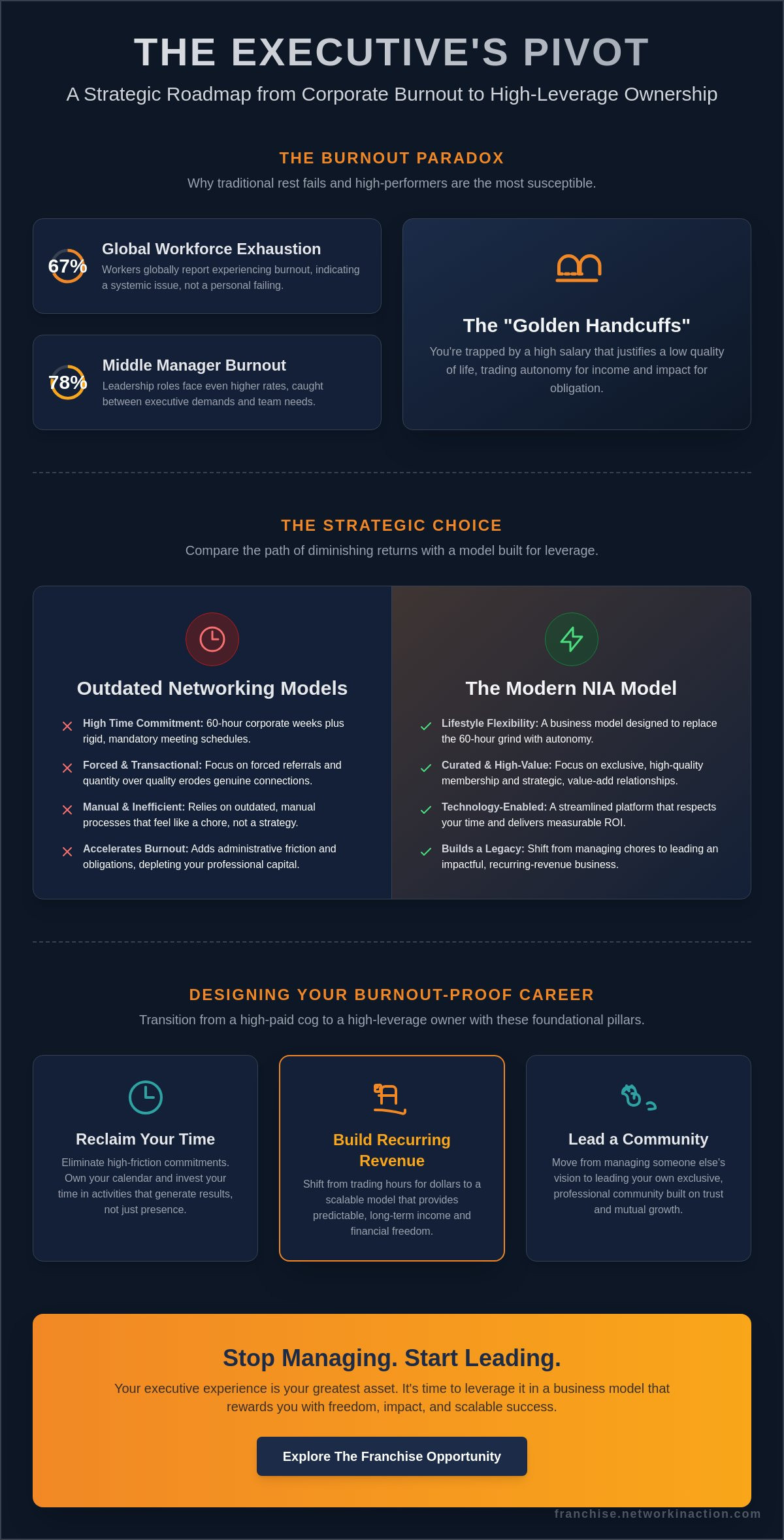
Legacy networking organizations often accelerate this exhaustion. They demand rigid, transactional participation that feels like a second job rather than a strategic advantage. When your professional growth depends on forced referrals and outdated, manual processes, you aren't building a network. You're managing a chore. This friction erodes the passion you spent decades cultivating, leaving you with a career that feels like a series of obligations rather than a legacy.
Recognizing the 2026 Burnout Markers
By May 2026, data shows that 67 percent of the global workforce reports experiencing burnout. For those in leadership, the numbers are even more stark. Middle managers face a 78 percent burnout rate, often caught between executive demands and team needs. This manifests as more than physical fatigue; it's a profound erosion of professional ambition. You might find yourself experiencing "decision fatigue," where even minor strategic choices feel insurmountable. High-performers are the most susceptible. Your ability to "push through" is exactly what leads to long-term professional depletion, as you ignore the warning signs in favor of short-term results.
The Myth of the Corporate Reset
Switching companies is rarely the answer. Moving to a different corporation often just replicates the same burnout cycle in a new building. Legacy business models are fundamentally unequipped to adapt to modern executive lifestyle needs. They prioritize presence over productivity and volume over value. It's time to analyze the ROI of your time. Is your current role a viable investment, or are you pouring your best years into a system designed to consume them? Professional ownership offers a way out. By shifting toward a high-leverage business model, you can reclaim your autonomy. Explore how a strategic pivot can lead to lasting freedom by reviewing a franchise kit that outlines a more efficient path to success.
Tactical Recovery: Reclaiming Your Mental and Professional Baseline
Recovery is an active strike against inefficiency. Corporate burnout recovery and next steps begin with a ruthless audit of your professional commitments. You don't need more "self-care" sessions; you need fewer high-friction relationships. If your calendar is cluttered with meetings that don't move the needle, you aren't leading; you're reacting. Reclaiming your baseline requires the aggressive elimination of transactional noise.
Implement a digital cleanse immediately. Purge your schedule of legacy networking organizations that demand rigid attendance and forced referrals. These outdated networking models are designed for volume, not velocity. They consume your energy without delivering a measurable return on your social capital. By prioritizing high-value connections over quantity-based social obligations, you protect your professional baseline. High-level 7 steps to burnout recovery emphasize that reclaiming control over your environment is the only way to restore your mental edge.
Establish non-negotiable boundaries for your energy management. Your time is a finite investment. Stop treating it like a limitless resource. This means saying no to transactional networking and yes to curated, technology-enabled systems that respect your schedule. Efficiency is the only cure for systemic depletion. Cut the noise. Reclaim the hours.
The Professional Relationship Audit
Categorize your network into "Value-Add" and "Energy-Drain" connections. Value-add relationships are built on mutual growth and strategic alignment. Energy-drain connections are transactional and often stem from traditional networking environments that value "showing up" over actual results. Eliminate the noise. Focus exclusively on curated circles that offer high-level professional impact without the 60-hour grind. This shift is essential for anyone looking to explore a high-leverage business model that prioritizes quality over quantity.
Restoring Decision-Making Clarity
High-stakes environments breed decision fatigue. When you're burned out, your ability to evaluate new opportunities is compromised. You stop making strategic moves and start making survival moves. A 90-day "Strategic Pause" is essential before making major career moves. Use this time to identify your core values beyond a corporate title. This period of intentional evaluation allows you to see the financial reality of recurring revenue models compared to the standard salary-and-bonus structures that keep you tethered to the corporate treadmill.
Evaluating the Pivot: Corporate Re-entry vs. Entrepreneurial Ownership
The decision to return to the C-suite after a period of exhaustion is often driven by a false sense of security. You know the environment. You understand the politics. However, corporate re-entry frequently leads back to the same systemic depletion you just escaped. Corporate burnout recovery and next steps must include an objective analysis of your risk profile. While a salary and bonus structure feels safe, it lacks the scalability and autonomy of business ownership. In a corporate role, your income is tethered to your presence. In an ownership model, your income is tied to a system.
Recurring revenue models offer a financial stability that the corporate world cannot match. Instead of starting every quarter at zero, you build a foundation of consistent income. This allows for scalability without a proportional increase in your hours. You move from being a high-paid laborer to a strategic owner. The "Freedom Factor" in modern franchise opportunities isn't a vague promise; it's a structural reality. It's the difference between managing a department and owning an asset that works for you. You don't need another job. You need a business model that respects your time.
The High-Level Franchise Advantage
Starting a business from scratch is a high-friction endeavor that often mimics the administrative grind you're trying to escape. Turnkey systems solve this by providing a ready-to-use architecture. Technology plays a critical role here, automating the manual tasks that define outdated networking models. When you evaluate executive business opportunities, focus on those that leverage digital tools to reduce operational drag. A modern franchise allows you to lead a community rather than manage a spreadsheet. This executive-level approach ensures that your transition is efficient, professional, and profitable from day one.
Lifestyle Autonomy as a Financial Metric
Time freedom is a quantifiable asset. If a new role requires 60 hours a week to maintain a certain income, the true ROI is lower than a model requiring 20 hours for the same return. Modern business models replace the rigid, weekly meetings found in legacy networking organizations with monthly, high-impact sessions. This shift is vital for preventing future burnout by ensuring your professional life supports your personal well-being. You transition from "being the network" to "owning the network," creating a sustainable professional chapter that values efficiency over raw activity. By focusing on quality over quantity, you build professional credibility without the traditional corporate grind.
Designing a Burnout-Proof Professional Life in 2026
Professional longevity in 2026 requires a departure from the "always-on" culture of the modern corporation. Your corporate burnout recovery and next steps must involve a transition from manual, cold prospecting to a relationship-driven growth strategy. High-level leadership shouldn't be defined by the number of hours you spend at a desk; it should be measured by the strength of your social capital. By shifting your focus toward exclusive, curated professional communities, you eliminate the noise of open-access groups and replace it with high-impact, high-leverage connections.
Building a business that serves your life is a deliberate architectural choice. It requires utilizing proprietary technology to automate the heavy lifting of connection and referral tracking. Most executives are used to managing people; professional ownership allows you to manage systems instead. This automation ensures that your business continues to grow even when you are offline, providing the time freedom that a standard C-suite role fundamentally cannot offer. Efficiency is the ultimate burnout-proof strategy.
Modernizing the Referral Engine
Traditional networking is a primary contributor to executive exhaustion. Outdated networking models rely on rigid, weekly commitments and forced, transactional interactions that drain energy without delivering a clear ROI. The modern alternative is a tech-enabled, results-oriented referral group. By integrating a sophisticated referral marketing strategy, you leverage trust and existing connections to drive growth. This approach replaces the 60-hour corporate grind with a streamlined system designed for maximum impact with minimal time commitment. You move from being a participant in a flawed system to the leader of a superior one.
Leading Your Professional Community
Positioning yourself as a local leader and business connector restores the professional status you've earned without the baggage of corporate politics. There are significant psychological benefits to facilitating growth for others in a structured, professional environment. It allows you to maintain your professional credibility while gaining the lifestyle autonomy you deserve. You aren't just starting a business; you are leading a community of like-minded professionals who value quality over quantity. This transition allows you to reclaim your passion for business leadership on your own terms. If you are ready to stop managing a department and start leading a territory, check available territories to see where you can make your mark.
The Strategic Exit: Leading a Network In Action Franchise
High-earning executives rarely have the luxury of simply walking away for a year to "find themselves." The financial stakes are too high, and the professional momentum is too valuable to squander. Corporate burnout recovery and next steps require a transition that preserves your income while dismantling the 60-hour grind. Network In Action (NIA) provides this bridge. It replaces the rigid, time-consuming structures of legacy networking organizations with a streamlined, technology-led model. This is the strategic exit designed for those who refuse to choose between their net worth and their well-being.
The NIA model is built on efficiency. Instead of the weekly, manual grind found in outdated networking models, NIA utilizes a monthly meeting structure. This delivers a high ROI for the franchise owner by concentrating impact and minimizing administrative drag. You aren't buying another high-pressure job; you are investing in a system. By leveraging the NIA technology platform, you manage your groups with executive precision. Referral tracking, member engagement, and community growth are handled through exclusive digital tools, ensuring that your business operates with modern velocity rather than manual friction.
From Corporate Leader to Network Owner
Your C-suite experience is your greatest asset when building a business networking franchise. You already understand high-level strategy, P&L management, and community leadership. NIA provides the turnkey system to monetize those skills without the corporate politics. The training and support systems are specifically designed for high-level professional transitions, ensuring you have the tools to lead from day one. The NIA model is the evolution of professional networking for the modern era.
Your Transition Roadmap
The path to professional ownership is structured and logical. It begins with a shift in perspective: viewing your network as an asset rather than a utility. Start your due diligence by evaluating the potential for recurring revenue and long-term equity in your specific market. You can download the franchise kit to review the underlying systems and financial metrics. This is a move for the smart professional who recognizes that the old way of working is obsolete. Explore available territories today to secure your professional future. Stop managing the corporate grind and start owning the solution.
Reclaiming Authority: Your Roadmap to Professional Ownership
Professional recovery isn't found in a sabbatical. It's found in a superior business model. You've identified the flaws of legacy networking organizations and the systemic trap of the corporate treadmill. Now, you have the framework to pivot. Successful corporate burnout recovery and next steps demand a shift from managing someone else's vision to owning your own results. It's about trading transactional noise for high-impact social capital.
Network In Action provides the architecture for this transition. With over 150 global locations and a proprietary tech-enabled platform, NIA streamlines the networking process. The monthly meeting model is specifically designed for executive lifestyles, ensuring you maintain your professional status without sacrificing your time freedom. You've already done the hard work of building your expertise. Now, it's time to leverage it for your own benefit.
The status quo is no longer an option. Download the NIA Franchise Kit to explore your executive exit strategy and discover a path that prioritizes your autonomy. Your next chapter starts with a strategic decision to lead. The future of professional networking is efficient, technology-driven, and entirely within your control.
Frequently Asked Questions
How long does it typically take to recover from corporate burnout?
Recovery from systemic depletion often takes three to twelve months depending on the severity of the exhaustion and the speed of environmental change. Rest alone is insufficient; you must address the root causes by reclaiming autonomy over your schedule. Shifting to a high-leverage business model accelerates this process by providing a clear path away from the stressors of the corporate treadmill and toward professional ownership.
Can I transition to business ownership while still in my corporate role?
Transitioning to business ownership is entirely possible while maintaining a corporate role if you choose a model built for maximum efficiency. The NIA monthly meeting structure is designed for this specific purpose. It allows you to build a foundation of recurring revenue without the immediate need to abandon your current salary. This phased approach reduces financial risk while you build a scalable professional asset.
What are the most common "next steps" for executives after burnout?
Common corporate burnout recovery and next steps include pursuing consulting, taking extended sabbaticals, or pivoting into entrepreneurial ownership. While consulting often replicates the transactional time-for-money trap, professional ownership allows you to leverage your existing network for long-term equity. This strategic pivot ensures that your next professional chapter is defined by leadership and impact rather than administrative friction or corporate politics.
How does a networking franchise differ from traditional consulting?
A networking franchise offers a recurring revenue model and scalability that traditional consulting cannot match. Consultants are often caught in a cycle of constant prospecting and project-based income where they are the product. In contrast, owning a professional network creates an asset where value grows through community leadership and technological automation. You move from being a service provider to a system owner.
What makes the Network In Action model more efficient than legacy networking?
Efficiency is the core differentiator of the NIA model. Legacy networking organizations rely on rigid, weekly commitments and manual referral tracking that drain executive energy. NIA replaces this with high-impact monthly meetings and a proprietary technology platform. This modern approach eliminates forced referrals and transactional noise, focusing instead on high-quality relationships, curated membership, and a lifestyle-friendly business model that respects your time.
Is business ownership less stressful than a high-level corporate position?
Ownership replaces the stress of corporate politics and lack of control with the purposeful challenge of growth. Most executive stress is a result of unmanageable workloads and administrative friction. Ownership stress is different because you have the autonomy to make high-level decisions. You control the culture, the schedule, and the ultimate financial outcome, turning professional pressure into measurable personal gain.
What skills from the C-suite translate best to owning a professional network?
C-suite experience in strategic leadership, P&L management, and high-level relationship building translates perfectly to owning a professional network. You already know how to identify talent and facilitate growth for others. Modern networking ownership simply gives you a structured, technology-enabled platform to apply these skills for your own benefit. Your professional credibility is the engine that drives the community and ensures its success.
How much time is required to manage a modern networking franchise?
Managing a modern networking franchise requires a fraction of the time demanded by a 60-hour corporate grind. The monthly meeting model is specifically engineered for executive lifestyles. By utilizing exclusive digital tools to automate administrative tasks, you can lead your professional community effectively with just a few hours of focused activity each week. This creates the time freedom necessary for a sustainable, high-leverage career.