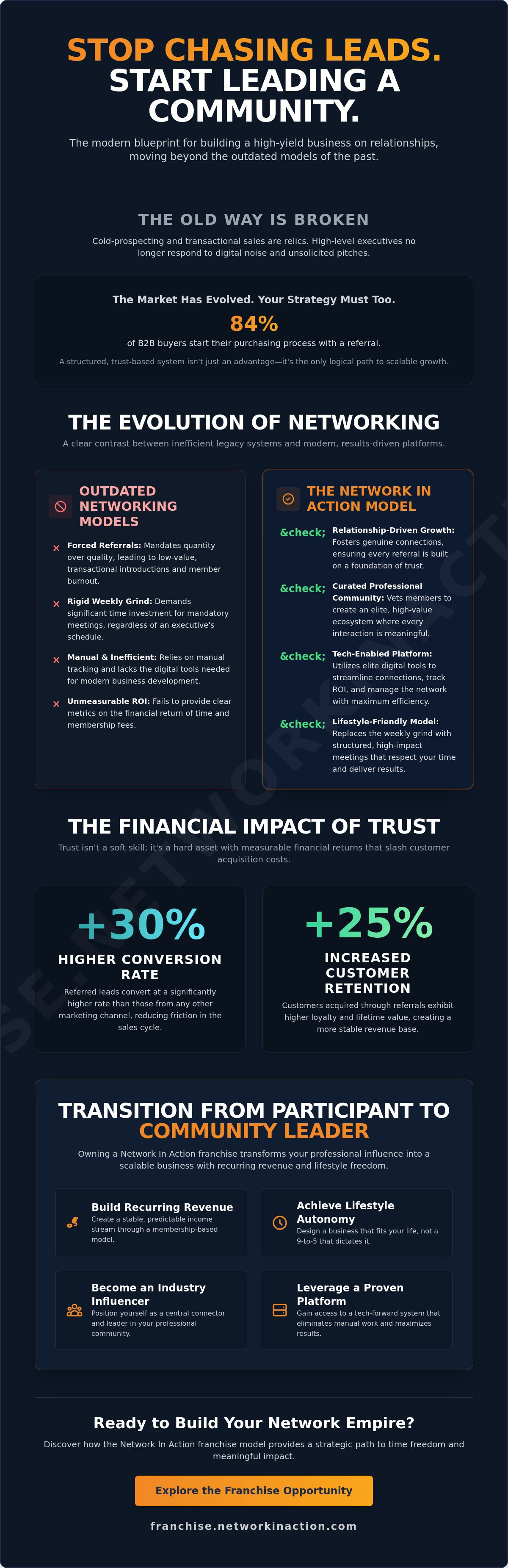
Cold-calling is dead, and the transactional sales grind is a relic of the past. You've likely felt the burnout of the traditional 9-to-5 or the frustration of legacy networking organizations that demand your time but yield minimal ROI. It's time to stop chasing leads and start leading a community. Building a business based on relationships isn't just a networking strategy; it's a high-yield, scalable business model designed for the modern executive. According to Entrepreneurs HQ, 84% of B2B buyers start their purchasing process with a referral, yet most professionals still lack a structured system to capitalize on this reality.
You already know that trust is the ultimate currency in 2026. This guide promises to show you how to leverage that trust into a profitable franchise opportunity that prioritizes results over activity. It explores how elite digital tools and a curated membership structure can replace the rigid, inefficient methods of the past. You'll discover a strategic path to recurring revenue and lifestyle autonomy that turns your professional network into your most valuable financial asset. It's time to move beyond the manual effort of outdated models and embrace the next evolution of industry networking.
Key Takeaways
- Stop wasting time on cold-prospecting and start treating professional connections as a scalable infrastructure for high-yield growth.
- Learn to treat your professional network as a diversified investment portfolio that yields measurable financial returns through social capital.
- Audit your current efforts to see why outdated networking models fail to provide the ROI that modern, technology-enabled systems deliver.
- Discover the strategic advantages of building a business based on relationships through a franchise model that offers recurring revenue and lifestyle freedom.
- Transition from a service provider to a community leader by leveraging a tech-forward platform that eliminates forced referrals and manual tracking.
The Evolution of Relationship-Based Business Models
The 2026 economy doesn't reward the loud. It rewards the connected. Traditional lead generation has become an expensive race to the bottom where the only winner is the platform selling the ads. High-level professional services are feeling the strain. Cold-prospecting is failing because executives have developed a natural immunity to digital noise and unsolicited pitches. Building a business based on relationships is no longer just a "nice to have" strategy. It's the only way to bypass gatekeepers and secure high-value contracts. This model shifts the focus from chasing single transactions to cultivating a robust ecosystem where Social Capital acts as a more stable and appreciative asset than any marketing budget.
When you prioritize social capital, you're building a foundation that resists market volatility. Geopolitical and social instability in 2026 has made trust the most valuable currency in the boardroom. A business built on a network of vetted professionals creates a moat that competitors can't cross with a bigger ad spend. It's about moving away from the "attention economy" and entering the "trust economy."
Why Traditional Networking is Obsolete
Legacy networking organizations are stuck in a manual, inefficient past. They rely on the "forced referral" trap, where members are required to bring a lead every week regardless of quality. This leads to transactional fatigue and a room full of low-value introductions. You don't have time for the weekly grind of a rigid, outdated networking model that treats your calendar like a punch clock. These systems drain executive energy without delivering a measurable ROI. The modern executive demands curated, high-level professional communities that value efficiency over activity. Curated environments ensure that every interaction has the potential for significant financial impact, making the old-school weekly meeting look like a relic of a bygone era.
The ROI of Trust in Modern Business
Trust is a force multiplier for your bottom line. Research from Tipsonblogging in March 2026 shows that referred leads have a 30% higher conversion rate than leads from any other marketing channel. This isn't just a feeling. It's a financial metric that proves trust-based models slash the cost of customer acquisition. When 84% of B2B buyers start their purchasing process with a referral, building a business based on relationships becomes the most logical path to scalability. You stop paying for attention and start owning the market through reputation. This creates a self-sustaining growth loop. High-quality introductions lead to higher lifetime values, with referred customers showing a 25% increase in retention. For those looking to franchise a business opportunity, this shift represents a chance to lead a community rather than just managing a sales team.
Social Capital: The Hidden Asset in Your Professional Network
Your professional network is not a phone book. It's a diversified investment portfolio. For the modern executive, building a business based on relationships requires a fundamental shift in how you view social capital. It's no longer a soft skill; it's a hard asset with measurable equity. While your inner circle provides support, the science of "Weak Ties" proves that your next high-yield opportunity likely sits on the periphery of your network. These distant connections act as bridges to new markets and untapped revenue streams that your immediate peers simply cannot reach. Mastering the art of Building Business Relationships means moving beyond casual coffee chats toward a structured system of value exchange and network ownership.
Ownership is the differentiator. Knowing influential people is a start, but owning the platform where those people connect creates a scalable business model. You're not just a participant in the economy; you become the infrastructure of the economy itself. This transition allows you to leverage existing influence to generate recurring revenue without the constant pressure of transactional sales.
Mapping Your Relationship Ecosystem
Successful network owners don't leave connection to chance. They map their ecosystem with surgical precision. This involves categorizing your contacts based on their strategic role and referral potential. Your map should identify:
- Key Influencers: High-authority figures who validate your professional credibility.
- Connectors: Individuals with expansive reach across multiple industries.
- Decision-Makers: Those with the capital and authority to greenlight major projects.
Using data to track these interactions ensures your network remains healthy and active. If you aren't measuring the velocity of your referrals, you aren't managing a business; you're managing a hobby.
Technology as a Relationship Multiplier
Manual CRM management is a bottleneck for growth. It's impossible to maintain high-level connections at scale using spreadsheets or outdated software. Legacy networking organizations fail here because they rely on manual tracking and rigid, physical attendance. Modern relationship-based models utilize proprietary platforms to automate the "check-in" process without losing the personal touch. This technology allows you to maintain a presence in hundreds of professional lives simultaneously, ensuring you remain top-of-mind when high-value opportunities arise. Efficiency is the priority. You need a system that handles the logistics so you can focus on leadership. To see how this technology integrates into a scalable model, you can download the franchise kit to explore our proprietary tools.
Traditional Networking vs. Modern Referral Systems
Activity is not the same as achievement. For decades, legacy networking organizations have sold the illusion of progress through repetitive, weekly meetings. They prioritize attendance over outcomes. Building a business based on relationships requires a rejection of this high-friction, low-reward status quo. High-level executives are walking away from outdated networking models because they realize that "passing leads" is a transactional game that doesn't scale. Modern referral systems focus on a strategic alternative: building a business infrastructure where technology and trust collide to create consistent, high-yield results.
The difference is fundamental. Traditional networking is a weekly grind. Modern systems are a monthly masterclass. While the leading brand in the industry might demand your presence every Tuesday morning to exchange low-value business cards, the next evolution of this industry leverages a tech-forward platform to keep the network active 24/7. This allows you to focus on high-level introductions that actually move the needle. You don't need more meetings. You need more leverage.
The Efficiency Gap in Professional Networking
Time is your most expensive asset. If you spend 90 minutes a week in a rigid, transactional meeting, you're investing over 70 hours a year into a system that often yields a negative ROI. This is the efficiency gap. Modern models utilize proprietary digital tools to bridge the gap between monthly interactions, ensuring that referrals flow without the need for constant physical presence. Research from DemandSage indicates that referral marketing can generate 3 to 5 times higher conversion rates than other channels. To capture this value, you must move toward a "less is more" philosophy. One high-quality, curated meeting per month creates more strategic alignment than four sessions of forced small talk. If you want to audit your current networking efficiency, you can explore a more sophisticated approach in our free book on modern relationship growth.
Curating a High-Quality Membership Base
The "open-to-anyone" philosophy is the death of professional credibility. Legacy networking organizations often prioritize quantity to drive their own revenue, leading to rooms filled with professionals who aren't at your level. This dilutes the network. Curation is the only way to maintain the integrity of a relationship-based business. Vetting members ensures that every person in the room is a decision-maker, a connector, or a visionary leader. This shift in membership dynamics transforms your role. You stop being a participant in a group and start being a community leader. Positioning yourself as the owner of an exclusive professional ecosystem allows you to dictate the quality of the interactions and the scale of the financial returns. You aren't just networking; you're managing a high-performance investment portfolio of human capital.
Turning Relationships into Recurring Revenue
Stop trading hours for dollars. High-level professionals often find themselves trapped in a cycle of service delivery that doesn't scale. Building a business based on relationships allows you to flip the script. Instead of being the one providing the service, you become the one facilitating the connections. This is the ultimate move for those seeking time freedom. You're building an asset that grows in value as your influence expands. It's a shift from linear growth to exponential returns. Learn more about a referral marketing strategy that works.
Ownership is power. In 2026, referral-based businesses see significantly lower customer acquisition costs. Companies with referral programs report a 24% lower acquisition cost according to Entrepreneurs HQ. By owning the network, you capture this efficiency. You aren't just making introductions; you're operating a scalable system for professional growth. This isn't about selling memberships. It's about franchising a business opportunity that leverages your existing social capital into a consistent income stream.
The Franchise Path to Relationship Ownership
Speed matters. Building a networking system from scratch is a manual, error-prone process. Franchising provides the fastest route to scale because it replaces guesswork with a proven framework. You gain access to proprietary technology that manages the heavy lifting of connection tracking and ROI reporting. This allows you to focus on high-level strategy rather than administrative clutter. The result is a lifestyle-friendly business model that generates recurring revenue while you maintain control over your schedule. It's the next evolution of the industry.
Leading Your Professional Community
Position yourself as the Super Connector in your market. As a franchise owner, you lead a curated group of top-tier professionals. You provide value through exclusive business education and verifiable ROI tracking. This isn't the transactional lead passing found in outdated networking models. It's community leadership. You become the central hub for high-value commerce in your territory. View available territories to start your network and claim your position as an industry visionary. To explore how this logic applies to your specific career goals, you should examine the NIA franchise model today.
The Modern Evolution: Owning a Network In Action Franchise
The industry has reached a tipping point. While legacy networking organizations continue to push rigid, manual systems, Network In Action (NIA) has emerged as the tech-forward disruption that high-level professionals have been waiting for. You don't need another club to join; you need a sophisticated asset to own. This business networking franchise opportunity represents the next evolution of professional connection. It's a model where building a business based on relationships is supported by proprietary algorithms and streamlined systems, allowing you to scale your influence without sacrificing your schedule. This is the "Lifestyle Franchise." It's built around your life, not the other way around.
Efficiency is the core value proposition. NIA franchisees don't spend their lives in basement meeting rooms. They lead high-impact, monthly sessions that respect the time of busy executives. By leveraging a centralized digital platform, you provide your community with 24/7 connectivity and verifiable ROI tracking. This ensures that every introduction made within your network is high-quality, high-intent, and high-value. You aren't just facilitating coffee dates; you're driving the economic engine of your local business community.
The NIA Differentiators
Legacy networking organizations are defined by their limitations. NIA is defined by its results. The model is built on three pillars that separate it from outdated networking models:
- Strategic Monthly Meetings: We've replaced the weekly grind with concentrated, high-level interactions designed for professionals who value their time.
- No Forced Referrals: Trust cannot be mandated. We prioritize organic, high-quality professional introductions over the transactional "lead quotas" found in the leading brand's system.
- Proprietary Tech Platform: Our exclusive tools keep your members connected and accountable, ensuring that the network remains active even when you aren't in the room.
Your Next Step as a Strategic Leader
The transition from a corporate employee to a strategic entrepreneur is a move toward autonomy. You've spent years building a network; it's time to own the platform that network lives on. NIA provides a comprehensive onboarding and training system that equips you with everything needed to launch and lead your own professional ecosystem. You bring the relationships, and we provide the infrastructure to monetize them. This is your path to recurring revenue and a legacy of community impact. Stop participating in inefficient systems and start leading a modernized business. To begin your transition, Download the Franchise Kit and discover how you can claim your territory in the trust economy.
Lead the Next Evolution of Business Networking
The era of the weekly grind is over. High-level executives are no longer willing to trade their most valuable asset, time, for the low-yield results of outdated networking models. You've seen how social capital has evolved into a measurable financial asset that powers the trust economy of 2026. By building a business based on relationships, you transition from a participant in a legacy organization to a strategic owner of a professional ecosystem. This is about leverage. This is about impact.
Network In Action has solved the inherent flaws of the industry with a monthly meeting model designed specifically for executive schedules. With over 150 locations worldwide and a proprietary technology platform that drives member ROI, NIA offers a scalable, lifestyle-friendly franchise opportunity. You have the network. The system is ready. It's time to align your professional influence with a business model that prioritizes freedom and recurring revenue.
Download the Network In Action Franchise Kit to see if you qualify and take the first step toward community leadership. Your network is waiting for a visionary. Be the leader they need.
Frequently Asked Questions
What does it mean to build a business based on relationships?
It means creating a scalable enterprise where social capital is the primary asset and revenue driver. Building a business based on relationships involves moving away from transactional sales and instead owning the platform where high-level professionals connect to exchange value. It is about turning your network into a permanent infrastructure that generates consistent returns through trust and referrals rather than chasing one-off deals.
How is a relationship-based business different from traditional sales?
Relationship-based models replace the high-friction grind of cold-prospecting with a warm, referral-driven ecosystem. While traditional sales rely on constant outreach to strangers, this model focuses on leveraging existing trust to open doors. It reduces customer acquisition costs and increases lifetime value because every new lead is pre-vetted by a trusted source. You stop being a salesperson and start being a strategic connector.
Why is traditional networking considered inefficient for executives?
Legacy networking organizations often rely on rigid, weekly meeting structures that prioritize attendance over actual ROI. These outdated networking models frequently use forced referrals, which lead to low-quality leads and transactional fatigue. Busy executives need curated environments that respect their schedules. Modern systems focus on high-impact monthly masterclasses rather than repetitive weekly sessions that drain time without delivering measurable results for your bottom line.
Can a professional network really be scaled into a franchise?
A professional network can be transformed into a scalable franchise by implementing a proven system and proprietary technology. Franchising a business opportunity in the networking space allows you to replicate a successful model across different territories. This approach provides you with the tools to manage multiple groups and track member ROI efficiently. It turns your personal influence into a national or global asset with predictable growth.
What are the benefits of owning a networking group vs. joining one?
Ownership provides control, recurring revenue, and positioning as a community leader. When you join a group, you are merely a participant in someone else's system. When you own the franchise, you are the architect of the local economy. Ownership allows you to curate the membership, ensuring only high-level decision-makers are in the room. You build an appreciative business asset that works on your terms and schedule.
How does technology improve relationship-based business models?
Technology acts as a relationship multiplier by automating the logistics of connection and tracking. Modern platforms replace manual CRM management with automated check-ins and verifiable ROI reporting. This ensures that the network stays active and valuable 24/7, even when you aren't physically present. It allows a single franchise owner to manage a large, high-performance community with minimal administrative overhead, focusing on leadership rather than paperwork.
Is recurring revenue possible in a professional networking business?
Recurring revenue is the cornerstone of the networking franchise model. By leading a community of committed professionals who value high-level introductions, you create a stable and predictable income stream. Unlike a service-based business where you must constantly find new clients, a relationship-based franchise grows through the continued success and retention of a curated membership base. It is a modern, superior alternative to traditional commission-based sales models.
How do I know if I have enough social capital to start a networking franchise?
If you have spent years in leadership roles or high-level sales, you likely already possess the necessary social capital. Building a business based on relationships does not require a massive list of thousands of contacts; it requires the ability to identify and connect key decision-makers. If people already look to you for advice or introductions, you have the foundational influence needed to succeed as a franchise owner and community leader.