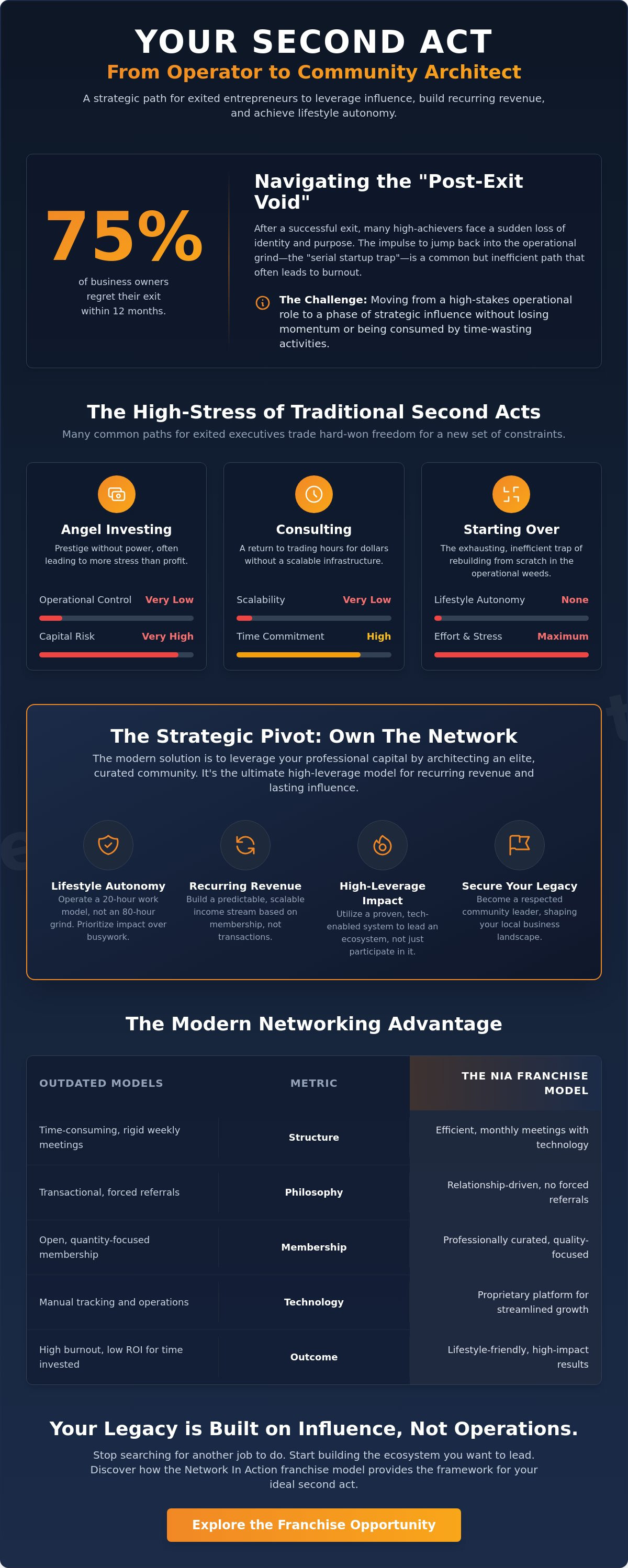
Seventy-five percent of business owners regret exiting their companies within twelve months. It's a staggering figure from Entrepreneur that highlights the "post-exit void" many executives face in 2026. You've successfully liquidated your greatest asset, yet you're likely grappling with a sudden loss of identity and the frustration of traditional networking models that waste your valuable time. Deciding what to do after selling your business shouldn't mean settling for a slow decline or a calendar full of aimless, transactional meetings.
You deserve a second act that honors your expertise while granting you genuine lifestyle autonomy. This guide outlines a strategic path to transform your executive influence into a high-impact community leadership role. We'll examine how to build residual, recurring income streams through a modernized franchise model that replaces outdated, manual networking with efficient, technology-led systems. You'll discover how to lead a curated community of peers and secure your professional legacy without the burnout of the daily grind. It's time to stop being an operator and start being the architect of your own elite professional ecosystem.
Key Takeaways
- Redefine your professional identity by moving beyond the operator role to avoid the common "post-exit void" experienced by high-achievers.
- Analyze the limitations of traditional second acts like consulting or angel investing, which often trade control for high-risk or high-effort commitments.
- Discover a strategic framework for what to do after selling your business that focuses on leveraging social capital through community leadership.
- Learn the benefits of owning the network rather than just joining it, creating a scalable model for recurring revenue and executive influence.
- Identify the core differentiators of modern, tech-enabled networking that replace the inefficiency of legacy organizations with structured, results-oriented growth.
Navigating the Post-Exit Void: Redefining Professional Identity
The wire transfer hits. The deal is closed. For most, this marks the peak of a successful exit strategy. Yet, for the high-achieving executive, the following Monday often brings a jarring sense of stillness. This is the post-exit void. It's a psychological phenomenon where your professional identity, once tied to a specific operation, suddenly lacks an anchor. You've spent years being the primary decision-maker. Now, the silence is deafening. High-achievers thrive on friction and problem-solving. Without it, they drift. When mapping out what to do after selling your business, the priority is avoiding the serial startup trap.
The serial startup trap is the impulse to build another company from scratch just to feel productive. It's inefficient. It's exhausting. Many former owners fail by trying to replicate their first success, only to find themselves back in the operational weeds dealing with HR disputes and supply chain friction. In 2026, the question isn't "What do I do next?" but "Who am I now?". A strategic second act focuses on high-leverage leadership and community impact rather than daily management. You've already proven you can operate. Now, you must prove you can lead an ecosystem.
The Psychology of the Exited Entrepreneur
Traditional retirement is a legacy concept that doesn't fit the modern entrepreneur. You're no longer the boss in a hierarchy; you're a visionary peer. This requires a fundamental mindset shift. You must learn to handle the loss of daily operational structure without losing your competitive momentum. Modern professionals in 2026 seek active influence. They want to stay in the game without being consumed by it. Success in this phase is measured by the quality of your connections and the efficiency of your schedule. It's about moving from a position of authority to a position of influence.
Auditing Your Remaining Professional Capital
Your business is gone, but your reputation remains. This is your greatest asset. You need to identify the value of your network beyond your former company and assess your desire for impact versus your need for operational involvement. Professional capital is the aggregate value of your reputation, relationships, and specialized knowledge that continues to generate returns long after you've exited an operation. The most effective answer to what to do after selling your business in 2026 is to leverage this capital through community leadership. You have the expertise. You have the status. Now, you need the right vehicle to deploy them without the burden of a traditional corporate structure.
Evaluating the "Second Act" Business Models for Executives
Don't trade your hard-earned freedom for a new set of handcuffs. When considering what to do after selling your business, many executives reflexively pivot to angel investing or consulting. These paths often lead to diminishing returns. Angel investing offers the prestige of the "investor" title, but it frequently results in the frustration of being a silent partner with zero operational control over high-risk capital. According to the Exit Planning Institute, 39% of owners intend to invest in another business, yet many find that the lack of influence over their investment leads to more stress than profit.
Consulting is another common trap. It's essentially becoming a high-paid employee. You're back to trading hours for dollars, often without the benefits of a scalable infrastructure. To truly prepare for your life after selling, you must look for models that offer high leverage. The modern franchise model allows you to bypass the "startup grind" by utilizing a proven, tech-enabled system. This is about owning the ecosystem, not just working within it. Community leadership represents the ultimate executive pivot. It allows you to curate elite professional relationships while generating consistent, recurring revenue.
High-Leverage vs. High-Stress Opportunities
The 80-hour startup week is a relic of the past. Modern leadership in 2026 focuses on a 20-hour model that prioritizes social capital and recurring income. You've already built one empire; your second act should be about lifestyle autonomy and influence. This requires a shift toward business models that emphasize quality over quantity. You can explore executive business opportunities that align with this high-leverage philosophy, ensuring your time is spent on strategy rather than logistics.
The Problem with Traditional Networking Models
Outdated networking models are fundamentally broken for high-level professionals. Legacy networking organizations rely on rigid, transactional structures that devalue your time. They often demand weekly breakfast meetings and "forced referrals" that prioritize volume over value. This inefficiency is a drain on executive resources. In contrast, modern networking should be results-oriented and tech-forward. It should provide a streamlined platform for genuine connection without the cumbersome requirements of manual, legacy systems. If you're ready to lead a sophisticated community, consider checking available territories for a more modern approach to professional growth.
- Angel Investing: High risk, low control, and often emotionally draining.
- Consulting: A non-scalable time-for-money trap.
- Franchise Ownership: Scalable, structured, and system-driven.
- Community Leadership: High influence with low operational friction.
Choosing what to do after selling your business requires a commitment to efficiency. You need a vehicle that rewards your experience without demanding your soul. By transitioning from a business operator to a community architect, you maintain your status as a visionary leader while securing true time freedom.
Transitioning from Operator to Community Architect
Stop managing. Start curating. When you're deciding what to do after selling your business, the most sophisticated move is to trade your title of "Operator" for "Community Architect." This isn't about retirement; it's about shifting your focus from managing internal employees to curating an elite circle of professional relationships. In 2026, the most resilient business model isn't built on physical assets or massive payrolls. It's built on social capital. This capital acts as a high-yield currency that drives consistent growth through trust rather than cold prospecting. You've spent decades learning how to scale. Now, you can leverage that expertise to help other owners grow while you remain strategically positioned above the operational fray.
This transition allows you to maintain your executive influence without the burden of daily friction. You aren't just joining a group; you're building an ecosystem. By facilitating high-level connections, you become the indispensable node in your local economy. This is a leadership model designed for the modern era, where your value is measured by the quality of the connections you foster rather than the number of hours you spend in an office. It's a path that offers both financial returns and professional fulfillment without the burnout of traditional ownership.
Leading with Influence, Not Authority
Authority is granted by a title, but influence is earned through value. As a community architect, you position yourself as the ultimate connector in your local business ecosystem. You move away from open-door, generic networking and toward a model of curated membership. This ensures that every individual in your circle brings measurable value to the table. You can build a powerful professional network that functions as a high-performance engine for all involved. This approach replaces the transactional nature of legacy networking organizations with relationship-driven growth that feels natural and elite.
The Efficiency of Monthly Engagement
Efficiency is the hallmark of a successful second act. Legacy networking organizations often demand weekly breakfast meetings that waste time and yield low-quality leads. In 2026, professional networking has evolved into a hybrid model. With over 123 million hybrid networking events occurring annually, the demand for high-impact, focused engagement is at an all-time high. Modern systems utilize tech-enabled platforms to maintain connectivity between physical events, allowing for a monthly meeting structure that respects your time. In the context of elite professional development, less is more; one high-impact monthly session far outweighs the diluted value of four mandatory weekly meetings. This streamlined approach allows you to lead effectively while maintaining total lifestyle autonomy.
The Strategic Pivot: Owning the Network, Not Just Joining It
Most post-exit guides suggest you join a board or volunteer your time. That's a passive approach to power. If you're looking for what to do after selling your business in 2026, you shouldn't just be a member of someone else's group. You should own the territory. Owning the network means you control the quality, the culture, and the financial outcomes. It transforms your social capital into a tangible, scalable asset. A business networking franchise serves as the ideal bridge from operator to visionary owner. It offers the structure of a proven system with the freedom of an elite lifestyle.
Territorial rights are the ultimate leverage. In a market where genuine connection is increasingly rare, owning the exclusive rights to a local business ecosystem is a high-value move. You're building a relationship-driven business where growth happens through reputation, not cold calls. Cold prospecting is for startups. For the exited executive, the focus is on curating a room of high-performers who already know, like, and trust each other. This is the next evolution of the industry, where "owning the room" isn't just a metaphor; it's a revenue model.
- Ownership: You control the membership quality and the meeting schedule.
- Scalability: Built-in systems allow for growth without adding operational friction.
- Residual Income: Monthly recurring revenue replaces the "one-and-done" consulting fee.
- Influence: You remain the central figure in your local business community.
The Modern Networking Differentiator
Legacy networking organizations are built on volume. They force referrals and demand attendance at rigid, time-consuming meetings. This outdated model fails because it ignores the value of an executive's time. Modern systems eliminate forced referrals entirely. Instead, they use proprietary technology to track real ROI and provide measurable value to every member. You aren't just hosting a meeting; you're running a tech-forward professional empire. Most importantly, it's a lifestyle-friendly model. You can maintain your influence and income by dedicating only 10 to 20 hours a month to the operation. This is how you reclaim your time while expanding your reach.
Step-by-Step Guide to Your Second Act
Transitioning doesn't have to be complex. Start by auditing your current network. Identify the high-performers who would make ideal founding members for an elite community. Next, research available territories to ensure you secure your local market before a competitor does. Finally, you should download a franchise kit to understand the underlying economics and systems that make this model work. This isn't about starting over. It's about leveling up. If you're ready to see how your expertise translates into community ownership, explore your local territory opportunities today.
Network In Action: The Evolution of Professional Networking
Legacy networking organizations are built on manual, time-consuming processes that have failed to evolve with the speed of modern commerce. If you are analyzing what to do after selling your business, you need a model that reflects your executive standards. Network In Action (NIA) positions itself as the modern, superior alternative to these outdated systems. It isn't just about franchising a business; it's about leading a results-oriented ecosystem that utilizes exclusive digital tools to drive growth. NIA franchisees function as community leaders who curate high-quality memberships, ensuring every connection has a measurable ROI. This is the next evolution of the industry.
This is the path to true lifestyle autonomy. By leveraging a turnkey system, you secure a consistent stream of recurring revenue without the operational friction of a traditional startup. You've spent your career managing complexity. Your second act should be about simplicity and influence. NIA provides the structure to maintain your professional credibility while granting you the freedom to dictate your own schedule. It is an elite image for an elite professional. You don't just join the network; you own the territory and lead the conversation.
Why NIA Fits the Executive Mindset
NIA strikes a professional balance between corporate sophistication and entrepreneurial excitement. It uses an "informed disruption" approach to fix the inherent flaws of the legacy industry. Forced referrals and rigid weekly meetings are replaced with a tech-forward platform that respects your time. In 2026, the focus for executives is on scaling proven applications. NIA aligns with this by moving from assistive tools to more autonomous systems that plan and execute tasks. For an executive who values efficiency above all else, this is the ultimate high-leverage opportunity. You stay in the game on your own terms, using a system designed for those who have already mastered the art of the deal.
Securing Your Professional Legacy
Your network is your most valuable asset after an exit. It is the aggregate of your social capital. By owning a franchise territory, you ensure that you stay relevant and influential in your industry indefinitely. You become the person who facilitates the growth of others, cementing your status as a visionary leader. This isn't just a business venture; it's the foundation of your professional legacy. You can Download the Network In Action Franchise Kit to begin your strategic second act today. It is time to move beyond the question of what to do after selling your business and start building your community empire. Secure your territory and lead the next generation of business growth.
Architect Your Executive Legacy
Your professional journey doesn't end with a wire transfer; it evolves. You've learned that what to do after selling your business isn't about finding a hobby or launching a high-stress startup. It's about transitioning into a high-leverage role as a community architect. By leveraging your existing social capital, you can maintain executive influence while securing true time freedom. This is the next evolution of professional networking, where your value is measured by the quality of your connections rather than the hours on your clock.
Network In Action provides the blueprint for this transition. With over 150 global locations and a proprietary technology platform, NIA has solved the inherent flaws of legacy networking organizations. Our lifestyle-friendly monthly meeting model ensures you stay at the center of your industry without the burnout of the daily grind. It's time to stop being an operator and start being the visionary owner of your own elite professional ecosystem. Take the next step toward a meaningful second act that rewards your experience and protects your autonomy.
Start Your Strategic Second Act - Download the Franchise Kit
Frequently Asked Questions
How soon after selling my business should I start a new venture?
You should take a strategic break to reflect on your personal and professional goals before jumping into a new venture. While 39% of owners intend to invest in another business immediately, rushing without a plan often leads to the 75% regret rate cited by Entrepreneur in 2026. Use this time to audit your social capital and decide if you want to be an operator or a visionary leader.
Is a franchise a good idea for an experienced entrepreneur?
A franchise is an excellent choice for experienced entrepreneurs who want to leverage a proven system without the exhaustion of a startup grind. It allows you to skip the trial and error phase and focus on high-level strategy and community leadership. For those deciding what to do after selling your business, a franchise offers the ideal balance of recurring revenue and lifestyle autonomy.
What are the most common mistakes people make after selling their business?
The most common mistakes include rushing into a "serial startup" trap and failing to plan for a loss of professional identity. Many high-achievers struggle with the sudden stillness of retirement and attempt to replicate their first success by starting over from scratch. This often results in operational burnout rather than the strategic second act they truly desire.
How do I maintain my professional network without a company to represent?
You maintain your professional network by transitioning your role from a business operator to a community architect. Your network is your most valuable asset after an exit; it shouldn't be tied to a single company. By owning the professional ecosystem, you remain the central node of influence in your local market regardless of your former title.
What is the difference between NIA and traditional networking organizations?
NIA replaces the rigid, transactional nature of traditional networking organizations with a modern, tech-enabled platform. Unlike outdated networking models that demand weekly breakfast meetings and forced referrals, NIA focuses on monthly high-impact sessions and curated membership. This results-oriented approach respects your time and prioritizes quality over quantity in professional relationships.
Can I run a professional networking franchise part-time?
Yes, the NIA model is designed to be lifestyle-friendly and can be managed in approximately 10 to 20 hours per month. This flexibility is a core differentiator for executives who value time freedom as much as financial returns. It allows you to build a professional empire while maintaining the autonomy you earned through your business exit.
How much capital do I need to start a second act in community leadership?
The capital requirements for a second act in community leadership vary based on your local market and territory goals. Rather than focusing solely on the initial investment, you should evaluate the potential for recurring revenue and the ROI of your social capital. You can download a franchise kit to review the specific economics of this business opportunity.
What happens if I feel bored after my business exit?
Feeling bored is a common symptom of the "post-exit void" and usually indicates a lack of professional purpose. If you find yourself missing the friction of the business world, it's a sign that you need a new challenge that utilizes your expertise. Transitioning to community leadership provides the intellectual stimulation you crave without the operational stress of running a massive company.