Why are you still managing someone else's chaos when you could own the ecosystem where that chaos is solved? You've spent years mastering complex systems and high-stress stakeholder management, yet your income remains capped by a corporate ceiling. You carry the risk of project failure without ever owning the financial upside. If you're searching for business ideas for former project managers, you're likely tired of the time for money trap and ready for a model that scales. Own the upside. Build authority.
You already know that your ability to drive results is your greatest asset. This article reveals how to leverage a command of systems to transition from a corporate employee to a high-ROI business owner. It explores scalable models with recurring revenue and explains why modern, technology-led platforms are the superior alternative to legacy networking organizations. You will discover how to secure lifestyle autonomy and position yourself as a local authority in a high-growth market. Professional freedom. Strategic impact.
Key Takeaways
- Stop managing scope for others and start owning the systems that drive results. Explore high-leverage business ideas for former project managers that convert corporate expertise into personal equity.
- Compare the volatility of independent consulting against the stability of executive franchise models. Prioritize recurring revenue and lifestyle autonomy over the "time for money" trap.
- Identify why modern, technology-led networking is the superior alternative to legacy industry practices. Leverage your stakeholder management skills to lead a high-status professional community.
- Execute a strategic transition by auditing your social capital and professional network strength. Transition from a corporate employee to a visionary leader with a scalable, high-ROI business model.
Beyond the Gantt Chart: Why Project Managers are Built for Ownership
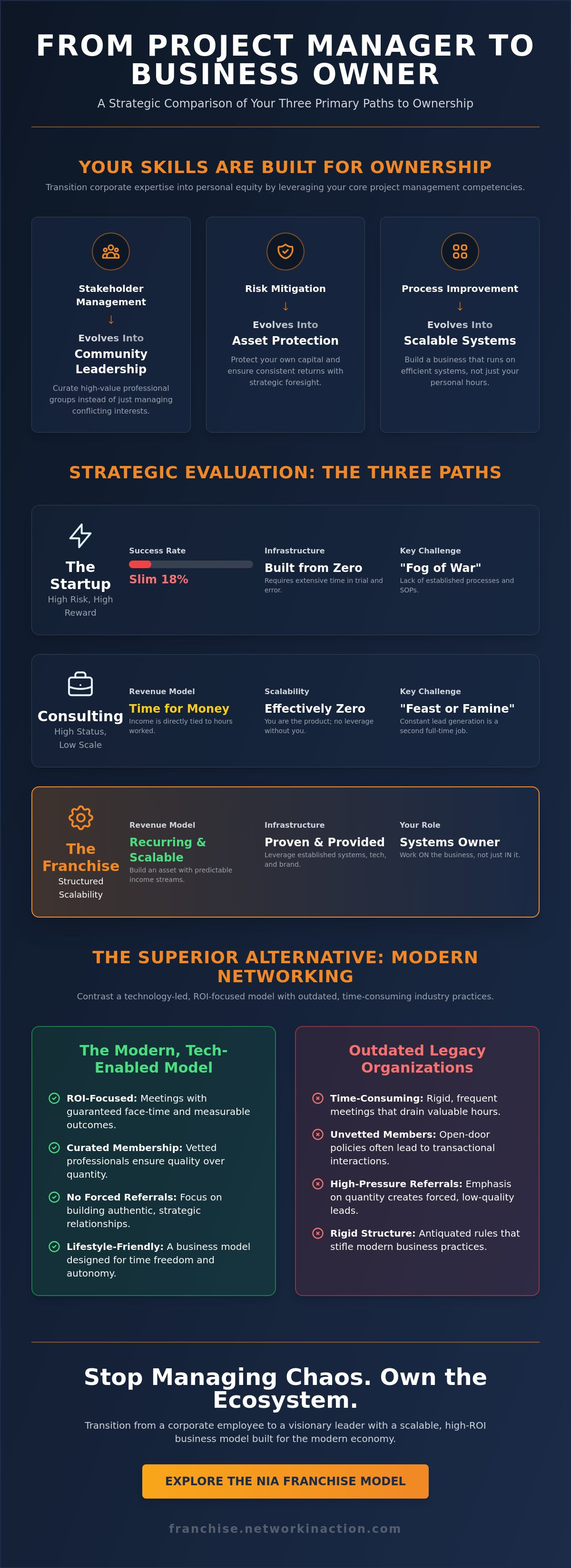
Corporate life is a paradox for high-level project managers. You possess military-grade efficiency, yet you're constantly throttled by slow-moving bureaucracy. You manage millions in budget and hundreds of stakeholders, but at the end of the day, you're a line item on a balance sheet. It's time to stop managing scope for someone else and start owning the business system. When exploring business ideas for former project managers, the most lucrative path involves taking those core project management skills and applying them to a model where you own the upside. Results matter. Ownership scales.
The psychological shift is profound. In a corporate role, you're often viewed as a cost center, a necessary expense to keep projects on track. As a business owner, specifically within a high-leverage franchise model, you become the profit generator. Your ability to mitigate risk isn't just a defensive move; it's a strategic advantage that protects your own capital and ensures consistent returns. You aren't just following a plan. You are building an asset.
Managing Stakeholders vs. Building a Community
Stakeholder management is essentially community leadership under a different name. You already know how to navigate conflicting interests, manage expectations, and drive consensus. These are the exact skills required to lead high-level professional referral groups. In a relationship-driven economy, your professional credibility is your highest-value currency. You don't just network; you curate. You vet connections with the same rigor you'd use for a vendor selection process, ensuring every member of your community adds measurable value. This positions you as an authority rather than just another participant.
The ROI of Efficiency in 2026
Efficiency is no longer just about saving time. It's about maximizing ROI. In 2026, operational excellence is the ultimate competitive advantage. While others struggle with manual, outdated networking models, you can leverage your background to implement tech-forward systems that scale. Consider these advantages:
- Systematized Growth: Use your process improvement skills to automate the mundane and focus on high-value interactions.
- Scalable Impact: Move from tactical task management to strategic executive leadership.
- Time Freedom: Build a business that runs on systems, not just your personal hours.
Transitioning to ownership allows you to work on the business rather than in it. This is how you break the 40-80 hour cycle and achieve true lifestyle autonomy. You've managed the projects. Now, it's time to own the engine.
Strategic Evaluation: Startups vs. Consulting vs. Franchising
Choosing the right vehicle for your transition is a high-stakes decision. Most lists of business ideas for former project managers focus on low-level service work, but you need a model that respects your intellect and leverages your executive experience. In 2026, the market is divided into three primary paths: the volatility of startups, the plateau of consulting, and the structured scalability of franchising. Each requires a different level of capital and risk tolerance. Strategic alignment is mandatory. Execution is everything.
Startups are often romanticized. The reality is a "fog of war" where first-time founders face a slim 18% success rate. You will spend months, perhaps years, building infrastructure from scratch. While filing fees for an LLC might only range from $50 to over $500 depending on your state, the true cost is the massive amount of time lost to trial and error. For a PM used to clear milestones, the lack of established SOPs can be agonizing. Risk is high. Infrastructure is zero.
Consulting feels like a natural pivot. The global management consulting market is massive, projected to reach $374.67 billion in 2026. However, it is a high-status trap. You're still trading hours for dollars. Without a dedicated platform, you're constantly hunting for your next lead, effectively becoming a "temporary employee" without the safety net of benefits or long-term equity. High status; low scalability.
The Problem with Traditional Consulting Models
PM consultants often find themselves in a cycle of feast or famine. Lead generation is a full-time job in itself, distracting you from the actual work. You might secure high-status projects, but you aren't building a scalable asset. If you want to move beyond these limitations, explore top executive business opportunities that offer higher leverage. Traditional models lack the recurring revenue needed for true freedom.
The Franchise Advantage: SOPs for Success
Franchising offers a "turnkey command" system. It aligns perfectly with the PM mindset. You don't have to invent the wheel; you just have to drive the car. Whether you are a Project manager or entrepreneur, the ability to execute within a proven framework is your greatest strength. With initial franchise fees typically between $40,000 and $60,000, you gain access to a brand and technology stack that would take years to build independently. This structure allows you to establish a recurring revenue stream quickly, moving you from tactical execution to strategic leadership. If you're ready to see where this model fits your goals, check available territories to find your next move.
Top 5 Executive Business Ideas for Former Project Managers
Forget the generic advice suggesting you open a laundromat or a landscaping business. Those models ignore your highest-value asset: your intellectual capital. When evaluating business ideas for former project managers, you must look for opportunities that require sophisticated system management and elite relationship building. You've spent years coordinating cross-functional teams and navigating high-stakes deadlines. Now, apply that expertise to a model where you own the infrastructure. These five executive-level paths leverage your command of systems to drive personal equity.
- Professional Networking and Referral Group Ownership: This is high-status work with minimal overhead. You act as the architect of a local business ecosystem, curating high-value relationships.
- Business Process Outsourcing (BPO) Management: Leverage your ability to streamline complex operations by managing decentralized service teams for mid-market firms.
- Strategic Implementation Consulting: Move beyond tactical task management. Advise organizations on how to build the systems that ensure project success.
- Executive Coaching for Technical Leaders: Your experience in the corporate trenches makes you the perfect mentor for the next generation of technical managers.
- Technology-Enabled Service Franchises: Manage professional service teams through sophisticated digital platforms. Focus on the system, not the labor.
The goal is to stop being a tool in someone else's kit. Start being the craftsman who owns the workshop. You have the skills. Now, you need the right vehicle.
The Rise of Networking as a Business
Business owners are fleeing legacy networking organizations. They are tired of rigid, time-consuming, and transactional environments that yield low-quality leads. They want curated, tech-enabled communities that respect their time. As a "Connector-in-Chief," you provide the bridge between high-level professionals. By choosing to franchise a business networking opportunity, you step into a role of professional authority with a proven technology stack. It's the next evolution of industry growth. Quality over quantity. Efficiency over activity.
Operational Excellence Franchising
Many small businesses suffer from a massive efficiency gap. They have the customers but lack the systems to scale without breaking. This is where your background in operational excellence becomes a goldmine. You can monetize this gap by owning a service-based franchise that relies on tight protocols and Lean methodologies. Build a portfolio of recession-resistant assets that thrive on logic and structure. When you own the system, you own the results. This is how you secure business ideas for former project managers that actually scale.
Why Modern Networking Ownership is the High-Leverage Move
Most business ideas for former project managers treat networking as a tactical chore. They view it as a necessary evil to find the next contract. This is a fundamental misunderstanding of social capital. High-level professionals understand that owning the network is where the real leverage exists. You aren't just attending meetings; you're architecting the platform where commerce happens. This move shifts you from a participant to the ultimate stakeholder. You own the ecosystem. You control the upside.
Legacy networking organizations are built on outdated, manual processes. They demand grueling weekly grinds and forced referrals that compromise professional integrity. These rigid systems are inefficient and transactional. Modern networking ownership disrupts this failed status quo. By hosting monthly meetings instead of weekly sessions, you respect the time of high-level members. You replace pressure with performance. You eliminate the quota system, ensuring that every connection is curated and high-quality. Results drive retention. Efficiency builds authority.
Technology-Enabled Growth
In 2026, manual outreach and paper reporting are relics of a bygone era. A modern franchise provides a proprietary technology stack that tracks ROI and member engagement automatically. This allows you to manage the entire operation from a single executive dashboard. Instead of chasing paper trails, you execute a sophisticated referral marketing strategy built on trust and verifiable data. It is about working smarter. It is about deploying systems that scale without increasing your personal workload. Direct impact. Measurable growth.
Lifestyle Autonomy and Professional Status
Project managers are frequently trapped in 40 to 80 hour weekly cycles. Ownership changes the math entirely. Because the system is technology-led and structured around high-value monthly interactions, you gain significant lifestyle autonomy. You become the most influential person in your local business community without the exhaustion associated with outdated networking models. You create a scalable asset that generates recurring revenue while you focus on high-level leadership. You aren't just a manager anymore. You are a community pillar. Professional credibility. Strategic freedom.
If you're ready to transition from managing projects to owning a high-status professional community, explore available territories to see where you can lead next.
The Roadmap to Ownership: Executing Your Strategic Transition
Transitioning from a corporate employee to a business owner isn't a leap of faith. It's a managed project. For those vetting business ideas for former project managers, the execution phase defines the eventual ROI. You must treat your career pivot with the same rigor you apply to a multi million dollar project budget. Start by auditing your social capital. Your professional network is no longer just a resource for finding your next job. It is the primary asset of your future community. High-level relationships are the foundation of a scalable business engine.
Evaluate executive franchise models that offer high-margin recurring revenue. You want a system that solves the "time for money" trap inherent in independent consulting. In May 2026, the prime rate sits at 6.75 percent, making the cost of capital a strategic consideration for new owners. SBA 7(a) variable rates currently range from approximately 9.0 percent to 11.5 percent APR. Securing funding for a proven system is a logical move when the infrastructure is already built and tested. Launch your business with a community-centric event to establish immediate authority. This positions you as the leader of a modern, technology-led alternative to legacy networking organizations. Strategic leadership. Immediate impact.
Due Diligence for the Strategic Investor
Analyze the Franchise Disclosure Document with the same precision you'd use for a project charter. Look beyond the initial franchise fee, which typically ranges between $40,000 and $60,000, to understand the long-term scalability of the model. Speak with existing owners about their actual ROI and operational freedom. You need to know how the system performs in the real world. Check available territories to identify a strategic market that isn't yet saturated by outdated networking models. Data drives decisions. Logic ensures success.
Your First 90 Days as an Owner
Your first quarter is mission-critical. Apply your background in operational excellence to set strict KPIs for member acquisition and network quality. Focus on building a community where quality outweighs quantity. This is the next evolution of professional connection. Use your onboarding project plan to automate administrative tasks and focus on high-value relationship building. To begin your mission-critical research and see the full operational breakdown, download the franchise kit today. Move from managing projects to owning the future. Results-oriented ownership starts here.
Take Command of Your Professional Future
The transition from corporate employee to high-ROI business owner requires a shift in perspective. You've seen why managing scope is a cost center, while owning the business system is a profit engine. Among the most strategic business ideas for former project managers, modern networking ownership stands out for its scalability and recurring revenue potential. You can leverage your command of systems without falling into the "time for money" trap of independent consulting. Efficiency over activity. Impact over busyness.
Network In Action has solved the inherent flaws of legacy networking organizations. With over 150 successful global locations and proprietary technology for member ROI tracking, the model is proven and ready for execution. The monthly meeting structure respects your schedule and ensures maximum efficiency for high-level members. This is the next evolution of the industry. It's time to build a scalable asset that generates revenue while positioning you as a local community authority. Ownership is the ultimate project. Execute it with precision.
Download the NIA Franchise Kit to evaluate your next strategic move. Your mission-critical research begins now.
Frequently Asked Questions
What are the best business ideas for former project managers in 2026?
The most lucrative business ideas for former project managers involve high-leverage roles like networking franchise ownership, BPO management, and strategic implementation. These positions allow you to move beyond tactical execution and focus on community leadership. You avoid the "labor trap" by owning the system that generates results rather than providing the labor yourself. High-status, low-overhead models are the priority for 2026.
How do PMP skills translate to business ownership?
Your PMP skills translate through expert risk mitigation, stakeholder management, and operational optimization. Business ownership is essentially a continuous project with higher stakes and greater financial upside. You apply the same discipline used in corporate project charters to manage your own operational systems and growth metrics. You aren't just starting a company; you're executing a strategic plan for long-term equity.
Is franchising better than starting a consultancy for former PMs?
Franchising offers a turnkey command system that independent consultancy lacks. Consultants often find themselves in a "feast or famine" cycle, acting as temporary employees who trade hours for dollars. A franchise provides a proven brand and a technology-led platform. This structure allows you to scale a business with recurring revenue without increasing your personal workload or hunting for every lead.
How much does it cost for a project manager to start a business?
Startup costs depend heavily on your chosen business structure. Filing fees for an LLC in 2026 range from $50 to over $500 depending on the state, with Kentucky being lower and Massachusetts on the higher end. Professional liability insurance for small consulting firms averages between $30 and $70 per month. These foundational costs are manageable for professionals seeking a strategic transition into ownership.
What is the most profitable business for someone with management experience?
High-margin, low-overhead models like professional networking ownership are often the most profitable. By curating high-level referral groups, you minimize operational costs while maximizing your social capital. This model allows for consistent, recurring income streams without the burden of heavy inventory or massive staffing requirements. It turns your management experience into a high-ROI asset that scales through technology and relationships.
How does modern networking differ from traditional networking organizations?
Modern networking utilizes proprietary technology and monthly meetings to respect your time and maximize efficiency. Traditional networking organizations often rely on rigid, weekly grinds and forced referrals that prioritize quantity over quality. Modern models eliminate these transactional pressures. They focus on curated, high-quality membership and data-driven ROI tracking to ensure every connection delivers measurable value to the professional community.
Can I own a business while maintaining a flexible lifestyle?
You can achieve a flexible lifestyle by owning a systems-led business that doesn't require your constant presence. Many business ideas for former project managers focus on working on the business rather than in it. By choosing a model with structured monthly interactions and automated reporting, you eliminate the 80 hour weekly cycle. This creates true lifestyle autonomy while maintaining your status as a local authority.
What are the risks of transitioning from a PM role to entrepreneurship?
The primary risks include cash flow volatility and the lack of a proven infrastructure. Statistics show that first-time founders have an 18 percent success rate when starting from scratch. You mitigate these risks by choosing a franchise model with established SOPs and a documented track record. Moving into a system that has already solved the inherent flaws of its industry significantly improves your chances of success.