Your twenty-five years of executive experience are either a legacy you'll leave behind or the foundation of a high-yield future you actually own. Many high-level professionals fear that leaving the C-suite means losing their professional identity or, worse, depleting their retirement savings on unproven ventures. You've likely spent years watching others profit from your strategic insights while you traded your time for a steady paycheck. Learning how to transition from employee to entrepreneur after 50 isn't about starting over from scratch. It's about a calculated pivot.
You deserve a business model that respects your status and prioritizes your lifestyle. This guide reveals how to leverage your existing social capital into a tech-enabled franchise that generates recurring revenue without the 80-hour work week. This analysis explores how to avoid the pitfalls of outdated networking models and instead build a community-led business that scales. You will discover a strategic path to time freedom that maintains your professional prestige while securing your financial future through 2026 and beyond. This is the modern evolution of business ownership for the seasoned executive.
Key Takeaways
- Convert decades of executive wisdom into a scalable asset by conducting a comprehensive social capital audit to identify high-value professional connections.
- Discover how to transition from employee to entrepreneur after 50 by choosing a turnkey franchise model that eliminates the startup lag of traditional businesses.
- Replace the time-consuming drudgery of outdated networking models with a technology-led system designed for high-impact monthly interactions rather than weekly meetings.
- Secure your financial future with a predictable, recurring revenue stream that prioritizes lifestyle autonomy and professional prestige over the corporate grind.
- Execute a five-step strategic roadmap to exit the corporate suite and establish yourself as a community leader through the next evolution of professional networking.
Leveraging 25 Years of Social Capital: Why 50 is the Optimal Entrepreneurial Age
Entrepreneurship after 50 is not a desperate pivot or a retirement hobby. It is the strategic deployment of accumulated professional wisdom. While the media fixates on twenty-something disruptors, the reality of the market favors the seasoned executive. You have spent decades refining your crisis management skills, building relational depth, and learning how to navigate complex organizational structures. When you decide how to transition from employee to entrepreneur after 50, you aren't starting over. You are finally owning the framework instead of merely executing someone else's vision. Experience wins. Maturity scales. Professional wisdom is your greatest unfair advantage.
The Myth of the Young Tech Founder
The narrative that business ownership is a young person's game is a persistent fallacy. Data suggests that founders over 50 are significantly more likely to succeed than their younger counterparts. This statistical advantage stems from a superior ability to identify genuine market gaps rather than chasing fleeting trends. While exploring What is Entrepreneurship?, it becomes clear that the core of the discipline is the identification and exploitation of opportunity. Executive maturity leads to better capital allocation and more disciplined growth strategies. You don't waste resources on vanity metrics. You focus on ROI. You understand that sustainable business models require structure, not just hype.
Monetising Your Professional Rolodex
Your network is not just a list of contacts; it is a measurable financial metric. In the corporate world, you used these relationships to hit quarterly targets for your employer. As an entrepreneur, this social capital becomes your most valuable asset. Decades of trust-building drastically reduce the cost of customer acquisition. You don't need to engage in the exhausting cold-prospecting cycles that plague younger founders. Instead, you leverage existing credibility to open doors that remain locked to others.
Social capital is the ultimate leverage for mid-life business owners who want to bypass the startup lag and move directly into high-value leadership. Unlike outdated networking models that prioritize transactional quantity, a sophisticated approach focuses on the quality of every connection. You understand that one high-level introduction is worth more than a hundred business cards exchanged at a generic mixer. When you learn how to transition from employee to entrepreneur after 50, you stop trading your time for a salary and start monetizing the influence you've spent a lifetime building. Results matter. Relationships drive them.
The Franchise Advantage: Protecting Capital and Accelerating ROI in Mid-Career
Transitioning after 50 requires a surgical approach to risk. You don't have twenty years to recover from a failed startup experiment. This is why seasoned leaders look beyond the "freelance consultant" trap. While consulting might seem like a natural move, it often leads to a high-stress "job" where you are the only employee. To protect your capital, you need a system. Infrastructure is the antidote to uncertainty. A franchise provides the immediate framework you lack as a solo founder, effectively eliminating the startup lag that kills most new ventures. It's about moving directly into the profit phase by using a model that has already solved the inherent flaws of the industry.
High-level professionals require models that offer predictable, recurring revenue streams. This financial predictability allows for better long-term planning and reduces the anxiety associated with the "feast or famine" cycle of independent business. When you evaluate how to transition from employee to entrepreneur after 50, your focus must remain on executive business opportunities that match your professional status. You aren't looking for a hobby. You are looking for a high-yield asset that respects your time and leverages your C-suite experience.
Proven Systems vs. Solo Experimentation
Independent startups face staggering failure rates because they lack a battle-tested roadmap. In contrast, a franchise offers a turnkey infrastructure, including a ready-to-use technology stack and a proven brand identity. A comprehensive Guide to Starting a Successful Business After 50 highlights that leveraging established systems is the fastest path to stability in a volatile market. A business networking franchise specifically allows you to use your leadership skills to manage a community of professionals rather than getting bogged down in manual administrative tasks. Efficiency is the key to ROI.
Scalability and Lifestyle Autonomy
Scalability is about autonomy. You want a business that works for you, not the other way around. There is a massive difference between "buying a job" and "owning a system." Legacy networking organizations often demand a rigid, weekly presence that feels like another corporate clock-in. Modern, technology-led models replace this weekly drudgery with high-impact monthly meetings. This shift creates a lifestyle-friendly business that allows you to maintain professional prestige while reclaiming your time. Understanding how to transition from employee to entrepreneur after 50 means recognizing that your time is now your most expensive resource. You can explore available territories to see where this modern evolution of networking is needed most.
Identifying High-Efficiency Models: Moving Beyond Legacy Networking
Legacy networking is a relic of a manual era. It was designed when time was cheap and professional meetings were often glorified social clubs. For an executive learning how to transition from employee to entrepreneur after 50, these outdated models are a strategic liability. You've spent years optimizing corporate workflows for maximum output. You shouldn't settle for a business model that ignores those same principles of efficiency. You need high-velocity results. You need a system that respects your calendar and leverages your status. Results matter. Time is non-renewable.
The Problem with Outdated Networking Models
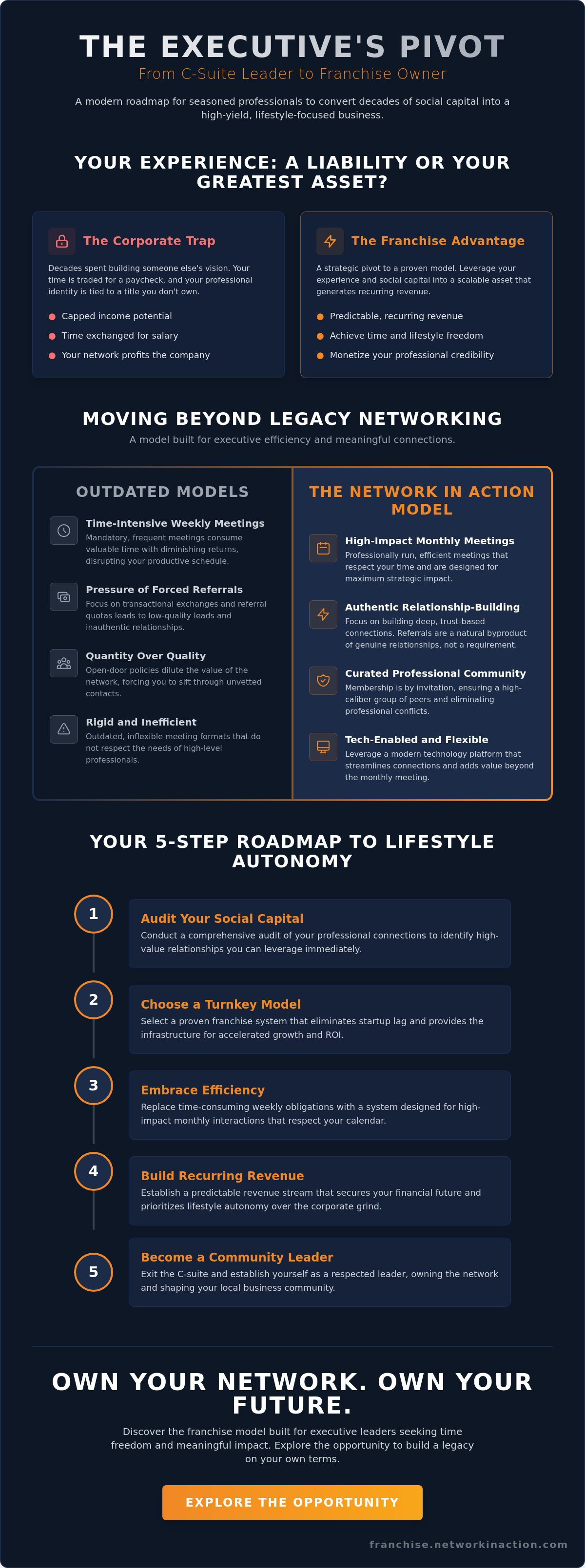
Traditional networking is frequently a burden rather than an asset. Many legacy networking organizations demand rigid, weekly attendance at the crack of dawn. For a seasoned professional, this is an inefficient use of time that could be spent on high-level strategy. The leading brand in this space often enforces a system of forced referrals. This practice is fundamentally flawed. It prioritizes transactional volume over professional quality, leading to a flood of low-value leads that waste everyone’s time. You don't need fifty business cards from people you'll never call. You need three high-impact partnerships that move the needle. Modern executives require a curated, results-oriented environment where membership is based on professional alignment, not just a checkbook.
Technology as the Great Multiplier
Technology is the ultimate differentiator for the modern entrepreneur. In 2026, manual tracking and paper-based referral logs are obsolete. A tech-forward franchise replaces the startup lag with automated engagement tools that work while you sleep. A proprietary platform keeps your community connected between physical meetings, ensuring that the momentum of your network never stalls. This isn't just a digital directory. It is a sophisticated referral marketing strategy powered by digital tools that track ROI in real-time.
When you master how to transition from employee to entrepreneur after 50, you must select a business model that acts as a force multiplier for your influence. Digital platforms allow you to lead a professional community without being tethered to a desk or a rigid weekly schedule. You manage the high-level relationships. The technology manages the logistics and reporting. This modernized approach represents the next evolution of the industry, offering a streamlined solution to the inherent flaws of legacy models. Efficiency is the primary metric. Lifestyle autonomy is the inevitable result.
The Strategic Transition Roadmap: 5 Steps to Exit the Corporate Suite
The transition from the boardroom to business ownership is a high-stakes maneuver. It requires more than just a desire for freedom. It demands a tactical framework. When you are learning how to transition from employee to entrepreneur after 50, you can't afford the trial-and-error approach of a twenty-something founder. You need a roadmap that turns your decades of experience into immediate market authority. This isn't a leap of faith. It's a calculated move into a superior business model.
- Step 1: Conduct a Social Capital Audit. Your professional rolodex is a measurable asset. Quantify the depth of your relationships to see where your influence is strongest. Identify the key decision-makers who already trust your judgment.
- Step 2: Evaluate ROI and Alignment. Evaluate business models based on their ability to produce recurring revenue. Discovering how to transition from employee to entrepreneur after 50 means choosing a path that matches your executive status and respects your time.
- Step 3: Research Market Opportunities. Identify regions where outdated networking models are failing. Check available territories to secure a market with high growth potential and a dense population of hungry business owners.
- Step 4: Execute a Strategic Soft Exit. Plan your departure so you can hit the ground running on day one. Your professional credibility is your launchpad. Finalize your new business structure while your corporate reputation is at its peak.
- Step 5: Tech-Enabled Launch. Use a technology-backed system to manage your new community. This ensures you provide value immediately without manual administrative drudgery. Results matter from the first meeting.
Financial Readiness and Due Diligence
Capital preservation is the priority. Initial fees and ongoing royalties are investments in infrastructure that eliminate the startup lag. You should download a franchise kit to examine the specific financial metrics of the NIA model. Assess the lifestyle ROI. If a business model requires the same rigid hours as your current job, it’s not an exit. It’s a lateral move. You are looking for a system that generates consistent income while providing the autonomy you've earned.
Mindset Shift: From Manager to Leader
The most common objection is the fear of selling. Executives often say they aren't "salespeople." In a modern networking franchise, you don't sell. You lead. You become the curator of high-quality connections. You move from managing internal corporate tasks to driving growth for an entire community of business owners. This shift in identity is essential for long-term success. You aren't just running a business. You are leading the next evolution of professional networking in your city.
Request the full executive franchise kit to start your strategic transition today.
Owning the Network: The Network In Action Executive Opportunity
Network In Action (NIA) represents the next evolution of professional networking. It is a sophisticated, tech-enabled business model designed specifically for the executive who is finished with the corporate grind but not finished with leadership. For those determining how to transition from employee to entrepreneur after 50, NIA offers a strategic path that avoids the high-risk pitfalls of independent startups. This is not about starting from zero. It is about taking the helm of a proven system that prioritizes high-yield results and professional prestige. Own the framework. Lead the community. Secure the future.
The NIA model disrupts the industry by replacing the exhausting weekly drudgery of legacy networking organizations with high-impact monthly meetings. This shift is intentional. Modern executives value efficiency over activity. By facilitating curated groups of small to mid-sized business owners, franchisees act as the primary architects of local economic growth. You aren't just running a business; you are building an elite ecosystem where every member is focused on measurable ROI. This is the ultimate executive business opportunity for those seeking a meaningful professional impact combined with genuine lifestyle autonomy.
The Power of the NIA Platform
Proprietary technology is the core differentiator that separates NIA from outdated networking models. While legacy organizations rely on manual tracking and paper-based logs, the NIA platform automates the heavy lifting. This allows you to focus on high-level relationship management rather than administrative tasks. A central pillar of this philosophy is the "No Forced Referrals" policy. Quality wins every time. By removing the pressure to produce low-value leads, the system ensures that every connection made within your group carries significant professional weight. You lead a community based on trust and results, backed by a support system designed to help you scale your franchise with corporate-level precision.
Your Next Chapter Starts Here
Transitioning into business ownership should be a move toward freedom, not another 60-hour work week. NIA is the logical conclusion for an executive who wants to leverage their social capital into a recurring revenue stream. It provides the structure of a franchise with the flexibility of a modern, tech-forward business. If you are serious about how to transition from employee to entrepreneur after 50, you must choose a model that aligns with your experience and your goals for time freedom.
Your journey from the C-suite to community leadership begins with understanding the logic behind this modernized approach. You can explore the free book to gain a deeper insight into the philosophy that is disrupting the networking industry. This is more than a business move. It is a strategic alignment with the future of professional connections. The status quo is broken. It is time to lead the alternative.
Secure Your Executive Future with Strategic Ownership
The corporate suite was your training ground. Now it's time to own the asset. You've seen that social capital isn't just a network; it's a measurable financial engine. By choosing a turnkey franchise model, you bypass the inefficiency of independent startups and the rigid, time-consuming meetings of legacy networking organizations. Success is about choosing a system that works for you. Learning how to transition from employee to entrepreneur after 50 doesn't mean sacrificing your lifestyle for a new grind. It's about a calculated move into a superior business model.
Network In Action (NIA) has already proven this with over 150 locations worldwide. The proprietary technology platform and high-impact monthly meeting model ensure maximum efficiency for you and your community. You have the experience. You have the connections. Now you just need the framework to scale them. Take the first step toward a future defined by autonomy, prestige, and recurring revenue. Download the NIA Franchise Kit to explore your next executive move. Your next chapter isn't about working harder. It's about leading smarter.
Frequently Asked Questions
Is it too late to start a business at 50?
It is actually the most strategic time to launch a business because you possess superior crisis management and capital allocation skills. Data shows that founders over age 50 are twice as likely to achieve high-growth success compared to their younger counterparts. Your objective isn't to hustle like a startup founder; it's to lead like an owner. You're leveraging decades of wisdom to bypass the entry-level mistakes that sink most new ventures.
How do I choose the right business model after a corporate career?
Select a model that prioritizes recurring revenue and lifestyle autonomy over high-intensity labor. When researching how to transition from employee to entrepreneur after 50, you should look for turnkey systems that offer a technology-backed infrastructure. Avoid models that require high overhead or extensive manual management. A franchise that allows you to act as a community leader ensures your business reflects your executive standing and professional prestige.
What are the risks of transitioning from employee to entrepreneur?
The greatest risks involve misallocating your retirement savings into unproven concepts or losing the professional identity you've built. Solo startups often lack the guardrails needed to protect your investment during the initial growth phase. Choosing an established franchise system mitigates these risks by providing a battle-tested roadmap and a ready-made brand. This structure ensures your transition is a calculated strategic move rather than a high-stakes gamble with your financial future.
How much time does a networking franchise require?
A modern networking franchise is designed for maximum output with minimal time commitment. Unlike legacy organizations that demand daily administrative involvement, high-efficiency models utilize proprietary technology to automate member engagement and referral tracking. This allows you to focus your energy on high-level relationship building and group facilitation. Most successful owners find that a structured monthly meeting schedule provides the perfect balance between professional impact and personal freedom.
How does modern networking differ from traditional networking models?
Modern networking eliminates the rigid, time-consuming weekly meetings and "forced referrals" that characterize outdated networking models. Traditional systems often prioritize quantity, leading to low-value connections and wasted time. In contrast, a results-oriented approach uses digital tools to maintain member engagement and focuses on high-level professional alignment. It's a shift from a social club atmosphere to a strategic business environment where every interaction is measured by its potential ROI.
Can I run a franchise while still working my corporate job?
You can initiate your business while still in the corporate suite to ensure a seamless financial transition. This "soft exit" allows you to build your community and establish your brand presence before fully leaving your salary behind. Understanding how to transition from employee to entrepreneur after 50 involves using your current network to seed your initial groups. This phased approach reduces financial pressure and allows you to scale your business at a pace that matches your exit timeline.
What skills from my corporate career will translate best to entrepreneurship?
Your ability to manage complex organizational structures and build long-term professional trust translates directly to community leadership. In a franchise environment, your role shifts from overseeing internal departments to curating a high-value network of business owners. The emotional intelligence and negotiation skills you've refined over twenty-five years are exactly what modern professionals seek in a leader. You aren't just managing tasks; you're driving growth through strategic influence.
What is the typical ROI for an executive business opportunity?
Financial returns in a franchise model are driven by recurring revenue and low overhead costs. However, for the seasoned executive, the ROI also includes the value of reclaimed time and professional autonomy. You should evaluate the potential for growth based on the strength of your local market and the efficiency of the tech stack provided. A high-yield business model respects your status and provides a predictable income stream without the 9-to-5 grind.