With 83% of professionals struggling with burnout in 2026, the traditional corporate climb has become a race toward diminishing returns. High-level expertise is currently being leased by organizations that value bureaucratic friction over actual innovation. Stop being a high-paid cog. When searching for business ideas for burnt-out corporate managers, the goal isn't just a job change. It's a total reclamation of autonomy and time.
The friction of large organizations often leads to a loss of purpose. This article provides a strategic roadmap to transition from exhaustion to executive ownership using high-leverage business models designed for modern leaders. Discover how to build scalable assets that prioritize recurring revenue and professional respect. The following sections break down efficient systems for achieving time freedom while moving beyond the limitations of outdated, legacy networking models. Proven results. Scalable growth. This is the next evolution of professional leadership.
Key Takeaways
- Identify the "Management Paradox" where high-level responsibility exists without true autonomy and learn how to reclaim your professional authority.
- Use the Leverage Audit to evaluate the best business ideas for burnt-out corporate managers based on speed-to-ROI and long-term asset value.
- Avoid the "wearing all hats" trap of traditional startups by pivoting toward executive ownership models that prioritize high-level strategy.
- Discover how a technology-forward franchise model creates recurring revenue and time freedom through community leadership.
- Replace the transactional friction of legacy networking organizations with a modern, curated system designed for sophisticated professional growth.
Beyond the Burnout: Why Corporate Managers Seek New Horizons in 2026
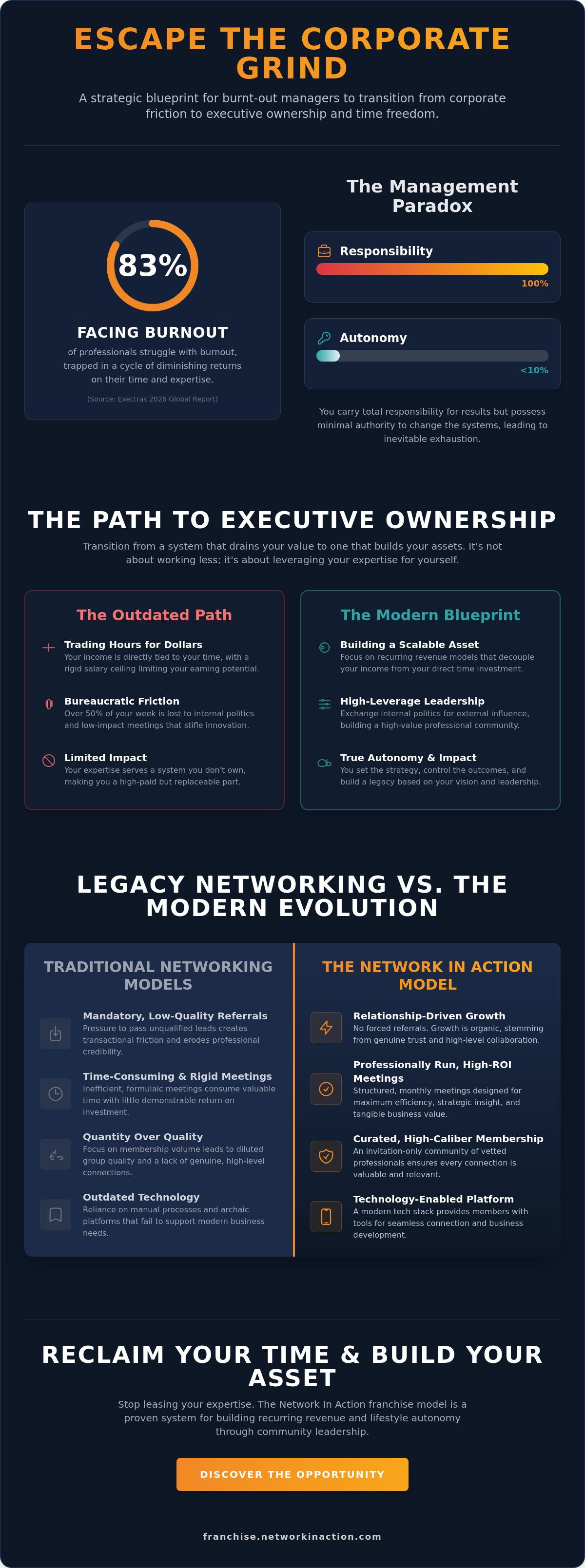
The corporate landscape of 2026 is a pressure cooker. Recent data reveals that 83% of global workers are currently battling exhaustion (Exectras). For mid-to-senior managers, this isn't just a bad week. It's a fundamental misalignment of value. You're likely searching for business ideas for burnt-out corporate managers because the "Management Paradox" has finally reached a breaking point. You carry 100% of the responsibility for results but possess 0% of the autonomy to change the underlying systems. This creates a cycle of diminishing returns on your time and talent.
Your 20 years of leadership experience is a massive untapped asset. While legacy organizations treat you as a replaceable cog, the market for executive ownership is expanding rapidly. The cure for your exhaustion isn't doing less. It's owning the system instead of serving it. You've already mastered the hard part: managing people, budgets, and complex strategies. Now, it's time to apply those skills to an asset you actually own. Stop leasing your brain to a board of directors that doesn't know your name.
The True Cost of the 9-to-5 Slog
Prolonged Occupational burnout does more than drain your energy. It erodes your professional confidence and limits your earning potential. High performers often fall into the trap of "quiet quitting," but that's a losing strategy for anyone with a visionary mindset. It merely delays the inevitable while you remain stuck under a rigid salary ceiling. Burnout costs the U.S. economy $322 billion annually in lost productivity (Gallup). You don't have to be part of that statistic. Equity-based business models allow you to build a scalable asset that grows in value, rather than just trading hours for a paycheck that stops the moment you stop working.
From Bureaucracy to Community Leadership
Most managers spend over half their week navigating internal politics and soul-draining meetings. This chronic meeting fatigue is a specific symptom of outdated corporate structures that prioritize activity over results. Transitioning to community leadership changes the dynamic entirely. You move from managing internal friction to building external influence. Consider these shifts:
- Autonomy: You set the strategy. No more waiting for committee approval.
- Leverage: Use your existing network to build a high-value professional community.
- Impact: Replace transactional meetings with high-leverage connections that drive real ROI.
Your leadership skills are highly transferable. They thrive when applied to high-leverage environments where results are measured by financial metrics and social capital, not by how many hours you sat in a conference room. The psychological shift from employee to owner is the most critical step in your 2026 exit strategy. It's about moving from a mindset of survival to a mindset of scale.
Evaluating High-Leverage Business Ideas for Former Executives
Reclaiming your time requires a clinical evaluation of how you invest your capital and energy. You aren't just looking for business ideas for burnt-out corporate managers; you're looking for an exit from the "trading hours for dollars" trap. This requires a Leverage Audit. Before committing to a new venture, you must analyze the time-to-ROI and the scalability of the model. High-leverage businesses, such as specialized consulting, franchising, and intellectual property development, allow you to decouple your income from your physical presence. Service-based models are particularly superior for former managers. They eliminate the logistical nightmares of manufacturing, inventory management, and retail supply chains. You've spent years managing complex systems. Your next move should focus on leveraging your intellectual capital, not managing a warehouse.
Recurring revenue is the ultimate safeguard against founder burnout. Without a predictable, consistent income stream, you're simply replacing a corporate boss with a demanding, unpredictable business. A University of Pennsylvania research on executive burnout suggests that a lack of control over outcomes is a primary driver of professional exhaustion. By prioritizing business models with built-in retention, you regain that control. You build a scalable asset that delivers financial returns while protecting your lifestyle autonomy.
The Executive Leverage Framework
Scalability is the first metric of success. If a business requires more of your personal time to generate more revenue, it isn't a high-leverage asset. It's a job. Your greatest moat is your professional network. High-level professional relationships are a barrier to entry that most aspiring entrepreneurs can't replicate. When evaluating opportunities, decide between "Build-from-Scratch" and "Turnkey" systems. Building from zero requires thousands of hours of administrative minutiae. Turnkey systems allow you to skip the infrastructure phase and move directly into leadership. You can explore available territories to see where your existing network offers the most strategic advantage.
Why Service Franchises Outperform Independent Startups
The data is clear. Franchises have a significantly higher survival rate in their initial years. One study from Michigan Ross showed an 8.4 percentage point higher two-year survival rate for franchised businesses compared to independent ventures. This is due to the pre-built technology stack and operational systems that allow for immediate execution. In 2026, you don't have time to be a part-time IT director or a manual bookkeeper. A modern franchise provides the digital tools needed to automate back-office functions. This allows for immediate authority positioning. You enter the market with a proven brand and a sophisticated platform, moving past the "unproven solo founder" phase on day one. It's the difference between struggling for recognition and leading a community from a position of established credibility.
Why Traditional Startups Often Fail the Burnt-Out Manager
The primary objection most executives have when evaluating business ideas for burnt-out corporate managers is a fear of the "founder grind." You've already spent decades in a 60-hour-per-week cycle. The last thing you need is a startup that demands 80 hours of manual effort. Traditional startups frequently lead to the "Wearing All the Hats" trap. In your corporate role, you have departments for HR, IT, and marketing. In a solo venture, you are the department. This administrative minutiae is the fastest path to professional resentment. It pulls you away from the high-level strategy where you actually provide value.
The consequences of job burnout don't disappear just because you changed your title to "CEO." Many managers jump from the corporate frying pan into an entrepreneurial fire, trading a demanding boss for a business that consumes every waking second. This is the Legacy Startup model. It's inefficient. It's exhausting. It's outdated. Contrast this with an executive-led franchise model. Here, the infrastructure is already built. You don't waste time building the engine; you focus on driving the car. You leverage a system that is already optimized for scale and efficiency.
The Myth of the Solo Founder
Going it alone is a recipe for Burnout 2.0. High-performing executives thrive when they focus on leadership and community influence rather than technical tasks. You need a support structure to maintain your role as a visionary rather than a technician. By utilizing turnkey business opportunities, you skip the "struggle phase" of inventing operational systems from scratch. You start with a proven technology stack and a refined brand. This allows you to remain the boss while having a corporate-level foundation backing your every move. It's about working smarter, not harder.
Avoiding the Pitfalls of Traditional Networking Models
Many managers explore networking as a business path but fall into the trap of legacy networking organizations. These outdated networking models are built on high-frequency, low-value meetings. They prioritize quantity over quality. They demand rigid attendance and forced referrals. For a sophisticated professional, this is a waste of social capital. These transactional groups fail to attract high-level business owners because they lack modern efficiency. Network In Action represents an informed disruption of this industry. The NIA model prioritizes curated membership and technology-enabled platforms. No forced referrals. No rigid, time-wasting rituals. Just high-leverage connections that drive measurable ROI. This is the next evolution of professional networking for those who value results over activity.
The Executive Franchise Model: Scaling Impact Without the 80-Hour Week
Most business ideas for burnt-out corporate managers suggest a massive pay cut in exchange for a slower pace. This is a false choice. High-level skills shouldn't be traded for entry-level wages. You don't need a smaller career; you need a more efficient system. The executive franchise model allows you to scale your impact while reclaiming your schedule. Unlike traditional startups where the founder is the chief technician, executive ownership focuses on strategy and community leadership. You aren't buying a job. You're investing in a scalable asset that operates with lean overhead and high leverage.
Semi-absentee and executive ownership models represent the next evolution of professional independence. In these structures, you leverage a proven technology stack to automate the administrative friction that plagues legacy networking organizations. By utilizing a sophisticated business networking franchise, you skip the infrastructure phase and move directly into a position of authority. Financial metrics in this model are transparent. You manage the relationship between royalties and recurring revenue to drive a consistent ROI. It's about working on the business, not in it.
Lifestyle Autonomy and Time Freedom
Designing a workweek that prioritizes high-value relationships over administrative tasks is the ultimate luxury. Executive ownership allows you to manage a franchise territory while maintaining total personal flexibility. The "Monthly Meeting" advantage is a key differentiator here. By replacing the high-frequency, low-value rituals of outdated networking models with a streamlined monthly format, you reduce your time commitment while actually increasing your impact. You provide a curated space for high-level professionals to connect without the rigid, time-consuming requirements of traditional groups. Results over routine. Impact over activity.
Building a Recurring Revenue Stream
Membership-based business models offer the financial stability corporate managers often fear losing. When you transition to executive ownership, you're building a predictable, scalable income stream. This allows you to project long-term value and develop clear exit strategies for your territory. A robust referral marketing strategy ensures organic growth without the need for high-pressure sales tactics. You leverage the trust within your curated community to expand your influence. This is how you build a professional asset that works for you, providing both financial returns and the lifestyle autonomy you've earned. If you're ready to see how this model fits your goals, download the complete franchise kit to explore the possibilities.
Network In Action: The Modern Evolution of Business Ownership
Network In Action (NIA) represents the informed disruption of a stagnant industry. It is the technology-forward alternative to legacy networking organizations that have long relied on manual, inefficient practices. When evaluating business ideas for burnt-out corporate managers, NIA stands out by offering a sophisticated system where quality precedes quantity. The model completely eliminates the forced referral culture common in outdated networking models. It replaces transactional pressure with curated membership. You don't act as a salesperson. You function as a Community Leader. You facilitate strategic connections using a proprietary technology platform that automates tracking and reporting. This is professional networking modernized for the 2026 economy. Modern systems. Measurable ROI. Elite leadership.
The NIA franchisee leverages exclusive digital tools to solve the inherent flaws of a traditionally manual industry. By removing the administrative burden, you focus on high-level strategy and relationship-driven growth. This is the next evolution of the industry, positioning you as a tech-savvy authority who values time and efficiency above all else. You aren't just starting a business. You are leading a professional community with a ready-to-use solution that challenges the status quo.
Why Executives Thrive as NIA Franchisees
Management experience translates directly to leading high-level business groups. Leading these circles requires the exact consultative leadership you've honed in the corporate world. You don't need cold prospecting. You need relationship-driven growth. You help local small businesses scale by providing the structure and high-quality membership they lack. This is high-leverage impact. It moves you away from the diminishing returns of a corporate slog and toward a scalable asset you actually own. Your existing network becomes your most valuable currency, allowing you to bypass the traditional startup struggle.
Next Steps for the Aspiring Entrepreneur
The transition from managing a department to owning an empire requires a strategic approach. Start by evaluating available territories in your region to identify where your network offers the most leverage. For full financial transparency and a detailed look at the underlying systems, reviewing the franchise kit is the essential next step. This is your path to time freedom and professional respect. Move beyond the limitations of legacy models. Lead your own professional community today.
Reclaim Your Professional Authority
The transition from corporate manager to executive owner isn't just about escaping a job. It's about deploying your leadership capital where it generates the highest ROI. You've seen why traditional startups often fail high-level professionals by forcing them into administrative minutiae. High-leverage business ideas for burnt-out corporate managers prioritize systems over sweat. By choosing a model built on recurring revenue and technology-enabled efficiency, you move past the limitations of legacy networking organizations and into true lifestyle autonomy.
Network In Action offers the modern evolution of professional community leadership. With over 150 global locations and a proprietary tech-enabled networking platform, the system is specifically designed for high-level professional ROI. You don't have to build the engine from scratch. You simply need to lead. It's time to stop managing someone else's vision and start building your own professional empire. Download the NIA Franchise Kit to explore your executive exit strategy. Your next chapter starts with a strategic move toward ownership and impact. You've earned the right to lead on your own terms.
Frequently Asked Questions
Is franchising a good idea for someone with corporate burnout?
Franchising is an excellent strategy because it bypasses the struggle phase of building operational systems from scratch. Managers can leverage their existing leadership skills within a proven framework. It provides the support structure of a corporation while granting the autonomy of a business owner. This balance is critical for those seeking business ideas for burnt-out corporate managers who want to avoid the 80-hour startup grind.
What are the best low-stress business ideas for managers in 2026?
The best low-stress ideas focus on intellectual capital rather than physical infrastructure. Consulting, executive coaching, and high-level networking franchises are top choices in 2026. These models allow you to monetize your professional network and expertise without the headaches of supply chain management or retail staffing. They prioritize high-value relationships over administrative minutiae and logistical friction.
How much does it cost to start a business networking franchise?
Initial franchise fees in 2026 typically range from $20,000 to $60,000 across the industry according to GrowthFactor. You should also account for ongoing royalty fees, which average 4% to 8% of gross sales. While these industry benchmarks provide a general framework, you must review the specific Franchise Disclosure Document for exact investment requirements and recurring operational costs.
Can I run a franchise while still working my corporate job?
Some ownership models allow for a semi-absentee approach, but executive-level franchises often perform best with an active community leader. Success depends on your ability to facilitate high-value connections and manage the proprietary technology platform. While some owners start while transitioning, the goal of executive ownership is usually to exit the corporate slog entirely to reclaim time freedom.
What is the difference between NIA and traditional networking organizations?
NIA is a technology-led evolution of the industry that solves the flaws of legacy networking organizations. Unlike outdated networking models, NIA features no forced referrals and curated membership. It uses a sophisticated digital platform to replace manual tracking and reporting. This creates a professional environment focused on quality relationships rather than transactional, high-frequency meetings that drain your schedule.
How do I know if I'm ready to move from employee to entrepreneur?
You're ready to move when the Management Paradox of high responsibility and zero autonomy becomes unsustainable. If you have decades of expertise and a strong professional network, you possess a massive untapped asset. Moving from employee to entrepreneur is a strategic shift toward owning the system rather than being a cog within it. It's about results, not activity.
What kind of training is provided for new franchise owners?
New owners receive extensive training on the proprietary technology platform and the relationship-driven growth model. This onboarding ensures you can effectively curate memberships and lead professional groups without needing a background in high-pressure sales. The focus remains on consultative leadership and facilitating structured referrals within your community. Ongoing support helps you maintain professional credibility as a community leader.
How long does it take to see a return on investment in a service franchise?
ROI in a service franchise is typically driven by low overhead and recurring revenue streams. While brick-and-mortar businesses face high startup costs and long lead times, service models allow for a more streamlined path to profitability. Timelines vary based on your local market execution and the speed at which you build your professional community. Low capital requirements often accelerate this process.