The most effective exit from the classroom isn't another job; it's a strategic transition into executive business ownership. Years spent managing chaotic classrooms and navigating bureaucratic red tape often lead to profound professional exhaustion. When searching for second career ideas for burnt-out teachers, most professionals settle for mid-level corporate roles that simply trade one income ceiling for another. This choice often results in the same lack of autonomy that caused the initial burnout.
This guide reveals why the smartest move involves leveraging existing leadership skills to build a scalable, high-impact business. The following analysis explores how to replace outdated networking models with a technology-led franchise system that prioritizes professional autonomy and income scalability. The upcoming sections break down the mindset shift required for executive status, the systems that drive ROI, and the specific steps to secure a lifestyle-friendly business model. Discover the roadmap to transition from an educator to an executive who leads a professional community with precision and authority.
Key Takeaways
- Recognize why lateral corporate moves often fail. Most simply replicate the administrative grind and lack of autonomy found in the classroom.
- Evaluate second career ideas for burnt-out teachers based on income scalability. Prioritize long-term lifestyle freedom rather than a modest salary bump.
- Reframe instructional leadership as high-level stakeholder coordination. Use these skills to command immediate respect and professional authority in the business world.
- Transition from educator to executive owner. Leverage a technology-led franchise model that replaces the transactional inefficiencies of traditional networking.
Why Most Second Career Ideas for Burnt-Out Teachers Fail to Solve the Real Problem
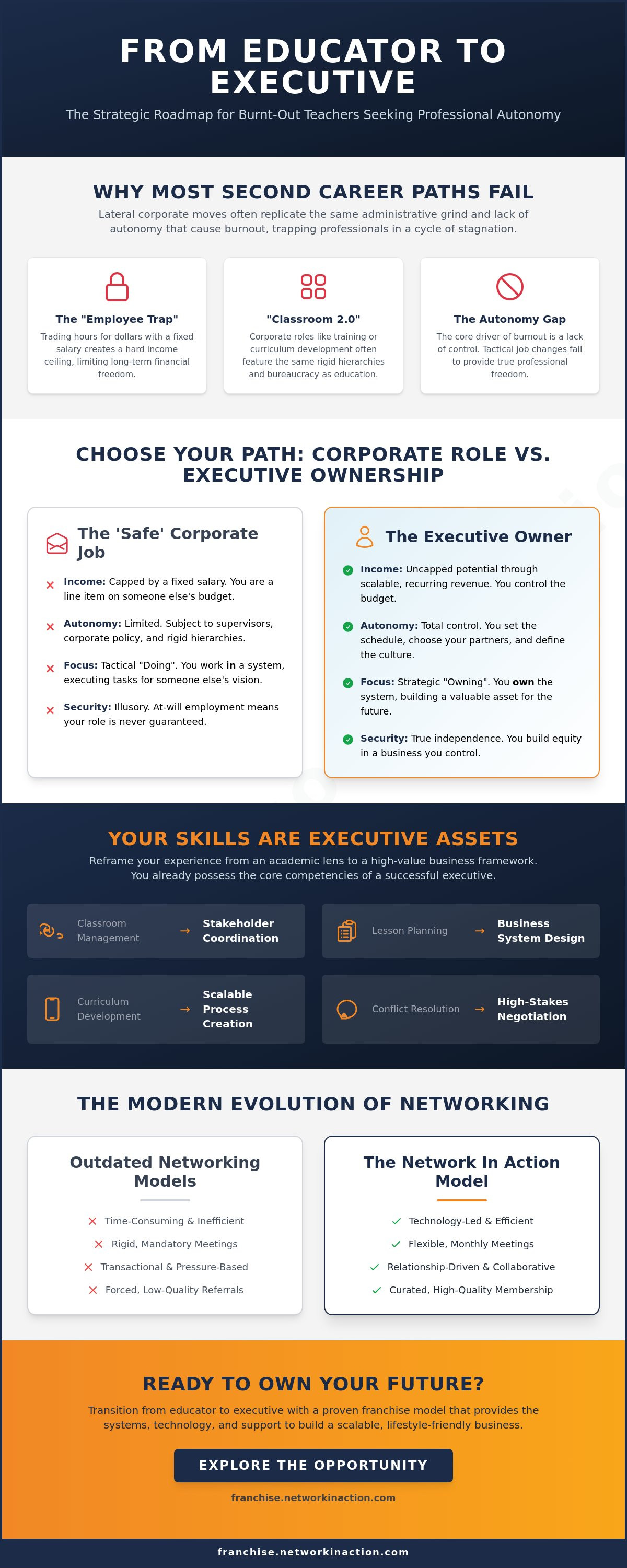
The standard list of second career ideas for burnt-out teachers is fundamentally broken. Most career coaches suggest lateral moves like corporate training, curriculum development, or academic advising. These roles are often just "Classroom 2.0" in disguise. You still answer to a rigid hierarchy. You still face bureaucratic red tape. The core driver of teacher burnout isn't just the workload; it's the professional stagnation. Professional stagnation. It's the feeling of being a high-level leader trapped in a system that doesn't respect your expertise. A new salary won't fix a lack of freedom.
Real transition requires a mindset shift from service to results. In education, success is often measured by compliance. In the executive world, it's measured by ROI and scalability. Strategic ROI. If you simply trade your classroom for a corporate cubicle, you remain stuck in the "Employee Trap." You're still trading hours for dollars. You're still subject to the whims of a supervisor. True professional autonomy only comes when you own the system instead of just working within it. Own the system.
The Myth of the 'Safe' Corporate Job
Corporate bureaucracy can be just as stifling as school board politics. Many teachers seek "safety" in large organizations, only to find themselves caught in the reality of at-will employment. In the 2026 economy, hiring timelines have slowed and competition for remote roles is fierce. Employers now demand tangible proof of skills and certifications beyond transferable experience. A fixed salary provides the illusion of security, but it actually creates a hard income ceiling. Business ownership allows you to leverage your leadership skills for uncapped earning potential. Uncapped potential. You move from being a line item on a budget to being the one who controls the budget.
Identifying the Autonomy Gap
Teachers crave control over their schedule and professional environment. This is the Autonomy Gap. Most career changes fail because they're tactical rather than strategic. They focus on what you'll do every day instead of who you'll be. Tactical moves like instructional design keep you in the "doing" phase. Strategic moves into business ownership put you in the "owning" phase. It's the natural evolution for a professional who has spent years managing complex groups. Owning the system means you decide how to scale. You choose who you work with. You utilize exclusive digital tools to drive efficiency rather than manual, outdated methods. This is how you bridge the gap between where you are and where you deserve to be.
The Executive Transition: Leveraging Classroom Leadership in the Business World
You aren't just an educator; you're a high-level stakeholder coordinator. This mindset shift is the most critical step in your transition to executive ownership. While most second career ideas for burnt-out teachers focus on technical pivots like instructional design, they ignore the massive human capital management experience you already possess. You've spent years managing diverse groups, mediating conflicts, and delivering complex information under pressure. To successfully change careers, you must stop viewing your skills through an academic lens and start seeing them as executive assets. Communication mastery is a premium in the 2026 business landscape. It's the engine of growth. High-level professionals value clarity and efficiency above all else. You already provide that. Finding the right second career ideas for burnt-out teachers means looking for roles where your voice carries weight.
From Lesson Plans to Business Systems
Curriculum design is the foundation of a scalable business system. You already know how to take a high-level goal, break it down into actionable steps, and measure the results. This is exactly how successful business owners optimize their workflows. Instead of managing students, you'll be managing business relationships and high-value networks. Educators are the ultimate organizational leaders because they consistently synchronize diverse human variables, complex schedules, and evolving objectives within high-pressure environments. You understand how to build a framework that produces consistent results. This isn't just teaching; it's systems engineering. You can explore available territories to see where these systems can be applied in your local market as a business owner.
Soft Skills as Hard Assets
Your ability to command a room is a rare commodity. In traditional networking circles, the environment is often disorganized and inefficient. Your presentation skills allow you to lead meetings with authority and precision. Conflict resolution isn't just a classroom tool; it's a vital part of professional mediation. You know how to build empathy and rapport, which are the primary drivers of a referral-based empire. While others rely on cold prospecting, you'll leverage your ability to build deep, authentic connections. This is relationship-driven growth. It's efficient. It's profitable. It's the modern evolution of professional networking. You aren't just leading a group; you're curating a high-quality membership that relies on your leadership to thrive. This creates a sustainable income stream built on your existing strengths.
Corporate Employment vs. Business Ownership: Escaping the Administrative Grind
Most second career ideas for burnt-out teachers focus on trading one desk for another. Transitioning into human resources or project management might feel like an escape, but it often results in "burnout transfer." You're still trapped in a system where you don't own your time. Corporate employment in 2026 remains subject to rigid hierarchies and administrative noise. If you want true professional evolution, you must look beyond being a high-level employee. You already have the transferable skills for a career change, but applying them to a new boss limits your ROI. Ownership is the only way to capitalize on your value. Strategic ownership.
Traditional networking models mirror the worst parts of the education system. Legacy networking organizations rely on rigid, weekly mandatory meetings and forced referrals. They're transactional. They're time-consuming. They're inefficient. Modern professionals don't have time for the manual tracking and "leading brand" bureaucracy of the past. A technology-enabled platform changes the game. It automates the administrative grind. It replaces forced participation with curated, high-quality relationships. This isn't just about finding a new job; it's about building a professional community that thrives on efficiency rather than compliance.
Autonomy and Lifestyle Control
Ownership grants you the power to design your schedule. Instead of the weekly grind required by outdated networking models, you can lead high-impact monthly sessions. This shift respects your time. It allows you to choose your members and curate an elite professional circle. You aren't just filling seats; you're building a community of high-level executives. This model ensures your business fits your life, not the other way around. Lifestyle autonomy. You move from answering to a school board or a CEO to being the visionary leader of your own territory.
Scalability and Income Potential
The math of recurring revenue is the key to long-term wealth. A teacher's salary has a hard ceiling, often peaking at $73,000 according to 2025 data. Even a high-level corporate role has limits. Business ownership offers a different trajectory. You're building an asset with value beyond your daily effort. A successful franchise creates consistent income streams that grow as your influence expands. You're no longer just earning a paycheck; you're developing a salable asset. This is the floor of executive ownership. It's about scalability, financial metrics, and the freedom to grow without permission.
Building Your Exit Strategy: Evaluating ROI, Lifestyle, and Scalability
Updating a resume for a job board is a strategy for an entry-level employee, not an executive. When exploring second career ideas for burnt-out teachers, your exit must be calculated and results-oriented. You aren't just looking for a new role; you're looking for an asset that provides a high ROI on your time. An exit strategy requires five critical steps:
- Audit Professional Capital: Catalog your high-level coordination skills and existing network assets.
- Define Non-Negotiables: Establish your absolute baseline for schedule flexibility and income scalability.
- Evaluate Business Models: Prioritize systems that utilize technology to minimize administrative noise and manual labor.
- Analyze Territory: Identify high-growth markets where professional networking is currently fragmented or inefficient.
- Secure Support: Invest in a model that provides the training necessary to bridge the gap between education and executive ownership.
In the 2026 economy, financial planning is essential. With SBA 7(a) variable rates currently between 10.5% and 13% APR, your business model must be efficient from day one. High-level ownership isn't about guesswork; it's about predictable metrics. You need a system that offers a clear path to recurring revenue to offset initial costs and drive profit. Most second career ideas for burnt-out teachers fail to address the income ceiling problem. Ownership solves it. Teachers excel here because they are masters of instructional planning and data tracking. They understand how to follow a system to achieve a specific result. Strategic results.
The Power of a Turnkey System
Starting a business from scratch is the hardest path to freedom. It's manual. It's slow. It's risky. Leveraging a proven model allows you to bypass the traditional startup struggle and move straight into community leadership. You gain access to exclusive systems and a ready-to-use solution that has already solved industry flaws. This is a strategic shortcut. You can download the franchise kit to see the exact roadmap for this executive transition.
Evaluating Modern Networking Platforms
Avoid the traps of legacy networking organizations. These outdated models focus on sheer volume and forced referrals, which drive away high-level professionals. Modern platforms prioritize the quality of membership and use proprietary tech to maintain engagement. This is the next evolution of the industry. It replaces the transactional nature of traditional networking with high-value, relationship-driven growth. Your business should leverage digital tools to manage the heavy lifting, allowing you to focus on leading the room. If you're ready to make a move, explore available territories to secure your future in a high-growth market.
Leading the Room: Why Owning a Networking Franchise is the Natural Evolution for Educators
The transition from classroom teacher to community leader is the most logical step in a high-level professional's career. While most second career ideas for burnt-out teachers focus on behind-the-scenes administrative work, executive ownership puts you at the center of the local economy. You aren't just facilitating lessons; you're facilitating growth. Network In Action represents the next evolution of the industry, solving the inherent flaws of outdated networking models that rely on manual tracking and forced referrals. Those legacy systems are built on compliance. This system is built on results. Strategic results.
The efficiency of this model is unmatched. Instead of the weekly, mandatory grind of traditional networking, you lead high-impact monthly meetings. Proprietary technology keeps your members connected between sessions. This tech-driven approach ensures a high-ROI environment for small to mid-sized business owners who are tired of transactional, time-consuming groups. You become the architect of a sophisticated professional community. This is how you reclaim your time while maximizing your influence. Influence matters.
The Sophisticated Choice for Former Educators
Teachers excel at facilitating high-level business referrals because they understand the mechanics of human connection. You've spent years building rapport and managing complex social dynamics. In the business world, these are your greatest assets. Building professional credibility happens fast when you provide a vital service that actually drives revenue for your members. You aren't just a participant; you're the owner of a high-value system. You can explore available territories to see where you can lead your own professional community and escape the classroom for good.
Your Next Chapter Starts with Ownership
The path from burnout to business success requires a clean break from the employee mindset. Stop searching for second career ideas for burnt-out teachers that keep you answering to a supervisor. Ownership is the only way to secure the lifestyle autonomy you've been craving. It's time to stop participating in inefficient networks and start owning the most modern solution in the industry. Your experience has prepared you for this level of leadership. Take the leap into executive ownership and build an asset that scales with your ambition. Read more about Business Networking Franchise: The Executive Guide to Modern Ownership to align your future with a results-oriented system.
Step Into Your Executive Future
Leading others is a skill already mastered; it's time to apply it to a personal asset. Most second career ideas for burnt-out teachers focus on lateral shifts that maintain a cycle of compliance and restricted earnings. Real professional evolution requires moving from a participant to an owner of the system. The human capital management skills developed in the classroom are the exact tools needed to command an executive room and coordinate high-level stakeholders. Strategic coordination is the new currency for the modern entrepreneur.
Network In Action represents the next evolution of the industry. With over 150 locations worldwide, this model replaces the rigid, time-consuming practices of legacy networking organizations with a lifestyle-friendly monthly meeting structure. The proprietary technology platform ensures consistent member ROI while automating the administrative grind. This creates a scalable, relationship-driven business that respects professional time and expertise. It's a system built for efficiency, structure, and measurable growth.
Download the Franchise Kit to start your executive transition and align professional capital with a results-oriented future. The next chapter as a visionary leader is ready to begin.
Frequently Asked Questions
Is a franchise a good second career for a teacher with no business experience?
A franchise is an excellent choice for educators because it offers a proven, ready-to-use system that eliminates the risks of starting from scratch. Educators are natural systems-thinkers who excel at following a structured roadmap to achieve specific results. This model provides the training and support necessary to bridge the gap from the classroom to the boardroom. It's one of the most stable second career ideas for burnt-out teachers seeking immediate professional authority.
How do teaching skills translate to owning a business networking group?
Teaching skills are the primary drivers of success in professional networking leadership. Classroom management translates directly to high-level stakeholder coordination and group facilitation. Your ability to present complex information and mediate diverse personalities ensures that every meeting is efficient and results-oriented. These human capital management skills are often more valuable in business ownership than a traditional MBA. You already possess the leadership foundation; you're simply changing the audience.
Can I run a networking franchise while still working part-time?
The lifestyle-friendly model allows for significant flexibility in your professional schedule. Unlike outdated networking models that demand weekly attendance, this system utilizes high-impact monthly meetings and digital tools to maintain momentum. This efficiency makes it possible to build your business while transitioning out of a current role. You control the calendar. You choose the members. You own the system. This is a strategic path to time freedom.
What makes modern networking different from traditional networking organizations?
Modern networking replaces transactional, rigid practices with relationship-driven growth and exclusive technology. Traditional networking organizations often rely on forced referrals and time-consuming weekly commitments that drive away high-level executives. The next evolution of the industry focuses on curated, quality membership and a technology-enabled platform. It's a more sophisticated, elite approach designed for the 2026 business landscape. It values quality over sheer quantity.
How much does it cost to start a networking franchise as a second career?
Initial costs vary depending on the specific franchise model and territory selected. In 2026, the average initial franchise fee across industries ranges from $20,000 to $50,000, while service-based startup costs typically fall between $3,000 and $15,000. Aspiring entrepreneurs should review specific disclosure documents for any opportunity to understand the full financial commitment. This is a strategic investment in a salable asset rather than a simple job change.
What is the typical ROI for a teacher transitioning into business ownership?
ROI is measured through recurring revenue streams and long-term equity growth. While the average teacher salary was $73,000 in 2025, business ownership offers uncapped earning potential. By leveraging your network and building a high-quality professional community, you create a scalable asset. The floor of a successful franchise often exceeds the ceiling of a traditional classroom role. It's a path to financial metrics that reflect your true social capital.
How does technology help manage a professional networking group?
Technology automates the administrative grind and keeps members engaged between physical meetings. Proprietary digital tools handle referral tracking, member communication, and ROI reporting, allowing you to focus on leading the room. This tech-forward approach solves the inherent flaws of manual, legacy industries. It ensures that your business operates with maximum efficiency, leaving more time for strategic growth and personal freedom. Efficiency is the core of this modern model.
Are there available territories for networking franchises near me?
Strategic territories are available for those ready to lead their local professional communities. High-growth markets require modern networking solutions to replace inefficient, outdated practices. You should consult the current territory map to identify opportunities in your specific region. Securing a territory early allows you to establish yourself as the primary authority in a curated, results-oriented network. This is your chance to own the room in your local market.