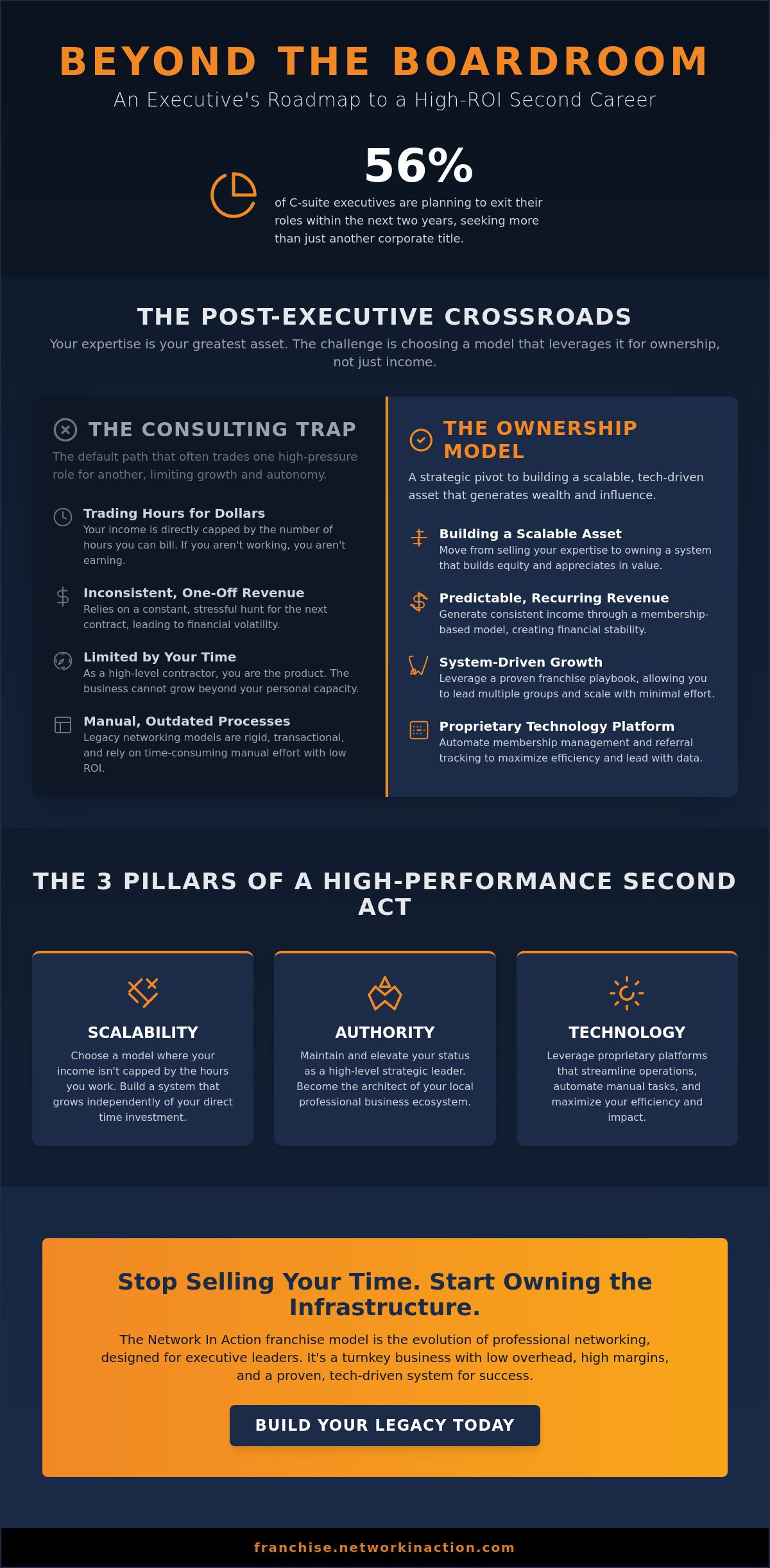
Over 56% of C-suite executives are planning to exit their roles within the next two years. It's a staggering figure that highlights a growing desire for something more than another corporate title. If you're searching for a second career for former executives, you likely want to move away from the inefficiency of legacy networking organizations and the exhaustion of constant travel. You've built a career on strategy and results; now, it's time to apply those skills to a business you actually own.
This shift isn't about starting from scratch. It's about leveraging your corporate expertise into a high-ROI business model that prioritizes time freedom and community leadership. You don't have to settle for the limitations of traditional networking or the isolation of consulting. This article explores how to build a scalable, technology-led enterprise that generates recurring revenue while positioning you as a visionary architect in your local market. Discover how to stop selling your time and start owning the infrastructure of professional connection.
Key Takeaways
- Identify the most strategic second career for former executives by shifting from a corporate contributor to a community architect through high-ROI business ownership.
- Avoid the "consulting trap" by moving beyond models that trade hours for dollars and instead building a scalable system with recurring revenue.
- Discover the competitive advantage of owning the networking infrastructure rather than just participating in rigid, outdated networking models.
- Leverage proprietary technology and curated professional connections to replace the manual, time-consuming processes of legacy networking organizations.
- Assess your current professional reach to identify high-growth territories and secure a lifestyle-friendly business model that prioritizes your autonomy.
Beyond the Boardroom: Defining the Ideal Second Career for Former Executives
Leaving the boardroom doesn't mean leaving your ambition behind. For many, the search for a second career for former executives begins with a desire for autonomy without sacrificing the intellectual rigor of the C-suite. You've spent decades mastering complex systems. Now, you need a model that serves your lifestyle rather than consuming it. True success in this phase requires informed disruption. It means challenging the assumption that your next move must be another high-pressure role or a slow-motion slide into retirement.
Most executives default to consulting. It feels safe. It's familiar. However, this often leads to the "consulting trap" where you're simply trading high-value hours for dollars. You become a high-level contractor without the leverage of a true business owner. Effective career management principles suggest that a strategic pivot should focus on owning an asset rather than just selling your expertise. You should move from executing corporate strategy to architecting a local business ecosystem that thrives on your leadership.
The Limitations of Traditional Post-Executive Roles
Board seats are often the first choice for departing leaders. While prestigious, they frequently lack the daily engagement and scalability that driven professionals crave. You're an advisor, not an owner. Interim management roles are another common path, but these often replicate the same high-stress environments you're trying to escape. Even participating in legacy networking organizations feels like a step backward. These outdated networking models are often rigid, transactional, and shockingly inefficient for someone used to high-level operations. They demand too much time for too little measurable ROI.
Criteria for a High-Performance Second Act
A truly successful transition requires a business model built on three specific pillars. First is scalability. Your income shouldn't have a ceiling based on the number of hours you can work in a week. Second is authority. You must maintain your status as a high-level strategic leader within your community. Finally, you need technology. Modern business ownership shouldn't rely on manual, old-school processes. It requires proprietary platforms that streamline operations and maximize efficiency. Choosing a second career for former executives that checks these boxes ensures you aren't just finding a new job; you're building a legacy of influence and financial freedom.
Evaluating Executive Business Opportunities: Consulting vs. Ownership
Consulting is often the default path for departing leaders, but it's rarely the most profitable. When you consult, you're the product. If you aren't prospecting, you aren't earning. Ownership changes the equation. By applying strategic career mapping to your post-corporate life, you can identify models that build equity rather than just paying a fee. A second career for former executives should prioritize a self-sustaining system over a constant hunt for the next contract. You've spent years managing assets; it's time to own one.
Evaluating executive business opportunities in 2026 reveals a clear trend toward service-based franchises. Unlike a startup, where you must build every system from scratch, a franchise provides a lower risk profile and a faster path to recurring revenue. You aren't guessing; you're executing a proven playbook. This model allows you to monetize your professional network without the volatility of independent consulting. It transforms your existing relationships into a scalable business asset that generates income even when you aren't in the room.
The Economics of the Professional Networking Franchise
Professional networking franchises offer a unique financial profile. They typically feature low overhead because you don't need expensive real estate or a massive payroll. The margins are high because you're monetizing social capital and proprietary technology. Systems that automate membership management and referral tracking reduce your time commitment, allowing you to lead multiple groups with minimal effort. It's a turnkey solution that allows you to start your second career for former executives with a fully functional infrastructure on day one. You focus on leadership while the technology handles the administrative heavy lifting.
Why Traditional Networking Models are Inefficient for Leaders
Most legacy networking organizations are built on "old-school" manual processes. They demand weekly meetings that drain your schedule and rely on forced referral quotas that dilute the quality of the network. High-level professionals don't have time for transactional, rigid structures. Traditional networking models often prioritize attendance over ROI. A modernized approach replaces these inefficiencies with curated, high-quality interactions. It positions you as a community leader who offers a superior alternative to the stale, time-consuming methods of the leading brand. You can explore how this shift works by deciding to download the franchise kit and reviewing the system's efficiency.
The Strategic Advantage of Owning a Modern Networking Franchise
Transitioning from a participant to the owner of a business networking franchise represents the ultimate strategic pivot. You've spent years in the C-suite observing how systems succeed or fail. Now, you can apply that perspective to "The Future of Networking." Unlike outdated networking models that demand weekly attendance and rigid quotas, this modernized approach utilizes monthly meetings and proprietary technology to respect the schedule of high-level professionals. This model delivers high-efficiency results for those who value measurable outcomes over empty activity. It's a way to build a legacy while maintaining the lifestyle you've earned.
When exploring post-CEO career ideas, many leaders overlook the massive value of their own professional reach. Your credibility is a currency that doesn't expire. Local business owners don't just want a group; they want a leader with a track record of corporate success. By stepping into the role of a "Visionary Architect," you curate a high-quality membership that reflects your own standards. This is a second career for former executives that isn't about cold prospecting. It's about monetizing the deep social capital you've already built throughout your career.
Leveraging Your C-Suite Credibility
Your existing network is your greatest asset. You aren't just selling a service; you're providing access to a curated ecosystem. Business owners crave the type of mentorship and structure that only an experienced executive can provide. Establishing yourself as the leader of a high-performance community solidifies your professional standing in your territory. It allows you to move away from the "employee" mindset and into a role where your influence drives growth for dozens of other businesses simultaneously. This is where your corporate expertise meets entrepreneurial freedom.
Proprietary Technology as a Growth Engine
Proprietary technology serves as the primary differentiator that eliminates the "clunky" feel of legacy groups. A tech-enabled platform provides a level of transparency that traditional networking simply cannot match. You use data and tracking to prove the ROI of every interaction within your group. This ensures that a referral marketing strategy is actually working for your members rather than just being a talking point. Technology keeps member engagement high between monthly meetings without requiring constant manual oversight. For anyone seeking a second career for former executives, this blend of high-touch leadership and high-tech efficiency is the key to scalability.
Executing the Transition: A Roadmap for High-Level Professionals
Stop updating your resume. Resumes are for employees seeking permission to work. As you transition into a second career for former executives, your focus must shift from "searching for a role" to "building an empire." This isn't a lateral move into another corporate hierarchy. It's a strategic move into ownership. You're no longer executing someone else's vision; you're the architect of your own professional community. Success in this phase depends on your ability to leverage existing assets while adopting a tech-forward, scalable mindset.
The first step is understanding the mechanics of the system you're about to lead. You shouldn't guess how to build a business ecosystem. Instead, secure a free book that outlines the underlying logic of modern networking. This resource provides the structural framework necessary to move away from the inefficiency of outdated networking models and toward a high-ROI franchise opportunity. It's about working smarter, not harder.
Phase 1: Inventory of Social Capital
Your network is your net worth, but only if you know how to monetize it. Begin by identifying the top 50 professionals in your current reach who would benefit from a high-level, curated networking environment. These are your "connectors." Consider the unique value proposition you bring as a leader. Are you a fixer, a strategist, or a bridge-builder? Define your goal for this phase in a single, punchy sentence. This clarity ensures that every conversation you have is ROI-driven and focused on long-term scalability.
Phase 2: Due Diligence and Territory Selection
Building a successful business requires the right location. Research available territories to identify high-growth hubs with high business density. Legacy networking organizations fail here because they lack sophistication. Understanding license fees and royalty structures is critical for financial planning. Request a download-franchise-kit for a deep dive into the numbers. Review the available territories in your region to secure your market before a competitor does.
Network In Action: The Modern Evolution for Executive Leaders
Network In Action (NIA) represents the final evolution of the professional connection industry. It's a platform built specifically for the executive mindset. You've outgrown the manual, time-consuming methods of legacy networking organizations. You need a model that values ROI as much as you do. By integrating proprietary technology into a traditionally manual industry, NIA has solved the inherent flaws of outdated networking models. This is the second career for former executives that bridges the gap between corporate sophistication and entrepreneurial freedom.
Networking evolved. It's that simple. NIA stands apart through three key differentiators that respect your time and your reputation. There are no forced referrals, which maintains the integrity of your professional recommendations. Monthly commitments replace the grueling weekly schedules of the leading brand. Most importantly, a tech-forward infrastructure provides the data you need to prove value to your community. With over 150 locations globally, the NIA model is a 2026-ready solution for leaders who refuse to settle for "old-school" inefficiency.
Why NIA Resonates with Former C-Suite Leaders
Corporate veterans don't want social "coffee chats." They want results. NIA focuses on ROI-driven networking that mirrors the high-stakes environment of a boardroom. You aren't managing subordinates; you're leading a group of peers. This shift allows you to maintain your status as a high-level strategic advisor while enjoying the lifestyle-friendly benefits of business ownership. You design your own schedule. You build a recurring revenue stream. You achieve the freedom to scale your income without the linear increase in hours required by consulting or interim management.
Next Steps: From Discovery to Leadership
The transition to ownership should be as professional as the career you've already built. The discovery process is designed for alignment, not high-pressure sales. It's about ensuring your personal vision fits a proven, scalable business model. As you look toward a second career for former executives, consider the legacy you want to leave. Leading a local business ecosystem allows you to make a meaningful impact while securing your financial future. You can begin this journey today by deciding to download the franchise kit or exploring available territories in your region. The future of networking is waiting for its next visionary architect.
Take Command of Your Professional Legacy
You've moved beyond the boardroom and evaluated the limitations of the consulting trap. Now, it's time to act. Choosing a second career for former executives is about more than just staying busy; it's about owning a scalable asset that delivers a high ROI on your social capital. By shifting from a participant to an architect, you replace the friction of traditional networking with a streamlined, tech-enabled system that prioritizes your autonomy.
Network In Action provides a proven infrastructure with over 150 successful locations worldwide. This model was designed by executives for executives, ensuring that every tool, from the proprietary technology platform for ROI tracking to the monthly meeting structure, serves your need for efficiency and measurable results. It's the modern evolution of business leadership for those who value time and professional credibility above all else.
If you're ready to align your corporate expertise with a lifestyle-friendly business model, it's time to take the next step. Explore the NIA Franchise Opportunity and Download Your Kit to see how your vision fits into NIA’s growing global network. Your next act of leadership starts here.
Frequently Asked Questions
Is a networking franchise a good investment for a former executive?
Yes, it's a strategic move that leverages your existing intellectual capital into a scalable business asset. It's an ideal second career for former executives who want to move away from trading hours for dollars in consulting. You build a recurring revenue stream with significantly lower overhead than traditional retail or food service franchises. It's about owning the infrastructure rather than just participating in it.
How does NIA differ from traditional networking organizations?
NIA eliminates the inherent flaws of outdated networking models by replacing draining weekly meetings with high-impact monthly sessions. It utilizes proprietary technology to track ROI and ensure member engagement without the need for forced referrals. This modern approach prioritizes quality over quantity. It attracts high-level professionals who find legacy networking organizations too rigid, transactional, and time-consuming for their busy schedules.
What is the average time commitment for an NIA franchise owner?
The model is engineered for lifestyle autonomy and maximum efficiency. Once your groups are established, the time commitment is typically much lower than a standard corporate role. Because meetings occur once a month rather than every week, you avoid the burnout associated with the leading brand. Proprietary technology handles the administrative heavy lifting, allowing you to focus on high-level community leadership and strategic growth.
Can I run a networking franchise while doing other consulting work?
Yes, many owners integrate this franchise into a "portfolio career" that includes board memberships or fractional executive roles. The flexibility of the monthly meeting schedule makes it easy to manage alongside other professional interests. It actually strengthens your consulting practice. You'll have constant, direct access to a curated network of business owners and decision-makers who recognize your authority as a community leader.
What kind of training does NIA provide for new franchisees?
You receive comprehensive, executive-level training that covers every aspect of the turnkey system. This includes deep dives into the proprietary technology platform and proven strategies for member curation. The support doesn't end at launch. You'll have ongoing access to a global network of owners and a dedicated support team. This ensures you can execute the "Visionary Architect" model with confidence from day one.
How do I know if my professional network is strong enough for this model?
If you've spent years in senior leadership, your social capital is likely your most undervalued asset. You don't need thousands of casual contacts to succeed. You only need a core group of high-quality "connectors" who value professional growth and efficient networking. This is a common concern when starting a second career for former executives, but the discovery process helps you inventory your network effectively.
What is the typical ROI for a business networking franchise?
ROI is driven by a high-margin, recurring revenue model that benefits from exceptionally low overhead. Unlike high-overhead franchises that require real estate and large payrolls, your primary investment is your time and leadership. The efficiency of the tech-enabled platform allows you to scale your income without a linear increase in work hours. It's a results-oriented business model designed to maximize profitability through professional social capital.
Are there territories still available for NIA in major metropolitan areas?
Yes, prime territories are still available, but high-growth business hubs are being claimed quickly as more leaders exit the corporate world. Securing your territory now is a strategic move to prevent competitors from owning your local market. It's important to check the current availability map to see if your preferred region is open. This is the first step toward transitioning from a corporate employee to a community architect.