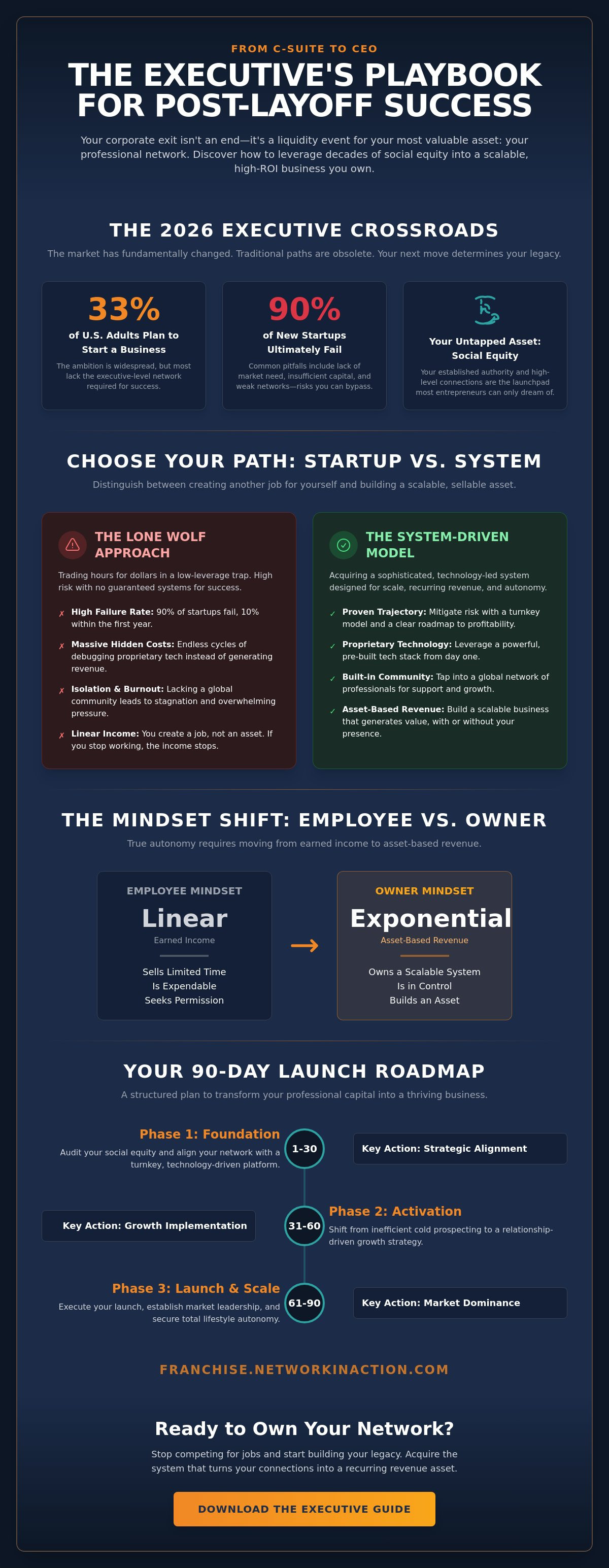
Your recent exit from the C-suite is not a career setback; it is a liquidity event for your professional capital. While 33% of U.S. adults plan to start a business in 2026, most will struggle because they lack the high-level networks you spent decades building. You don't need to start at the bottom or waste years on low-yield prospecting. Understanding how to start a business after being laid off means recognizing that your most valuable asset isn't your corporate title, but the social equity you've already earned.
You likely feel the weight of replacing a high-level executive income and the fear of your professional identity dissolving. It's a valid concern when 90% of startups fail, often due to a lack of market need. However, you can bypass these risks by leveraging a turn-key business model that prioritizes recurring revenue and lifestyle autonomy. This guide reveals how to transform your existing connections into a structured, technology-led community that delivers measurable ROI. You'll learn to move past outdated networking models and build a scalable asset that positions you as a visionary architect in your industry, ensuring the future of networking is one you own and lead.
Key Takeaways
- Learn to audit your existing social equity and transform it into a high-ROI business asset rather than wasting your expertise on a traditional job search.
- Discover why a turnkey franchise model provides a superior risk profile and faster time-to-market compared to the high failure rates of independent startups.
- Master the strategic steps of how to start a business after being laid off by shifting from inefficient cold prospecting to a relationship-driven growth strategy.
- Identify the proprietary technology and streamlined systems that allow executives to build recurring revenue without the rigid, manual requirements of legacy networking organizations.
- Execute a 90-day roadmap to launch a sophisticated community leadership model that secures your professional credibility while providing total lifestyle autonomy.
From Corporate Layoff to Strategic Entrepreneurship: A 2026 Perspective
The corporate landscape in May 2026 is undergoing a structural purge. Large organizations are aggressively pivoting toward lean, AI-integrated frameworks, resulting in a significant wave of executive displacement. This isn't a typical market cycle. It's a fundamental shift in how high-level labor is valued. When you master how to start a business after being laid off, you pivot from a position of vulnerability to one of total market dominance. It's the moment you stop seeking permission to lead and start owning the platform yourself.
Traditional job hunting is a low-ROI activity for leaders in this environment. Spending six to nine months navigating recruiters only to land another role where you're ultimately expendable is a waste of your professional capital. Learning how to start a business after being laid off is the only way to ensure your income isn't tied to a single board's decision. You're moving from selling your limited time to owning a scalable system that generates value regardless of your physical presence. This is Informed Disruption: choosing to break the employee cycle before it breaks you.
The ROI of Career Autonomy
True success post-layoff is measured by the transition from earned income to asset-based revenue. Earned income is linear; it stops when you do. Asset-based revenue is exponential and driven by systems. This transition requires a total shift from a fixed employee mindset to a growth-oriented owner mindset. You aren't just replacing a paycheck. You're building an asset. In this new model, time freedom becomes your primary KPI. You decide who you work with, when you work, and how your business scales. This is entrepreneurship designed for the executive level, focusing on high-impact results rather than busy work.
Why 2026 is the Year for Executive Ownership
The 2026 market favors decentralized professional services. Bloated corporate structures are out. Agility is in. High-level networking has emerged as the world's most valuable currency, proving far more resilient than any single salary. Professionals are fleeing the transactional, time-consuming nature of legacy networking organizations in favor of curated, results-oriented communities. Professional capital is the sum of your industry influence and trusted connections. By leveraging this capital, you bypass the 90% failure rate associated with independent startups. You aren't starting from zero. You're starting from a position of established authority.
Independent Startup vs. Scalable Franchising: Choosing Your Path
Most career coaches suggest launching a solo consulting practice. They call it freedom. In reality, it is a low-leverage trap where you trade hours for dollars. When researching how to start a business after being laid off, you must distinguish between creating a job and building an asset. Approximately 90% of startups fail, with 10% collapsing within the first year. The median startup cost is $12,000; however, most aspiring entrepreneurs underestimate the capital required to reach true profitability. A franchise model offers a proven trajectory, cutting the time-to-market and providing a structured framework that an independent venture lacks.
Executives often struggle with the lack of structure in solo consulting. The fluff of modern business coaching doesn't resonate with professionals used to corporate sophistication. You need a model that mirrors the complexity of your previous roles without the red tape. You can explore these executive business opportunities to see how your skills translate into ownership. Choosing a franchise isn't about buying a job; it's about acquiring a sophisticated system designed for scale.
The Pitfalls of Traditional Business Models
Building proprietary technology from scratch involves massive hidden costs. You'll spend months, or years, debugging systems instead of driving revenue. The lone wolf approach is equally dangerous. Without a global professional community, you're isolated. Most independent businesses fail to scale past the founder's personal capacity because they lack the underlying systems to function without constant manual intervention. You shouldn't be the bottleneck in your own success. Before committing your capital, you might want to download the franchise kit to understand what a scalable system looks like.
The Franchise Advantage for Corporate Refugees
Buying a system allows you to leverage existing leadership skills immediately. You don't have to reinvent the wheel; you just have to drive the vehicle. In 2026, the franchising sector is projected to generate $921 billion in economic output. This growth is driven by recurring revenue models that provide financial stability. Modern franchises provide the sophisticated understanding of market dynamics that executives expect. They offer technology-enabled platforms that replace the clunky, manual processes of legacy networking organizations. You gain the autonomy of business ownership with the structural integrity of a proven corporate model. This is how you secure your financial future while maintaining professional credibility.
Monetizing Your Professional Capital: The Power of Referral-Based Business
Professional capital is the most underutilized asset in an executive's portfolio. It isn't just a list of contacts; it's the sum of your industry influence, trusted connections, and the social equity you've built over decades. Most professionals view networking as a secondary support tool to find their next role. In reality, your network is the business. When you determine how to start a business after being laid off, you must stop viewing your connections as a way to get a job and start viewing them as the foundation of a high-ROI enterprise. Owning the network allows you to control the quality of the community and the resulting revenue streams.
Legacy networking organizations rely on outdated, manual processes that demand weekly attendance and forced referrals. This transactional approach is a drain on your time and reputation. Sophisticated business owners don't want to be forced to give referrals; they want a curated environment where relationships lead to genuine growth. By shifting from cold prospecting to relationship-driven growth, you can bypass the noise of traditional marketing. You can learn more about this transition by exploring the strategies in this free book on modern networking systems.
Quality Over Quantity in Professional Relationships
Forced referrals in traditional networking models are inherently transactional and ineffective. They prioritize volume over the actual needs of the business owner, leading to low-quality leads and wasted time. In contrast, curated, high-level groups for mid-sized business owners focus on the depth of the connection and the strategic alignment of the members. ROI-driven networking is the evolution of social capital into measurable business growth. When you lead a community of high-caliber professionals, you aren't just facilitating meetings. You're architecting a powerhouse of referral equity where every member's success contributes to your business's scalability.
Leveraging Networks Instead of Cold Prospecting
Executives are uniquely positioned to lead professional referral groups because they already possess the credibility that takes years to build from scratch. When you are considering how to start a business after being laid off, leveraging this credibility is the most efficient path to profitability. Cold prospecting is expensive and time-consuming; however, a referral-based empire grows through trust and established authority. Data shows that referral leads have a 37% higher retention rate than those acquired through other channels. This model allows you to scale your business through social capital rather than massive advertising spend, creating a sustainable and elite professional community.
The 90-Day Roadmap: Launching a Sophisticated Business Model
Executing a successful career transition requires a tactical timeline. You don't have years to experiment with unproven concepts or manual processes. The 90-day window is critical for maintaining your professional momentum and securing your financial baseline. Start by auditing your professional network to identify high-value industry gaps. You'll likely find that mid-sized business owners are starving for sophisticated connection but are currently underserved by the rigid, transactional nature of traditional networking. This audit is the first tactical step in how to start a business after being laid off. You aren't just looking for a new source of income; you're identifying a community that is ready for elite leadership.
After the audit, you must align turnkey models with your specific lifestyle and income goals. A successful transition means you stop selling your time and start owning a system. This requires a model that offers recurring revenue and scalability without the overhead of a traditional brick-and-mortar operation. Once you've aligned your goals, the next step is securing your market. You should immediately investigate available territories to ensure you can claim a region where your industry influence is strongest. Following this roadmap ensures you move from displacement to ownership with surgical precision:
- Step 1: Audit your network to identify high-value industry gaps.
- Step 2: Align turnkey models with your desired lifestyle and income goals.
- Step 3: Secure your territory and finalize funding via SBA-backed options.
- Step 4: Execute a high-impact launch using proprietary management tools.
Funding Your Transition
Severance packages or retirement funds are strategic tools for business acquisition. Securing the right capital is a major hurdle in how to start a business after being laid off, but a franchise model simplifies the process. In May 2026, the WSJ Prime Rate for SBA 7(a) loans is 6.75%. Lenders consistently favor franchise models over independent startups because the failure rate for first-time founders is a staggering 82%. A franchise provides the historical data and operational structure that banks require for approval. Focus on a model with low overhead. High scalability is only possible when your revenue isn't swallowed by fixed costs like long-term office leases or massive payroll.
Technology as a Force Multiplier
Proprietary technology is the force multiplier that separates elite owners from struggling solo-preneurs. In a modern business environment, your platform should automate the administrative fluff that kills productivity. A tech-enabled platform reduces your administrative burden, allowing you to focus on high-impact relationship building rather than manual data entry. Legacy networking organizations remain stuck in manual, paper-heavy processes that waste your time. If you're ready to see how a modernized system functions, download the franchise kit for a deeper look at business management systems. You need a tool that turns social capital into measurable ROI.
Owning the Network: Why Network In Action is the Premier Choice for Executives
Network In Action represents the informed disruption of a stagnant industry. For decades, legacy networking organizations have forced high-level professionals into rigid, weekly meetings that prioritize attendance over actual business growth. When you are evaluating how to start a business after being laid off, you don't need another job that dictates your schedule. You need a system that respects your time and leverages your expertise. NIA’s monthly, tech-led model is designed for the modern executive who values efficiency and measurable results over transactional volume. It is the sophisticated alternative for those ready to lead rather than follow.
The Future of Networking is built on a foundation of proprietary technology and curated membership. By moving away from the clunky, manual processes of outdated networking models, NIA allows you to own a business that functions with surgical precision. This isn't about participating in a group; it’s about franchising a business opportunity that positions you as the architect of your local professional community. You're building a scalable asset that delivers recurring revenue while providing the lifestyle autonomy you've earned through years of corporate service.
The NIA Differentiators
Success in professional networking requires a shift from quantity to quality. NIA’s strict "no forced referrals" policy ensures that every connection made within your group is meaningful and high-yield. This approach maintains the integrity of the community and ensures that members stay engaged for the long term. Key brand differentiators include:
- Proprietary Technology: A tech-enabled platform that manages referrals and tracks ROI in real-time, reducing your administrative burden.
- Monthly Meetings: A schedule designed for busy professionals, replacing the time-consuming weekly requirements of legacy organizations.
- ROI-Driven Metrics: A focus on measurable growth for both members and the franchise owner, ensuring every hour spent produces a return.
A Strategic Path to Time Freedom
Owning an NIA franchise allows you to lead your community while maintaining total flexibility over your schedule. The model is built for scalability, allowing you to manage multiple groups through a centralized system. With an initial franchise fee of $35,000 and a total initial investment starting at $37,710, the barrier to entry is strategically positioned for executives looking for a high-ROI transition in May 2026. This is a 10-year agreement designed to secure your professional legacy and provide long-term financial stability through recurring revenue streams. It's time to stop navigating the world of corporate uncertainty and start building your own empire. You can begin this journey by exploring available territories to see where your leadership is needed most. This is your opportunity to own the network and define your future on your own terms.
Architect Your Future Ownership
You've spent decades building a level of social equity that most entrepreneurs only dream of. A corporate exit isn't an end; it's the start of your most profitable chapter. By leveraging a turnkey model and following a tactical 90-day launch plan, you can transform professional displacement into a high-ROI asset. The core of knowing how to start a business after being laid off lies in your ability to shift from a linear paycheck to asset-based revenue.
Network In Action offers the only tech-forward system designed specifically for the executive mindset. With over 150 locations worldwide, the NIA model replaces the rigid, transactional feel of traditional networking with a sleek, proprietary technology platform and ROI-driven results for professionals. You aren't just starting a business; you're leading a community that respects your time and maximizes your impact. The opportunity to own your market and secure your lifestyle autonomy is waiting for those ready to disrupt the status quo.
Secure your future and explore available territories today.
Frequently Asked Questions
Is starting a business after being laid off a high-risk move in 2026?
Starting a business is often less risky than returning to a lean corporate structure where you remain expendable. While 90% of independent startups fail, franchising into a proven system significantly reduces uncertainty. With Americans filing 1.56 million new business applications in early 2026, the shift toward ownership is a strategic response to job market volatility. You're trading the illusion of corporate security for the reality of asset ownership and control.
How much capital is typically required to start an executive-level franchise?
The total initial investment for a high-level networking franchise typically ranges from $37,710 to $43,000. This includes an initial franchise fee of $35,000. For those seeking SBA 7(a) financing, the May 2026 Prime Rate is 6.75%. This capital entry point is significantly lower than many retail franchises; it allows you to maintain liquidity while building a scalable asset with recurring revenue and low overhead.
Can I leverage my existing professional network to start a business?
Your professional capital is your most valuable asset when learning how to start a business after being laid off. Instead of using your network to find another job, you use it to seed your own community of high-level professionals. This allows you to bypass cold prospecting entirely. You're monetizing decades of relationship building; you're turning social equity into a recurring revenue stream that scales with your industry influence.
How does a networking franchise differ from legacy networking organizations?
Modern networking franchises prioritize quality over the transactional volume found in legacy networking organizations. Unlike outdated networking models that require weekly attendance and forced referrals, NIA uses proprietary technology to facilitate connections between meetings. This shift to a tech-enabled platform ensures that relationships are driven by genuine ROI rather than rigid, manual requirements. You lead a curated community of sophisticated peers rather than managing a clunky, time-consuming club.
What are the benefits of a monthly networking model versus a weekly one?
A monthly model respects the schedule of high-level executives and mid-sized business owners. Weekly meetings in traditional networking often become stale and repetitive; this leads to member burnout and lower-quality interactions. By meeting monthly, you maintain a high energy level and ensure every session is high-impact. This structure allows for more efficient time management. It gives you the freedom to scale your business while members focus on running theirs.
How long does it take to see an ROI when starting a networking business?
ROI timing depends on your execution of the 90-day roadmap, but the franchise model significantly accelerates your time-to-market. By leveraging a turnkey system, you avoid the years of trial and error that sink 70% of independent businesses between years two and five. With a focus on recurring revenue from day one, you build a predictable income stream. This scales as you add more groups to your territory and leverage established brand credibility.
What technology is needed to manage a professional referral group effectively?
Effective management requires proprietary technology that automates administrative tasks and tracks ROI for every member. You shouldn't be stuck with manual spreadsheets or paper-based tracking used by legacy networking organizations. A tech-forward platform keeps your community connected 24/7; it facilitates referrals and measures social capital as a primary metric. This Visionary Architect approach ensures your business is modern, efficient, and capable of scaling without increasing your personal workload.
Is a franchise better than a solo consulting practice after a layoff?
A franchise is a superior strategic move because it builds a scalable asset rather than just creating another job. Solo consulting is often limited by your personal capacity; it requires constant cold prospecting to maintain income. When you consider how to start a business after being laid off, a franchise offers a proven system and recurring revenue. You own a system that works for you, providing true lifestyle autonomy and long-term value.