What if the most valuable asset in your city wasn't real estate or capital, but your position as the ultimate gatekeeper of professional referrals? Most high-level executives are exhausted by the rigid, transactional nature of legacy networking organizations where valuable time is traded for low-quality leads. You've likely felt the frustration of cold prospecting or the difficulty of breaking through the digital noise. Learning how to become a local business influencer isn't about chasing vanity metrics on social media. It's about building a modernized ecosystem where you own the market and control the flow of high-value business.
This guide reveals how to transition from a professional to a local authority by mastering the modern mechanics of business influence. With the influencer marketing industry projected to reach $32.55 billion in 2026, the opportunity to capture a $5.78 return for every dollar invested in social capital has never been higher. The following sections outline the strategic path to becoming the go-to person in your community, allowing for lifestyle autonomy while maintaining professional prestige and elite market standing. You'll discover how to build a scalable, recurring revenue stream that replaces outdated networking models with a technology-driven approach.
Key Takeaways
- Shift your focus from vanity metrics like social media followers to "capital influence" by learning how to drive high-value referrals and real-world deals.
- Avoid the "Legacy Trap" of rigid, time-consuming weekly meetings by leveraging proprietary technology and curated professional networks for maximum efficiency.
- Master the strategic roadmap on how to become a local business influencer by identifying key power players and positioning yourself at the center of your market's referral ecosystem.
- Discover how to transition from a professional to a community leader using a turnkey franchise model that converts social capital into recurring revenue and lifestyle autonomy.
Beyond the Follower Count: Redefining the Local Business Influencer in 2026
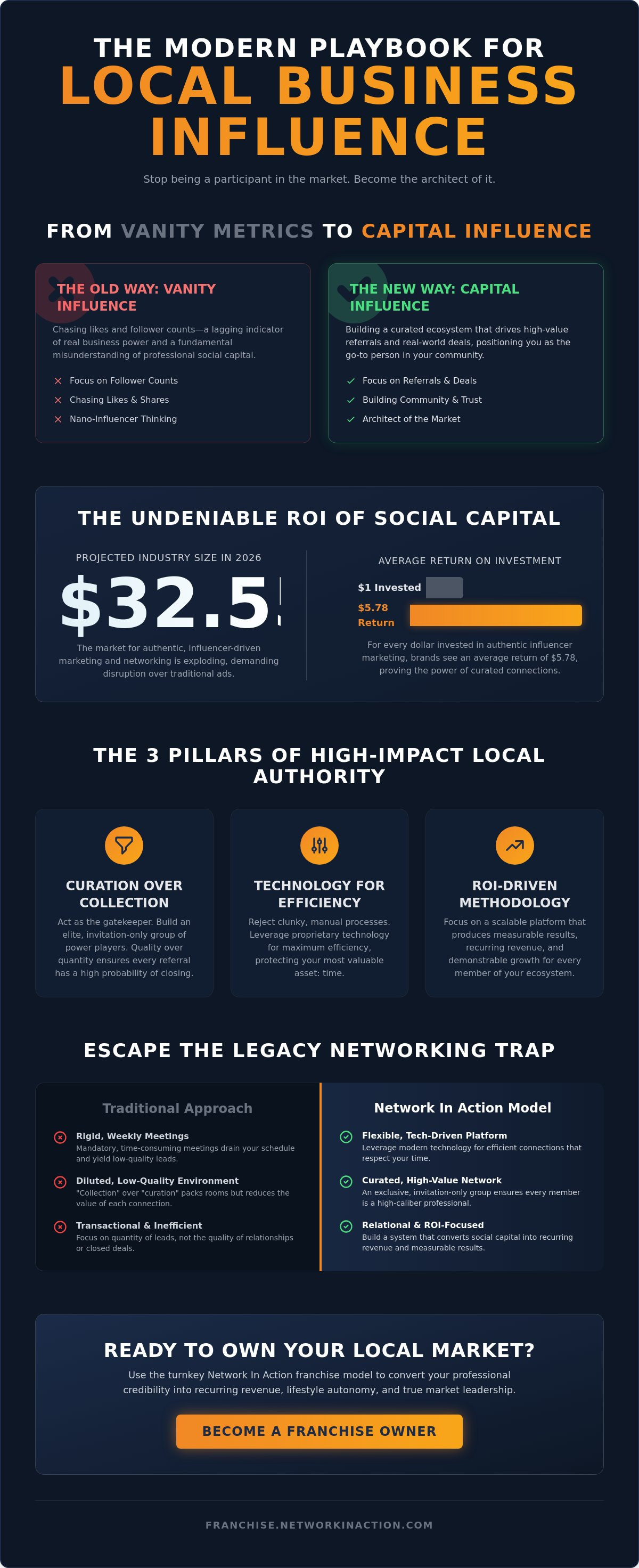
In 2026, the definition of influence has shifted. It's no longer about who sees your posts; it's about who calls you before they sign a contract. Real influence in a professional context is measured by your ability to move the needle for local business owners. If you're looking for how to become a local business influencer, you must first distinguish between vanity influence and capital influence. Vanity influence is built on likes and shares. Capital influence is built on referrals and closed deals. The global industry for this social capital is projected to reach $32.55 billion in 2026. This market demands informed disruption over traditional advertising. You must move from being a participant in the market to becoming the architect of the market.
The ROI of Social Capital
High-level professionals can translate decades of experience into local authority. Business owners are tired of algorithmic suggestions. They want curated connections. In the current market, 73% of brands prefer working with micro-influencers because they offer higher engagement. In the B2B world, this engagement translates to trust. For every dollar spent on influencer marketing, the average ROI is $5.78. When you control the network, you're the primary connector in a specific territory. This isn't just networking; it's owning the market. You're building a system where your professional credibility is the currency that drives community growth.
The Problem with "Nano-Influencer" Thinking
Follower counts are a lagging indicator of actual business power. Most competitors define local influencers by small follower counts between 500 and 5,000. This is a fundamental misunderstanding of professional social capital. Consumer-facing creators chase attention. B2B community leaders chase impact. A Local Business Influencer is an individual who curates high-value professional relationships to drive community-wide growth. You aren't just a participant in the market. You're the architect of the market. You're the person who decides who gets the deal. This is the difference between being another face in the crowd and being the person who owns the crowd. It requires a tech-forward mindset that favors efficiency over the clunky, manual processes found in legacy networking organizations.
Learning how to become a local business influencer requires you to stop thinking like a freelancer and start thinking like a franchise owner. You're building a scalable platform that produces measurable results for every member of your ecosystem. By focusing on capital influence, you create a moat around your professional reputation that no social media algorithm can disrupt.
The Three Pillars of High-Impact Local Authority
Building local authority isn't a matter of luck; it's a matter of architecture. To understand how to become a local business influencer, you must move beyond the haphazard "coffee for business" approach. High-level executives don't have time for aimless chatter. They require a framework that protects their most valuable asset: time. Real influence rests on three specific pillars that create a "moat" around your professional reputation. These pillars ensure that you aren't just another name in a directory. You're the person who controls the room. When you master curation, technology, and ROI-driven methodology, you stop chasing the market and start owning it.
Curation Over Collection
The first pillar is the power of the gatekeeper. Legacy networking organizations focus on collection, trying to pack as many people into a room as possible. This leads to a diluted environment where high-level professionals are surrounded by low-quality referrals. Modern influence requires curation. You must decide who enters the inner circle. Focus your efforts on small to mid-sized business owners who are already generating revenue but are hungry to scale. By maintaining an invitation-only group, you create a psychological advantage. People value what is exclusive. When you filter for quality, you ensure that every referral passed within your ecosystem has a higher probability of closing. This isn't just about networking; it's about building an elite strike team of local power players.
Leveraging Modern Technology for Efficiency
The second pillar is the rejection of manual, clunky processes. If you're still using spreadsheets to track your network, you're falling behind. True authority in 2026 is tech-forward. By utilizing a sophisticated business referral platform, you can automate the administrative heavy lifting that kills most networking groups. This technology allows for a monthly meeting model that actually outperforms the exhausting weekly schedules of outdated networking models. Automation tracks referral velocity and member engagement in real-time. This data-driven approach ensures that no one is wasting their time. You can quantify exactly how much business is moving through your network, providing the transparency that seasoned entrepreneurs demand.
The third pillar is an uncompromising focus on results. Successful local marketing strategies depend on measurable outcomes rather than vague promises of "exposure." Every interaction in your ecosystem must have a clear business purpose. When you can demonstrate a consistent ROI for your connections, your influence becomes bulletproof. You aren't just a "connector" anymore. You are a strategic partner in their growth. If you are ready to lead your own professional community, you can explore available territories to see where your influence is needed most. This structured approach replaces the "legacy trap" with a modernized system designed for the executive mindset.
Traditional Networking vs. Modern Influence: Why Legacy Models Fail
Legacy networking organizations are built on a foundation that no longer supports the modern executive. They rely on the "Legacy Trap," a system of rigid, time-consuming requirements that prioritize attendance over actual business outcomes. For a professional exploring how to become a local business influencer, these outdated networking models represent a significant barrier to entry. High-level leaders don't want to spend 52 mornings a year at 7:00 AM in a hotel basement. They want a system that respects their schedule and produces a measurable return on investment. The future of networking isn't found in a dusty handbook; it is found in streamlined, tech-enabled leadership.
The leading brand’s model is fundamentally flawed for 2026 because it relies on forced referrals. When members are required to "pass a lead" every week, the quality of those leads inevitably drops. This creates a transactional environment where trust is replaced by quotas. Modern influence is relationship-driven, not transactional. It is the difference between passing out business cards and building local empires. By challenging the status quo through informed disruption, you position yourself as a leader who values substance over ritual. You are not just joining a group; you are architecting a power base.
The Death of the Weekly Meeting
Time is the most valuable asset for any local influencer. Weekly meetings are often "time-vampires" that offer diminishing returns for seasoned entrepreneurs. Shifting to monthly, high-impact gatherings respects executive schedules and significantly increases the effectiveness of a referral marketing strategy. This transition moves the needle from "attendance-based" membership to "results-based" participation. High-level professionals are more likely to engage when the commitment is streamlined and the outcomes are clear. Efficiency is the ultimate luxury in a high-growth business environment.
Professional Sophistication vs. Rigid Rituals
High-level leaders avoid groups that feel like desperate "sales clubs." The clunky feel of legacy networking organizations, with their rigid rituals and manual tracking, often alienates the very people you want to attract. To understand how to become a local business influencer, you must project a modern, tech-forward image. Positioning yourself as the sophisticated alternative in your market allows you to curate a group of peers rather than a list of vendors. It’s about creating an elite environment where business happens naturally because the right people are in the room, supported by proprietary technology. This approach ensures your professional prestige remains intact while your influence expands.
A Strategic Roadmap to Dominating Your Local Business Ecosystem
Dominating your local market requires more than a handshake; it requires a blueprint. If you want to master how to become a local business influencer, you must follow a structured progression from professional participant to market architect. This roadmap isn't about collecting business cards. It's about securing your position at the center of a high-value referral ecosystem. By 2026, the influencer marketing industry is expected to hit $32.55 billion, and the most profitable segment for executives is local B2B authority. You don't just want a seat at the table. You want to own the room.
- Step 1: Identify the Power Players. Target the centers of influence in your territory. Focus on professionals who already hold the trust of your ideal clients.
- Step 2: Establish the Platform. Create the physical and digital space where high-level deals happen. You need a curated environment that filters out the noise of traditional networking.
- Step 3: Deploy the Technology. Implement a proprietary system that keeps the network active 24/7. Modern influence doesn't sleep.
- Step 4: Monetize the Influence. Transition from a helpful connector to a profitable business owner. This is where you convert social capital into a recurring revenue stream.
- Step 5: Scale the Model. Once you've mastered one territory, expand. Real wealth comes from scalability across multiple markets or industry niches.
Identifying High-Value Referral Partners
Gatekeepers are the lifeblood of your local economy. These are the CPAs, attorneys, and specialized consultants who already have the ear of small to mid-sized business owners. To build a healthy referral ecosystem, you must ensure cross-industry representation. This diversity prevents the "echo chamber" effect found in legacy networking organizations. You can leverage existing executive business opportunities to vet potential members. High-level vetting ensures that every person in your inner circle is capable of delivering the $5.78 average ROI expected from professional influence in 2026.
Transitioning to Ownership
Participating in someone else's network limits your ceiling. When you're just a member, you're building someone else's asset. Ownership changes the equation. It provides the financial benefits of recurring revenue through membership fees and licensing without the rigid rituals of outdated networking models. You gain the freedom to lead on your own terms while maintaining professional prestige. This is the ultimate shortcut to lifestyle autonomy. If you're ready to stop participating and start leading, you should download a franchise kit to see the exact blueprint for successful market ownership. This strategic move positions you as the visionary architect of your city's professional future.
The Ultimate Shortcut: Owning the Network as an NIA Franchisee
Building a professional empire from scratch is a high-risk gamble that most executives don't have the time to take. If you're researching how to become a local business influencer, you've likely realized that the "startup struggle" of establishing credibility can take years. Network In Action provides the "Visionary Architect" with a turnkey solution that bypasses these hurdles. By leveraging a proven brand, you step into a position of authority on day one. This is the "Lifestyle Franchise" model. It balances high-level community impact with the personal freedom you've earned. With 2026 being a pivotal year for market shifts, securing available territories now ensures you own the referral engine before the market becomes saturated.
The NIA Differentiator: Technology and ROI
The core of this modernization is proprietary technology. It replaces the manual, clunky processes found in legacy networking organizations. This tech-forward approach allows you to guarantee a return on investment for your community members, a feat impossible for outdated networking models. You aren't just managing a group; you're providing a data-driven solution. This creates a psychological shift in how you lead. You're no longer a participant; you're the owner of a scalable system that generates recurring revenue while driving measurable growth for every business in your ecosystem. It's about efficiency and impact, not just attendance.
Your Path to Community Leadership
Transitioning from an executive role to a local business influencer doesn't have to be a multi-year journey. NIA’s training and support system is designed to facilitate this evolution in approximately 90 days. You'll learn how to leverage your existing network to build a professional power base that serves as the central hub for your city's economy. The long-term value of owning this referral engine is immense. It provides lifestyle autonomy and professional prestige that cold prospecting or traditional advertising can never match. It’s about building a legacy of impact while securing your financial future. You should explore the free book to understand the full potential of this modern networking evolution.
Architect Your Professional Future
The transition from a passive participant to a market architect is the definitive strategy for 2026. You've seen why legacy networking organizations fail high-level leaders with their rigid rituals and manual processes. Real authority comes from owning the referral ecosystem through a tech-driven model that respects your time. Understanding how to become a local business influencer means moving beyond the digital noise and into a position of measurable capital influence. You're no longer just a face in the crowd; you're the person who controls the room.
With over 150 locations worldwide, Network In Action offers a proprietary, tech-driven networking model specifically designed for executive schedules. It’s a turnkey solution for those ready to lead their communities without the "startup struggle" of building credibility from scratch. The shift toward modernized, ROI-driven connections is inevitable. You have the opportunity to secure your market before the legacy models are completely phased out. It's time to claim your seat at the center of your city's business ecosystem and build a legacy of impact.
Secure your territory and lead your community—Explore NIA Franchise Opportunities
The future of networking is efficient, structured, and unapologetically results-oriented. Align your professional prestige with a system built for the modern era.
Frequently Asked Questions
What is the difference between a social media influencer and a local business influencer?
Social media influencers focus on vanity metrics like follower counts and digital reach, whereas a local business influencer prioritizes "capital influence" and referral velocity. One moves content to a broad audience; the other moves markets within a specific professional community. Real influence is measured by the ability to facilitate closed deals rather than collecting likes or shares.
Can I become a local influencer if I don’t have a large social media following?
You don't need a massive digital footprint to learn how to become a local business influencer. In 2026, data shows that 54% of marketers prefer working with nano-influencers because their engagement rates are 2.53% higher than celebrity accounts. Professional power stems from your reputation among 30 to 40 local power players rather than thousands of passive online followers.
How much time does it take to manage a professional networking group?
Managing a modernized professional group requires approximately 10 to 15 hours per month. This streamlined schedule is possible because the model rejects the 52 weekly meetings required by legacy networking organizations. Leveraging proprietary technology allows you to maintain constant connectivity with your network without sacrificing your primary career or personal freedom.
Is it better to start my own networking group from scratch or buy a franchise?
Buying a franchise is the superior choice for executives seeking immediate scalability and a proven brand. Starting from scratch often leads to a "startup struggle" that can last 24 to 36 months before the network gains enough credibility to attract high-level members. A turnkey solution provides the structural blueprint and proprietary technology needed to lead a community from day one.
What are the main problems with traditional networking groups like the leading legacy brands?
Outdated networking models are typically rigid, transactional, and inefficient for high-level professionals. The leading brand’s reliance on "forced referrals" often results in low-quality leads that waste everyone's time. Modern leaders avoid these groups because they feel like "sales clubs" rather than elite environments for strategic, relationship-driven growth.
How do local business influencers make money?
Local business influencers generate income through recurring revenue streams tied to network ownership and licensing. Instead of simply participating in someone else's group, you're building a scalable asset that produces monthly revenue. This model allows you to monetize your decades of professional experience and social capital while maintaining an elite market standing.
What industries benefit most from having a local business influencer?
Industries with high transaction values, such as commercial law, accounting, insurance, and specialized consulting, benefit most from this authority. These sectors rely on "gatekeepers" to access high-quality deals and new opportunities. When you own the network, you become the central gatekeeper for your city's most important professional relationships.
How does technology help in building a local business network?
Technology automates the manual, clunky administrative tasks that make traditional networking feel like a second job. A successful how to become a local business influencer strategy utilizes proprietary platforms to track referral velocity and member engagement in real-time. This data-driven approach ensures that every interaction within your ecosystem produces a measurable ROI for its members.