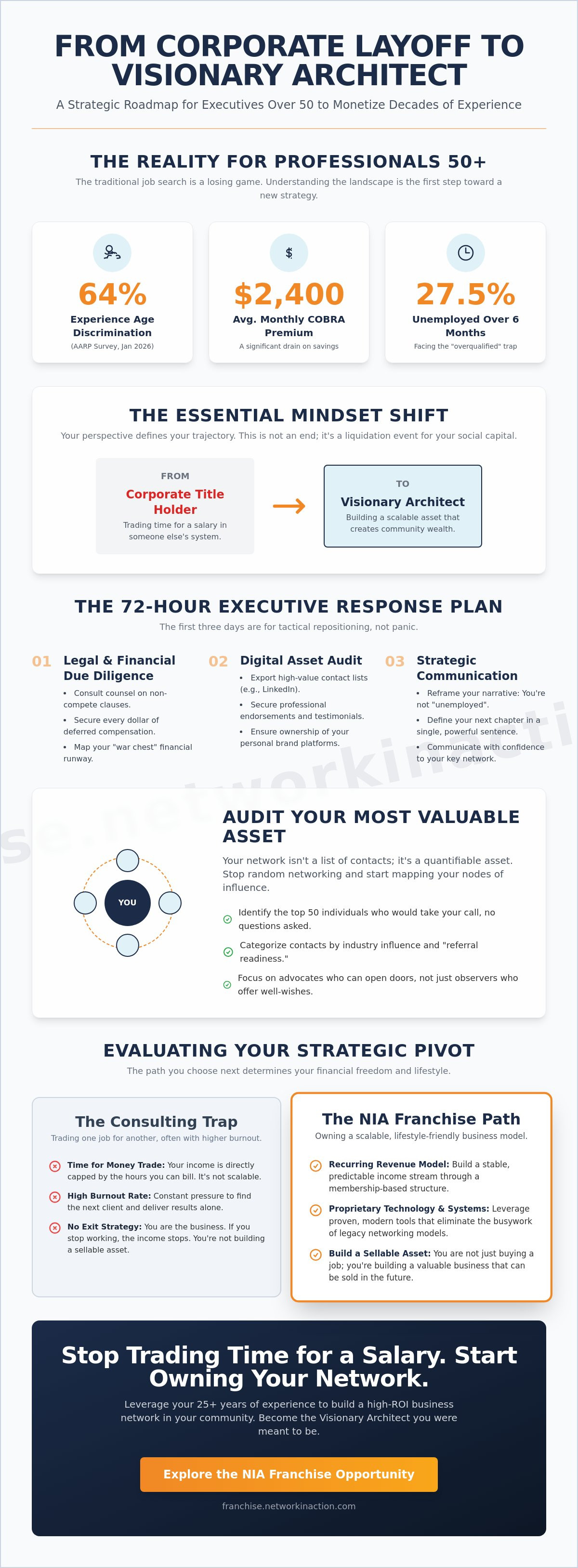
A January 2026 AARP survey reveals that 64% of workers aged 50 and over have witnessed or experienced age discrimination in the workplace. When you're staring down a $2,400 monthly family COBRA premium and a hiring market where 27.5% of your peers remain unemployed for over six months, the traditional job search feels like a losing game. Understanding what to do after a corporate layoff at 50 requires a fundamental shift in perspective. You aren't just an unemployed executive. You're a professional who has reached a social capital liquidation event.
It's frustrating to watch a professional identity, once tied to a prestigious title, vanish while retirement savings face the threat of depletion. This guide promises to transform a corporate exit into a strategic evolution by leveraging 25 years of expertise. You'll discover how to stop trading time for a salary and start owning a scalable, lifestyle-friendly business model. This article provides a 90 day roadmap to monetize your network, bypass outdated networking models, and secure your financial future through high-ROI business ownership.
Key Takeaways
- Master the 72-hour clinical response plan to preserve your industry reputation and secure every dollar of deferred compensation.
- Navigate the hidden job market by understanding exactly what to do after a corporate layoff at 50 to avoid the "overqualified" gatekeeper trap.
- Audit your social capital to identify high-quality nodes of influence rather than wasting time on transactional, outdated networking models.
- Evaluate the strategic shift from high-burnout consulting to a scalable, lifestyle-friendly franchise model built on recurring revenue.
- Transition from a corporate title holder to a Visionary Architect of your local business community using proprietary technology and proven systems.
The 72-Hour Executive Response Plan
The first three days following a corporate exit are not for mourning; they are for tactical repositioning. Most professionals default to a state of reactive panic. They polish a resume that hasn't been touched in a decade and blast it to 100 recruiters by Friday afternoon. This is a massive tactical error. High-level leadership is bought through relationships, not sold through an automated portal. When you are determining what to do after a corporate layoff at 50, your priority is executing a "clean break" that preserves your industry reputation while securing every cent of your earned compensation.
Adopt a mindset of informed disruption. The traditional 9-to-5 trajectory is a legacy model that often fails to reward the depth of experience you've accumulated. Instead of rushing to replace a lost salary, view this window as an opportunity to audit your value. You're moving from being a component in a corporate machine to becoming the architect of your own professional ecosystem. This requires clinical precision and a refusal to settle for the first "overqualified" role that comes your way.
Administrative and Legal Due Diligence
Precision in the first 72 hours prevents expensive mistakes later. You must move quickly to secure your financial and legal standing. Consider the following actions:
- Review non-compete agreements: Consult with specialized executive counsel to audit non-solicitation and non-compete clauses. Don't sign severance documents in the room; you typically have 21 to 45 days to review them under federal law.
- Audit digital assets: Ensure you have full ownership of your personal brand platforms. Export your high-value contact lists and professional endorsements before your access is revoked.
- Establish a "war chest" timeline: Map out your financial runway based on severance and savings. If you have a 12-month cushion, use that time to build a scalable asset rather than hunting for another cubicle.
Emotional Calibration for the Seasoned Leader
Your professional identity isn't your title. A "VP of Operations" title is temporary; your ability to optimize complex systems is permanent. To pivot successfully, you must separate your ego from the corporate masthead. When you communicate this transition to stakeholders, do it with the confidence of a visionary architect. You aren't "in between jobs." You're liquidating your social capital to lead a new professional community. Write a single sentence defining your next chapter. For example: "I'm leveraging 25 years of market expertise to build a high-ROI business network." Avoid terms like "retired" or "unemployed" as they imply a lack of momentum. You're simply moving to a modernized, more efficient model of work.
Conducting a Social Capital Audit
After decades in the corporate world, your most valuable asset isn't your resume. It's your social capital. While generic advice suggests "talking to friends" for support, a seasoned executive must treat their network as a quantifiable business asset. When deciding what to do after a corporate layoff at 50, the first step is to stop looking at connections as mere acquaintances and start viewing them as high-quality nodes of referral power. You've spent 25 years building trust; it's time to measure the ROI of those relationships.
A social capital audit involves moving beyond past proximity. Just because you worked with someone for five years doesn't mean they hold influence in your next target sector. Instead, categorize your contacts by their industry influence and "referral readiness." This requires a sophisticated referral marketing strategy to evaluate which connections can actually move the needle for a strategic pivot. By quantifying the strength of these ties, you transform a list of names into a roadmap for growth.
Mapping Your Influence Sphere
Focus on the top 50 individuals who would take a call without a pre-set agenda. These are your primary nodes. Analyze the industries where your professional credibility remains highest. Are these individuals positioned to open doors to the hidden job market? Or better yet, are they potential partners or clients for a new business venture? Evaluate their readiness to refer you by the quality of their own professional circles. You need advocates, not just observers who only offer vague well-wishes.
The Value of Modern Connection Tools
Outdated networking models often demand a significant time investment for minimal return. Legacy networking organizations rely on rigid, transactional meetings that feel like a chore. As a Visionary Architect, your time is too valuable for clunky systems. Modern networking leverages technology and proprietary platforms to maintain warm connections without the daily time-drain. By positioning yourself as a community leader rather than a job seeker, you shift the power dynamic. You aren't asking for a favor; you're offering 25 years of expertise to a curated group of high-level professionals. This is the future of networking. If you're ready to lead rather than follow, you might find that exploring a franchise kit is the next logical step in your career evolution.
Why the Legacy Job Hunt Fails Executives at 50
The 2026 hiring landscape is designed to filter you out, not bring you in. For an executive deciding what to do after a corporate layoff at 50, the realization that 80% of high-level roles are never posted is both a challenge and a liberation. Relying on public job boards is a statistical dead end. These platforms are the territory of middle management, not the "Visionary Architect" who commands a six-figure salary and decades of institutional knowledge. When you apply through a portal, you aren't competing against peers; you're competing against an algorithm programmed to find the lowest-cost compliant candidate.
Corporate gatekeepers frequently weaponize the "overqualified" myth to bypass high-earning experts. In reality, this is often code for age bias or budget constraints. Legacy organizations view your 25 years of experience as a liability rather than an asset. They fear you'll be bored, or worse, that you'll outshine the existing leadership. To break this cycle, you must stop selling skills and start offering solutions. Transitioning to a fractional or independent leadership role allows you to bypass the gatekeepers and speak directly to the decision-makers who value ROI over headcount costs.
The Inefficiency of Traditional Networking
Many executives default to legacy networking organizations out of habit, but these models are fundamentally flawed. Traditional networking is often rigid, transactional, and exhausting. You shouldn't waste your time in groups that demand "forced referrals" or weekly attendance just to pass business cards with people who don't understand your industry. This "old-school" approach lacks the sophistication required for high-level career evolution. Instead, look for relationship-driven growth that respects your time and leverages your influence. Exploring top executive business opportunities can reveal paths that bypass the corporate ladder entirely, allowing you to own the network rather than just participating in it.
The AI Filter and the Executive Resume
A 20-page resume is a catastrophic liability in the modern era. Applicant Tracking Systems (ATS) are now powered by sophisticated AI that prioritizes keyword density over actual leadership impact. If your digital presence doesn't signal tech-savviness and a results-oriented mindset, you're invisible to the system. Disrupt this process by securing direct peer-level entry. Your goal is to move the conversation from a PDF document to a high-value consultation. By maintaining a sleek, modernized digital brand, you demonstrate that you aren't just a relic of the past, but a leader who understands the future of business efficiency.
Evaluating Strategic Pivots: Consulting vs. Franchising
Most executives view consulting as the default path following a departure from the C-suite. It seems low-risk and familiar. In reality, the "Consultant Trap" often forces you to trade hours for dollars in a cycle that lacks long-term scalability. When you stop working, the revenue stops. This isn't a career evolution; it's simply a job you've created for yourself. When considering what to do after a corporate layoff at 50, you must decide if you want to be the laborer or the owner. Franchising offers a business-in-a-box framework that allows you to excel at execution without the exhaustion of reinventing the wheel.
Modern service-based franchises provide a superior ROI compared to capital-heavy retail models. You don't need a million-dollar build-out or massive inventory to see results. You need a proven system and a high-value network. Funding this transition is more accessible than many realize. Through a Rollover as Business Startups (ROBS) plan, you can utilize your 401(k) funds to invest in your business without the typical 10% early withdrawal penalty or immediate tax hit. For 2026, with 401(k) contribution limits reaching $32,500 for those over 50, your retirement account is your most powerful tool for strategic reinvestment.
The Freedom of the Franchise Model
Success in this new chapter is measured by recurring revenue and lifestyle autonomy. You've spent decades answering to a board or a CEO. Now, you can identify turnkey opportunities that leverage your leadership skills rather than your technical labor. This is about building a scalable asset that works for you. You can explore available territories to identify regions where your executive presence can dominate the local market and create lasting community impact.
Risk Mitigation in Business Ownership
Independent startups have notoriously high failure rates; often exceeding 90% within the first decade of operation. In contrast, an established franchise system provides proprietary technology and corporate support that significantly de-risks the venture. Age 50 is the golden age for this move. You possess a unique balance of professional maturity and a decade or more of peak productivity ahead. You aren't just buying a job; you're acquiring a modernized system that outperforms outdated networking models. If you're ready to stop hunting for a salary and start building equity, download the franchise kit to see how your experience translates into ownership.
Owning the Network: The NIA Executive Transition
The ultimate evolution for a high-level leader isn't finding a new seat at someone else's table. It's building the table itself. When you are evaluating what to do after a corporate layoff at 50, the most sophisticated move is to transition from a participant in the market to a "Visionary Architect" of your local business community. Network In Action (NIA) provides the framework to monetize your existing social capital by leading a professional referral group. This isn't about selling a service; it's about owning a scalable asset that generates recurring revenue while positioning you as the premier connector in your region.
Unlike traditional employment, where your value is tied to a single company's budget, owning a business networking franchise allows you to build a portfolio of influence. You leverage proprietary technology to streamline operations, ensuring that your time is spent on high-impact leadership rather than administrative minutiae. As your network expands, the value of your asset grows. You're no longer trading hours for a paycheck. You're building equity in a modernized system designed for the 2026 economy.
Networking Evolved: Quality Over Quantity
Outdated networking models have spent decades forcing professionals into rigid, transactional environments. These legacy networking organizations often rely on forced referrals and "clunky" manual tracking that feel more like a chore than a business strategy. NIA represents the future of networking through a philosophy of informed disruption. There are no forced referrals. Instead, the focus is on curated, high-level memberships where quality is the primary metric for ROI. This ROI-driven approach ensures that every meeting is high-impact and every connection is meaningful. To understand how this structure delivers consistent results, download the franchise kit and review the underlying systems that make this model superior to traditional alternatives.
Next Steps: From Layoff to Leadership
The transition from a corporate title to a business owner doesn't have to take years. You can launch an NIA territory in approximately 90 days following a corporate exit. This aggressive timeline is possible because the model is turnkey; it's designed for executives who excel at execution and community leadership. You move from the uncertainty of a job search to the autonomy of a lifestyle-friendly business model. By choosing to lead, you bypass the "overqualified" filters of the legacy job market and establish yourself as a permanent fixture in your local economy. Read more about the business networking franchise model to see how your 25 years of experience can be converted into a strategic, long-term asset. The next chapter of your career isn't about recovery; it's about total professional sovereignty.
Secure Your Second Act Through Strategic Ownership
A corporate exit at 50 isn't a signal to slow down; it's a mandate to disrupt the traditional trajectory. The expertise built over decades often remains unquantified by legacy networking organizations and automated hiring filters. By executing a clinical response plan and auditing social capital, you move from being a job seeker to a community leader. Understanding what to do after a corporate layoff at 50 means recognizing that a professional network is an asset waiting to be transformed into a scalable business.
The NIA model is designed specifically for high-level executive leaders who demand efficiency and measurable results. With over 150 locations worldwide and a proprietary ROI-driven technology platform, this system has modernized a stale industry to prioritize time and impact. Trading hours for dollars or navigating the "overqualified" trap is no longer necessary. A second act defined by recurring revenue and lifestyle autonomy is within reach. Explore the NIA franchise model and reclaim your professional autonomy. The most productive decade is just beginning.
Frequently Asked Questions
Is it too late to start a business at 50 after a layoff?
No, age 50 is the ideal time to transition into business ownership because you possess a unique combination of professional maturity and a decade of peak productivity ahead. A January 2026 AARP survey notes that 64% of workers over 50 face workplace discrimination; starting a business bypasses these systemic barriers. Instead of fighting an uphill battle in the hiring market, you leverage your accumulated social capital to build a scalable asset.
What are the best franchise opportunities for former executives?
The best opportunities are those that prioritize leadership and relationship management over technical labor or retail operations. Executives thrive in B2B service models where their institutional knowledge and high-level networking skills translate directly into community influence. Look for franchises that offer proprietary technology and recurring revenue streams; these provide the efficiency and scalability required for a modern executive pivot.
How can I use my 401(k) to buy a business without penalties?
You can use a Rollover as Business Startups (ROBS) plan to invest your retirement funds into a new business without incurring the 10% early withdrawal penalty or immediate tax liabilities. This strategy allows you to use your 401(k) as a "war chest" for your new venture. Given the 2026 catch-up contribution limits of $8,000 for those over 50, your retirement account often represents your most accessible source of startup capital.
What are the most common mistakes executives make after a layoff?
The most frequent error is the "panic-apply" trap; blasting resumes into AI-driven portals that are programmed to filter out high-earning candidates. Many also waste time in outdated networking models that demand transactional, time-consuming meetings with low-quality leads. When determining what to do after a corporate layoff at 50, avoid settling for a lesser title out of fear and instead focus on owning your professional future.
How do I explain a layoff to my professional network?
Frame the transition as a strategic career evolution rather than a setback. Adopt the persona of a "Visionary Architect" who is liquidating social capital to lead a professional community or launch a new venture. Instead of focusing on the departure, highlight the results-oriented roadmap you've established for your next chapter. This confidence signals that you are in control of your trajectory and looking for high-value alignment rather than a favor.
Why should I consider a service-based franchise over a retail one?
Service-based franchises offer higher lifestyle autonomy and lower overhead compared to capital-heavy retail models. You don't need to manage physical inventory or a massive retail build-out; you simply leverage your expertise and a proven system. These models typically provide a faster path to recurring revenue and allow for a professional environment that mirrors the corporate sophistication you've already mastered.
How much does it cost to start a networking franchise?
Investment levels for networking franchises vary based on territory size and market potential. While specific fees are detailed in the Franchise Disclosure Document (FDD), which franchisors must update by April 30, 2026, these models are generally considered low-overhead compared to traditional brick-and-mortar businesses. Focus on the ROI of the proprietary technology and the potential for recurring revenue when evaluating the total investment required to launch your territory.
Can I run a franchise while still looking for a part-time consulting role?
Yes, a lifestyle-friendly franchise model is designed to provide the flexibility needed to maintain other professional interests like consulting. However, the most successful owners treat their franchise as a primary asset that grows in value as their network expands. Integrating consulting work into your new business model can actually strengthen your credibility as a community leader and provide additional value to your professional circle.