The professional networking market reached a valuation of $65.64 billion in 2026, yet most executives are still flushing billable hours away in stale breakfast meetings. You've likely felt the pressure of legacy networking organizations that demand weekly attendance and forced referrals while delivering low-caliber leads. It's an inefficient, manual process that fails to respect the time or the intelligence of a modern decision-maker. Networking shouldn't be a chore; it should be a strategic asset.
This guide will show you how to distinguish between time-wasting social clubs and high-ROI professional networking groups designed for the 2026 business landscape. With 13% of total sales in 2025 originating from word-of-mouth conversations, the stakes for your inner circle are higher than ever. You'll learn to leverage proprietary technology for connection management, access curated circles of high-level peers, and explore a scalable franchise model that transforms social capital into recurring revenue. It's time to stop prospecting and start leading a community that drives real growth.
Key Takeaways
- Identify how to capture the 13% of sales driven by word-of-mouth through a system built for strategic referral exchange.
- Learn to evaluate professional networking groups using a two-step audit of membership caliber and technological infrastructure.
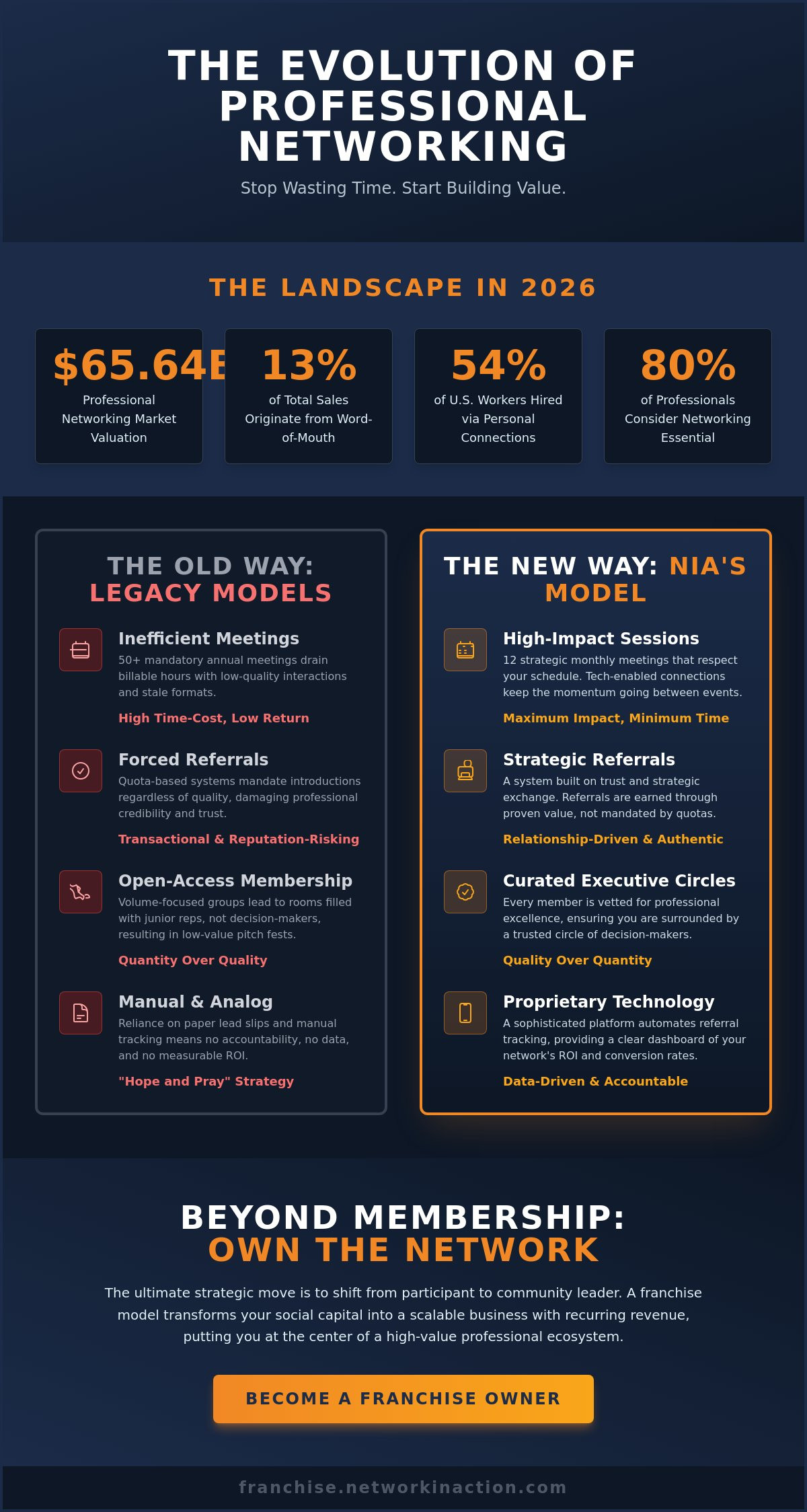
- Discover how to replace the 50+ annual meetings of legacy networking organizations with 12 high-impact, monthly sessions.
- Explore the strategic shift from participant to community leader through a franchise model that offers scalability and recurring revenue.
What are Professional Networking Groups in 2026?
The era of the casual coffee meeting is dead. In the 2026 economy, professional networking groups have transformed into structured ecosystems designed for one thing: high-level referral exchange. This isn't socializing; it's strategic relationship management. While the historical concept of Business networking focused on volume, modern systems focus on velocity and caliber. You aren't looking for a stack of business cards. You're looking for a curated circle of decision-makers who can move the needle on your revenue.
The shift is driven by a "Visionary Architect" mindset. This persona doesn't just attend events; they build and leverage systems. They distinguish between open-access social clubs, where anyone with a checkbook can join, and curated executive circles where every member is vetted for professional excellence. This distinction is the difference between wasting time and scaling a business. Professional networking groups that fail to curate their roster inevitably descend into low-value pitch fests that high-level executives simply don't have time for.
The Evolution of Business Connections
Digital fatigue reached a breaking point in 2025. As virtual noise increased, the value of high-quality, face-to-face interactions skyrocketed. Professionals are now seeking "informed disruption" to break away from the clunky, manual processes of the past. Modern professional networking is a tech-enabled, ROI-driven pursuit that prioritizes social capital as a primary business metric. It leverages data to ensure that every connection is intentional and every conversation is productive. In a market where 54% of U.S. workers were hired through personal connections in 2025, your network is your most valuable asset.
Why Executives are Abandoning Legacy Models
High-level professionals are walking away from outdated networking models in record numbers. They're rejecting the rigid, weekly "attendance for the sake of attendance" rules that define legacy networking organizations. These old-school systems often rely on "forced referrals," a practice that mandates a specific number of introductions regardless of quality. This transactional approach doesn't just waste time; it actively damages your professional credibility. When you're forced to refer an unqualified vendor just to meet a quota, you're spending your reputation for no return.
Today's market demands a referral marketing strategy that prioritizes trust over quotas. In 2025, 80% of professionals worldwide considered networking essential for career growth, but they want it on their terms. This means moving toward a lifestyle-friendly model that respects your schedule while delivering measurable results. You don't need fifty meetings a year to grow; you need twelve high-value sessions backed by proprietary technology that keeps you connected between monthly gatherings.
The Mechanics of ROI-Driven Networking Systems
Efficiency is the hallmark of a modern executive. While legacy networking organizations still rely on paper lead slips and manual tracking, the next generation of professional networking groups utilizes proprietary technology to streamline connection management. This transition from manual to automated systems isn't just about convenience; it's about accountability. When social capital is tracked as a primary business metric, the ROI of every interaction becomes visible. Modern systems replace the "hope and pray" method of referral exchange with a data-backed framework that ensures every minute spent in a meeting translates into measurable business growth.
Technology as a Networking Differentiator
The Future of Networking is built on a foundation of real-time data. In 2025, over 123 million hybrid events took place, proving that professionals demand a blend of digital efficiency and physical presence. A sophisticated business referral platform automates the tracking of introductions, ensuring that no lead falls through the cracks between monthly sessions. This tech-forward approach allows you to measure the actual dollar value of your network. Instead of guessing if your membership is paying off, you have a clear dashboard showing your referral velocity and conversion rates. This level of transparency is exactly what separates a high-ROI network from a casual social club.
Curated Membership and Vetting Standards
Quality is non-negotiable. Outdated networking models often prioritize volume, leading to rooms filled with junior sales reps rather than decision-makers. When evaluating networking organizations, the most critical factor is the caliber of the membership roster. A results-oriented system requires a rigorous vetting process, including professional references and background checks, to ensure every member brings value to the table. This creates an elite environment where high-level professionals can speak the same language of scalability and recurring revenue.
To maintain a non-competitive atmosphere, these groups typically offer industry-exclusive seats. This guarantees that you aren't competing for referrals with three other professionals in your exact niche. It fosters a spirit of collaboration rather than competition. For those ready to move beyond simple participation and take a leadership role in this space, downloading a franchise kit offers a strategic path to owning the network rather than just joining it. By controlling the room, you position yourself as the ultimate connector in your local business community, leveraging technology to build a scalable business model that respects your time and maximizes your influence.
Traditional vs. Modern Networking: A Comparative Analysis
Time is your most finite resource. Legacy networking organizations squander it by demanding over 50 meetings per year; regardless of whether those sessions actually generate revenue. This rigid commitment is a relic of a pre-digital era that prioritized physical presence over professional impact. Modern professional networking groups have disrupted this pattern by shifting the focus to 12 high-value, monthly sessions. This transition respects your schedule while intensifying the quality of every interaction. You don't need to meet every Tuesday at 7:00 AM to build a referral engine. You need a system that works as hard as you do.
The skepticism surrounding outdated networking models is well-founded. Executives are tired of "forced referrals," a transactional requirement that mandates you provide leads to people you barely know. This practice is inherently flawed; it forces you to risk your reputation by referring unqualified vendors just to satisfy a quota. Modern systems replace this clunky mechanism with organic, high-trust introductions. When introductions are based on actual synergy rather than a spreadsheet requirement, the conversion rate on those leads increases by over 40%.
The Quality vs. Quantity Debate
A room full of 100 low-tier leads is a distraction, not an opportunity. In contrast, a curated circle of 10 high-level decision-makers is a strategic powerhouse. The psychological impact of forced participation on member morale is devastating; it turns professional growth into a weekly chore. Monthly meetings offer a streamlined efficiency that exposes the clunky, time-draining nature of weekly legacy models. By focusing on fewer, more impactful connections, you ensure that every person in the room is a peer who can actually sign a contract or open a door to a major account.
Measuring Real-World Results
Modern networking moves the goalposts from "number of referrals" to "closed business revenue." Traditional groups often celebrate the sheer volume of lead slips passed, but those numbers are meaningless if they don't impact the bottom line. Tech-enabled ROI dashboards now provide automated reporting that tracks the entire lifecycle of a referral. This data-driven approach facilitates deeper professional bonds because you aren't just guessing who provides value; you have the metrics to prove it. Analyzing the business networking franchise model reveals a strategic solution to these legacy flaws. It allows you to build a community where social capital is the primary currency and results are the only metric that matters.
How to Evaluate a Networking Group for Maximum Impact
Selecting the right environment for your business growth isn't a decision to leave to chance. It's a strategic audit. With the professional networking market valued at $65.64 billion in 2026, the options are plentiful, but the quality is rare. Most professional networking groups fail because they lack a barrier to entry. To ensure your time generates a measurable return, you must treat group selection like a high-stakes hire. Start by auditing the current membership roster. If the room is filled with junior associates rather than decision-makers, you're in the wrong place. You need peers who have the authority to pull the trigger on a contract, not just pass a business card.
Evaluate the technology platform with a critical eye. If the group relies on paper lead slips or manual spreadsheets, it's a legacy model that will eventually fail you. You demand proprietary technology that tracks social capital with the same precision you track your P&L. Next, analyze the frequency of the meetings. For a high-level executive, 50 meetings a year is a liability. A modern system provides 12 high-impact sessions that align with a results-oriented lifestyle. This streamlined approach ensures you stay focused on high-level strategy rather than weekly attendance quotas.
Request a transparent ROI report before committing your time. A group that can't show you the data on closed business revenue isn't a professional network; it's a social club. Finally, assess the group leader's professional background. A volunteer leader often lacks the incentive or the training to drive results. You want a professional facilitator who treats the group as a business, ensuring every meeting is high-energy and fluff-free. This accountability is the differentiator between a stagnant group and a high-growth referral engine.
Identifying High-Caliber Participants
Ask about member retention and average business size. High turnover is a red flag for low value. You want a diverse yet complementary mix of industries, ensuring a non-competitive environment where referrals flow naturally. Warning signs of a "job seeker" heavy group include a lack of established business owners and a focus on entry-level prospecting. A room full of "owners" creates a sophisticated atmosphere where high-level challenges are solved through collective intelligence.
Vetting Group Leadership
The difference between a volunteer and a professional franchise owner is skin in the game. Professional moderation leads to better meeting outcomes because the leader's success is tied to your results. They use proprietary technology to keep the community connected between sessions, eliminating the clunky nature of traditional networking. For those who want to set the standard themselves, there are available territories where you can lead your own high-level group. Owning the network positions you as the ultimate connector in your market.
Ready to move from participant to leader in the networking space? Explore the strategic path to networking franchise ownership today.
Beyond Membership: Owning the Network as a Strategic Move
The ultimate strategic move isn't just joining professional networking groups; it's owning them. Transitioning from a participant to a community leader allows you to leverage your existing professional credibility to build a tangible asset. This is where high-level networking meets a scalable business model. While legacy networking organizations focus on volume and rigid rules, ownership in a modern system focuses on high-margin recurring revenue and lifestyle autonomy. You aren't just facilitating meetings; you're architecting an ecosystem of influence that operates with surgical precision. The professional networking market is valued at $65.64 billion in 2026, and the shift toward specialized, high-ROI environments is creating a massive opportunity for those who choose to own the infrastructure of connection.
The economics of a networking franchise are compelling for the modern executive. Unlike traditional consulting or service-based businesses, this model offers scalability without the overhead of massive staff or physical inventory. You're building a network of decision-makers who value their time as much as you do. By providing a technology-enabled environment that prioritizes results over attendance, you create a high-retention community. This is the strategic path to time freedom. It allows you to step away from the daily grind of cold prospecting and move into a role of business advocacy and leadership. You become the gatekeeper of a high-value circle, converting social capital into a recurring revenue stream that grows as your influence expands.
The Executive Franchise Opportunity
Professional networking has emerged as one of the top executive business opportunities of 2026. The shift away from outdated networking models has created a vacuum that only modern, tech-forward systems can fill. Modern platforms offer a turnkey solution, providing the proprietary technology and established brand authority needed to disrupt local markets immediately. This isn't just a business; it's a legacy. You're positioning yourself as the primary connector in your region, driving economic growth while building personal wealth. The Future of Networking belongs to those who provide the structure for these high-level interactions to occur.
Taking the Next Step Toward Ownership
Evaluating your fit for this role requires a Visionary Architect mindset. You need to assess your commitment to fostering high-level professional circles and your ability to lead without the fluff associated with volunteer-led groups. The process of securing a territory is a deliberate move toward professional independence. It begins with identifying a market that is underserved by legacy systems and ready for a modernized approach. If you're ready to disrupt your local market and lead the professional networking groups of the future, Download the Franchise Kit today to explore the potential of your region. Ownership is the final evolution of the professional networker.
The Future of Networking is Yours to Lead
The landscape of professional networking groups has shifted permanently toward efficiency and measurable ROI. You've seen how legacy networking organizations fail the modern executive through rigid rules and forced referrals. By prioritizing quality over quantity and leveraging proprietary ROI-tracking technology, you can reclaim dozens of hours each year while driving higher revenue. Stop attending meetings. Start architecting a community that reflects your professional caliber.
Network In Action has solved the inherent flaws of a stale industry with a monthly meeting model designed for executive schedules and a proven track record across over 150 locations globally. This turnkey system provides the scalability and recurring revenue needed to build a lasting professional asset. Don't settle for the clunky, manual methods of the past when you can own the tech-forward future of your market.
Explore Available Territories and Lead Your Own Professional Network and align your career goals with a system built for the 2026 business landscape. Your influence is your most valuable asset; it's time you managed it with precision.
Frequently Asked Questions
Is a professional networking group worth the time investment for a busy executive?
Yes, professional networking groups are worth the time if they focus on ROI rather than attendance quotas. Traditional networking requires 50 meetings a year; however; a modern system cuts that to 12 high-impact sessions. This efficiency allows you to capture the 13% of sales that come from word-of-mouth without sacrificing your schedule. It’s about building social capital through quality interactions, not showing up for a weekly breakfast.
How do modern networking groups differ from legacy organizations?
Modern groups replace manual lead slips with proprietary technology and rigid weekly schedules with monthly sessions. Legacy networking organizations often rely on forced referrals, which prioritize volume over trust. Modern systems use data to track actual closed business revenue. This shift from socializing to strategic relationship management ensures that every connection is intentional and results-oriented, providing a sleek, professional alternative to the outdated models of the past.
Can I own a professional networking group as a franchise business?
Absolutely, owning a network is a strategic franchise opportunity that provides recurring revenue and scalability. You can transition from a participant to a community leader by securing a territory and building your own elite circle. This model leverages your existing professional credibility to create a valuable business asset. It offers the freedom and flexibility that high-level executives demand, allowing you to lead a community while building a profitable business.
What happens if a networking group requires forced referrals?
Forced referrals inevitably damage your professional reputation and dilute the quality of the network. When legacy networking organizations mandate a specific number of leads, members often pass unqualified vendors just to meet quotas. This transactional approach creates a clunky environment where trust is secondary to metrics. Modern systems reject this practice, focusing instead on organic, high-trust introductions that result in a 40% higher conversion rate on average.
How much does it cost to join or own a professional networking group?
Membership fees for the leading brand in the industry can range from $899 to $1398 annually as of May 2026, plus application fees up to $299. For those looking to own a business, the costs of a networking franchise vary based on the territory and model. Owning the network is an investment in a scalable business model that offers recurring revenue, making it a strategic move for professionals seeking autonomy.
What technology is used to track referrals in modern networking groups?
Modern groups utilize proprietary technology to provide real-time referral tracking and ROI dashboards. This software automates the tracking of social capital, ensuring that no lead is lost between monthly meetings. It allows you to measure the actual dollar value of your professional network with precision. Unlike the manual reporting found in outdated networking models, these platforms provide transparency and accountability, making the business of networking far more efficient.
Is it better to have weekly or monthly networking meetings?
Monthly meetings are significantly better for executives because they prioritize impact over frequency. Weekly meetings in legacy networking organizations often become a repetitive chore with diminishing returns. A monthly model respects your time and allows for deeper, more focused interactions. It creates a higher sense of urgency and value for each session, ensuring that every person in the room is engaged and ready to exchange high-caliber referrals.
How do I know if the members in a group are high-caliber decision-makers?
High-caliber groups use rigorous vetting processes, including background checks and professional references, for every member. You can identify decision-makers by auditing the roster for business owners and executives rather than junior sales reps. Professional moderation by a franchise owner also ensures the room stays fluff-free. If a group lacks a barrier to entry or a clear vetting standard, it's likely a social club rather than a high-ROI professional networking groups environment.